
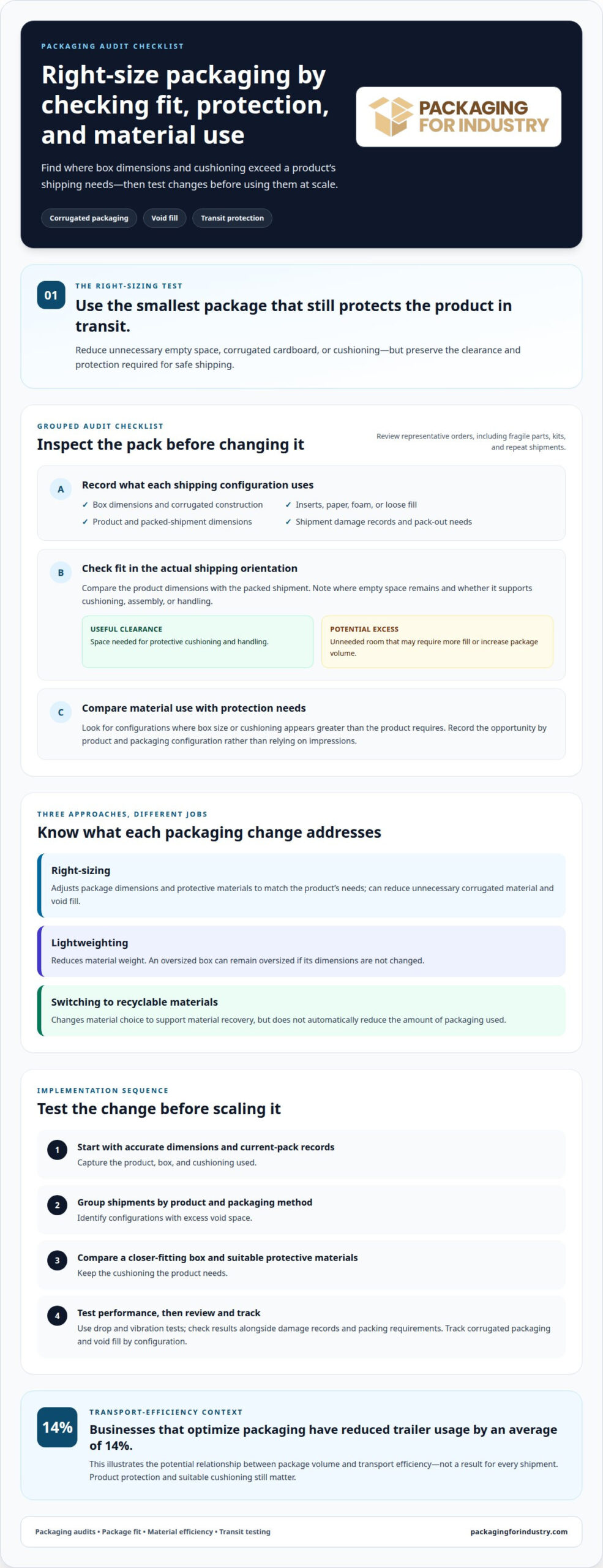
The biggest box isn’t always the safest choice. Packaging right-sizing to reduce material waste means matching a product with the smallest package that can protect it in transit, without unnecessary empty space, corrugated cardboard, or cushioning.
For manufacturers and warehouse teams in Orange County, Los Angeles, and San Diego, extra material can seem like added protection, especially for valuable or damage-sensitive shipments. But oversized packaging can use more box material and cushioning than a product needs, while taking up more space in storage and during shipping.
This article explains how packaging audits and void-space analysis can reveal where materials are overused, and how custom-fit boxes and efficient cushioning can improve the fit. You’ll learn what to assess, how packaging changes affect product protection and shipping efficiency, and why reducing corrugated and cushioning waste starts with understanding the product and its shipping requirements.
Key Takeaways
- Audit product dimensions, current box sizes, and cushioning to identify where packaging uses more material than protection requires.
- Analyze empty space in shipments to spot opportunities to use less corrugated cardboard and reduce package volume.
- Compare custom-fit boxes with a standardized range of sizes to improve fit without adding unnecessary packaging.
- Choose cushioning based on the product’s protection needs, then test packaging performance in transit before making changes at scale.
- When cushioning needs review, PFI’s foam packaging can support a more efficient protective fit.
Packaging audits and void-space analysis
A packaging audit compares each product’s protection needs with the corrugated packaging and void fill used. Measuring package fit helps identify excess material that may be reduced without compromising safe transit.
Auditing Corrugate and Void Fill
A packaging audit records the box and cushioning materials used for each shipping configuration. Review representative orders, including fragile parts, kits, and repeat shipments. Note box dimensions, corrugated construction, inserts, paper, foam, and loose fill. Then compare material use with product protection needs and shipment damage records.
For example, a small component in a large box may require substantial void fill. The carton may also use more corrugated material than the shipment needs. Record these differences by product and packaging configuration. This gives purchasing and warehouse teams specific opportunities to investigate instead of relying on impressions about excess packaging.
Assessing Package Fit and Void Space
Package fit describes how closely the interior dimensions accommodate the product and its protective materials. Measure the product, then compare those measurements with the packed shipment’s dimensions. The remaining gap is void space. Some clearance supports cushioning and handling, while excessive clearance can require more fill and increase package volume.
Assess the packed item in its actual shipping orientation. A machine part with projecting edges, for instance, may need space for protective cushioning, while a compact component may not need a large carton. Record where empty space appears and whether it serves protection, assembly, or handling. The average package is half empty, making fit a practical focus for sustainability and environmental footprint reviews.
Comparing Right-Sizing Approaches
Right-sizing adjusts package dimensions and protective materials to match a product’s needs. Lightweighting reduces material weight, while switching to recyclable materials changes material choice. These approaches can work together, but they address different aspects of packaging use.
Right-sizing can reduce both corrugated material and void fill by removing unnecessary space. Lightweighting may reduce material weight while leaving an oversized box unchanged. Recyclable materials can support material recovery, but they don’t automatically reduce the amount used. For example, changing a large carton’s material without adjusting its dimensions leaves the empty space in place. While circular economy innovators like Healix advance material recovery by transforming plastic waste into circular polymers, packaging optimization focuses directly on eliminating excess volume. Compare fit, protection, material quantity, and recyclability when assessing packaging sustainability.
Planning Right-Sizing Implementation
Start implementation with accurate product dimensions and a record of current packaging. Group shipments by product, existing box, and cushioning method. Identify configurations with excess void space, then evaluate suitable box sizes and protective materials. For example, compare an existing carton with a closer-fitting option while preserving the cushioning the product needs.
Next, test revised packs for transit protection using drop and vibration tests. Review the results alongside damage records and packing requirements before adopting a change. Track material use by configuration, including corrugated packaging and void fill. This helps teams distinguish a genuine reduction from a change that merely shifts material use elsewhere. Repeat the audit when products, pack-out methods, or shipping conditions change.
Packaging optimization and material efficiency
Optimization balances protection, material use, warehouse handling, and freight requirements across the supply chain. A smaller package improves efficiency only if it still protects the product and works for packing operations.
Reducing Material Use and Transport
Packaging dimensions affect material consumption and how shipments use transport space. A large carton can require extra corrugated material and void fill while occupying more room on pallets and trailers. Optimizing the pack can reduce material use and improve the amount of freight carried per load.
Businesses that optimize packaging have reduced trailer usage by an average of 14%. That figure illustrates the potential relationship between package volume and transport efficiency, not a result for every shipment. Consider a component shipped in a roomy carton: removing unnecessary empty space may let more cartons fit on a pallet. The product still needs suitable cushioning and clearance, so saving space cannot come at the expense of protection.
Changes to materials and package dimensions can also affect warehouse operations. Smaller cartons may take up less shelf and staging space, while a simpler range of sizes can make supplies easier to organize. At packing stations, cartons suited to the products can reduce the need for bulky void fill. Review how a proposed package moves through storage, packing, palletizing, and dispatch, not just its material weight.
Sizing Around Regulations and Carrier Rules
U.S. packaging requirements depend on the product and shipment context, so package dimensions must meet applicable requirements as well as operational needs. Separately, carriers may calculate shipping charges using dimensional weight, meaning external package dimensions can affect billable weight.
Compare a carton’s dimensional weight with its actual weight when assessing freight impact. A light product in a large box may take up substantial carrier space, even if the contents weigh little. Carrier rules can differ by service and package category, so evaluate dimensions against the specific shipping method used. Keep required labels, handling provisions, and product protection in the design. Reducing the carton should not remove a necessary shipping or handling feature.
Managing Package Reduction Risks
Reducing package size or material can lead to product damage, packing delays, or inconsistent pack-outs if the new design removes needed protection. A tightly packed assembly, for example, may be harder to load consistently if workers have to force components into place. Reduced cushioning can also leave fragile edges exposed during handling.
Assess the full packing process before adopting a change. Confirm that workers can load and close the carton consistently, and that the product stays secure in its shipping position. Track damage reports and packing issues after implementation, then adjust the design if the new configuration creates problems. This helps distinguish lower material use from a shift in costs toward damage, rework, or slower fulfillment. For a packaging quote based on your products and shipping needs, request a packaging quote.
Custom-fit boxes and on-demand box-making machines
Custom-fit boxes reduce empty space by matching carton dimensions to the product and its protection needs. On-demand box-making equipment can create cartons around specific orders, while a planned range of standard sizes can offer a practical alternative.
Choosing a Right-Sizing Approach
For a small business shipping a limited product range, a few carefully selected box sizes may provide a close fit without requiring box-making equipment. An e-commerce operation with varied product dimensions may benefit from more flexible carton options, especially when fixed-size boxes leave substantial unused space. The right solution depends on order mix, packing volume, storage space, and how often product dimensions change.
Custom-fit cartons use less empty space and packaging material, reducing shipping volume. For example, a business shipping a long component and a compact part may need different box proportions, even if both products weigh about the same. Matching dimensions can reduce unnecessary corrugated material and void fill. The product still needs room for cushioning, loading, and closure, so the smallest possible carton is not automatically the best fit.
Standard Sizes or On-Demand Production
A standardized box range works well when products fit predictable size groups. It can simplify purchasing, inventory storage, and packing instructions. Review actual products and pack-outs before choosing sizes. A carton that fits the product alone may not fit once protective materials or accessories are added.
On-demand box-making equipment offers greater sizing flexibility by producing cartons for individual shipments or product dimensions. It may suit operations with varied orders and recurring oversized-box problems. But equipment also requires floor space, operator time, material supply, and integration with packing workflows. A machine that sits idle between occasional orders can add complexity without improving daily fulfillment.
Evaluating Equipment Costs and Return
Equipment or software costs depend on the setup, production needs, and operating requirements. Estimate return by comparing current box and void-fill use, freight charges, labor time, storage demands, and expected equipment expenses. For example, if oversized cartons drive extra handling and shipping volume, include those impacts alongside material consumption.
Use order records to model the comparison. Separate frequently shipped products from occasional shipments, then estimate how often each could use a closer-fitting carton. Include setup, maintenance, training, and material handling in the equipment assessment. A simple standardized size range may work better operationally than automation when order patterns are stable or shipment volumes are modest.
Protecting the Product and Packing Flow
Before adopting a new carton, test the complete pack-out, including inserts and closure. A custom-fit box should hold the product securely without crushing it or making packing difficult. For a fragile assembly, test the cushioning arrangement and carton together, then review handling results before expanding the change across orders.
Compare options against real shipping profiles, not carton dimensions alone. Dimensional-weight charges can make package volume relevant to freight, while the product’s shape and protection needs limit reductions. A measured trial can show whether custom sizing, standardized cartons, or on-demand production best supports efficient packing and dependable delivery.
Definition and benefits of packaging right-sizing
Right-sizing aligns a package’s dimensions and protective materials with the product. Its benefits can include lower material use, better use of freight space, and simpler handling.
Defining Packaging Right-Sizing
Packaging right-sizing means using only the packaging needed to protect a product through shipping and handling. The goal is a suitable fit, not simply the smallest possible carton. A delicate instrument, for example, may need cushioning around vulnerable surfaces, while a durable part may need less protective material.
This approach considers the complete package: the carton, inserts, cushioning, and space required for safe packing. A box that fits the product’s dimensions but leaves no room for protective material may increase damage risk. Conversely, excess clearance can require more void fill and increase the shipment’s external dimensions.
Benefits can extend beyond material use. A well-matched package can take up less space in storage and on pallets, and may be easier for employees to handle. Reducing unnecessary packaging can also make recycling or reuse easier by avoiding excess layers and complicated material combinations—an approach embraced by eco-friendly packaging suppliers like Goodies Distribution when helping businesses minimize environmental impact.
Estimating Material and Cost Reductions
There isn’t one reduction amount that applies to every business. Results depend on the current carton sizes, product mix, cushioning, order patterns, and freight profile. Companies using 3D cubing cartonization to right-size packages have reduced corrugate use by 12.5% per order, with an average of one square foot of material eliminated per carton.
Results from a specific approach are not a universal forecast. A business already using well-matched cartons may have fewer opportunities than one shipping compact products in oversized boxes. Compare current material use with a proposed design for each relevant product and pack-out. Include void fill, carton dimensions, packing time, and damage performance in the comparison.
For a practical estimate, select representative shipments and document their existing packaging. Then calculate the material used for each carton and cushioning arrangement. Compare those measurements with a right-sized alternative, including the product’s protection needs. This creates a clear baseline for assessing material changes without assuming every product will produce the same result.
Cost effects also depend on how packaging interacts with freight and warehouse operations. Smaller external dimensions may improve space use, while changes to materials or packing steps can affect purchasing and labor. Track these factors together rather than treating box material as the only measure. A complete comparison shows where right-sizing can reduce waste while maintaining protection and an efficient shipping process.
Reducing corrugated cardboard and cushioning waste
Corrugated cardboard and cushioning often account for avoidable packaging material. A focused review can identify excess without removing protection the product needs.
Over 90% of packages are shipped in corrugated cardboard. In the U.S., 56% of discarded corrugate still ends up in landfill. These figures make carton use a practical place to examine material waste. Start by comparing the box size and construction with the product, its shipping configuration, and the protection required. An oversized carton can consume more cardboard and cushioning, much of which gets discarded after delivery.
Review the carton as a complete structure, not just a sheet of cardboard. A box may include flaps, partitions, pads, or inserts that add material. For example, a small component shipped in a large carton may need loose fill to prevent movement. A better-fitting carton could reduce both the corrugated area and the amount of void fill. Keep necessary clearance for the product and its protective layers.
Cushioning should address the product’s actual exposure to impact and movement. Foam, molded pulp, or corrugated inserts can provide protection without adding unnecessary bulk. Choose based on the item’s shape and vulnerable areas. A part with exposed corners may need localized support rather than cushioning throughout the box. An insert that holds the part in place can also replace excess loose fill.
For each shipping configuration, record the carton and cushioning components used. Then identify what protects the product and what simply fills space. Compare the current pack with an alternative that removes an unnecessary layer or replaces loose fill with a fitted insert. For example, a corrugated partition may separate several components while reducing the need for individual wraps. Evaluate each product and pack-out specifically.
Material reduction should preserve reliable handling from the packing station to delivery. Review whether workers can load the revised package consistently and whether the product remains supported. Track cardboard and cushioning separately, so a decrease in one material doesn’t hide an increase in another. This gives purchasing and operations teams a clearer view of total packaging use and helps them make sustainability decisions alongside protection needs.
To discuss packaging options for reducing excess cardboard and cushioning, request a packaging quote.
Packaging For Industry (PFI): Foam Packaging
Packaging For Industry (PFI) supports manufacturers, warehouses, and distribution centers with practical protection for recurring shipments. Its foam packaging, including custom foam inserts, end caps, pads, and assemblies, can help protect products that need a more controlled fit. PFI also provides custom packaging design and prototypes to evaluate fit before full production.
For teams reviewing supply needs, PFI also offers Vendor Managed Inventory (VMI) and Just-In-Time (JIT) Inventory Management for Packaging. These options support recurring packaging supply, while local packaging delivery serves businesses in Orange County, Los Angeles, and San Diego. Compare packaging pricing and bulk packaging pricing against your usage and operational requirements.
Contact Packaging For Industry (PFI) to discuss foam packaging for your operation.
Put Your Packaging Review Into Practice
Packaging right-sizing to reduce material waste works best as an ongoing operating practice, not a one-time carton change. Product lines, order profiles, and packing workflows can shift, so revisit packaging decisions when those conditions change. A clear review process helps teams keep protection, material use, and fulfillment needs aligned.
Choose a product or shipment configuration where the current packaging offers a clear opportunity for improvement. Use its pack-out as a working example, document the materials and handling requirements, and evaluate a revised design against those needs. This gives purchasing and operations teams a practical basis for refining packaging decisions and maintaining consistent pack-outs.
Contact Packaging For Industry (PFI) to discuss your packaging requirements and identify a suitable next step.
A thoughtful packaging review can turn a material concern into a manageable improvement. Start with the shipment that needs attention, and build from there.
Frequently Asked Questions
What Is Right-Sizing?
Right-sizing means selecting packaging that fits a product and its shipping needs without unnecessary space or materials. For a shipment containing several parts, consider whether dividers or a fitted insert can keep components organized inside one carton. The right configuration depends on product shape, fragility, and handling. A close fit should support protection and efficient packing, not make loading difficult or put pressure on the contents.
What Is Right Size Packaging?
Right-sized packaging is a carton and protective setup suited to a particular item or order. It accounts for the product’s packed dimensions, accessories, and how workers load and close the package. For example, a kit with cables and a control unit may need an organized interior, not simply a smaller outer box. The useful fit leaves room for appropriate protection while avoiding empty space that serves no handling purpose.
What is packaging right-sizing and how does it reduce material waste?
Packaging right-sizing adjusts the carton and protective components to suit the shipment, helping remove material that does not contribute to protection or handling. A program focused on packaging right-sizing to reduce material waste can compare how each product is packed, including inserts, pads, and void fill. If a component stays secure with a fitted support instead of loose fill, the pack may use less cushioning while keeping the part organized.
What data and measurements are needed to determine the right package size?
Record each product’s length, width, height, weight, and shipping orientation, then measure accessories and protective components. Also capture the final packed dimensions, carton type, cushioning materials, and pallet arrangement. Order history helps show which products and combinations ship regularly. Damage reports and handling requirements add context, since dimensions alone cannot establish a suitable design. Together, these records help compare packaging options against actual products and fulfillment patterns.
What packaging right-sizing methods and tools are available?
Businesses can use manual packaging audits, a standardized box-size matrix, cartonization software, or on-demand box-making equipment. A size matrix can help teams match repeat products with an established carton range. Software can evaluate product combinations and package dimensions across orders. Equipment creates cartons to fit individual shipments but requires operational capacity and material supply. Start with the method that fits order variety, packing workflow, and available warehouse space.
How can right-sized packaging protect products during shipping and reduce damage?
Protection comes from controlling product movement and supporting vulnerable areas, not from adding material indiscriminately. Select cushioning for the item’s shape, weight, and sensitive surfaces, then secure the product in its shipping position. For a multi-part assembly, separate components so they cannot strike one another. Check that workers can pack the design consistently and that the closed carton holds its contents securely through normal handling.
What are the environmental trade-offs of right-sizing, including void fill and shipping emissions?
Using less cardboard and void fill can reduce material demand, while smaller packages may use transport space more efficiently. However, removing cushioning that prevents damage can create additional waste if products need replacement or reshipment. Material choice matters too: recyclable packaging is useful only when local recovery systems accept it. Assess packaging materials, product protection, shipment volume, and damage outcomes together to understand the broader environmental footprint.