
A foam block’s firmness tells only part of the story. Closed-cell foam has separate, intact cells filled with gas or air, creating a firmer structure that resists moisture. For die-cut closed-cell foam blocks in Long Beach, this structure can suit applications that need cushioning or sealing where moisture exposure matters.
Choosing foam for a part means balancing protection, fit, durability, and cost. This guide explains how closed-cell structure affects moisture resistance and shape retention, where die-cut blocks can work as seals or cushioning, and what influences cost. It also covers when another foam structure may better suit the application, so you can focus on the fit and performance your packaging needs.
Key Takeaways
- Closed-cell structure affects how foam handles moisture, pressure, and the demands of shipping or storage.
- Match firmness and cushioning to the item being protected rather than choosing foam by thickness alone.
- Consider long-term compression when shape retention matters, especially for foam used repeatedly or under sustained pressure.
- Die-cut blocks can support sealing or cushioning applications, but the intended fit and function guide material selection.
- Compare foam costs by looking at design, material, quantity, and how well the solution addresses damage and packaging needs.
Durability and moisture resistance
Closed-cell foam resists water because its gas- or air-filled cells remain separate. Compared with open-cell foam, it has fewer connected pathways for moisture to travel through. This structure can help protect packaged parts when damp conditions are a concern. For die-cut closed-cell foam blocks in Long Beach, that resistance can matter during storage, handling, and shipping.
Cell size also affects performance. Smaller, more compact cells make closed-cell foam more water-resistant, which can be useful when foam contacts a component or forms part of a gasket. When compressed, closed-cell foam can prevent water and air from passing through, even at low pressures. A seal still depends on how the foam fits the opening and contacts adjoining surfaces.
Moisture resistance can limit conditions that contribute to mold and mildew, but it does not guarantee that every packaged item will stay dry. Gaps, exposed edges, or water entering around the package can still affect the contents. For example, a foam block protecting a metal component needs a close fit to avoid leaving vulnerable contact points.
- Moisture exposure: Consider whether the block encounters splashes, damp storage, or direct contact with water.
- Cell structure: More compact cells improve water resistance compared with larger, less compact cells.
- Fit: Match cutouts and edges to the part so the foam supports the intended barrier or cushioning function.
- Handling environment: Account for dust, repeated handling, and the surfaces the block contacts.
Closed-cell foam also resists dust and does not settle or shrink, helping maintain a consistent fit around a packaged item during storage. A die-cut block holding a machined part, for instance, can retain its shape around the part’s outline rather than shedding dust onto nearby surfaces. This can matter when debris could complicate assembly or inspection.
Durability depends on the application, not just moisture resistance. A block exposed to water still needs suitable dimensions and contact areas to perform its sealing or cushioning role. Consider the part’s shape, the direction of likely moisture exposure, and whether the foam forms a complete contact surface. These details help distinguish a moisture-resistant insert from a design that can create an effective seal.
For operations serving Long Beach and coastal Orange County, packaging decisions may span multiple locations. The Huntington Beach service-area page provides a location-specific reference for businesses coordinating packaging needs in the region.
Closed-cell foam can be relevant when moisture could contribute to mold or mildew around a packaged component. Its water resistance can help limit moisture-related exposure, but it does not guarantee that the package or its contents will stay dry in every circumstance. Consider where water could reach the insert and whether its contact surfaces provide the intended protection. Water resistance can help inform the packaging choice, but the foam’s fit and arrangement remain important to performance.
Closed-cell foam structure
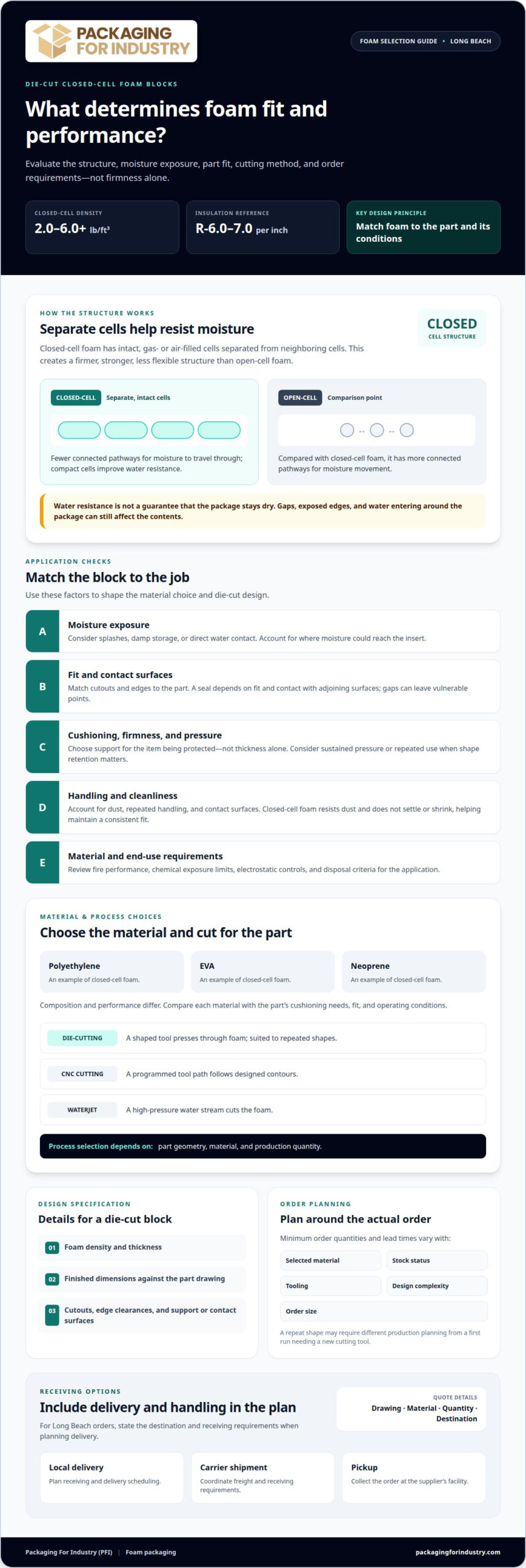
Closed-cell foam contains gas- or air-filled cells that remain intact and separate from neighboring cells. That structure makes the material firmer and stronger than open-cell foam, though less flexible. Closed-cell foam typically has a density of 2.0-6.0+ lb/ft³. Thermoplastic closed-cell foam can also be remolded and reshaped while maintaining its strength.
Polyethylene, EVA, and neoprene are examples of closed-cell foam. Their composition and performance differ, so compare each option with the part’s cushioning needs, fit, and operating conditions. A protective block for a rigid electronic component, for example, may need different support from cushioning for a flexible assembly.
Die-cutting, CNC cutting, and waterjet cutting shape foam through different processes. Die-cutting presses a shaped tool through foam and suits repeated shapes. CNC cutting follows programmed tool paths for designed contours, while waterjet cutting uses a high-pressure water stream. Part geometry, material, and production quantity help determine which process is appropriate.
For die-cut blocks, specify the foam density, thickness, and finished dimensions against the part drawing. The typical closed-cell density range is 2.0-6.0+ lb/ft³, but dimensions depend on the design. Include cutouts, edge clearances, and any surfaces that must contact or support the component.
Safety, fire-rating, and environmental requirements depend on the foam’s end use and the product it protects. A purchasing specification can identify required fire performance, chemical exposure limits, electrostatic controls, and disposal criteria. For example, an electronic assembly may need a different material review from a component with no electrical sensitivity.
Minimum order quantities and lead times vary with the selected material, stock status, tooling, design complexity, and order size. A repeat die-cut shape may require different production planning from a first run that needs a new cutting tool. These factors, rather than a universal minimum or timeline, determine the purchasing plan.
Long Beach buyers may receive foam blocks through local delivery or carrier shipment; pickup means collecting an order at a supplier’s facility. Each option has different receiving and handling implications, such as dock scheduling for a delivery or freight coordination for a shipment. State the destination and receiving requirements when planning the order.
A clear drawing, material choice, quantity, and delivery destination make a foam packaging quote easier to scope. Request a packaging quote from Packaging For Industry (PFI) with those details to compare the requirements for your application.
Proper delivery scheduling and a clear receiving plan help keep the order aligned with the component’s needs. Closed-cell foam provides an R-value of 6.0 to 7.0 per inch, which may be relevant when insulation is part of the application. Its sound-dampening use can also matter in spaces where unwanted noise is a concern: closed-cell foam can dampen sound that escapes a noisy furnace or a garage band practice space. Consider these performance needs alongside cushioning and fit when choosing a material, and confirm that the selected die-cut closed-cell foam blocks Long Beach projects rely on suit the intended use.
Compression set and shape retention
Compression set describes lasting deformation after foam has remained compressed. Closed-cell foam may not return to its original shape after extended flattening or heavy loading. A block beneath a stored machine component, for example, may retain an impression after the pressure is removed. That change can affect how the foam supports the part during its next use.
Shape retention matters when a packaging insert must repeatedly locate the same component. Consider a die-cut block with a cavity for a machined housing. If sustained pressure changes the cavity walls, the housing may sit differently during a later packing cycle. That shift can reduce support at contact points and leave the item less stable inside its package.
Closed-cell foam is not automatically the best choice whenever a block must keep its original profile under compression. Repeated use, heavy items, and long periods under load all affect the decision. A cushioning block used once for shipping has different demands from a fixture used daily to hold the same part on a production line.
Review the load path before specifying an insert. Identify which surfaces carry the component’s weight, where the foam compresses, and whether pressure remains during storage. A part resting on a narrow base, for example, can concentrate force in one area. A broader contact surface distributes support differently, though the final fit still depends on the part and block design.
- Duration: Note whether foam supports a part briefly during transit or remains compressed in storage.
- Load location: Identify concentrated contact points, such as a component’s feet or narrow edges.
- Reuse: Distinguish single-shipment cushioning from a reusable insert in a packing or assembly process.
- Fit after use: Consider whether an altered cavity could affect the next placement of the item.
These checks help distinguish cushioning from long-term support. A block designed to absorb energy during shipment may not suit a fixture that holds a heavy assembly continuously. Likewise, a foam cavity that fits a new part closely may become less effective if prolonged compression leaves a lasting imprint. Let the intended duty cycle guide the design.
When documenting a foam requirement, describe the component, its contact surfaces, how the block is loaded, and whether the insert will be reused. Include an example from the actual packing or storage process, such as a housing held in a tray between production steps. These details clarify whether cushioning, repeatable fit, or resistance to sustained compression matters most.
When consistent shape matters, evaluate the block in its actual position of use. A drawing can show the cavity, but the load and duration determine where compression occurs. Matching the material and design to those operating conditions helps avoid relying on a foam shape that may change under prolonged pressure.
Die-cut foam for sealing and cushioning
No single closed-cell foam suits every packaging, insulation, or marine application. For cushioning, consider the part’s shape and impact exposure; for a gasket, focus on fit and watertight sealing. Closed-cell foam also offers high insulation value and can perform in hot and cold temperatures, while its moisture resistance may matter in marine settings.
Die-cutting shapes foam to match a product or opening. A block can hold a component in a shaped cavity, while a gasket can follow the outline of a cover or joint. Closed-cell foam is used for energy absorption in products such as phones and helmets. In packaging, a fitted cutout helps position an item and limit unwanted movement inside its container.
Sealing and cushioning have different design requirements. A watertight gasket needs continuous contact around the opening, without gaps at corners or interruptions. A cushioning insert instead needs contact areas that support the item during handling. A die-cut block can serve either purpose, but the drawing should show the perimeter, openings, contact surfaces, and protected areas.
- For cushioning: Map the component’s outline and identify where support is needed, such as beneath a housing or around delicate edges.
- For sealing: Define the full seal path, including corners, holes, and joints that could create gaps.
- For insulation: Consider the required thermal role and operating conditions, since closed-cell foam has high insulation value.
- For marine applications: Account for water exposure and the locations where foam must contact or protect the component.
Closed-cell foam is firmer and stronger than open-cell foam, but less flexible. That difference affects how a die-cut piece fits irregular surfaces. A rigid part with defined edges may sit securely in a fitted cavity. A surface with changing contours may need a design that accommodates those shapes without forcing the foam into an unsuitable fit.
Compressed closed-cell foam can prevent water and air from passing through, even at low pressures. This property can support gasket applications that need a watertight seal. Accurate dimensions still matter: a cutout that is too narrow, too wide, or misaligned can interrupt contact around the joint.
Before selecting a design, identify the primary job: protect a part, seal an opening, or insulate an assembly. Then provide a drawing or sample showing the item’s shape and required contact points. For custom foam packaging design, request a packaging quote with the application and dimensions.
Foam cost considerations
The cost of a die-cut foam block depends on more than the raw foam. Material type, density, dimensions, cutout geometry, order quantity, and cutting method all affect the finished part. A thick block with several precise cavities, for example, requires a different design and production approach from a simple flat pad. Compare the full specification, not just the material name.
Choose material based on the application. Closed-cell foam is useful when moisture resistance, firmer support, or a watertight gasket function matters. If the only requirement is an airtight seal, open-cell foam is described as a more affordable option. Choosing a more complex structure than the application needs can add cost without meeting a useful performance requirement.
Density and dimensions also affect material use. A larger block uses more foam, while a denser selection changes the material specified for each part. A protective insert for a compact instrument, for instance, may need distinct cavities and support points. A plain spacer for a uniform item may require less shaping. A product drawing helps show where additional design detail is useful.
- Material: Compare closed-cell and open-cell options against sealing, cushioning, and moisture needs.
- Dimensions: Specify the block’s length, width, thickness, and any product cavities.
- Design: Identify contours, openings, and contact points that affect cutting complexity.
- Quantity: Provide expected order volume so pricing reflects the planned production run.
- Use pattern: Distinguish a single-shipment insert from a block reused in packaging or handling.
Cutting requirements can affect setup and production. A repeat shape may use a different approach from a one-off design with complex contours. A block with multiple openings for an assembled component, for example, requires more definition than a rectangular pad. Clear drawings and consistent dimensions help scope the work and reduce avoidable design changes.
Foam pricing is project-specific and follows a quote request. Material, density, dimensions, design complexity, order quantity, and cutting method all shape the cost. A useful request includes the part drawing, intended function, required quantity, and any sealing or cushioning priorities. These details make it easier to compare pricing against the same specification.
For Long Beach operations, value also depends on how well the design fits the packing process. A custom block that positions a part correctly may help reduce shipping damage and rework, while an unnecessary feature adds complexity. Review the block alongside its container and packing workflow before finalizing the specification.
To compare costs for a defined foam application, gather the drawing, quantity, and performance requirements, then request a foam packaging quote.
Packaging For Industry (PFI): Foam Packaging
Packaging For Industry (PFI) supplies foam packaging for manufacturers and industrial operations, including aerospace, electronics, and medical device companies. Its custom packaging design services help businesses address product-specific packaging needs within their shipping or production workflows.
A tailored packaging approach can help teams organize purchasing around the parts they handle and reduce avoidable product damage. For businesses with recurring demand, Vendor Managed Inventory (VMI) for Packaging and Just-In-Time (JIT) Inventory Management can support coordinated replenishment. PFI also offers stretch film for operations managing multiple packaging materials.
Share your application and packaging priorities to discuss a practical fit for your operation. Contact Packaging For Industry to discuss foam packaging.
Put the specification to work
For die-cut closed-cell foam blocks in Long Beach, connect the material choice to your purchasing and packing workflow. Define how the foam will be used, who handles it, and how replenishment fits your operation. This context helps align product protection with practical supply planning.
Packaging For Industry (PFI) offers foam packaging for industrial packaging needs, along with stretch film and Vendor Managed Inventory (VMI) for Packaging. These offerings can support businesses coordinating protective materials with broader packaging supply requirements. Share the intended application and purchasing priorities to start a focused discussion.
A clear specification gives your team a useful starting point for evaluating fit, ordering needs, and supply coordination. Take the next step when you’re ready to plan packaging around your operation.
Frequently Asked Questions
What Is Closed-Cell Foam?
Closed-cell foam consists of separate, intact cells filled with gas or air. Unlike connected-cell structures, its cells do not form open pathways through the material. This structure gives it a firmer feel than open-cell foam and suits applications requiring shaped support. For example, a die-cut insert can hold a component in a defined position inside a shipping container.
What are typical prices for custom die-cut closed-cell foam blocks?
There is no single typical price for a custom die-cut block. Cost depends on foam material and density, block dimensions, cutout design, cutting method, and order quantity. A simple pad and a block with multiple fitted cavities involve different material and production requirements. To compare pricing for a Long Beach project, include the intended use, drawing or dimensions, and quantity in your quote request.