
Defense shipments need packaging built around requirements, not just a box that fits. Mil-spec packaging solutions in Orange County follow MIL-STD, ASTM, and federal specifications, with protection tailored to the item and its handling, storage, and transport conditions. The right design can help limit damage from impact, movement, and environmental exposure while keeping packaging aligned with the shipment’s requirements.
That matters when sensitive or mission-critical equipment must arrive ready for use. A sturdy outer container may not be enough: the materials, cushioning, and method of securing the item all affect how well the package protects it through the supply chain.
This article explains what mil-spec packaging is designed to protect against, which industries use it, and how defense packaging projects in Orange County are planned. You’ll also learn what shapes a packaging design, how to assess supplier fit, and how custom packaging design can support a more reliable shipping process.
Key Takeaways
- Identify the shipment’s handling, storage, and transport demands before deciding how to secure and protect it.
- Learn how packaging design can address shock and vibration while keeping equipment stable in transit.
- Understand which defense-related and industrial sectors use military-specification packaging and what their packaging needs may involve.
- See how packaging requirements and delivery workflows shape the services available to Orange County businesses.
- Explore how foam packaging, stretch film, and packaging inventory management can support a more dependable supply process.
What is Mil-Spec Packaging & Why Do I Need It?
Military packaging requirements may reference MIL-STD, ASTM, and federal specifications. When assessing a packaging partner, compare the proposed capabilities with the exact requirement, including design and crating scope, project process, and supporting documentation for any requested certification.
Custom Military Packaging and Crating
Custom military packaging starts with the item, its configuration, and the shipment’s handling and storage conditions. Those details guide the choice of a box, crate, or internal restraint that holds the equipment securely. A delicate assembly, for example, may need fitted cushioning, while a large component may require a purpose-built crate. Review how the design accounts for the item’s dimensions and vulnerable areas.
Crate and pallet identifiers help clarify what a specification covers. MIL-C-52950 is listed for open crate boxes with a solid base and lumber membranes. MIL-P-15011 is listed for pallets with 4-way forklift access. These identifiers are not interchangeable: confirm that the specification named in the contract matches the packaging item being supplied. A box, crate, and pallet each serve a different role in preparing a government shipment.
Military packaging acronyms can make procurement documents harder to interpret. MIL-STD refers to a military standard, while ASTM identifies standards associated with ASTM. Government buyers may also see “DoD,” the abbreviation for the Department of Defense, in procurement materials. Treat each acronym as a cue to review the full requirement, not as a substitute for it. Match the item description, packaging method, and cited specification before approving a design.
Military and Commercial Compliance
Military and commercial specifications may apply to different shipments, so begin with the purchase order or contract. Military packaging requirements may cite MIL-STD, ASTM, and federal specifications; commercial shipments may follow their own documented criteria. Record the applicable identifiers and instructions, then compare them with the proposed design. This helps prevent a commercially suitable package from being mistaken for compliance with a separate government requirement.
Compare capabilities that matter for your shipment, such as custom box design, crate construction, and pallet compatibility. Ask how the proposed package addresses the named requirement and what documentation supports any certification claim. Timelines depend on factors such as design complexity, materials, and production scope, so compare equivalent project scopes rather than relying on a general estimate.
For defense buyers seeking mil-spec packaging solutions in Orange County, start with the contract’s exact packaging language. Confirm the required specification, decide whether the shipment needs a box, crate, or pallet, and provide the item’s dimensions and handling needs. This gives a packaging partner a clear basis for assessing design capability, schedule, and compliance documentation.
Shock- and vibration-resistant packing
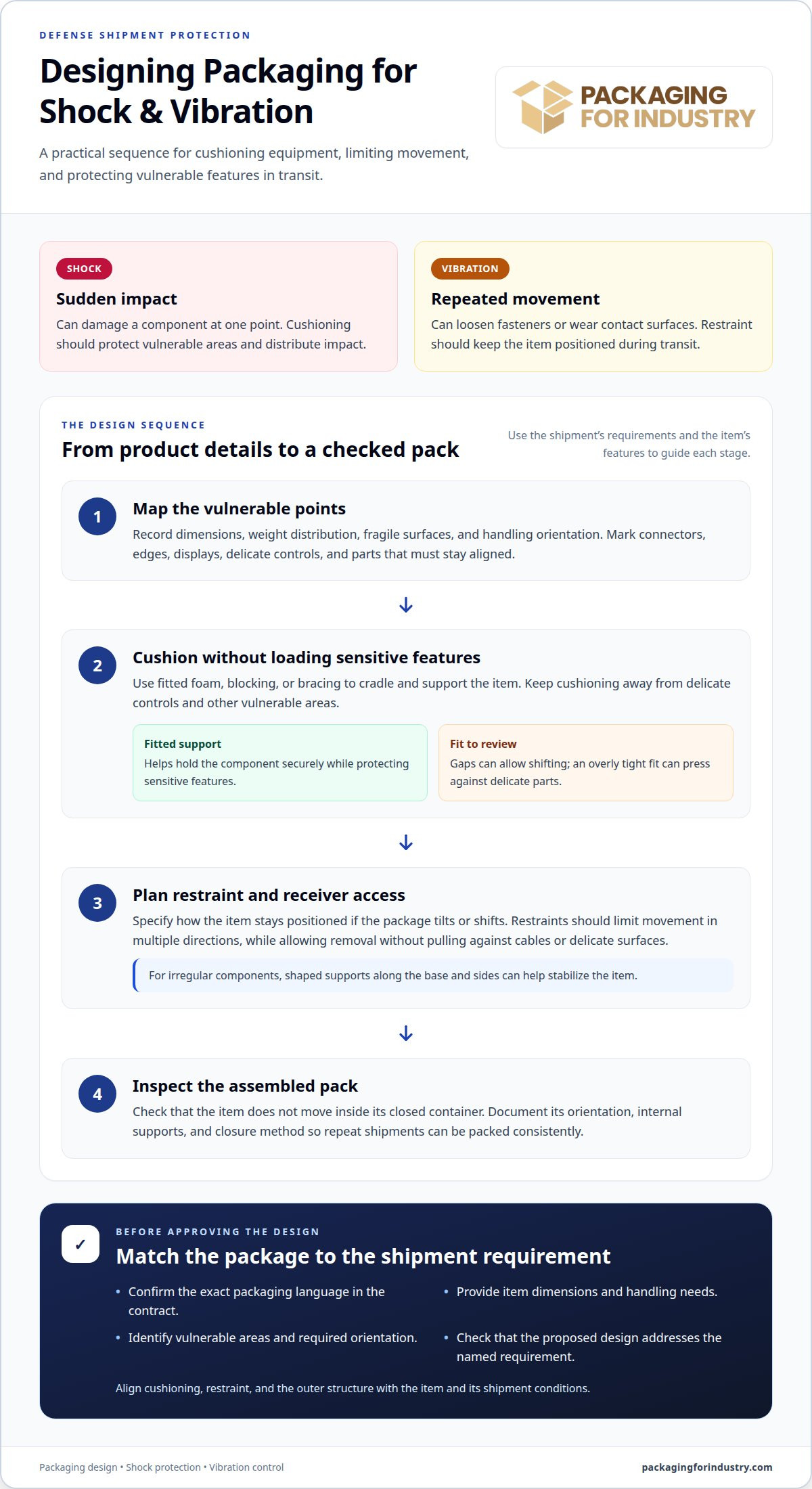
Shock and vibration create different risks for defense shipments. A sudden impact can damage a component at one point, while repeated movement can loosen fasteners or wear contact surfaces. Packaging should address both through cushioning, restraint, and a structure suited to the item. An instrument with a protruding connector, for example, needs protection around that feature as well as support for its main body.
Start with the item’s vulnerable areas and its route through the supply chain. Record dimensions, weight distribution, fragile surfaces, and handling orientation. Note whether the equipment has moving parts, delicate controls, or components that must stay aligned. These details guide the cushioning layout and help prevent excessive room for movement inside the package.
Cushioning absorbs and distributes impact, but its placement matters. A foam insert can cradle a component while keeping pressure away from a delicate control panel. Gaps may let the item shift, while an overly tight fit can press against sensitive features. Use a fitted interior, blocking, or bracing to stabilize the product without loading vulnerable areas.
Vibration protection also depends on how the product is secured inside its package. An unsecured pump or electronic assembly may move repeatedly in transit, even if the outer container stays intact. Restraints should limit movement in multiple directions, and the package should support the product rather than rely on loose fill alone. A crate carrying an irregular component may need shaped supports along its base and sides.
- Map vulnerable points: Mark connectors, edges, displays, and other sensitive areas on a product drawing.
- Plan restraint: Specify how the item stays positioned when the package tilts or shifts.
- Review access: Check that the receiver can remove the item without pulling against cables or delicate surfaces.
- Inspect the assembled pack: Confirm that the item does not move inside its closed container.
For a defense shipment, align the protective design with the packaging requirements in its contract. Document the item’s orientation, internal supports, and closure method so production teams can pack repeat shipments consistently. If packaging changes, review how the revised fit affects restraint and access. A packaging quote is more useful when it includes product dimensions, handling concerns, and any required packaging instructions. You can request a packaging quote with those details to support a practical design discussion.
Business location and contact details
Orange County, California buyers can narrow a military-packaging search by location, delivery route, and project scope. Companies in Anaheim, Irvine, and Costa Mesa may be relevant when local coordination matters. Packaging For Industry serves Orange County, Los Angeles, and San Diego, with next-day delivery in Southern California. Match the project’s destination and requirements to the service scope rather than assuming a nearby address establishes capability.
Which Orange County, California companies provide military-spec packaging services? Look for packaging providers that state they handle military packaging and can work from the shipment’s documented requirements. Compare their stated capabilities, service location, and process for discussing the packaging scope rather than relying on a general industrial-packaging listing.
Clear contact details help route a request to the right team. Use the company’s quote or contact channel, and identify the request as defense-related in the subject line or opening note. Include a business contact name, organization, preferred response method, and shipment destination. Those details help connect design questions, purchasing review, and delivery planning.
How do I prepare a quote request for mil-spec packaging for a defense shipment? Provide the item description, dimensions, weight, quantity, destination, and packaging instructions from the purchasing documents. Add drawings or photos if they clarify unusual shapes, fragile surfaces, or handling points. Include the required specification identifiers and any contract language relevant to the package.
Before sending a request, organize the details into a concise packaging brief. Separate product data from shipment requirements and identify the requested packaging format. This makes proposals easier to compare on an equivalent basis and helps reveal differences in scope, materials, or included documentation.
- Shipment: Give the destination, delivery conditions, and planned shipment quantity.
- Item: Share dimensions, weight, product orientation, and relevant drawings.
- Requirement: Copy the packaging instructions and specification identifiers from procurement documents.
- Schedule: State the target date and any design or approval milestones.
- Contact: Name the purchasing or engineering contact responsible for follow-up.
Use the same brief when you request a packaging quote, so the response can address the actual shipment rather than a broad product category. If an item is changing, mark the revision and explain what changed, such as a new connector location or shipping destination. Clear revisions help prevent outdated drawings from guiding a new packaging proposal.
For Orange County procurement teams, compare responses against the same checklist. Review whether each addresses the destination, item configuration, requested packaging format, and procurement documents. A structured comparison keeps location, contact routing, and technical scope in view without confusing proximity with qualification.
Industries and customers served
Military-specification packaging serves government agencies and businesses supplying defense programs. The customer may be a procurement team, defense contractor, or manufacturer shipping equipment under contract. Needs differ by item, destination, and purchasing requirements. An agency may focus on documented instructions, while an aerospace supplier may need packaging shaped around a delicate assembly.
Aerospace companies handle components such as control units, machined parts, and maintenance equipment. Packaging plans should account for product geometry, handling points, and how technicians will remove the item. A protruding fitting, for example, may need a protected clearance area. A reusable service part may also need packaging suited to repeat handling and organized storage.
Electronics manufacturers and defense technology suppliers ship circuit assemblies, sensors, and communication equipment. These products may have exposed connectors or surfaces that need careful separation from other materials. Identify sensitive features and specify how the product will stay positioned. Buyers should also communicate any handling instructions in the purchase documents.
Industrial manufacturers may supply pumps, valves, motors, tools, or replacement parts for government programs. A heavy component may require a different package structure from a small precision instrument. Share the product’s weight, lifting points, and loading orientation so the package can be considered alongside warehouse equipment and the receiving process.
Government agencies, prime contractors, and subcontractors can have different roles in a defense shipment. An agency or prime contractor may set procurement requirements, while a subcontractor prepares the item for delivery. Each handoff can affect labeling, documentation, and packaging instructions. Buyers should identify who approves the packaging plan and who packs the final shipment.
- Government procurement teams: Translate contract instructions into clear packaging requirements for purchasing and operations.
- Aerospace suppliers: Share component drawings and identify sensitive features, access points, and orientation.
- Electronics manufacturers: Flag exposed connectors, delicate surfaces, and separation needs.
- Industrial suppliers: Provide product weight, lifting points, and warehouse handling details.
- Defense contractors: Coordinate requirements between the customer, production team, and shipping department.
Commercial manufacturers may also ship products to defense customers, but commercial and government shipments should not be assumed to have identical requirements. A manufacturer selling the same motor through separate commercial and government channels, for example, should review the packaging instructions for each order independently. The destination, customer documents, and contract language determine the applicable criteria.
For buyers comparing mil-spec packaging solutions in Orange County, identify the customer type and the item’s role in the shipment first. Then gather the order documents, product details, and handling needs. This brief helps an industrial packaging supplier understand whether the project involves aerospace components, electronics, industrial equipment, or another defense-related product.
MIL-SPEC packaging and defense packaging services
Defense packaging connects procurement instructions with a repeatable packing process. A useful workflow begins with reviewing the contract, identifying the applicable packaging language, and matching each instruction to the item and shipment. A fragile instrument and a replacement assembly, for example, may need different internal support even under one purchase order.
Next, translate product details into a design brief. Include dimensions, weight, orientation, handling points, destination, and required packaging format. Drawings can clarify features that written descriptions might miss, such as a projecting connector or uneven base. Identify who approves the design and who packs the shipment.
MIL-STD-2073 compliance can depend on the shipment’s stated purpose. The described exception to MIL-STD-2073 compliance applies to items intended for immediate use, defined as less than six months of storage, or items that are non-mission capable. Buyers should connect that distinction to the procurement documents and shipment purpose. It should not be treated as a blanket exemption for every defense item.
Document control matters for repeat orders. A revision to a drawing, product configuration, destination, or contract instruction can affect the packaging plan. Identify the current version in the design brief and retain approval records with the order documents. This helps purchasing, engineering, and shipping teams work from the same requirements instead of an outdated specification.
A defense packaging project may also coordinate the steps between design approval and packing. A typical process can include reviewing requirements, developing a package concept, preparing a sample or prototype, incorporating feedback, and documenting the approved configuration. Assign a clear owner to each step. Engineering, for instance, may approve product fit while procurement reviews contract criteria.
Before a production run, evaluate the complete packed configuration. Check that the item sits in the intended orientation, internal supports match the approved design, and handling instructions remain accessible. For repeat shipments, packing instructions help teams reproduce the approved arrangement. If the product changes, reassess fit and support rather than assuming the previous package is still suitable.
Buyers comparing mil-spec packaging solutions in Orange County should assess more than the container. Review how the packaging partner handles requirement review, design changes, approvals, and consistent packing instructions. A clear process helps align the work with the shipment’s contract, operating needs, and purchasing workflow.
Prepare a quote request with procurement documents, product drawings, shipment destination, and requested packaging scope. These details give the packaging team a practical starting point for discussing design and project steps.
The U.S. Department of Defense launched a program to change Mil-Spec packaging in 1994. In a current project, keep that historical reference distinct from the contract language and applicable requirements being reviewed, so the package plan is tied to the instructions governing the shipment.
Packaging For Industry (PFI): Foam Packaging
Packaging For Industry (PFI) can help defense suppliers address product movement and impact concerns with foam packaging. For a component with delicate surfaces or irregular contours, a custom foam insert can provide shaped cushioning and help keep the item positioned inside its package. The design should reflect the product’s dimensions, vulnerable areas, and handling needs.
Turn to PFI when a standard interior doesn’t fit the item or when it’s difficult to maintain packaging consistency across repeat shipments. Vendor Managed Inventory (VMI) and Just-In-Time (JIT) inventory programs can support packaging supply planning alongside protective materials. These services help manage inventory flow, while foam provides cushioning and fit.
Share the item details and packaging requirements to start a practical discussion about the right approach. Contact Packaging For Industry (PFI) to discuss your packaging needs.
Move Your Packaging Plan Forward
For teams evaluating mil-spec packaging solutions in Orange County, connect the shipment’s requirements with a practical supply plan. Share the product’s packaging needs, purchasing documents, and expected usage so the discussion can focus on fit, protection, and supply planning. Packaging For Industry (PFI) offers foam packaging for cushioning, stretch film for securing loads, and Vendor Managed Inventory (VMI) for packaging supply planning.
A clear request helps PFI understand where packaging materials or inventory coordination could support your operation. It also gives your team a practical starting point for discussing a solution that fits its workflow.
Take the next step with a packaging plan built around your shipment and operational needs.
Frequently Asked Questions
What does mil-spec packaging require under MIL-STD-2073-1?
Under MIL-STD-2073-1, follow the applicable packaging instructions identified in the governing procurement documents. Map each cited requirement to the item and its packaging configuration, then keep that mapping with the order record. If the purchase documents identify a specific method or code, use that language to guide the review. This helps purchasing and shipping teams work from the same requirements.
Which packaging standards apply to military shipments, including MIL-STD-129 and ASTM standards?
Military shipment standards apply according to the contract and purchase documents. If MIL-STD-129 or an ASTM standard is cited, record the identifier as written and determine which shipment or package element it governs. Don’t assume every standard named in a general specification applies to every item. A procurement checklist can separate required identifiers from references, helping purchasing and shipping teams review the same scope.
What mil-spec packaging services are available near Orange County, including crating, preservation, and export packing?
For an Orange County defense shipment, define the project scope clearly. Treat crating, preservation, and export packing as separate work items when assigning responsibilities. A crate provides the outer shipping structure; preservation concerns preparing the item for storage or transit; export packing concerns packing for export movement. Specify which tasks are needed and where responsibility transfers between packaging, shipping, and receiving teams.
What certifications should a mil-spec packaging provider have, such as ISO 9001 or AS9100?
Use the solicitation, contract, or supplier qualification documents to determine which credentials apply; don’t assume ISO 9001 or AS9100 is universally required for every packaging project. If either credential is named, compare the requested scope with the provider’s documentation and ensure the paperwork covers the relevant activity. Keep that review distinct from checking whether the packaging design and shipment records meet the order’s stated requirements.