
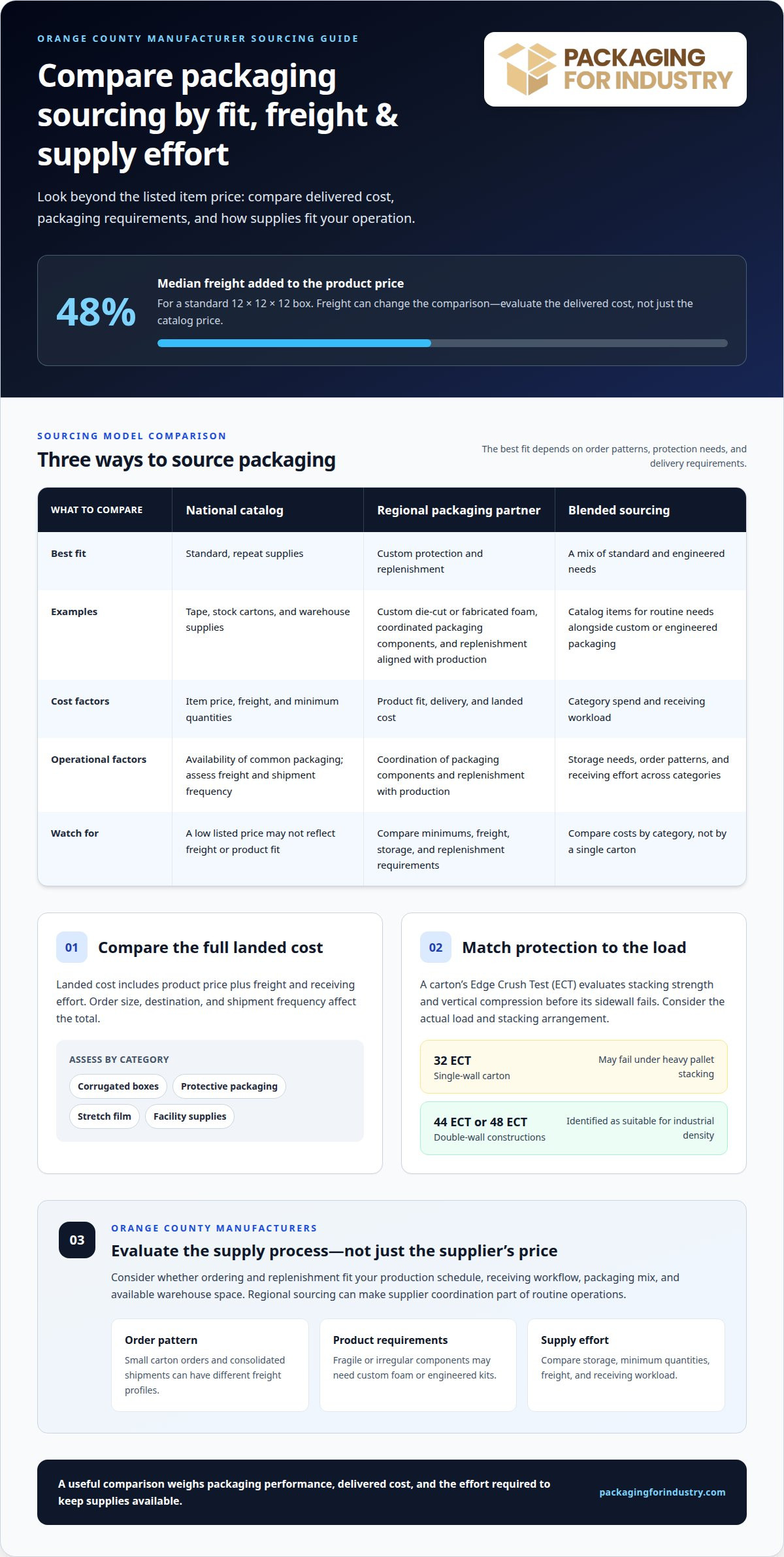
Freight can change the comparison: for a standard 12 × 12 × 12 box, it adds a median 48% on top of the product price. Orange County manufacturers comparing local packaging suppliers with national catalog distributors should weigh delivery distance, order size, and custom packaging needs against the listed item price.
National catalog suppliers can make common packaging easy to source, and predictable availability matters to busy operations. But the listed product price alone does not show freight costs or whether stock packaging fits your product and shipping process. This comparison explains how to evaluate landed cost, delivery needs, and product fit when considering a local alternative to Uline in Orange County. You’ll see when regional sourcing may suit Orange County manufacturers and how to weigh standard supplies against custom packaging and replenishment support.
Key Takeaways
- Compare the delivered cost of packaging, not just the catalog item price; order size, shipment frequency, and delivery distance all affect the freight picture.
- Match standard packaging needs to catalog purchasing, and consider a regional partner when custom protection or coordinated replenishment matters.
- Evaluate suppliers by product fit, delivery options, and ability to support packaging needs across your operation.
- Use order patterns and packaging requirements to make a more useful quote comparison and identify opportunities to lower supply costs.
- For foam packaging, stretch film, or packaging inventory management, PFI can help manufacturers assess a practical sourcing approach.
Catalog resellers versus regional packaging partners
A national catalog can simplify purchasing, while a regional packaging partner may better match materials to local production and delivery needs. Compare landed cost, meaning the product price plus freight and receiving effort. Order size, destination, and shipment frequency all affect the total. A small carton order and a consolidated shipment of several supply categories can have very different freight profiles, even when buyers purchase similar materials.
Which local suppliers sell warehouse, janitorial, and safety supplies alongside packaging? Orange County buyers can compare broadline industrial distributors for facility supplies with packaging-focused partners. Broadline catalogs may consolidate routine purchasing, while packaging partners focus on packaging materials and operational support.
Which local alternatives serve Orange County businesses and residential customers? Regional packaging partners generally focus on commercial supply needs, while national catalogs may serve both business and residential buyers. Manufacturers should compare each option against their packaging mix, order patterns, and delivery requirements.
Catalog resellers can suit repeat purchases of standard items such as tape, stock cartons, and warehouse supplies. A regional partner may be useful when shipments need coordinated packaging components or replenishment aligned with production. Neither model suits every order. Minimum quantities, freight, storage, and receiving workload can all change the cost of maintaining supply.
Cartons are only one category. A fragile or irregular component may need custom die-cut or fabricated protective foam, while palletized goods may call for industrial-grade stretch film and edge protectors. Heavy-duty wood shipping crates or plastic pallets can suit loads that standard corrugated packaging cannot support. Engineered kits can combine containers with cushioning, reducing separate material handling at packing stations.
Standard stock packaging has limits. A 32 ECT single-wall carton can fail under heavy pallet stacking, while 44 ECT or 48 ECT double-wall constructions are identified as suitable for industrial density. The Edge Crush Test evaluates stacking strength and vertical compression before a carton’s sidewall fails. Use these ratings alongside the actual load and stacking arrangement when selecting protection.
Assess costs by category rather than comparing a single carton. Separate corrugated boxes, protective packaging, stretch film, and facility supplies. Compare minimums, freight, storage needs, and replenishment patterns. A low unit price may not save money if excess stock occupies warehouse space or packaging fails to protect the product.
| Option | Best fit | Compare |
|---|---|---|
| National catalog | Standard, repeat supplies | Item price, freight, minimum |
| Regional packaging partner | Custom protection and replenishment | Product fit, delivery, landed cost |
| Blended sourcing | Mixed standard and engineered needs | Category spend and receiving workload |
Choose the sourcing model that meets packaging performance requirements while controlling landed cost and supply effort.
Local sourcing for Orange County manufacturers
Regional purchasing can strengthen supply continuity when packaging supports a scheduled production run. California’s Source Diverse Source Local initiative emphasizes regional procurement as a way to build operational resilience for manufacturers.
Local Stores and Warehouses
For Orange County manufacturers, local sourcing can make supplier coordination part of routine operations rather than an isolated purchasing task. A food producer planning packaging around output, for example, needs materials aligned with its production schedule and storage capacity. Buyers can assess how a local supplier’s ordering and replenishment process fits the facility’s receiving workflow, and how interruptions could affect production.
Do Orange County suppliers offer business accounts, volume discounts, or custom packaging? Suppliers may provide business purchasing arrangements, volume-based pricing, and custom packaging options. Compare the terms against order frequency, protection requirements, and available warehouse space.
Custom Packaging and Independent Suppliers
Independent packaging suppliers can offer a direct working relationship for manufacturers whose needs change with product design or production schedules. Aerospace and electronics operations, for instance, may need packaging designed around component shape and handling, while medical device manufacturers may prioritize consistent protection across repeat shipments. This differs from a store-focused purchase because the supplier can address product-specific requirements and recurring supply needs together.
What are the best-rated independent packaging suppliers in Orange County, California? Ratings depend on the review platform and individual customer experience, so compare feedback with relevant industry experience, product range, and ability to support your purchasing needs. A rating alone cannot show whether a supplier can meet your packaging requirements.
Packaging For Industry (PFI) is a practical option for manufacturers that need protective foam packaging or more structured recurring inventory. PFI provides foam packaging for product protection and Vendor Managed Inventory (VMI) for packaging to support planning for repeat-use supplies. These offerings can suit manufacturing, aerospace, electronics, medical, food, and warehouse operations with ongoing packaging needs.
Local sourcing can also reduce purchasing friction when packaging requires product-specific design or coordinated supply. PFI’s custom packaging design services tailor packaging to an application, while Just-In-Time (JIT) inventory management supports planned replenishment. For buyers managing repeat orders, this organizes supply around operational requirements rather than isolated purchases.
To compare a local packaging program with your current supply process, outline the product, usage pattern, and receiving needs in a packaging quote request.
Which Orange County packaging suppliers offer comparable products?
Orange County businesses comparing packaging sources can consider regional distributors, specialty packaging companies, and broadline industrial suppliers. The right fit depends on whether purchasing needs stop at standard cartons and tape or include protective packaging and supply planning. Compare suppliers by product category, ordering process, delivery fit, and ability to support the packaging used on your production line.
A broadline supplier may combine packaging with warehouse, janitorial, or safety supplies. That can suit buyers consolidating routine orders for cartons, tape, and workplace consumables. A packaging-focused distributor may center its range on corrugated boxes, foam, stretch film, cushioning, and engineered protection. These supplier types overlap, but their strengths can differ by category.
Before requesting quotes, map your current catalog purchases and group them by how the items are used:
- Shipping basics: stock cartons, packaging tape, and cushioning materials.
- Palletizing: stretch film, edge protection, and pallet-related supplies.
- Product protection: foam inserts or packaging designed around a specific component.
- Operations: recurring warehouse supplies that purchasing wants to source together.
This breakdown shows whether one supplier can cover the full order or category specialists make more sense. A distribution center, for example, may buy tape and stretch film routinely, while an aerospace manufacturer may need foam shaped around a component. Product fit matters as much as catalog breadth.
Similar products do not always provide equivalent packaging performance. A stock carton may fit a standard shipment, while an irregular or fragile item may need tailored cushioning. Ask suppliers to compare the application, not just the item description. For palletized shipments, include the load arrangement and protection needs in the quote request. That helps you compare like with like.
Business ratings can help identify candidates, but they do not establish product range or operational fit. Review feedback alongside the supplier’s stated categories, service model, and ordering options. A useful shortlist includes suppliers that address your actual needs, such as bulk cartons, protective materials, or recurring warehouse orders. Avoid ranking providers by star ratings alone.
When comparing local packaging suppliers in Orange County, assess regional partners and national catalog options category by category. Request comparable quotes for the same specifications, quantities, and delivery destination. Then weigh freight, order minimums, storage impact, and replenishment needs together. This reveals whether consolidated sourcing or a specialist supplier better supports your operation.
Where are local packaging supply stores and warehouses in Orange County?
Orange County buyers should distinguish retail counters, distribution warehouses, and packaging suppliers serving business accounts. The right location depends on whether you need a small carton purchase, pallet quantities, or recurring deliveries to a production site.
Start with the destination, not a broad countywide search. Anaheim, Irvine, Costa Mesa, Brea, and Huntington Beach are useful city names for narrowing a supplier search around your facility. Consider the route from each candidate location to your receiving dock, especially when bulky packaging could require repeated pickups or deliveries.
A map listing alone does not explain how a facility operates. A storefront may handle walk-in purchases, while a warehouse may stage commercial orders for scheduled delivery. Before planning a pickup, review the listing’s business details, ordering process, loading access, and whether the address serves customers directly. This helps avoid visiting a shipping location that does not operate as a retail counter.
For a warehouse order, ask how the supplier handles palletized cartons, stretch film, or cushioning materials. A standard passenger vehicle may not suit a bulk order. Confirm whether the order is staged, what vehicle access the site supports, and how collection should be coordinated with receiving staff. These details matter to manufacturers with limited dock availability.
Location also affects replenishment decisions. A nearby counter can help with a small, unexpected need, such as tape for a short production run. A warehouse supplier may suit planned orders better, especially when purchasing spans several packaging categories. Compare pickup effort with delivery scheduling, freight, and the labor needed to receive or move materials.
Use a consistent location check for each candidate:
- Identify the facility type: retail counter, warehouse, or delivery-focused supplier.
- Match the order: one carton, mixed supplies, or a pallet shipment.
- Check site logistics: pickup process, loading access, and receiving coordination.
- Compare total effort: travel, freight, warehouse handling, and replenishment frequency.
For example, a Costa Mesa distributor needing occasional tape may value convenient counter access. An Irvine manufacturer receiving recurring cartons may prioritize an organized delivery plan and clear receiving coordination. The best location fits the order and workflow, not simply the closest map pin.
When comparing suppliers serving Orange County, organize requirements by delivery address, packaging category, order size, and receiving constraints. A packaging quote request can help frame those details for a direct comparison.
Business-account packaging suppliers and distribution warehouses are the closest Uline-style options. Compare their cartons, stretch film, and cushioning materials, as well as pickup and delivery arrangements.
Anaheim, Irvine, Costa Mesa, Brea, and Huntington Beach can help narrow a search. Check whether each listing is a walk-in counter, a warehouse for staged orders, or a delivery-focused supplier. Review pickup and loading arrangements before visiting.
For small purchases, look for a local storefront that serves walk-in customers. For larger or recurring business orders, compare warehouses and delivery-focused packaging suppliers. Check that each location serves customers directly and that its order process fits your needs.
Which nearby suppliers offer same-day pickup or delivery in Orange County?
Same-day packaging access depends on the item, order readiness, and fulfillment method. Orange County buyers should distinguish walk-in pickup, staged warehouse collection, and local delivery before treating a supplier as an urgent-order option.
A nearby storefront may help with a small, immediate need, such as tape or stock cartons. A warehouse can handle larger commercial orders, but collection depends on order staging and loading arrangements. Local delivery timing depends on route schedules and destination. Compare these service models separately.
Regional packaging partners may use dedicated delivery routes and staged local runs to support inventory control. These systems can help manufacturers align replenishment with operational needs, but they do not mean every product can arrive the same day. Match the requested item and order size to the supplier’s fulfillment method.
For example, a warehouse short on stretch film may need a standard stocked item. A production line requiring a particular carton or protective insert has a different constraint: the exact packaging must be available and ready. Urgency does not remove product-fit requirements. An unsuitable carton can create handling problems or weaken protection.
Use this sequence to assess an urgent order:
- Identify the item: record the product type, dimensions, and required quantity.
- Choose fulfillment: distinguish counter pickup, warehouse collection, and delivery.
- Check the destination: provide the Orange County delivery address or pickup location.
- Assess readiness: determine whether the order is standard stock or needs preparation.
- Compare impact: weigh travel, freight, receiving time, and production urgency.
This process helps buyers avoid a wasted trip. A local address alone does not establish that a facility sells over the counter or has the required packaging ready. Catalog orders may suit planned replenishment, while a nearby supplier can help when local stock and collection logistics align.
For recurring warehouse demand, planned replenishment can reduce reliance on urgent purchases. Review consumption, storage capacity, and delivery cadence for cartons, film, and cushioning. If a manufacturer regularly runs short on one category, prioritize it in the ordering plan. Local routes and staged runs may support that approach.
For an urgent order, state the item, quantity, destination, and whether pickup or delivery works for your operation. Then compare the full operational effect, including freight, employee travel, loading, and any delay to packing. The fastest option is the one that gets suitable packaging to the work area in time.
A nearby storefront may be the best option for a small urgent need, while a warehouse may offer collection of larger orders once they are staged. Local delivery timing depends on route schedules and destination, so confirm item availability and fulfillment timing directly with the supplier.
Packaging For Industry (PFI): Foam Packaging
Packaging For Industry (PFI) helps Orange County manufacturers address protective packaging and replenishment needs beyond standard catalog orders. Turn to PFI when a product needs foam protection tailored to its shape or recurring packaging supplies need coordinated management.
Foam packaging can cushion products during handling and shipment, while stretch film secures palletized loads. For ongoing supply planning, PFI’s Vendor Managed Inventory (VMI) and Just-In-Time (JIT) inventory programs support packaging replenishment around operational needs. These options can help when product protection, packaging availability, or warehouse inventory control affects daily production.
To discuss your packaging requirements, contact Packaging For Industry (PFI).
Make your next packaging comparison actionable
For manufacturers weighing a local alternative to Uline in Orange County, turn purchasing records into a practical sourcing plan. Group recurring orders by packaging category, delivery destination, and production need. This gives your team a clearer basis for deciding which supplies to source routinely and where coordinated replenishment could simplify purchasing.
Packaging For Industry (PFI) supports operations that need protective foam packaging, stretch film, or Vendor Managed Inventory for packaging. These offerings can help when product protection, pallet preparation, or stock control needs more attention than a one-time catalog order provides. Start with a specific operational requirement, such as limiting product movement inside a shipping container or managing recurring packaging inventory.
Include relevant packaging categories and order patterns in a quote request. A focused comparison helps your purchasing team make a sourcing decision that fits its workflow and supply priorities.
A considered sourcing plan makes the next purchasing decision clearer and more manageable.
Frequently Asked Questions
How do freight costs from local packaging distributors compare to national catalog suppliers?
Freight comparisons depend on the shipment and delivery arrangement, so compare the complete delivered order. A local distributor may suit recurring purchases delivered on regional routes, while a national catalog may fit a different purchasing pattern. Include quantities, destination, delivery cadence, and receiving requirements. Consolidating several supply categories can change the shipment profile and the work required to receive it.
What packaging products can Orange County manufacturers source locally?
Orange County manufacturers can source corrugated boxes, foam packaging, stretch film, tape, cushioning materials, pallets, crates, and tubes through local industrial suppliers. Product needs vary by application. An electronics company may need protection against movement during shipment, while a warehouse may prioritize pallet wrap and carton replenishment. Provide product dimensions, handling conditions, and order patterns to help narrow the right packaging categories for a quote.
What local packaging and shipping supply companies serve Orange County, California?
Packaging For Industry (PFI) serves Orange County businesses alongside regional packaging distributors and broadline industrial suppliers. Compare providers by the categories they handle and the needs they support, such as custom packaging, recurring orders, or warehouse supplies. A manufacturer seeking a local alternative to Uline in Orange County can shortlist suppliers based on its actual purchasing mix, then compare product fit and delivery arrangements.
How do local suppliers’ prices compare for boxes, tape, and shipping materials?
Compare equivalent items and ordering conditions rather than relying on a single catalog listing. Match box dimensions and construction, tape type, quantities, and delivery destination. Include freight and ordering frequency. Pricing depends on specifications, quantities, product mix, and delivery requirements, so request a quote for an accurate comparison. This gives purchasing a more useful basis for evaluating the overall order.
What are the minimum order quantities and delivery fees from Orange County packaging suppliers?
Minimums and delivery fees vary by supplier, product, order size, and destination. Custom packaging may have different order requirements from standard stock materials because it is made for specific product needs. To compare terms, group requested items by category and provide quantities, delivery address, and expected order frequency. This helps purchasing assess the order structure and delivery arrangement without comparing unlike quotes.