
Do foam end caps really use a lot of material? Not necessarily. A fitted design can place foam where the server chassis needs support without adding unnecessary packaging. For buyers seeking custom foam end caps for server chassis in Orange County, the right shape and amount of cushioning depend on the chassis and its transit protection needs.
It’s reasonable to want packaging that protects equipment without adding unnecessary bulk. This article explains how end caps cushion a server chassis, how their shape and foam material can be tailored, and how recycled foam grades may fit the design. You’ll also learn what affects material use and what information helps develop a practical fit for your shipping setup.
Key Takeaways
- Shape foam end caps around the chassis to support a secure fit without adding unnecessary material.
- Tailor foam specifications, including recycled content, to the product’s form and packaging requirements.
- Consider how shock, vibration, and abrasion during transit affect the cushioning design for servers and other equipment.
- Match the foam design to the products and shipping needs of your operation to support dependable packaging workflows.
- Share your packaging requirements to get a quote for a custom foam solution and related packaging support.
Custom Foam End Cap Products
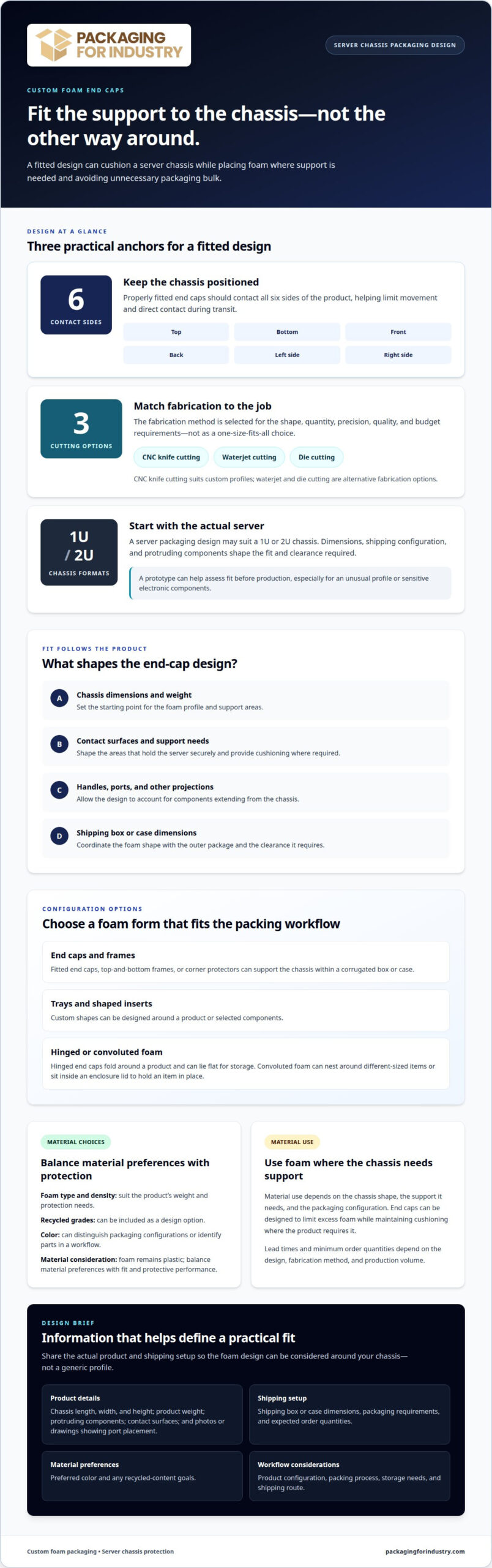
Foam end caps hold a product away from the shipping box’s interior surfaces. For rack-mount servers, a fitted pair can cushion the chassis while leaving space for connectors, handles, or other protruding components. Properly fitted end caps should contact all six sides of the product, helping limit movement and direct contact during transit. A server packaging design may suit a 1U or 2U chassis, depending on its dimensions and shipping configuration.
Custom foam designs can fit around a product or selected components. Options include end caps, top-and-bottom frames, corner protectors, trays, and shaped inserts inside a corrugated box or case. Hinged end caps fold around a product and can lie flat for storage. Convoluted foam can nest around different-sized items or sit inside an enclosure lid to hold an item in place.
Packaging professionals choose CNC knife cutting, waterjet cutting, or die cutting based on the shape, quantity, precision, quality, and budget requirements. CNC knife cutting suits custom profiles, while waterjet and die cutting are other fabrication options selected to match the job. The process is part of the design decision, not a one-size-fits-all choice.
To design end caps, packaging professionals consider the chassis dimensions and weight, contact surfaces, and the location of handles, ports, and other projections. They shape support areas to hold the server securely, accounting for the shipping box and required clearance. A prototype can help assess the fit before production, especially when the chassis has an unusual profile or sensitive electronic components.
Shape, color, and recycled content can be included in the design requirements. Recycled foam grades are an option, while the foam type and density should suit the product’s weight and protection needs. Color can distinguish packaging configurations or identify parts in a manufacturing workflow. The chosen material is still plastic foam, so the design should balance material preferences with fit and protective performance.
Lead times and minimum order quantities depend on the design, fabrication method, and production volume. A simple, repeatable profile differs from a complex insert that needs development and prototype review. Packaging For Industry serves Orange County, Los Angeles, and San Diego, coordinating custom packaging design and foam packaging to help manufacturers align packaging development with production planning.
For a useful quote, manufacturers should provide the chassis length, width, and height; product weight; protruding components; and shipping box or case dimensions. Include expected order quantities, packaging requirements, preferred color, and any recycled-content goals. Photos or drawings can clarify port placement and contact surfaces, helping develop a design around the actual server rather than a generic profile.
Material use depends on the chassis shape, the support it needs, and the packaging configuration. End caps can be designed to limit excess foam while maintaining cushioning where the product requires it. For electronics manufacturers, this provides a practical basis for comparing fit, protection, storage, and material use before choosing a production design.
Industries Served
Computer manufacturers use foam end caps to prepare finished servers and chassis for shipment between production, integration, and customer locations. A rack-mount system may travel with rails, bezels, or other components that need space within the package. Packaging design considers the product configuration and shipment route, so protection suits the actual application rather than a generic electronics carton.
Data infrastructure suppliers also ship equipment to data centers, where receiving teams need to identify and unpack systems efficiently. A consistent foam layout can keep a chassis positioned and separate included components during transit. For server shipments, packaging teams can coordinate the end caps with the outer box and included parts, supporting repeatable packing across manufacturing and fulfillment operations.
Orange County companies seeking a local source can work with Packaging For Industry for foam packaging and custom packaging design services. These offerings address packaging needs for server manufacturers and other industrial businesses. The foam packaging options can be considered alongside the product’s shipping configuration and the manufacturer’s packing workflow.
Electronics manufacturers face varied packaging demands because products differ in shape, weight, and sensitivity. A server chassis may ship as a complete unit, while a computer systems supplier may package smaller assemblies or accessories. For each application, the foam arrangement should match the product and packaging process. Static-control needs also influence material selection for electronics and batteries.
Telecommunications companies ship network hardware and related equipment through distribution channels. Foam end caps can hold equipment in place and reduce contact with the shipping container, while coordinated packaging can keep accessories organized. A supplier handling several hardware configurations can use distinct foam profiles to separate models or component sets, reducing confusion during packing and receiving.
Aerospace and medical equipment manufacturers also ship precision products that need application-specific cushioning. Packaging for an aerospace component may prioritize surface protection and stable positioning. Medical equipment packages may need an insert that organizes multiple parts. In both cases, packaging design considers the product’s shape and handling needs, then adapts the foam configuration to the equipment rather than applying a server-only solution.
Automotive suppliers offer another example. Expanded polyethylene and expanded polypropylene are used in packaging applications that require durability and resistance to multiple impacts. These materials can support packaging for components moving between suppliers, assembly operations, and distribution points. The right configuration depends on the part and its handling path, not simply on the industry.
Warehouses and distribution centers support these industries by storing, picking, and shipping packaged products. A foam design that matches the product and packing sequence can help teams handle repeat orders consistently. Packaging kitting can group foam, boxes, and specified components for an assembly or fulfillment workflow, while stretch film can secure completed packages on pallets for transport.
For buyers comparing custom foam end caps for server chassis in Orange County, the key is matching the packaging to the product, shipment, and operating process. Server makers, electronics suppliers, telecommunications companies, aerospace manufacturers, and medical equipment producers each have distinct requirements. A design aligned with those needs can support dependable movement from manufacturing through delivery without treating every shipment as identical.
Protection for Servers During Shipping
Server chassis can face impact, vibration, and surface rubbing as packages move through handling and transport. Foam end caps cushion the chassis and keep it from contacting the inside of the box. The design needs to support the product’s weight while limiting movement, especially around delicate connectors, control panels, and projecting hardware.
Material selection starts with the chassis weight, fragility, and sensitivity. Medium-weight polyethylene foam can protect products with average to low fragility, and a suitable design can also protect lighter, more fragile products. Polyurethane foam has a soft, elastic, open-cell structure, making it useful for delicate or vibration-sensitive items. Cross-linked polyethylene is a high-density, closed-cell option that resists water and chemicals and can protect Class A surfaces.
There is no single foam density for every server chassis. Packaging professionals select the foam type, amount, and density according to the product and the protection required during delivery. A heavier chassis may need a different support arrangement than a lighter unit, while a sensitive finish or exposed connector can influence where cushioning makes contact. The fit must hold the chassis without pressing on vulnerable features.
Shock protection depends on how the end caps support the equipment and manage impact forces. A well-fitted design cushions the chassis before it strikes the box, while loose foam can allow movement. Vibration presents a different challenge: repeated motion can cause rubbing or gradual displacement. Foam should secure the product within the package, with suitable contact areas around the chassis rather than pressure concentrated on connectors or controls.
Abrasion can occur when a server shifts against its packaging or a rough contact point repeatedly touches a finished surface. End caps separate the chassis from the carton and help prevent that contact. For a chassis with a sensitive exterior, the material and contact geometry should protect the surface while keeping the equipment stable. A prototype helps assess contact points and fit before production.
Shipping and drop-test criteria should reflect the shipment route, chassis weight, product fragility, and customer requirements. Packaging professionals define the test protocol for the complete packed configuration because the box and end caps work together. Applicable customer or carrier requirements guide which handling conditions the packaging must address.
Poor-fitting end caps create practical risks. If the chassis shifts, connectors or projecting components may strike the box or other parts. Loose foam can permit abrasion, while an overly tight fit can press against delicate features. Incorrect support can also leave sections of the chassis exposed to impact. These risks make fit and contact placement central to the packaging design.
For server shipments, foam end caps can be designed for virtually any product profile, but protection depends on matching the material and geometry to the actual equipment. A 1U or 2U server, for example, calls for a profile shaped to its chassis and shipping configuration. The result should keep the equipment positioned, cushion impact, and limit vibration and abrasion through transit.
Why Choose Packaging For Industry for Foam Packaging
Packaging For Industry helps manufacturers plan foam packaging around production and shipping requirements. Turn to PFI when standard packaging doesn’t suit a server program, product configurations change, or recurring orders make supply planning difficult. For Orange County manufacturers seeking custom foam end caps for server chassis, PFI can connect design decisions with purchasing and packing needs rather than treating each order as an isolated material request.
PFI’s custom packaging design services support projects that need packaging developed for a specific product or shipping method. Project requirements guide the design, and foam packaging can be coordinated with the manufacturer’s shipping process. This is useful for procurement and operations teams managing product changes, repeat shipments, or packaging that needs to fit an established workflow.
A packaging quote depends on factors such as design complexity, material requirements, and production volume. These factors help define the project scope and pricing. Manufacturers can explain whether they need a new design, a revision to an existing solution, or a repeat order. That context makes it easier to assess the requirement and compare options consistently.
Supply planning matters once the design is selected. For businesses with recurring packaging demand, PFI’s Vendor Managed Inventory (VMI) for Packaging supports planned replenishment and reduces the burden of managing routine packaging purchases internally. It can be useful when a foam component is essential to shipping and a shortage could interrupt packing operations.
Stretch film can also secure prepared shipments on pallets. Considering it alongside foam can help purchasing teams coordinate supplies for the complete shipping process. The need depends on how products move through the warehouse and how the team prepares loads. It is a related option, not a requirement for every server packaging project.
To scope a foam packaging project, manufacturers can describe how the packaging is used, whether orders recur, and what changes are expected across product configurations. Purchasing teams can also identify their preferred order pattern and any coordination needs between design and supply planning. Clear project context helps PFI focus on the relevant design and purchasing decisions without adding unrelated packaging requirements.
For buyers seeking custom foam end caps for server chassis in Orange County, PFI offers a local path to discuss packaging needs for manufacturing or distribution. A custom solution is especially relevant when standard materials do not suit the product or packing operation. If the current setup creates purchasing complexity, a focused packaging review can clarify the design scope and supply needs.
Packaging decisions affect more than the material inside a box. A workable solution must fit the manufacturer’s purchasing process, shipment preparation, and ongoing supply needs. PFI connects custom packaging design with foam packaging and, where appropriate, packaging inventory support. This gives procurement and operations teams a practical basis for aligning the packaging program with production demand.
To discuss your requirements and request a foam packaging quote from Packaging For Industry, use the quote request form.
Frequently Asked Questions
Do foam end caps use a lot of material?
Not necessarily. End caps can focus cushioning on the areas needed to support and separate a server chassis instead of filling the entire shipping box with foam. Material use depends on the chassis profile, required protection, and fit within the outer packaging. A design review can balance cushioning with package size, helping avoid excess foam while preserving support during shipment.
What are typical lead times and minimum order quantities for custom foam end caps in Orange County?
Lead times and minimum order quantities depend on the design, fabrication method, and production volume. A simple, repeatable profile differs from a complex insert that needs development and prototype review.