
Tight banding can secure heavy freight but put damaging pressure on exposed corners. Caliper cardboard edge protectors for heavy freight banding in San Diego help shield pallet edges from strap tension and transit impacts while supporting stable stacking.
Choosing the right protector means balancing board thickness, leg length, and the way the load is banded. This guide explains how edge protectors support stacking, reduce corner damage, and fit tight banding, with practical considerations for freight moving through San Diego.
Key Takeaways
- Specify edge protectors by leg length, board length and caliper so they fit the load and banding configuration.
- Caliper is measured in thousandths of an inch; the appropriate thickness depends on the load’s support and protection needs.
- Longer protector legs can provide more coverage against strapping, while paired strap protectors shield banding impact points.
- Packaging needs vary across aerospace, food, medical, electronics, construction and other industrial operations, so protection should suit the product and shipping workflow.
- PFI’s custom packaging design, foam, stretch film and inventory services can support broader packaging and supply planning.
Caliper Cardboard Edge Protectors for Heavy Freight in San Diego
Selecting caliper cardboard edge protectors for heavy freight banding in San Diego starts with the pallet load and strap layout. Match the leg length, board length, and thickness to the corners that need support.
Corner Board Purposes
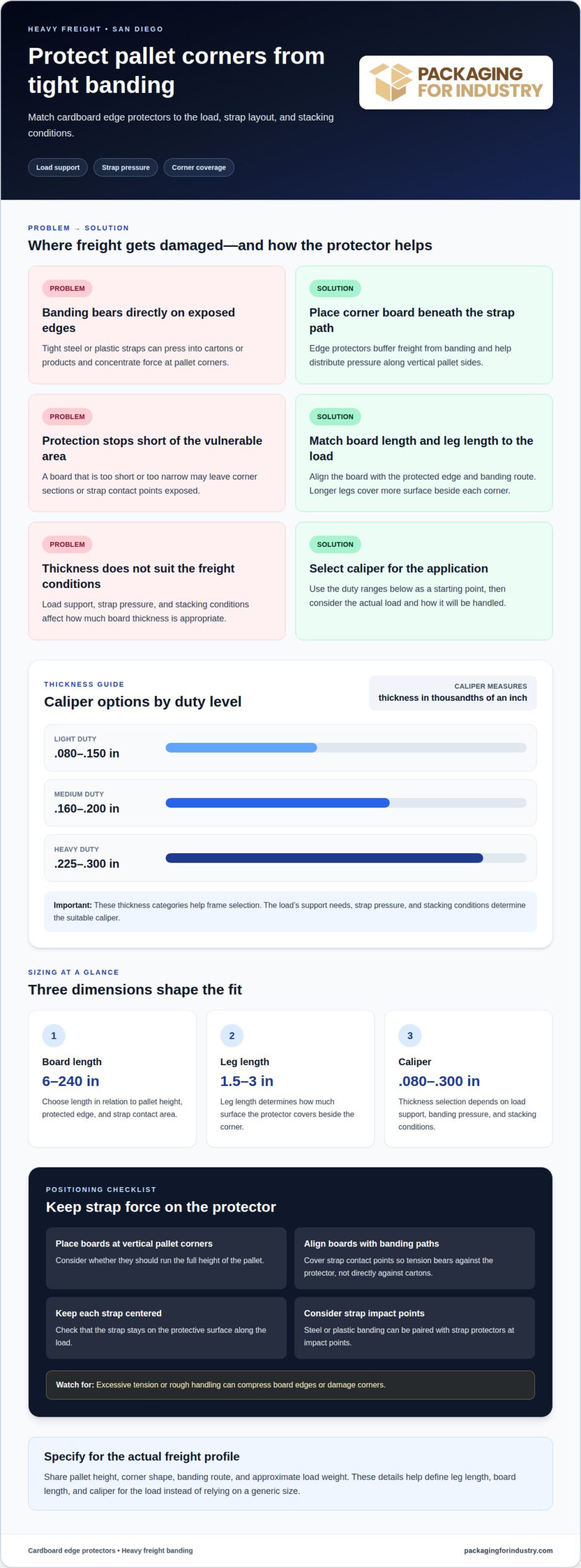
Corner boards reinforce pallet edges, protect exposed corners, and help distribute stacking pressure along vertical sides. They also buffer freight from steel or plastic banding, reducing direct strap contact with cartons or products. For a tall pallet, consider whether boards should run the full height of its vertical corners. Leg length determines how much surface the protector covers beside each corner.
Custom Sizes and Order Options
San Diego packaging operations can match board dimensions to the load by specifying the pallet height, corner shape, banding route, and approximate load weight. Same-day pickup is a fulfillment option, not an edge-protector dimension. These details help define suitable leg length, board length, and caliper for the actual load, rather than relying on a generic size.
Available Lengths
Cardboard edge protector board lengths commonly range from 6 to 240 inches. A supplier selects length by comparing pallet height, the protected edge, and whether the board must cover a strap contact area. Longer boards can reinforce more of a vertical corner; shorter boards may fit a defined section of a load. Custom board lengths can align protection with the freight profile and reduce unnecessary overhang.
Thickness and Caliper Choices
Caliper measures edge-protector thickness in thousandths of an inch. Common options range from .080 to .3 inches. Light-duty boards are .080 to .150 inches thick, medium-duty boards are .160 to .200 inches, and heavy-duty boards are .225 to .300 inches. For heavy freight banding, these ranges help frame selection; load support, strap pressure, and stacking conditions determine which thickness suits the application.
Specifications for Heavy Freight Banding
For heavy freight, a supplier weighs load support, stacking pressure, corner exposure, and banding position when specifying V-board dimensions. Leg lengths commonly range from 1.5 to 3 inches, while caliper indicates board thickness. Longer legs offer more protection against strapping. Steel or plastic banding can also pair with strap protectors at impact points. Excessive tension or rough handling can compress board edges or damage corners.
Positioning and Securing Protectors
Position boards along the pallet’s vertical corners and align them with the banding paths and exposed edges. They should cover the strap contact points so tension bears against the protector, not directly against cartons. Consider whether board length matches the corner height and whether each strap stays centered on the protective surface. This layout helps distribute pressure and limit shifting during handling.
Industries Served
Freight protection needs vary with the product, packaging line, and delivery route. Manufacturers, warehouses, distributors, fulfillment centers, aerospace companies, food businesses, medical companies, electronics firms, and construction suppliers all manage distinct shipping risks. A packaging plan should account for how each operation prepares loads, stores inventory, and transfers freight. For San Diego businesses, these details help align packaging choices with routine handling instead of relying on a one-size-fits-all setup.
Manufacturing and industrial operations move finished goods, components, and production materials between work areas, warehouses, and customers. Since load shapes can vary across product families, packaging teams consider how cartons or bundles fit on a pallet and where straps contact the load. Packaging for manufacturers may combine corrugated boxes, cushioning, stretch film, and corner protection. The goal is to protect products during handling while keeping packing processes practical for repeat shipments.
Aerospace companies ship components that may have specific fit, surface-protection, or handling requirements. Their packaging plans can involve custom-designed protection, foam, and crates alongside materials used to stabilize freight. A consistent package configuration helps operations prepare shipments with fewer last-minute adjustments. Aerospace packaging also needs to account for the product’s shape and the way the shipment will be handled across the supply chain. Aerospace packaging solutions can address those industry-specific packaging needs.
Food and medical businesses coordinate packaging with product protection, shipping workflows, and warehouse handling. A food company may move boxed products through storage and distribution, while a medical operation may ship equipment, supplies, or packaged components. In both settings, the outer shipping package must support the product through its intended logistics process. Select packaging based on the freight configuration rather than assuming the same box, cushioning, or pallet arrangement suits every shipment.
Electronics companies often ship items that need careful cushioning and organized placement within the package. Packaging teams may evaluate foam inserts, protective materials, cartons, and pallet stabilization as parts of a coordinated design. Needs depend on the product and shipping configuration, not simply the industry label. For freight loads, consider how the inner package, pallet, and banding work together to keep the shipment organized during transit and handling.
Construction suppliers distribute building materials, hardware, and industrial products in varied shapes and shipment quantities. Some freight arrives in cartons; other materials may be bundled or palletized. Packaging for distribution centers and warehouses must fit receiving and storage workflows as well as outbound transport. Planning for secure stacking, protected corners, and suitable unit loads can help reduce avoidable handling damage and keep goods moving through inventory operations.
Distributors and fulfillment centers handle products from multiple manufacturers and serve varied destinations. They need packaging that supports efficient receiving, storage, order preparation, and shipment consolidation. Packaging kitting and assembly can organize materials for repeatable fulfillment workflows, while inventory programs can support a steadier supply. The right approach depends on product mix, shipment patterns, and warehouse processes, so packaging decisions should reflect everyday operations.
Across these industries, start with the shipment itself: product type, package configuration, pallet arrangement, and handling path. These details help industrial businesses select packaging for their freight needs, support supply reliability, and work toward lower packaging costs without treating every shipment alike.
Benefits of Cardboard Edge Protectors
For purchasing teams, cardboard edge protection offers value beyond the condition of a single shipment. A defined protector specification helps keep packaging consistent across repeat pallet builds. Caliper cardboard edge protectors for heavy freight banding in San Diego can be assessed as one element of a broader packaging plan, alongside cartons, cushioning, and load-securing materials.
Unlike plastic or steel corner protectors, cardboard protectors have a paper-based construction. The choice depends on the shipment’s handling needs, material preferences, and packaging workflow; no single material suits every freight load. When evaluating caliper cardboard edge protectors for heavy freight banding in San Diego, consider how they fit existing packing procedures and the materials already used at the facility.
For United States requirements, applicable rules depend on the shipment and its handling context. According to the Office of the Federal Register, National Archives and Records Administration, one permitted top-cap construction for Postal Service pallet loads uses a C-flute corrugated sheet covering the load with standard solid-fiberboard pallet corner edge protectors. This specific construction is not a universal requirement for every freight shipment.
Cardboard edge protectors are available through industrial packaging suppliers and distributors serving San Diego. Coordinate product specifications with the facility’s packing process, recurring load profiles, and purchasing needs. For operations shipping similar freight repeatedly, consistent specifications make it easier for warehouse teams to identify the right packaging components and prepare comparable loads from one shipment to the next.
Standardized packaging also supports clear communication between purchasing, production, and shipping teams. A written specification can record the protector profile, length, thickness, and intended application, while packing instructions show where it belongs in the shipment configuration. This reduces ambiguity when different employees prepare the same product family or packaging supplies move between work areas.
During receiving and shipment reviews, a consistent packaging setup gives teams a clearer basis for inspecting the outer package. They can note marks, tears, or compression on a carton or appliance package, then compare those observations with the packing configuration. For furniture, appliances, and boxed industrial products, this review helps identify whether an issue relates to package design, handling, or the arrangement of materials. It also gives operations teams useful information for refining repeat shipment procedures.
Cardboard protection can fit into a broader packaging specification without changing every part of a shipment. A warehouse may retain its current carton and pallet process while documenting where corner protection is used. This can help purchasing forecast required materials and shipping staff follow a consistent preparation method. The objective is a practical, repeatable system suited to the freight operation, not an assumption that one protector fits every product.
For San Diego freight operations, cardboard edge protection is most useful when its role is clear within the packing process. Product packaging, pallet preparation, storage, and shipment handling all influence how the materials work together. Defining the application helps teams maintain consistent packing practices and assess shipment condition using the same criteria, while keeping decisions tied to the loads they actually prepare.
Why Choose Packaging For Industry (PFI)
Packaging For Industry (PFI) helps businesses plan packaging around freight protection, packing workflows, and supply reliability. For palletized shipments, edge boards are one part of the protection system; cushioning and stretch film can also help protect and secure products. PFI’s related packaging offerings support these needs, especially when a business wants to review materials and inventory together.
Consider the full shipment. A packaging issue may involve more than strap contact at pallet corners. If products move inside their cartons, foam packaging can provide cushioning suited to the item and package configuration. Stretch film can help contain a load during handling. These materials address different parts of the packaging system, so the right combination depends on the product, shipment arrangement, and operating process.
PFI’s stretch film options can be considered as part of a broader freight packaging plan. Stretch film wraps a pallet load to help hold packages together; it does not replace corner protection where banding presses against exposed edges. Coordinating the materials around their specific roles helps operations avoid relying on one packaging component to solve every load-stability or damage concern.
When to review packaging design. A change in product dimensions, carton configuration, or shipment handling can make an existing setup less suitable. PFI helps businesses evaluate related packaging needs, including foam protection for individual products and stretch film for palletized loads. A review is useful when damage patterns point to more than one cause or materials need to work together across packing and distribution.
When inventory planning matters. Packaging availability can affect production and shipping schedules. PFI offers Vendor Managed Inventory (VMI) for Packaging and Just-In-Time (JIT) Inventory Management for Packaging. These services help businesses manage packaging inventory in line with operating requirements. A review can consider which materials are used repeatedly, how consumption fits the workflow, and where supply planning could simplify purchasing.
Packaging kitting and assembly services can help organize components for repeatable operations. For example, a manufacturer handling similar shipments may benefit from a consistent set of materials staged for its packing process. The appropriate approach depends on the products, packing steps, and supply needs. Connecting these factors can help teams manage packaging efficiently without treating every shipment as identical.
For manufacturers, warehouses, distributors, and industrial businesses in San Diego, define the issue clearly as a practical next step. Note where damage occurs, how freight is secured, which materials are in use, and whether supply interruptions affect packing. This context focuses a packaging discussion on relevant protective materials and inventory requirements. PFI supports broader packaging decisions involving foam, stretch film, and packaging supply programs.
If you’re reviewing freight packaging or related supply planning, contact Packaging For Industry (PFI) to discuss your requirements.
Frequently Asked Questions
What sizes and thicknesses are available?
Edge protectors come in different profiles, board lengths, and calipers, with custom dimensions suited to particular freight configurations. For an accurate specification, provide the pallet layout, product or carton dimensions, and a drawing or description of the load. Note whether one protector design needs to serve several product configurations. This information helps align the specification with the packing process and makes repeat purchasing clearer.
How do caliper thickness, leg length, and profile affect edge protector strength?
Strength depends on how the protector fits the load and performs in its intended use, not on one dimension alone. A supplier can review a representative packed load for fit, board deformation, and compatibility with the packing sequence. A close-fitting profile helps keep the board seated, while the specified caliper and leg dimensions must suit the load’s support demands. This assessment can guide a consistent specification for repeat shipments.