
For long parts, the box design can matter as much as the board strength. Heavy-duty telescoping corrugated boxes for long parts in Anaheim use a separate base and lid, with the lid sliding over the base to create an overlapping protective wall. The overlap depth and custom inside dimensions can be specified to suit the part and the finished package.
This two-piece design can be a practical alternative to a standard RSC box when side-wall protection and stacking strength matter. It also affects assembly and material use, so the right choice depends on the product, shipping conditions, and packing process.
This guide explains how suppliers determine box dimensions, adjustable depth, board grades, and strength ratings for long-part shipments. It also compares telescoping boxes with other packaging types and outlines the details that help match protection to your application without adding unnecessary material.
Key Takeaways
- Learn which part dimensions and package-fit details shape a custom telescoping box specification.
- See how overlap, board grade, and strength ratings affect protection and shipping performance.
- Compare telescoping boxes with other packaging designs to understand the trade-offs in protection and material use.
- Explore how cushioning and securing methods can help protect long parts in transit.
- Find out how PFI’s custom packaging design and foam packaging can support industrial shipping needs.
Products for Long Parts
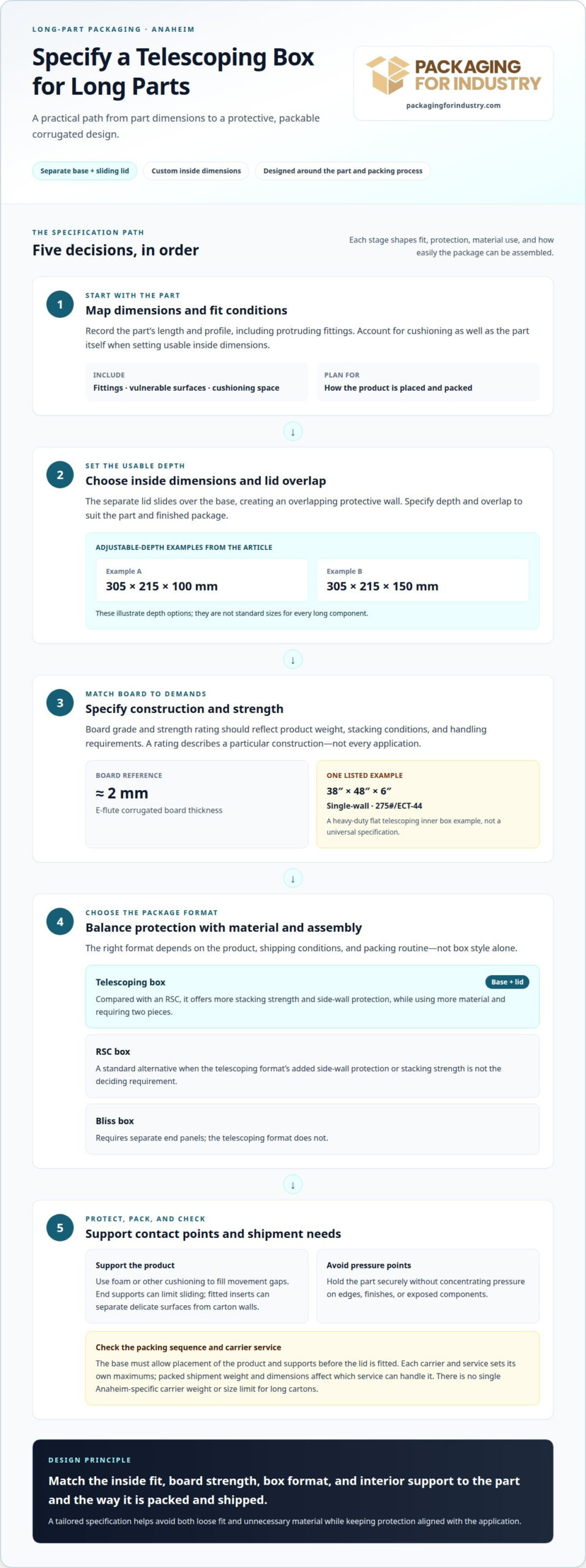
A telescoping carton has a separate base and lid, with the lid sliding over the base. Heavy-duty telescoping corrugated boxes for long parts in Anaheim can be designed around the part’s inside dimensions and required depth. Account for protruding fittings and cushioning, not just the part’s longest measurement. This helps ensure the carton fits the product and the packing process.
Board grade also affects the specification. E-flute corrugated board is approximately 2 mm thick, while telescope boxes can be made in custom inside dimensions and board grades. Adjustable-depth examples include a 305x215x100 mm box and a 305x215x150 mm box. These examples illustrate depth options, not standard sizes for every long component.
There is no single Anaheim-specific carrier weight or size limit for long cartons. Each carrier and service sets its own maximums, and the packed shipment’s weight and dimensions affect which service can handle it.
Strength ratings help describe a particular construction. One listed 38″ x 48″ x 6″ heavy-duty flat telescoping inner box uses single-wall construction with a 275#/ECT-44 rating. That example should not be treated as a specification for every application. Product weight, stacking conditions, and handling requirements all affect the board strength needed for a shipment.
Packaging format matters. Compared with an RSC, a telescope box provides more stacking strength and side-wall protection, but uses more material and has two pieces. A Bliss box requires separate end panels; the telescope format does not. Choose based on the part, packing routine, and protection priorities, not box style alone.
Design interior support around the part’s contact points. Foam or other cushioning can support vulnerable areas and fill gaps that could allow movement. End supports can help limit sliding, while fitted inserts separate delicate surfaces from carton walls. The support should hold the part securely without concentrating pressure on edges, finishes, or exposed components.
Before production, a packaging designer can use the part’s dimensions, protrusions, and cushioning requirements to establish usable inside dimensions and depth. The packing sequence matters too: the base must allow placement of the product and supports before the lid is fitted. For local context, packaging support in Anaheim includes industrial packaging needs.
Industries Served
Long components move through different supply chains, but manufacturers, distributors, and warehouses share a need for packaging that protects products and suits the handling process. In Anaheim and across Orange County, Los Angeles, and San Diego, requirements vary with the part’s shape, destination, storage conditions, and packing workflow. A production-line packaging plan may differ from one for individual orders.
Aerospace operations handle components that may have delicate surfaces, unusual profiles, or precise handling requirements. Packaging design can account for contact points and movement during transit, while cushioning helps isolate sensitive areas. PFI serves aerospace businesses with custom packaging design services and foam packaging. The design can be considered alongside the way parts move between production, storage, and shipment. For aerospace-specific packaging support, see packaging for aerospace.
Manufacturers and industrial businesses often need packaging for repeatable movement from a work cell to a warehouse or distribution point. Long shafts, rails, fabricated sections, and machine components each present different packing challenges. A useful design considers how workers place the part, protect exposed ends, and prepare the package for handling. Packaging kitting and assembly can also organize components for a defined production or fulfillment process.
Electronics, medical, and food businesses have distinct products and operating environments. Electronics shipments may include assemblies with exposed connectors or fragile surfaces. Medical businesses may ship instruments or equipment that need stable placement. Food companies manage packaging around production, storage, and distribution. In each case, the approach should reflect the product and process rather than assume one box suits every shipment.
Warehouses, distributors, and fulfillment centers focus on storage, order preparation, and dependable replenishment. Packaging decisions affect floor space, packing consistency, and material availability at the point of use. Vendor Managed Inventory (VMI) for packaging and Just-In-Time (JIT) inventory management can support planning when demand recurs. Kitting and assembly may also help organize materials for repeat orders.
Construction suppliers and other industrial businesses may move long, heavy, or irregular items between facilities, job sites, and customers. Packaging design needs to account for staging, handling, and shipping. Across these sectors, a packaging supplier can align design and inventory support with product flow, helping teams reduce damage risks and improve supply reliability without treating every application the same.
Benefits of Heavy-Duty Telescoping Boxes
A long part can be vulnerable during storage, handling, and transit. A telescoping box provides a surrounding corrugated shell, while a fitted interior helps limit contact with the walls. For example, a rail with a finished edge needs support to prevent rubbing against the carton during movement. A tailored design can address the product’s shape rather than rely on a generic carton.
Fit also matters for warehouse handling. Excess space can let the part shift unless cushioning fills the gaps. If the fit is too tight, loading may be difficult or pressure may land on sensitive features. A packaging designer considers length, profile, surface, and handling sequence together, aligning protection with how teams pack and move the item.
Long products can be difficult to keep stable during repeated transfers. A support plan can position cushioning near vulnerable ends and along areas needing support, then restrain the item in place. Foam packaging can be shaped around a component’s profile, while other cushioning can fill open spaces. The right approach depends on weight distribution and the surfaces requiring protection.
Telescoping cartons can support a consistent routine for recurring shipments. Workers place the item in the base, position protective supports, and fit the lid over the package. This defined sequence can make packing more repeatable across shifts. When a production team ships the same machine component regularly, consistent placement can reduce variation and make missing protective materials easier to spot.
Protection and material use need to work together. Adding cushioning without considering carton dimensions can create an unnecessarily large package. Removing too much clearance may leave fragile features exposed to contact. Matching the carton and interior support to the product can help reduce shipping damage while keeping the package suited to storage and dispatch.
For Anaheim manufacturers shipping long parts, the benefits depend on the full package system, not board alone. The designer considers how the part is supported, how the package is closed, and how it moves through the shipping workflow. A fitted solution can protect industrial components during handling and transit while supporting a controlled packing process. Reviewing repeat shipments can also reveal ways to improve consistency across warehouse and distribution packaging.
Which Anaheim-Area Packaging Suppliers Sell Heavy-Duty Telescoping Corrugated Boxes for Long Parts?
Anaheim businesses can source telescoping corrugated boxes from industrial packaging suppliers and custom corrugated box manufacturers. These suppliers serve manufacturers, warehouses, and distribution operations. Stock-focused distributors may carry standard cartons, while custom packaging providers can develop a box around a long component’s dimensions and handling needs. The right source depends on whether the shipment needs a standard format or a tailored design.
For example, a manufacturer shipping a long metal rail may need a carton with a specific inside length, cushioning clearance, and suitable board grade. A supplier with corrugated design capability can translate those requirements into a two-piece base-and-lid configuration. This differs from choosing an off-the-shelf RSC, which may not provide the same overlapping side-wall structure.
Supplier capability matters because “heavy-duty” does not identify one universal box specification. A suitable supplier considers product weight, dimensions, stacking conditions, and handling requirements when developing the package. A 275#/ECT-44 rating appears on one listed single-wall telescoping inner box, but that example does not define the correct rating for every shipment. Box strength must match the actual application.
Anaheim buyers comparing packaging suppliers can assess the support they provide. Relevant capabilities include custom corrugated design, cushioning selection, and supply planning. For a fragile component, the supplier may need to account for exposed surfaces and contact points. For repeat production shipments, consistent materials and replenishment planning may matter as much as carton design.
Some businesses need more than a box. A long component may require foam supports, end protection, or a packaging kit that keeps cushioning components together. Suppliers that coordinate these elements can help streamline packing and reduce the risk of missing protective materials. The design should give workers access while holding the product securely during storage and transit.
For buyers searching for heavy-duty telescoping corrugated boxes for long parts in Anaheim, the practical distinction is between standard carton supply and application-specific packaging support. A distributor focused on stock packaging can suit routine needs. A custom packaging supplier is better suited to unusual dimensions, recurring damage concerns, or a defined packing process. Comparing these supplier types helps purchasing teams narrow their options.
Before selecting a source, purchasing and operations teams can define product dimensions, shipment patterns, storage methods, and known damage points. These details help determine whether a telescoping design fits or another corrugated format is more efficient. This keeps the discussion focused on protection, handling, and supply consistency rather than choosing a box by name alone.
Another design detail to discuss with a supplier is the telescope box’s overlap depth. It can be adjusted to suit the required protection level and the finished package dimensions. Buyers can include both considerations when specifying the box, rather than treating overlap as fixed. The chosen depth can reflect the protection level needed while also suiting the intended finished package dimensions, connecting the package design to those two requirements.
Why Choose Packaging For Industry (PFI)
Packaging For Industry (PFI) helps Anaheim businesses address protection and supply planning for long-part shipments. A telescoping carton is only one part of the package system: the product also needs suitable cushioning, and the packing operation needs dependable material access. PFI’s foam packaging, Vendor Managed Inventory (VMI) for Packaging, and Just-In-Time (JIT) Inventory Management for Packaging support these related needs.
Foam packaging can cushion a long component inside its carton. A part with a finished surface, for example, may need support that prevents contact with the box walls. The appropriate foam layout depends on the product’s profile and the areas needing protection. Consider interior protection alongside carton design.
Supply continuity matters when businesses ship components on a recurring schedule. A packaging shortage can disrupt packing, while excess inventory can take up warehouse space. VMI for Packaging and JIT Inventory Management for Packaging help manage packaging inventory. These services can suit operations that want material availability to align more closely with demand and workflow.
PFI can help when damage concerns involve cushioning, packaging materials need more organized replenishment, or multiple teams rely on steady supply. A manufacturer shipping parts to another facility may prioritize material availability at the packing station. A warehouse or distributor may need packaging readily available as orders move through fulfillment.
For a productive packaging discussion, useful details include the part’s dimensions, vulnerable surfaces, shipment frequency, and current packing process. Operations teams can also describe where packaging is stored and how workers access it. These details clarify whether foam packaging or inventory management best addresses the issue around the telescoping box.
PFI helps businesses connect packaging materials and supply planning to practical operating needs. Foam supports product protection, while VMI and JIT address packaging inventory management. The right emphasis depends on whether the main concern is cushioning, material availability, or consistency across repeat shipments. This focused approach can help reduce damage, avoid supply interruptions, and manage packaging costs without assuming every business needs the same solution.
For Anaheim businesses reviewing packaging needs for long parts, request a packaging quote from Packaging For Industry (PFI). Include the part’s dimensions, vulnerable surfaces, shipment frequency, and current packing process to help us assess your requirements.
Frequently Asked Questions
What Is a Telescope Box?
A telescope box is a corrugated container with a separate bottom and cover; the cover fits over the bottom. This format can package products with varying heights or shapes that need a broad protective surface. For example, a long instrument with a raised fitting may need clearance for that feature without changing the support around the rest of the item. The two-piece design also allows access from above during packing.
How Are Telescoping Boxes Used Across Different Industries?
Telescoping boxes package long or flat products in manufacturing, aerospace, electronics, automotive, and distribution operations. An aerospace supplier might use one for a component with a delicate finish, while a building-products manufacturer could package a long profile for transfer to a warehouse. Packaging design considers shape, sensitivity, and route through the operation, so a production transfer package may differ from one prepared for a customer.
What Are the Benefits of Using Telescoping Boxes for Business?
Businesses use telescoping boxes when a product benefits from a fitted, removable cover and surrounding corrugated structure. A separate lid can make loading long products straightforward, while adjustable overlap can accommodate the required package depth. For repeat shipments, a defined box design can make packing more consistent. Its value depends on whether those features meet the product’s protection and warehouse-handling needs.
What telescoping corrugated box sizes and maximum lengths are available near Anaheim?
Custom inside dimensions can be designed for a product, but no single maximum length applies to every box or shipment. The practical limit depends on box design, board grade, packed weight, handling method, and carrier service. A supplier can assess overall length alongside width, height, and protective clearance. For Anaheim shipments, the packed carton’s final dimensions matter, not just the part length.
What flute grades, burst strengths, and edge crush ratings are offered for heavy-duty telescoping boxes?
Flute construction and strength ratings depend on the package specification. One listed example is a single-wall telescoping inner box rated 275#/ECT-44, while E-flute corrugated board is approximately 2 mm thick. Edge crush and burst strength describe different board-performance measures, so they shouldn’t be treated as interchangeable. The appropriate specification depends on product weight, stacking conditions, and handling needs. A single example rating does not define every available design.
Can Anaheim suppliers make custom telescoping boxes for unusually long or heavy parts?
Yes. Telescope boxes can be made with custom inside dimensions and board grades to accommodate unusual part profiles and application needs. For a long assembly with fittings at one end, the design can account for projections and the clearance around them. Product weight, support points, and packing process also influence the specification. Custom design aligns the carton with the shipment instead of forcing a standard size.
How do telescoping corrugated boxes compare with long double-wall boxes and wood crates for shipping parts?
A telescoping box has an overlapping lid and base, while a long double-wall box may use a one-piece format. The telescope design offers added side-wall protection in the overlap area but uses more material than an RSC. Wood crates are a different approach and may suit shipments requiring a rigid structure. Choose based on the part, handling conditions, protection needs, and packing workflow.
What measurements should you provide to a supplier when ordering a telescoping corrugated box for a long part?
Provide the part’s maximum length, width, and height, including protruding fittings or handles. Identify surfaces that must not touch the carton and areas needing support. Note whether the part ships alone or with accessories, and describe how it is placed in the package. If cushioning is required, include its planned position or clearance needs. These details help determine usable inside dimensions and package depth.