
A fabric roll can lose its shape when its core gives way. Textile and fabric cores need enough rigidity to support winding and resist compression, bending, and deformation as rolls move through production and storage.
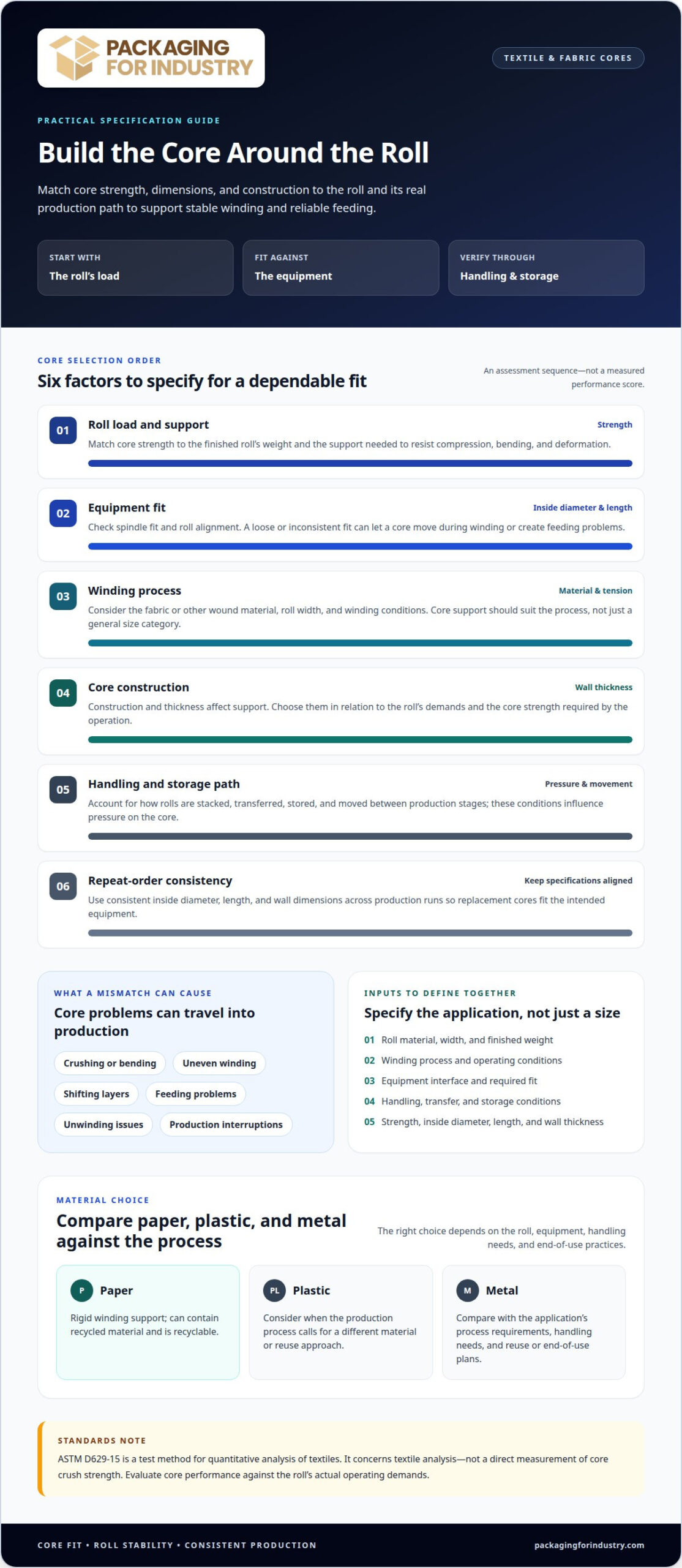
Choosing the right textile and fabric cores involves more than selecting a material. Paper, plastic, and metal each have different trade-offs, while core strength, dimensions, and wall thickness must suit the fabric and equipment. A poor fit can cause uneven winding, feeding problems, and production interruptions.
This article explains how paper cores support roll stability, which specifications affect performance, and how to compare paper with plastic or metal. It also covers how custom dimensions and tolerances can support consistent production, and when a broader packaging solution may help your operation. Use these practical criteria to choose cores that protect textile materials and support reliable handling without paying for features the application does not need.
Key Takeaways
- Core strength and dimensional consistency affect how well textile rolls hold their shape and move through production.
- Matching core dimensions and thickness to the application can support smoother feeding and more consistent winding.
- Paper, plastic, and metal cores involve different practical trade-offs; the right comparison depends on operating and handling needs.
- Packaging choices can help reduce product damage, control material use, and improve supply reliability.
- PFI’s foam packaging, stretch film, VMI, and JIT packaging services can support broader protection and inventory needs.
Core strength and resistance to deformation
Textile and fabric cores resist deformation when their walls support the wound material without collapsing under its load. A rigid paper core provides a stable winding surface for fabric, yarn, thread, or tape. This support helps a roll retain its cylindrical shape during production instead of flattening, bending, or letting layers shift. Core strength affects both roll integrity and how consistently material feeds through equipment.
Resistance depends on matching the core’s construction to the application. A roll’s weight, winding tension, handling, and storage conditions all influence the pressure placed on its walls. If the core compresses, the roll can develop uneven edges or unwind inconsistently. Textile producers can reduce those risks by specifying suitable core strength and dimensions, then maintaining those specifications across production runs. Paper tubes and cores should be assessed against the winding and handling demands they will face.
ASTM D629 – 15 is a named standard test method for quantitative analysis of textiles, according to ASTM International. It concerns textile analysis, not a direct measurement of core crush strength. That distinction matters: textile composition data can describe the wound material, while core performance must be evaluated against the roll’s actual operating demands.
Common fabric-core problems include crushing, bending, uneven winding, and unwinding during movement. Start by choosing a core suited to the roll’s load and winding process, then keep dimensions consistent so equipment feeds the material smoothly. These steps help limit deformation and production disruptions.
Crush resistance and dimensional stability
During textile manufacturing, each wound roll must retain its shape as it moves between winding, handling, and storage. Paper cores provide rigid inner support, helping keep layers aligned and limiting compression across the roll. If a core crushes, fabric may shift, edges can be damaged, and unwinding may become uneven.
Crush resistance matters when rolls are stacked, transferred, or fed into production equipment. Pressure on a weak core can flatten its opening, making it harder for a spindle or machine to hold the roll securely. A stable core helps maintain the roll’s cylindrical shape and supports consistent rotation. It can also help prevent creases and wrinkles that affect usable fabric.
Dimensional consistency matters as much as pressure resistance. If core sizes vary between batches, textile machinery may experience feeding problems, uneven winding, or stoppages. Consistent inside diameter, length, and wall dimensions help rolls fit the intended equipment and stay aligned. For example, a core that fits one winding station but sits loosely on another can move during winding.
Address these issues by matching core construction and dimensions to the roll’s load, winding process, and handling path. Define the required fit and strength based on actual operating conditions, then use those specifications for repeat orders. This helps protect textile rolls in transit through the facility and keeps material feeding reliably. It can also reduce rework and interruptions caused by damaged rolls, collapsed cores, or inconsistent fit.
Custom core strength, dimensions, and thickness
Core specifications should match the roll, winding process, and equipment. Strength, dimensions, and wall thickness all affect how well a core supports the operation.
Custom Core Specifications
Custom specifications define a core’s strength, length, inside diameter, and wall thickness. A narrow roll used on a rewinding line may need a different fit from a wide roll moved between production stages. Construction and thickness affect support, while consistent dimensions help replacement cores work with the same equipment.
For repeat production, precision matters. A varying inside diameter can affect spindle fit, while inconsistent length can interfere with roll alignment. Custom packaging design can account for these application details and set dimensions suited to the material and process.
Choosing a Core for a Roll
A packaging supplier can help select specifications by reviewing the roll material, finished weight, winding process, equipment interface, and handling conditions. Evaluate the core against the actual operation rather than selecting it by a general size category alone. A roll used on a specific winding line, for example, needs a core that fits the spindle and supports the process.
Consider how rolls move through manufacturing and storage, too. Comparing required dimensions with equipment needs helps identify a design for consistent production. Details such as roll width, winding conditions, and current fit problems provide practical criteria for choosing a core. This helps align the design with the operation and avoid mismatches that disrupt feeding or winding.
Recyclability and comparison with plastic or metal cores
Paper cores used in textile applications can contain recycled material and are recyclable. Paper, plastic, and metal differ in handling, reuse potential, and end-of-use considerations. The right material depends on the winding process, roll requirements, and how the core will be managed after use.
A paper core provides a rigid winding base and may suit operations that prioritize recyclable materials. Plastic or metal may be appropriate when a production process calls for a different material or reuse approach. Compare each option with the finished roll, equipment fit, handling conditions, and disposal practices. A material that conflicts with the process can create avoidable handling or waste challenges.
Textile manufacturers use cores to support rolls of fabric, yarn, thread, or tape. Paper cores can contain recycled material and are recyclable, although disposal depends on the material and local recycling practices.
For quality and safety, ASTM D629 – 15 is a named standard test method for quantitative analysis of textiles, according to ASTM International. It addresses textile analysis, not core safety or core crush performance; core selection must account for the roll and production requirements.
Core cost depends on material, dimensions, thickness, strength requirements, and order quantity. Pricing is provided after a quote request based on those project details.
Paper cores are made by forming paperboard into a cylindrical tube, bonding its layers, and finishing it to the required dimensions. The tube is cut to length for winding textile materials such as fabric or yarn.
What types of materials are used to make textile and fabric cores?
Paper, plastic, and metal are material options for textile winding cores. Paper cores can contain recycled material and are recyclable. The fibers wound around a core are separate from the core itself. For example, a paper tube may hold fabric or yarn, while the textile material determines the roll’s handling requirements.
Paper cores provide a rigid base for winding and storing textile rolls. Recycled content and recyclability may matter to manufacturers planning material use and end-of-life handling. The core still needs to suit the roll, winding process, and equipment. A paper core that fits the application can support the material without relying on a plastic or metal alternative.
Plastic and metal cores offer different material options for textile operations. Their suitability depends on the equipment, roll handling, reuse practices, and material requirements of the process. Compare options across the operating cycle, from winding and movement to eventual disposal. The core material should support the production task and suit the facility’s handling practices.
Synthetic, or manmade, textile fibers are produced through chemical synthesis. They may be wound onto a core, but they are not core materials. This distinction helps purchasing teams specify the right item: the core supports the roll, while fibers make up the fabric, yarn, or thread. For example, a synthetic-yarn producer selects the core material separately from the yarn’s fiber composition.
Textile cores are cylindrical tubes used to wind and store fabrics, yarns, threads, and tapes. The tube must support the particular textile roll and remain compatible with winding and storage needs. When comparing paper, plastic, and metal, first identify what will be wound, how the roll will be handled, and whether the core is intended for reuse or disposal. The fibers and the tube are not interchangeable; these details define the demands on the tube. The same fabric or yarn can be evaluated separately from the core selected to hold it.
Pressure performance matters when deciding whether a paper core suits a textile operation. A core that fails under pressure can damage textile products, waste material, and extend production time. Assess whether a paper option suits the conditions it will face rather than choosing by material label alone. Consider the roll, winding process, equipment, handling, and end-of-life plans. If the tube does not meet those requirements, it may undermine the purpose of using a core, whether or not its material is recyclable or reusable. Evaluating the core and textile as separate but connected parts clarifies specifications and helps avoid selecting a tube that cannot support the task.
Textile and Fabric Core Products
Textile roll packaging can include a winding core and protection for the finished roll. Paper, plastic, and metal are core material options; the right choice depends on the textile, equipment, and handling process. Fabric, yarn, thread, and tape may each need a different roll setup. Specify the core and outer packaging separately.
For finished rolls, protective packaging addresses handling and transit needs beyond the core itself. Foam packaging can form part of a broader protection plan, designed around the product and its movement through the supply chain. The required protection depends on how the roll is stored, handled, and shipped, not on a universal package configuration.
Custom packaging design can align protection with a manufacturer’s process. For example, a design may account for how finished textile rolls are handled between production, storage, and shipment. Packaging For Industry provides custom packaging design services to develop packaging around application requirements. Packaging kitting and assembly can also help organize packaging components for a repeatable packing workflow.
When evaluating packaging, define the roll material, dimensions, handling path, and protection needs. These details help determine whether the core is sufficient or additional protection is needed. For warehouse and distribution operations, coordinating packaging components can support consistent packing and reduce avoidable handling issues. The aim is a setup that fits the textile product and operation without unnecessary materials.
Industries Served
Textile mills and fabric manufacturers use cores to handle roll goods across production stages. Fabric, yarn, thread, and tape operations differ, so packaging needs depend on equipment and workflow. Textile and roll-goods businesses in Orange County, Los Angeles, and San Diego can assess packaging requirements alongside their production and shipping processes.
Textile converters also need packaging that suits the next operation. A business slitting or rewinding fabric may move rolls between machines, while a yarn producer may transfer material between winding and storage. These workflows shape how materials are staged and moved through a facility. Procurement teams can account for these needs when planning recurring packaging supply.
Warehouses and distribution operations handle rolls after production. Receiving, inventory, and shipping teams may stage rolls, retrieve them for orders, or prepare them for outbound movement. In Los Angeles, for example, a distribution workflow may involve different handoffs from a textile production line. Mapping those steps helps teams identify where packaging must support storage and movement.
Related businesses include textile finishers, industrial fabric processors, and contract manufacturers working with roll goods. Their operations may connect production to regional warehouse or shipping functions. Manufacturing packaging support can be relevant to businesses coordinating packaging needs with production workflows. Identifying the product, process, and destination gives purchasing and operations teams a practical basis for planning packaging across Orange County, Los Angeles, and San Diego.
Benefits of Choosing the Right Packaging
Packaging matched to textile rolls can support production, storage, and shipping. A core that fits the winding process helps maintain roll integrity, while suitable protection can limit handling damage. Matching packaging to the product and workflow also avoids materials that serve no clear purpose.
Damage prevention protects more than the fabric. A crushed core or poorly protected roll can lead to creases, edge damage, rework, or unusable material. Review how rolls move from manufacturing through warehouse staging and shipment to identify where protection matters. For example, rolls transferred between workstations may need different handling support from those prepared for outbound distribution.
Manage packaging costs by aligning material selection with product needs, order patterns, and the packing process. Overpackaging adds materials without improving operations, while insufficient protection can lead to damage-related costs. A fit-for-purpose specification helps purchasing teams compare packaging prices and weigh bulk pricing against material performance and supply needs.
Reliable supply supports consistent packing schedules. A packaging shortage can interrupt production or delay shipments, even when textile products are ready. Vendor managed inventory for packaging can help coordinate replenishment with ongoing operational demand. For manufacturers handling repeat roll shipments, the combined focus on protection, appropriate material use, and packaging availability can reduce avoidable disruption and support more predictable warehouse and distribution workflows.
Packaging For Industry (PFI)
Packaging For Industry (PFI) helps manufacturers evaluate how textile rolls are protected, handled, and supplied for production. Once core requirements are defined, consider the surrounding packaging system as well. Roll protection, shipment preparation, and replenishment planning can affect product condition and workflow continuity.
Foam Packaging can provide protective cushioning for products that need extra protection during handling or shipment. Stretch Film helps secure packaged goods for movement and storage. The right combination depends on the product and how it moves through the facility, so packaging decisions should reflect actual handling needs rather than add materials without purpose.
Supply planning matters, too. Vendor Managed Inventory (VMI) for Packaging can coordinate replenishment with ongoing demand. Just-In-Time (JIT) Inventory Management for Packaging supports availability in line with operational needs. These approaches can help when packaging use is recurring and supply gaps could disrupt packing or shipping schedules.
For textile manufacturers, consider the complete packaging workflow alongside core specifications. Review where protection is needed, how rolls move through production and shipping, and how packaging is replenished. This gives purchasing and operations teams a clearer basis for aligning protective materials and inventory management with their process.
Request a packaging quote from Packaging For Industry (PFI) to discuss your packaging needs.
Frequently Asked Questions
What are textile and fabric cores, and what are they used for?
Textile cores are cylindrical supports that keep roll goods organized for production and handling. In a converting plant, a core lets a roll be loaded and processed as one unit instead of handling loose material layers. This is useful for fabrics, yarns, threads, and tapes moving between workstations. The core should suit the roll and the equipment used at the next production stage.
What are the common sizes and specifications for fabric cores?
No single specification suits every textile line. For a purchasing request, provide the machine or spindle requirements, the roll’s finished width and weight, and any fit problems encountered in production. A sample from the current operation can help clarify the required interface. Recording these details consistently makes repeat purchasing easier and helps prevent substitutions that do not suit the process.
How do paper, plastic, and textile cores compare in strength, cost, and sustainability?
Paper, plastic, and metal describe core materials; textiles are generally wound onto cores rather than used as core materials. Compare options based on performance in the actual process and how the facility handles them afterward. Cost evaluation can include purchase requirements, reuse or return practices, and waste handling, not just the initial unit price. The right comparison depends on the operation’s priorities.
What are the environmental impacts and recycling options for textile cores?
Recycling options depend on the core material and the facility’s waste program. One practical approach is to establish separate collection streams for paper, plastic, and metal cores, then track which materials are reused, recycled, or discarded. This gives purchasing and operations teams a clearer picture of waste handling. Before changing materials, consider how the new option fits existing collection, storage, and disposal workflows.
What quality and safety standards apply to textile cores in the United States?
ASTM D629 – 15 covers quantitative analysis of textiles, not core safety or crush performance. The US Textile Fiber Products Identification Act sets content-disclosure and advertising requirements for covered textile fibre products.