
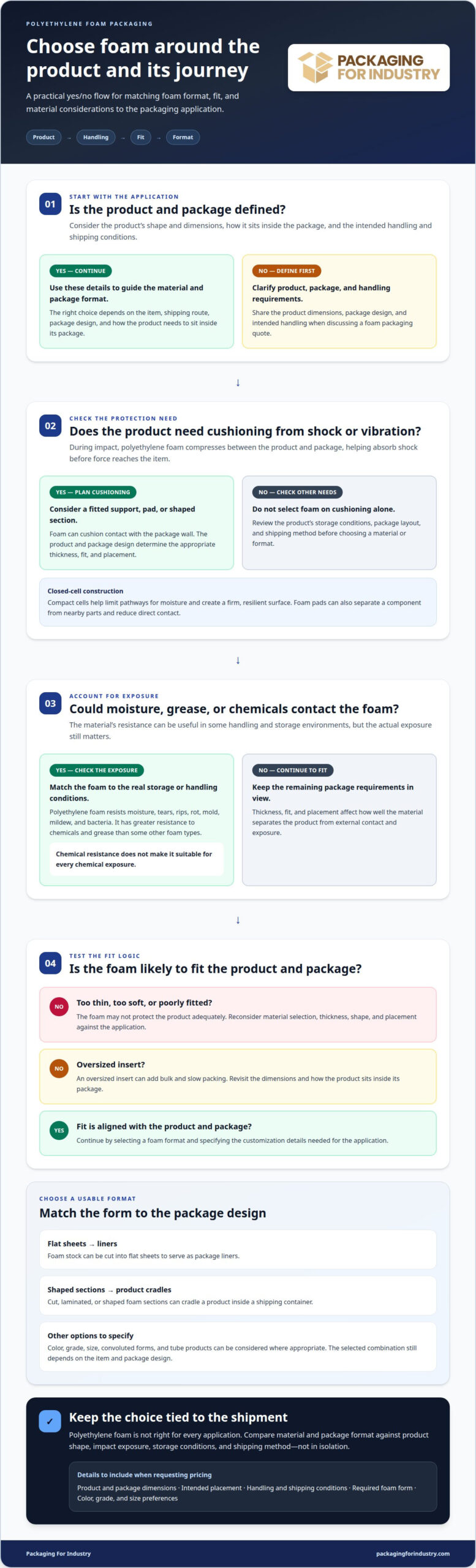
The thickest foam isn’t automatically the best protection. Polyethylene foam packaging cushions products by absorbing shock and vibration, but the right fit depends on the item, its shipping route, and how it needs to sit inside its package.
For manufacturers in Orange County, Los Angeles, and San Diego, a poor fit can waste material, slow packing, or leave products vulnerable to shipping damage. Choosing suitable polyethylene foam packaging and package dimensions helps balance protection, handling efficiency, and cost.
This article explains how polyethylene foam is made and how it cushions products in transit and storage. You’ll learn about common applications, sheet density and color options, and the factors that affect pricing. The sections ahead also cover how packaging design can be tailored to a product’s dimensions and shipping needs.
Key Takeaways
- Understand how closed-cell construction helps polyethylene foam resist moisture and support product protection.
- See how foam manufacturing and design choices affect cushioning, fit, and handling efficiency.
- Compare common packaging applications, from liners and end caps to custom product inserts.
- Learn how sheet density, color, and custom sizing influence material selection and pricing.
- Explore how PFI’s foam packaging and inventory management services can support more reliable packaging supply.
Closed-cell foam characteristics
Polyethylene foam has a closed-cell structure, with compact cells rather than an open, interconnected network. This structure helps limit pathways for moisture and creates a firm, resilient surface. In packaging, a foam pad around a metal component can keep it separate from nearby parts and reduce direct contact during handling. The material is lightweight and durable for many protective packaging applications.
Its surface resists staining, and the foam resists tears and rips. Those properties matter when packaging is handled repeatedly in a production area or warehouse. A torn corner can expose a product to its container, while resilient foam helps maintain the protective barrier. Polyethylene foam also resists rot, mold, mildew, and bacteria, which can be useful in storage environments where packaging may encounter moisture.
Resistance to chemicals and grease is another practical distinction. Polyethylene foam has greater resistance to these substances than some other types of foam. For example, cushioning around a machine part with light grease residue may help limit contact-related damage. This resistance does not make the foam suitable for every chemical exposure, so select the material and package design for the product’s actual handling conditions.
Closed-cell foam can add a layer between temperature-sensitive products and changing conditions during storage or transport. For example, a foam liner around a component can help separate it from the surrounding environment. Polyethylene foam packaging still needs to suit the product, container, and shipping conditions. Thickness, fit, and placement affect how well the material separates the product from external contact and exposure.
How polyethylene foam is made
When sourcing polyethylene foam packaging, buyers can focus on the finished format rather than the manufacturing process. Foam stock can be cut, laminated, or shaped for packaging. Flat sheets can serve as liners, while shaped sections can cradle a product inside a shipping container. These options give manufacturers a starting point for specifying foam to fit a product and package.
Compared with polyurethane foam, expanded polystyrene (EPS), and molded pulp, polyethylene foam differs in structure and handling properties. No single material suits every shipment. The right choice depends on the product, cushioning needs, package design, and shipping conditions. A buyer shipping a metal component may prioritize grease resistance, while another application may call for a different combination of protection and package format. When requesting a foam packaging quote, provide details about the product and how it will be packed and shipped so the material and format can be considered against the application.
Shipping requirements depend on the product, destination, carrier, and customer specifications. The foam alone does not determine whether a complete package meets a particular requirement. The package design must suit the shipment and its intended handling. Buyers can compare foam options as part of the complete packaging design rather than selecting material in isolation.
For commercial purchasing, the key consideration is whether the foam format fits the packaging requirement. Buyers can specify the product, package design, and intended handling when requesting pricing, then review suitable options with a packaging supplier. This keeps the discussion focused on the application and the required packaging, rather than on general foam properties that may not affect the purchase decision.
Design limitations matter too. Foam that is too thin, too soft, or poorly fitted may not protect a product adequately, while an oversized insert can add bulk and slow packing. Polyethylene foam is not the right choice for every application. A packaging professional considers product shape, impact exposure, storage conditions, and shipping method before selecting a material and converting it into a usable package. Sharing these requirements when requesting a quote can help guide the selection process.
Customization gives manufacturers options for matching polyethylene foam to a package’s form and presentation. Polyethylene foam can be customized by color and grade, cut to different sizes, and made in convoluted forms. Buyers can consider appearance, material grade, dimensions, and surface shape together rather than treating the foam as a single standard format. A selected size can be considered in relation to the product and its package, while a convoluted form offers another shape to evaluate when planning a fit. The appropriate combination still depends on the item being protected and the package design; customization alone does not establish that a package will provide adequate protection. Include the required color, grade, size, and form in a custom foam packaging quote to help guide selection and conversion.
Tube products offer another way to consider polyethylene foam for a package. That starting price provides a reference for this specific material and product form, rather than a complete price for every foam configuration. Buyers can assess whether a solid tube suits the product and intended fit, then consider the required size and grade alongside the rest of the packaging design. Color and convoluted forms may also be part of the customization choices where appropriate. When requesting pricing, compare the required form with available options to keep the material selection tied to the product and its packaging needs, instead of assuming that one configuration will suit every application.
Impact damping and shock absorption
During a drop or collision, polyethylene foam compresses between the product and package. This deformation helps absorb shock before the force reaches the item. For example, a fitted foam support around a machined component can cushion contact with the box wall during transport. The foam can recover its shape, helping maintain the package’s protective layout through repeated impacts.
Packaging design determines how well cushioning works. A product that sits loosely in a carton can shift and strike the sides. A fitted insert limits movement by supporting key surfaces and cushioning exposed edges. For a delicate electronic assembly, supports can hold the unit in place and keep it from contacting nearby accessories. The insert’s shape and placement matter as much as the material.
Vibration is another shipping concern. Trucks, conveyors, and warehouse handling can expose packed goods to repeated movement. Foam cushioning helps reduce vibration between the product and its outer container, limiting rubbing and repeated contact. A protective layer beneath a metal part, for instance, can separate it from a rigid carton floor during storage and shipment. Polyethylene foam also provides insulation that can help shield products from outside temperature influences.
Material selection should reflect the item’s weight, shape, and route through the supply chain. Polyethylene foam sheets are available in densities from 1.2 lb to 9.0 lb. Density is one design consideration, not a stand-alone measure of package performance. A compact component with a projecting edge may need localized support, while a broad, flat item may need cushioning across a larger surface. Proper fit helps avoid both concentrated pressure and unnecessary movement. Since polyethylene foam can withstand repeated impacts while maintaining its original design, it can support packaging layouts used across multiple handling stages.
Packaging and padding applications
Polyethylene foam can be converted into end caps, top and bottom cushioning, liners, and pads. End caps fit over a product’s edges, while top and bottom pieces support it from both sides. A liner separates an item from the inside wall of its carton. These formats help match the protective material to the product’s shape and available package space.
For electronics and other delicate items, foam inserts can hold components apart during shipping and handling. A fitted cavity can keep a part from shifting, while a separate layer protects a screen or finished surface from contact. In a mixed shipment, divided foam sections can prevent small components from knocking against one another. Plan the package layout around the product and any accessories packed beside it.
To design foam packaging for fragile products, a packaging supplier uses the product’s dimensions and shape to plan support points, clearances, and insert geometry. The supplier can then cut sheets or blocks to those specifications, including die-cut shapes or convoluted foam where the design calls for them.
Polyethylene foam can suit nautical products and items that need water resistance because it is buoyant and shatterproof. A shaped insert can help keep a component positioned inside its container, while a liner adds separation from the package walls. These properties make the material worth considering for products exposed to demanding handling or storage conditions.
Product geometry guides the format. A long, narrow item may need a fitted channel, while a compact component may sit in a shaped block. Custom-cut pads can also protect specific contact points without filling every open space. Color and grade options provide further design choices, and the final configuration can be tailored to the item’s dimensions and packaging requirements.
Polyethylene foam sheet densities, colors, and product prices
Sheet selection balances cushioning needs with the space available inside the package. Available densities range from 1.2 lb to 9.0 lb. Options include 1.2 lb green sheets, 1.7 lb sheets, and 2.2 lb sheets. Higher listed densities include 4.0 lb, 6.0 lb, and 9.0 lb white sheets. Density helps describe the material, but package fit and product handling also shape the choice.
Color options include green, blue, pink, and white. For example, 1.7 lb sheets are available in blue and pink, while white sheets include 4.0 lb, 6.0 lb, and 9.0 lb choices. Pink antistatic sheets can serve applications where static control is a design consideration. Color can also help distinguish packaging materials in a warehouse or production process.
A packaging supplier determines foam thickness, density, and format by evaluating the product’s dimensions, weight, fragile areas, shipping conditions, and storage needs. The supplier can then recommend sheets, blocks, or shaped inserts that support the product without taking up unnecessary package space.
Pricing varies with the material and finished format. Retail sample prices vary by density, color, dimensions, thickness, and customization, so they do not establish the price of a custom manufacturing order. Project pricing depends on the specific application and is provided after a quote request. Order quantity and cutting requirements can also affect the total packaging cost.
For purchasing teams, compare equivalent specifications rather than color alone. A 1.7 lb blue sheet and a 1.7 lb pink antistatic sheet may serve different packaging requirements. Include the needed dimensions, thickness, density, color, and format when defining the application. Those details help align material selection with product protection, packing workflow, and purchasing requirements.
Sheets vary in density and color and can be die-cut to product specifications.
Industries Served
Aerospace manufacturers ship components with varied shapes, finishes, and handling needs. A fitted foam support can separate a machined part from neighboring items inside a carton. Electronics manufacturers also use foam to hold circuit assemblies, control units, and other delicate components steady during transport. For sensitive electronics, packaging teams can select antistatic or conductive ESD foam when the application requires it.
Industrial manufacturers use foam to protect replacement parts, tools, and finished assemblies moving between production sites or customers. A shaped insert can keep a metal fitting from shifting inside its box, while a liner can separate a finished surface from the carton. These formats can also support consistent packing processes across warehouse and shipping teams.
Medical companies ship instruments, diagnostic equipment, and device components that need organized protection during handling. Foam dividers can keep separate pieces from contacting each other inside a shipping container. Food companies may use foam to protect equipment parts, processing components, or production tools in transit. Packaging materials should suit the item and application, not imply suitability for direct food contact.
Distributors and fulfillment centers handle products from multiple manufacturers, often with different shapes and packing requirements. Foam blocks, pads, and fitted inserts can support products as teams prepare outbound orders. For example, a warehouse packing a delicate instrument separately from its accessories can use divided spaces to keep the contents organized in transit.
Construction suppliers and industrial equipment businesses also ship components such as gauges, fittings, and control panels. A shaped insert can stabilize a small instrument inside a larger carton, while foam padding can protect corners or surfaces from contact. In each sector, the design should start with the product, its route, and the handling it will face. The package can then be tailored to manufacturers, warehouses, and distribution centers without assuming one foam layout suits every shipment.
Benefits of Polyethylene Foam Packaging
For purchasing teams, a defined foam specification makes recurring orders easier to manage. Recording the material grade, dimensions, color, and format gives buyers a consistent reference when replenishing packaging supplies. It also helps prevent substitutions that could change the packout or complicate production. A clear specification supports comparisons between equivalent materials and makes purchasing decisions more accountable.
Standardized packaging can improve coordination between procurement, production, and shipping teams. When everyone follows the same packaging configuration, buyers can plan replenishment around established usage and operators can follow a consistent packing sequence. A shared specification is especially useful when several product models move through the same facility. Teams can review packaging changes against each product’s needs rather than making informal adjustments at the packing station.
Foam formats can also support better space planning. Assessing an insert together with the container dimensions shows how the complete package occupies storage and shipping space. This gives operations teams a more useful basis for reviewing package dimensions than material cost alone. The aim is to balance protection with storage, handling, and transportation needs.
Clear packaging requirements also make quality reviews more useful. If a shipment arrives damaged, teams can compare the product and package with the intended specification. That record helps identify whether the issue relates to packing consistency, package dimensions, or shipment handling. For manufacturers managing repeat shipments, documented specifications make it easier to assess proposed changes and keep purchasing and operations aligned as product or shipping requirements evolve.
Packaging For Industry (PFI): Foam Packaging
Packaging For Industry (PFI) helps manufacturers connect foam selection with product requirements and day-to-day packing operations. Its foam packaging can support projects where buyers need a consistent specification for recurring shipments or a packaging format designed around a particular product. This is useful when purchasing teams need to coordinate material choices with production and shipping workflows.
Foam and stretch film serve different purposes in packaging. Foam protects products inside individual packages, while stretch film secures palletized loads for storage and transport. Planning both materials together helps businesses coordinate packaging from the packed unit through warehouse handling and outbound shipping.
For recurring packaging needs, supply planning is part of the operational decision. PFI offers Vendor Managed Inventory (VMI) for Packaging and Just-In-Time (JIT) Inventory Management for Packaging. These programs help businesses organize replenishment around their operating needs instead of treating each purchase as an isolated order.
A foam packaging quote can be based on product dimensions, package format, material requirements, expected order quantities, and shipping conditions. Sharing these details helps define the project and clarify how foam fits into the broader packaging workflow. If the operation also uses stretch film or recurring packaging supplies, those needs can inform the purchasing and inventory discussion. Clear specifications support useful quote comparisons and help align procurement, production, and shipping teams.
Request a packaging quote from Packaging For Industry (PFI) to discuss your requirements.
Frequently Asked Questions
What is polyethylene foam packaging, and what forms are commonly used?
Polyethylene foam packaging is cushioning made from polyethylene, available as sheets, planks, inserts, end caps, and convoluted foam. Some formats are designed for static-sensitive products, including antistatic and conductive ESD foam. For example, a manufacturer shipping a set of components can use a fitted insert to keep each part organized. The best format depends on the product’s dimensions, handling needs, and shipping configuration.
Which properties make this foam useful for protective packaging?
Polyethylene foam packaging combines a lightweight structure with durability, tear resistance, and cushioning for shipping and storage. It can also resist staining, rot, mold, mildew, and bacteria. These characteristics can support consistent packaging through repeated handling. Resistance to chemicals and grease can be useful in some industrial applications, but the specific foam and package design should suit the product’s exposure.
What kinds of products and businesses use polyethylene foam?
Manufacturers use polyethylene foam to package components that need separation, cushioning, or organized placement. Applications include electronics, aerospace parts, machinery components, medical devices, and industrial equipment. A distributor shipping a kit of related parts, for example, can use shaped cavities to keep items arranged inside one container. Product geometry, handling conditions, and shipping routes help determine whether sheets, pads, or a fitted insert best suit the application.
How is the cost of foam packaging determined in the United States?
Pricing depends on the foam’s dimensions, density, thickness, color, format, cutting requirements, and order quantity. A flat pad and a custom insert with several cavities require different material and converting work. Packaging For Industry (PFI) provides project pricing after a quote request. Include product dimensions, packaging format, expected order quantity, and application details so the quote reflects the actual requirements rather than a different specification.