
A standard core may not suit a particular substrate or winding process. Film and tape cores can be specified to match the material, application, and required dimensions, helping manufacturers in Southern California plan for production.
For manufacturers in Orange County, Los Angeles, and San Diego, choosing a core means more than finding a tube that fits. The specification should reflect how the roll will be used and the requirements of the operation.
This guide explains how to match paper cores to tape and label applications and what information to include in a custom specification. You’ll learn which dimensions and quality requirements to provide when sourcing cores for production.
Key Takeaways
- Match a core’s construction and load capacity to the winding process and material it needs to support.
- Provide clear dimensional and quality requirements so a supplier can assess fit for your equipment and application.
- Understand how paper cores differ from general-purpose tubes, and how paperboard, plastic, and metal suit different needs.
- Align quality checks with the dimensions and performance requirements that matter to your operation.
- For related packaging needs, PFI offers stretch film, foam packaging, and VMI and JIT packaging inventory management.
Film core use in winding, slitting, laminating, and converting
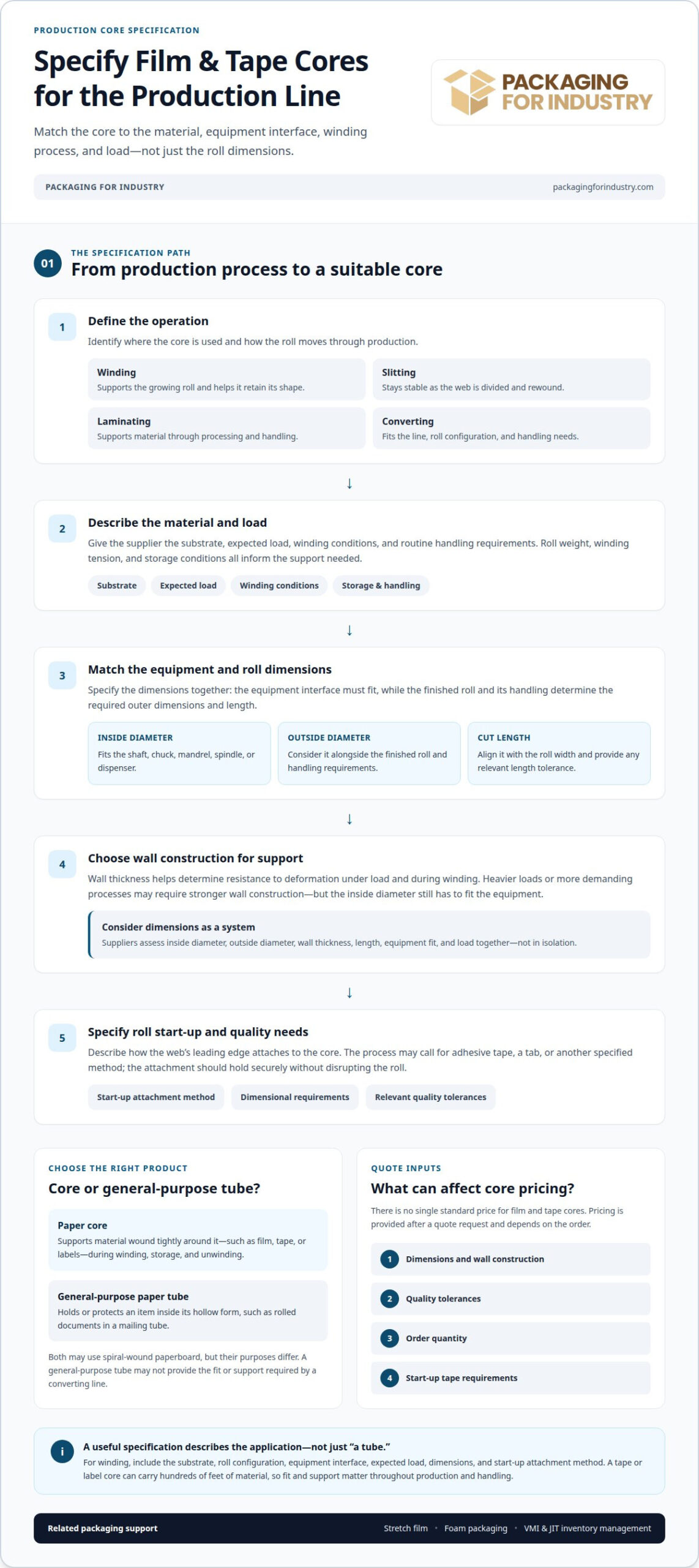
Film cores support rolls as material is wound, processed, and handled on production equipment. Their construction and dimensions should suit the material, equipment interface, and load.
Winding and Converting Uses
During winding, the core supports the growing roll and helps it retain its shape. Slitting operations depend on a core that stays stable as the web is divided and rewound. Laminating and converting lines also need a suitable core to support material through processing and handling. Wall construction should match the load and winding conditions. The web’s leading edge may be attached with adhesive tape, a tab, or another method specified for the process. The attachment should hold securely without disrupting the roll.
Diameter and Wall Thickness
The core’s inside diameter must fit the equipment’s shaft or chuck, while its outside diameter and length must suit the finished roll and handling requirements. Wall thickness helps determine how well the core resists deformation under load and during winding. Heavier loads or demanding processes may require stronger wall construction, but the inside diameter must remain compatible with the equipment. Suppliers consider these details together rather than selecting diameter or thickness in isolation.
Custom Core Dimensions
Custom dimensions can address a line or roll configuration that standard cores don’t fit. Provide the required inside diameter, outside diameter or wall thickness, cut length, and any relevant length tolerance. Include the substrate, winding process, expected load, and start-up attachment method. Those details help a supplier assess the core as a working component, not just a tube. For related product information, see paper tubes and cores.
There is no single standard price for film and tape cores. Pricing depends on the order and is provided after a quote request. Dimensions, wall construction, quality tolerances, quantity, and start-up tape requirements can all affect the quote.
Clean paperboard cores may be recyclable where local recycling programs accept them. Remove attached tape where practical, and follow local sorting instructions for the remaining material.
Paper cores for tape and label rolls
Paper cores support tape and label stock as it is wound, stored, and unwound. A core can carry hundreds of feet of tape or label material. Its inside diameter must fit the winding or dispensing equipment, and its length should match the roll width. A mismatch can make loading, handling, or downstream use more difficult.
Core construction matters, too. The paperboard wall must support the wound roll during production and handling. The required strength depends on roll weight, winding tension, storage conditions, and how the roll moves through the process. A converter handling narrow label stock may need a different construction from a line winding heavier tape rolls.
- Inside diameter: Match the mandrel, spindle, or dispenser used by the production line.
- Cut length: Align the core length with the tape or label width.
- Wall construction: Specify the support needed for winding and routine handling.
For a custom size, provide the finished roll width, equipment interface, material type, and expected handling conditions. Include requirements for inside diameter, outside diameter, and wall thickness. These details help determine whether a standard paper core will fit or a custom dimension is more suitable. Consistent specifications also let purchasing teams compare equivalent options across orders.
Consider the converting process as well. A label roll may pass through printing, slitting, and dispensing, while packaging tape may be applied by hand or machine. The core should remain compatible at each relevant step. Describe how the roll will be stored and shipped, too, since movement or stacking can affect the support required. Clear application details help match the core to production needs and prevent avoidable fit problems.
Differences between paper cores and paper tubes
Paper cores and paper tubes may share a spiral-wound paperboard construction, but they serve different purposes. A core supports material wound tightly around it, such as film, tape, or labels. A general-purpose tube acts as a hollow container or sleeve, such as a mailing tube for rolled documents. The intended use determines the required construction.
As material builds into a roll, winding creates pressure against the core’s inner wall. Film cores are designed to support this pressure, unlike general-purpose paper tubes. A tube for rolled plans may not suit a converting line, where the wound load, machine interface, and handling demands affect performance. Treating the two as interchangeable can cause fit or support problems.
- Core application: Supports a roll during winding, storage, and unwinding.
- Tube application: Holds or protects items inside its hollow form.
- Selection details: Match construction to the roll, equipment, and handling needs.
For example, a label converter needs a core that fits its winding spindle and finished roll. A shipper sending rolled drawings may instead need a tube sized to contain and protect the documents. Both products are cylindrical, but their dimensions serve different purposes. A core’s inside diameter must fit production equipment; a mailing tube’s dimensions must accommodate its contents.
When specifying either product, describe its actual purpose rather than relying on the word “tube.” For winding, identify the substrate, roll configuration, equipment interface, and expected load. For a protective or mailing application, provide the item’s dimensions and required fit. These details distinguish a load-bearing core from a general-purpose paper tube and help define a suitable specification.
Dimensional tolerances and quality checks
A core may look right but still bind on a spindle or shift during winding. Dimensional tolerances define the acceptable variation in inside diameter, outside diameter, length, and wall thickness. Agreeing on those limits helps ensure the delivered core fits the equipment and roll requirements.
In the United States, core tolerances are generally set for the application rather than assumed to be universal. Provide the required dimensions and acceptable variation for each critical measurement. For example, spindle fit on a winding line may make inside diameter a key acceptance point.
- Inside and outside diameters: Confirm fit on the equipment and assess the finished core profile.
- Length: Check that the core matches the roll width and line setup.
- Wall and edge condition: Review construction consistency and look for crushing, splits, or rough cuts.
Quality checks should follow the specification. Use calipers to measure diameters and length, and inspect for damaged edges, dents, or uneven cuts. For production use, check that samples fit the intended spindle and rotate without binding. Record results against the agreed limits so purchasing and operations apply the same acceptance criteria.
Inspect the core’s condition after handling, too. A damaged edge can interfere with roll loading, and a distorted opening may affect equipment fit. Keep samples from approved production runs as references for later deliveries. If a measurement repeatedly approaches its allowable limit, review the specification and process with the supplier before changing the tolerance.
Clear documentation prevents teams from interpreting “standard size” differently. List each dimension, its unit, the measurement method, and the acceptable range. Include a drawing if the core has special features or several critical measurements. This gives receiving staff a practical basis for checking incoming cores and reporting variations consistently.
How do paperboard, plastic, and metal cores compare?
Paperboard, plastic, and metal cores all serve winding and converting operations, but each has different trade-offs. Paperboard is a common choice for film, tape, and label rolls, and its layered construction can be specified for the application. Plastic or metal may suit processes where moisture exposure, repeated use, or particular operating conditions affect material selection.
Start with the substrate, roll load, machine interface, and handling cycle. Paperboard may suit a routine converting run, while plastic may be considered where moisture exposure matters. Metal may suit an operation that requires rigid, reusable support. These are application considerations, not universal rules.
- Paperboard: Consider for wound materials such as film, tape, and labels.
- Plastic: Assess where moisture exposure or repeat use affects core selection.
- Metal: Evaluate where the process calls for a rigid support and reuse.
Compare operating requirements, not material names alone. The inside diameter must fit the spindle or chuck, and the core must support the roll during winding and handling. For example, if a line uses a core once and discards it, reuse may be less important. If cores circulate through a production loop, durability and return handling become relevant.
Consider compatibility with the finished product and converting process as well. A label operation may prioritize steady unwinding and a consistent fit. A process exposed to damp conditions may place different demands on the material. When comparing options, share the substrate, equipment interface, storage environment, expected use cycle, and disposal or return process. This information helps narrow the choices without assuming one core type suits every production line.
Industries Served
Film and tape cores serve businesses that wind, convert, dispense, or package roll materials. Requirements vary with the substrate, equipment, finished roll, and handling process. Matching the specification to the operation helps maintain compatibility from production through storage and use.
Tape manufacturers use cores to support adhesive products during winding and converting. Label producers need cores that fit their winding and printing workflows. Slitting operations rely on cores to receive divided rolls, while laminators use them to handle processed material. In each case, equipment fit and roll handling determine the requirements.
Other converting businesses work with flexible materials wound into rolls for production or distribution. Packaging operations may use film, tape, or label rolls in assembly and shipping workflows. In these settings, a core must suit both the production equipment and the way staff move, store, and load finished rolls.
- Tape and label manufacturers: Core fit supports winding, storage, and dispensing.
- Converters and slitters: Core construction must suit the material and processing workflow.
- Laminators: Roll handling and equipment compatibility inform core specifications.
- Packaging operations: Core dimensions should align with how rolls are loaded and used.
Manufacturing teams can make specifications more useful by describing the material, process, equipment interface, roll dimensions, and handling conditions. A label producer using a printing and rewinding workflow may prioritize consistent spindle fit. A slitting operation may focus on how the core supports separate rolls after processing. These distinctions help ensure a generic specification does not overlook the production need.
For manufacturers with broader packaging requirements, core selection is one part of an integrated supply plan. Related needs may include protective materials and supplies used around finished rolls. PFI’s packaging support for manufacturers addresses packaging needs across production environments.
Benefits of Choosing the Right Core
A suitable core supports the roll through production, storage, and use. When its dimensions match the spindle, operators can load it without forcing a poor fit. When its construction suits the wound material, it helps maintain the roll’s shape during routine handling. These details support smoother workflows on winding, slitting, and dispensing equipment.
The right core fit can also help prevent avoidable material damage. A distorted core, for example, may cause a roll to sit unevenly or make it harder to handle. A well-matched core supports the roll as it moves between production and packaging. The core is only one part of damage prevention, but it matters wherever rolls are processed or shipped.
- Production consistency: Align the core dimensions with equipment and roll requirements.
- Handling support: Select construction suited to the material and expected handling.
- Purchasing clarity: Record specifications so repeat orders follow the same requirements.
Documented specifications make replenishment more reliable. Purchasing teams can use the same inside diameter, length, wall construction, and acceptance criteria for each order. This reduces ambiguity between production, receiving, and procurement. If the process changes, such as with a new substrate or winding setup, update the specification before placing repeat orders.
Supply planning also benefits from clear usage and timing information. Sharing core specifications alongside order quantities and production schedules helps align replenishment with operational demand. For example, a label converter can track cores for separate lines rather than treating every size as interchangeable. That makes inventory planning more precise and helps prevent shortages caused by unclear item descriptions.
A good selection balances equipment fit, roll support, handling, and purchasing consistency. Define the application first, then specify measurable dimensions and quality requirements. This gives production and procurement a shared reference for evaluating core performance and maintaining a reliable packaging supply.
Packaging For Industry (PFI): Stretch Film
Packaging For Industry (PFI) supplies stretch film and protective foam packaging, and supports businesses with coordinated packaging inventory. Film and tape cores are one part of roll production; the materials used to secure and protect finished goods also matter in shipping and storage.
For palletized loads, PFI’s stretch film options support warehouse and manufacturing workflows. Film and tape cores may be used in production, while stretch film helps secure packaged loads for handling and distribution. The suitable film depends on the load and wrapping process. Share whether the application uses hand or machine wrapping, along with the load type and supply needs.
Protective foam packaging helps cushion products during handling and shipment. It can suit manufacturers shipping delicate components or distributors packing items with different protection needs. Product and shipping requirements guide the packaging approach, balancing protection with packing efficiency.
Inventory planning also affects packaging availability. PFI’s Vendor Managed Inventory (VMI) programs coordinate replenishment around usage, while Just-In-Time (JIT) inventory management aligns supply timing with operational needs. These options help businesses manage recurring packaging demand alongside purchasing and warehouse requirements.
To discuss packaging needs, prepare details about the product or load, wrapping method, usage pattern, and storage requirements. For foam, describe what needs protection and how it will be packed or shipped. For inventory management, explain how packaging moves through purchasing, receiving, and production. These details keep the discussion focused on your operation.
Contact Packaging For Industry (PFI) to discuss your needs and request a packaging quote for stretch film, foam packaging, or packaging inventory management.
Frequently Asked Questions
Can I Request a Quote for a Customized Paper Core?
Customization can help when a production change creates a different fit or handling requirement. To request a core quote, identify the substrate and production line, especially if several products share similar roll sizes. This helps teams distinguish inventory items and reduces the chance of ordering a core for the wrong setup. Include the approved specification with your quote request.
How Can I Compare Pricing for Different Core Diameters and Wall Thicknesses?
The right core depends on its design and production requirements. A supplier can work from an existing specification or help establish one for a particular application. When comparing pricing, make sure each proposal describes the same core configuration and use case. If replacing a core, include its current identification or drawing revision so the discussion starts with the correct item.
How Do I Specify Film Cores When Requesting a Quote?
The key difference is the intended use, not simply the cylindrical shape. A winding core is selected for a roll-producing process, while a general-purpose paper tube may serve as a protective container. On a quote request or purchase order, specify a winding core when production performance is required rather than ordering under the broad label “paper tube.”
Can I Order Film and Tape Cores in Bulk Quantities?
Cores are the center supports in rolls of film, tape, and similar materials. They are part of the finished roll assembly and can affect how it is stored, identified, and supplied to a production or packaging station. For bulk quantities, connect each core item to the roll or finished product it supports rather than treating all cylindrical paper components as interchangeable.
How Do I Source Custom Core Sizes and Materials?
Paperboard is common, while plastic or metal may suit particular operating needs. Available sizes depend on the core design and application. For clear purchasing records, include material and size together in the item description. Cores with similar dimensions may still differ in material or intended use, so compare the full specification rather than one measurement alone.
What Specifications Should I Include in a Core Quote Request?
No universal dimensions and tolerances apply to every core application. The approved drawing or written specification should set the requirements for the item being purchased. Receiving teams can use it to record whether delivered cores meet the agreed criteria. Keeping inspection records with the relevant specification also makes it easier to investigate recurring fit issues or variations between deliveries.
How Can a Supplier Help Determine the Right Core Diameter and Width?
A supplier can help translate production requirements into a clear purchasing specification. Involving procurement and the team running the equipment helps resolve differences between an item description and actual line needs. Provide the current specification, relevant equipment information, and the roll’s intended use. The supplier can then clarify which requirements belong on the order and which details distinguish the item from similar cores.
What Applications Should I Include When Requesting a Core Quote?
Common applications include tape and label production, flexible-film converting, slitting, laminating, and winding roll goods. Textile manufacturers may also handle materials supplied in rolls, where compatible cores support production. The relevant application depends on where the roll enters the workflow, such as a converting line, label-printing operation, or packaging station using tape. Identifying that destination helps purchasing classify the core correctly.