
Reusable V-Board can protect shipment edges across multiple trips when it remains in good condition. V-Board edge protection in San Diego helps brace palletized loads and shield vulnerable corners from pressure during handling and transit, while helping businesses manage packaging use.
That matters when crushed corners, shifting loads, or damaged finishes cause product loss and added packaging expense. The right edge protection depends on the shipment, including its weight, load height, and handling conditions. It should support the product without adding unnecessary material.
Manufacturers, distributors, and businesses in construction, food, aerospace, and electronics use edge protectors for different shipping needs. This article explains how V-Board works, when it can be reused, and how it fits into a pallet-protection system. You’ll also learn how suitable protection can help limit shipping damage and packaging costs, and what San Diego operations should consider when sourcing edge protection.
Key Takeaways
- V-Board can be reused when it remains in good condition; inspect it for damage before putting it back into service.
- Match edge protection to the shipment’s weight, load height, handling environment, and shipping conditions.
- Manufacturers, distributors, and businesses shipping products such as building materials or finished goods can use edge protectors to support palletized loads.
- Positioning protection along vulnerable edges can help limit impact from strapping and handling, reducing the risk of product damage.
- Packaging For Industry can help connect edge protection needs with custom packaging design, stretch film, and packaging inventory programs.
V-Board Edge Protection Products
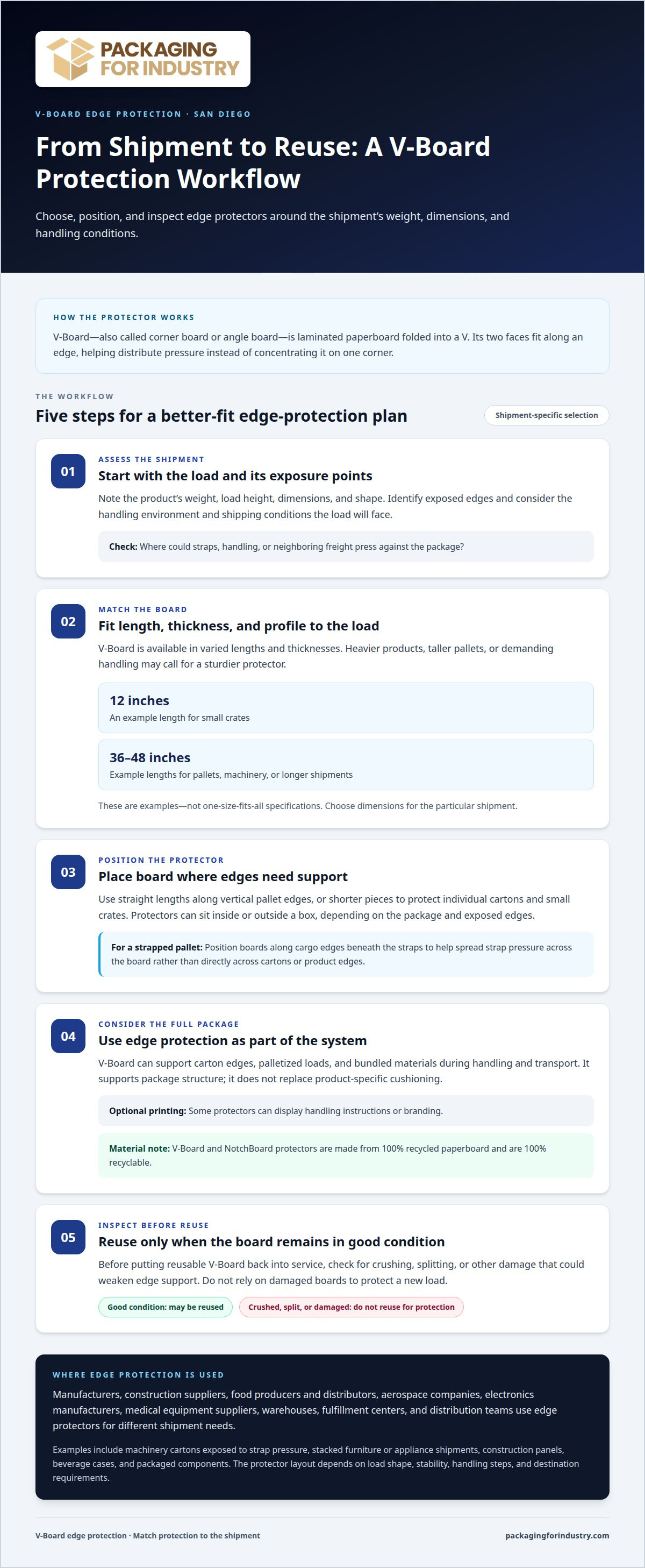
V-Board, also called corner board or angle board, is laminated paperboard folded into a V shape. Its two faces fit along an edge, helping distribute pressure instead of concentrating it on one corner. Multiple paperboard layers are laminated to add strength and durability. The profile can protect carton edges, palletized loads, and bundled materials during handling and transport.
Product selection starts with the shipment’s dimensions and exposure points. Straight V-Board lengths suit vertical pallet edges, while shorter pieces can protect individual cartons or small crates. A 12-inch board works well for small crates. Boards measuring 36 to 48 inches can suit pallets, machinery, or longer shipments. These examples show how length changes with the protected load, rather than defining one size for every application.
Thickness and profile matter, too. A heavier product, taller pallet, or demanding handling environment may call for a sturdier protector than a light carton. Shipping conditions and load shape help determine the right fit. V-Board comes in varied lengths and thicknesses, allowing specifications to suit the product and shipment rather than relying on one standard dimension.
Protectors can be positioned inside or outside a box. Inside placement supports an edge within the package; outside placement shields exposed corners or pallet edges. On a strapped pallet, boards can sit along cargo edges beneath the straps. This helps spread strap pressure across the board rather than directly across cartons or product edges. The layout depends on the load’s shape and how it is secured.
Some edge protectors can also be printed with handling instructions or branding. Printing can make orientation or handling information visible on the package, while keeping the protective profile functional. Paperboard construction is another product consideration: V-Board and NotchBoard protectors are made from 100% recycled paperboard and are 100% recyclable. These material properties may suit businesses that track packaging materials and end-of-use handling.
Reusable V-Board can serve more than one shipment when it remains in suitable condition. A practical inspection checks for crushing, splitting, or other damage that could weaken the edge support. Damaged boards should not be relied on to protect a new load. The corner and edge protection options illustrate the broader role of edge protectors within shipping packaging. For V-Board Edge Protection in San Diego, the important product details are the board’s length, thickness, profile, placement, and intended shipment.
V-Board is available in different lengths and thicknesses to suit a range of product sizes and shipping needs. Matching dimensions to the shipment keeps the choice specific to the load, rather than treating one specification as suitable for every case. Consider dimensions alongside the conditions the load will face.
Choose edge-protector thickness, length, and profile based on product weight, pallet-load height, handling environment, and shipping conditions. Considering these factors together helps assess options for the particular shipment: its weight and height, how it will be handled, and the conditions it will encounter in transit. The selection should reflect those requirements.
Industries and Users of Edge Protectors
Manufacturers use edge protectors as products move between production, storage, and freight. A machinery maker, for example, can protect boxed equipment where straps press against carton edges. Furniture and appliance manufacturers can also use corner board to support stacked shipments and help limit compression at exposed edges.
Construction suppliers handle long, dense materials that can shift or press against neighboring freight. Drywall bundles, panels, and building components may benefit from protection along pallet edges. Edge boards help distribute pressure from straps and handling across a wider surface, rather than concentrating it on one vulnerable corner.
Food producers and distributors ship cartons in stacked loads through warehouses and delivery networks. Edge protection can reinforce pallet corners as workers move loads with forklifts or secure them for transport. For beverage distributors and producers utilizing automated liquid packaging lines like those from arsanmak.com, protected carton edges can help keep cases aligned and reduce crushing during routine handling.
Aerospace companies ship components with varied dimensions and handling requirements. A packaged aircraft component may need edge support to protect its outer packaging during transfers between facilities. The design of aerospace packaging accounts for the product and its shipping conditions, making edge protection one consideration within a broader packaging system.
Electronics manufacturers and medical equipment suppliers may ship products in cartons or on pallets. Edge protectors can reinforce outer packaging where stacking or strapping creates pressure points. They do not replace product-specific cushioning; instead, they support the package structure while other materials protect the item inside.
Warehouses, fulfillment centers, and distribution teams use edge boards when preparing pallets. Packaging staff can apply them to loads with exposed corners before securing the shipment. The warehouse manager, shipping lead, or packaging buyer typically decides where protection is needed based on load shape, handling steps, and destination requirements.
Packaging needs differ by shipment format. A single boxed machine, a pallet of cartons, and a bundle of construction panels present different edge risks. The right protector layout depends on package dimensions, load stability, and the points that contact straps or adjacent freight. A repeatable specification helps purchasing teams maintain consistency across recurring shipments.
For San Diego businesses, likely users include local manufacturers, building-material distributors, food shippers, aerospace operations, and warehouse teams. Purchasing departments can work with shipping and production staff to identify recurring damage locations. That information helps define where edge reinforcement fits, which loads need it, and how to apply it consistently.
Edge Protection Benefits and Packaging Cost Savings
San Diego businesses evaluating V-Board edge protection can compare material use with the cost of damaged shipments. A useful review tracks product replacement, repacking labor, claims, and customer service work. Costs can extend beyond the damaged carton. A packaging change is most useful when it addresses a recurring loss pattern rather than adding material to every shipment.
Start with a damage log for recurring shipments. Record the affected product, package condition, shipment route, and where in the process the damage was noticed. Then compare those records with packaging consumption and rework. This gives purchasing and operations teams a practical basis for deciding whether edge protection is reducing losses or simply adding another material.
A supplier can help translate shipment details into a consistent packaging specification and explain how the selected protector fits the packing sequence. The supplier should also clarify its intended placement and use with the shipment’s other materials. Clear instructions help warehouse staff apply the same method across shifts and reduce variation in packaging practice.
V-Board provides targeted edge reinforcement, but it has limits. It does not cushion every product surface, immobilize loose items inside a carton, or correct an unstable load. Sensitive products may need separate internal protection. For example, a finished component may need cushioning against movement even when its outer package has edge reinforcement.
Alternatives include foam packaging for contact-sensitive items or other cushioning materials suited to the product and package. The choice depends on the damage mechanism: pressure on an outer package, surface contact, or movement inside the container. For V-Board edge protection in San Diego, comparing these risks helps prevent treating one material as a complete solution.
Cost control also comes from reducing unnecessary packaging steps. Review whether each material addresses a distinct risk, whether packers use consistent quantities, and whether damaged shipments share a common cause. If two materials do the same job, a packaging review can identify a simpler configuration. Evaluate any change against product condition and shipping outcomes.
V-Board edge protection in San Diego can support a broader effort to reduce shipping damage, but results depend on how well the packaging system fits the shipment. Track damage and material use after a change, then adjust the packing specification as patterns emerge. This creates a practical feedback loop for operations and purchasing, helping teams make consistent decisions about protection and packaging costs.
San Diego V-Board Edge Protection Delivery and Pickup
For San Diego buyers, delivery planning should account for the receiving address, order size, required timing, and whether pickup is practical. Packaging For Industry provides next-day delivery in San Diego County, as well as nationwide shipping through its distribution network. Consider the delivery arrangement alongside the product specification and shipping schedule.
A business receiving materials at a production site should account for dock access, receiving hours, and unloading procedures. For example, a facility with limited dock availability needs an arrival time that fits its receiving workflow. Clear site instructions help prevent a packaging shipment from competing with inbound product freight or disrupting scheduled warehouse activity.
Pickup involves different operational requirements. The buyer needs to plan transportation, vehicle capacity, loading, and safe storage after collection. A small shipping department may have limited space for bulky materials, while a larger warehouse may have room to stage an order. These constraints can make pickup less suitable even when the location is convenient.
Order planning also affects how well a delivery arrangement fits. A company using V-Board steadily can align replenishment with purchasing and receiving routines. A project shipment may need a different schedule because packaging demand is temporary. Before setting an order plan, the purchasing team can map expected use against available storage and production dates.
San Diego operations should also consider how V-Board moves from receiving to the packing area. If the material is stored far from pallet preparation, warehouse staff may spend extra time moving it during busy shifts. Locating stock near the relevant packing station can simplify access, while keeping aisles and receiving areas clear supports normal warehouse flow.
For recurring orders, consistent product identification helps reduce receiving errors. A purchase record can capture the board specification, quantity, delivery address, and internal receiving instructions. Matching each replenishment to that record gives purchasing and warehouse staff a shared reference. It also helps distinguish materials intended for different production lines or shipping processes.
Before setting a fulfillment plan, operations and purchasing can outline the practical requirements: where materials should arrive, who receives them, when they are needed, and how they will be moved or stored. Those details help evaluate delivery or pickup as part of the total packaging workflow, rather than as a separate transportation decision.
For San Diego manufacturers, distributors, and warehouses, the right arrangement fits the site and operating schedule. Compare delivery terms with receiving capacity, transport resources, storage space, and planned use. A clear process helps packaging supplies reach the point of use without avoidable handling or interruptions to shipping operations.
Packaging For Industry (PFI)
Packaging For Industry (PFI) helps industrial buyers connect shipment-protection needs with practical packaging and inventory support. For a San Diego operation reviewing V-Board, the next step is to look at the full packing process: how products are cushioned, how pallet loads are secured, and how materials reach the shipping floor. That view helps teams identify where packaging changes can improve consistency and control material use.
Share details about the shipment, such as product type, package dimensions, pallet configuration, and recurring damage points. A manufacturer shipping boxed components has different requirements from a distributor handling mixed freight. Clear operating details help frame the packaging problem and identify how foam packaging or stretch film may support the wider shipment plan.
Foam packaging can address cushioning needs for products that require protection from contact or movement inside a package. Stretch film helps secure palletized loads as part of a packing system. These materials serve different roles from edge protection, so select them according to the damage risk and the function each material needs to perform.
Supply consistency matters, too. If packaging demand changes with production, Packaging For Industry’s Vendor Managed Inventory (VMI) program can coordinate replenishment around operational use. Its Just-In-Time (JIT) inventory program offers another way to align packaging supply with timing needs. These programs can help teams manage stock levels and reduce disruptions from packaging shortages or excess inventory.
Packaging decisions often involve purchasing, production, and shipping staff. Purchasing can share order patterns and material requirements; warehouse teams can describe storage limits and receiving routines; shipping staff can identify where loads encounter pressure or handling risks. Together, these details clarify the packaging workflow and its supply requirements.
For San Diego manufacturers and distributors, PFI is a practical next step when recurring shipments need a more coordinated packaging approach, or when product damage and material use warrant a review. The discussion can focus on the operational issue, whether that means cushioning a product, securing a pallet, or managing packaging replenishment. A tailored conversation keeps recommendations tied to the actual shipping process rather than a one-size-fits-all package.
Share the product and shipment details, current packaging process, and supply concerns to make the discussion useful. That information gives PFI a practical starting point for understanding how foam packaging, stretch film, VMI, or JIT inventory management may fit the broader operation. Request a V-Board or packaging quote from Packaging For Industry to discuss your needs.
Frequently Asked Questions
Are these reusable?
Yes, V-Board can be reused when it remains fit for the next shipment. For a returnable packaging loop, assign a collection point and storage area so protectors don’t get mixed with waste or unrelated materials. Track how many usable boards return from each shipping cycle. That record helps purchasing estimate replacement needs and decide whether reuse suits the operation.
What Is V-Board and Why Is It Crucial for Edge Protection?
V-Board is a folded paperboard edge protector used in shipping. Its value is most apparent when cartons need reinforcement beyond their own walls, such as during repeated transfers. It can complement a packaging specification, but it doesn’t replace the box, pallet, or internal protection. Treating it as one component helps teams assign it a clear purpose.
What Is V-Board in Packaging?
In a packaging bill of materials, V-Board is an edge-protection component listed alongside the carton, cushioning, film, or strapping used for a shipment. Naming it consistently helps purchasing, warehouse, and packing teams refer to the same material. For recurring orders, record the approved specification with the product or shipment it serves, so substitutions don’t create inconsistent packing practices.
How can a supplier help determine the right V-Board size for my products and shipments?
A packaging review can consider an existing specification, package drawings, or a sample shipment configuration. This helps translate operational requirements into a purchasing description that warehouse staff can use consistently. For repeat shipments, keep the approved description with the packaging record and share changes to the product or packing process before replenishment.
What is V-Board Edge Protection?
V-Board edge protection means using folded paperboard protectors as part of a shipment’s packaging arrangement. The term refers to the edge-reinforcement component, not a complete packaging system. That distinction matters for procurement: specify the protector alongside the carton and other materials, while ensuring the full package addresses product fit, movement, and handling.
What sizes and specifications are available for V-Board edge protection?
Specifications vary by length, thickness, and profile. For consistent purchasing, include the approved dimensions and intended application in the item description, then use that description for repeat orders. If the product or shipment configuration changes, update the specification rather than relying on a similar-looking substitute. A clear record helps receiving teams identify the material and packing staff use it consistently.