
Stretch wrap can secure a pallet, but it does not protect exposed product edges from pressure or impact. Custom printed edge protectors in Southern California can reinforce corners while displaying handling instructions, logos, or identifying information.
For heavy loads, stacked pallets, or sensitive products, choose edge protection according to the freight, pallet arrangement, and handling conditions. The size and strength must suit the load: a protector that is too light may not provide suitable support, while an unnecessarily heavy option can add material without solving a real need.
This guide explains how edge protectors support palletized loads, what to consider when specifying dimensions and protection, and which factors affect pricing and production. It also covers how printing can aid identification and warehouse handling, helping you assess what fits your freight and packaging requirements.
Key Takeaways
- Match protector dimensions and duty level to the load, pallet layout, and handling conditions to support freight protection without overengineering.
- Consider how printed logos, handling messages, and color coding can help identify shipments and support warehouse workflows.
- Pricing and turnaround depend on the design, materials, order volume, and production requirements.
- Edge protection can work alongside pallet wrap and reinforcement to help stabilize loads and reduce shipping damage.
- PFI’s custom packaging design, foam packaging, stretch film, and packaging inventory services can support a coordinated packaging plan.
Custom Printed Edge Protector Products and Options
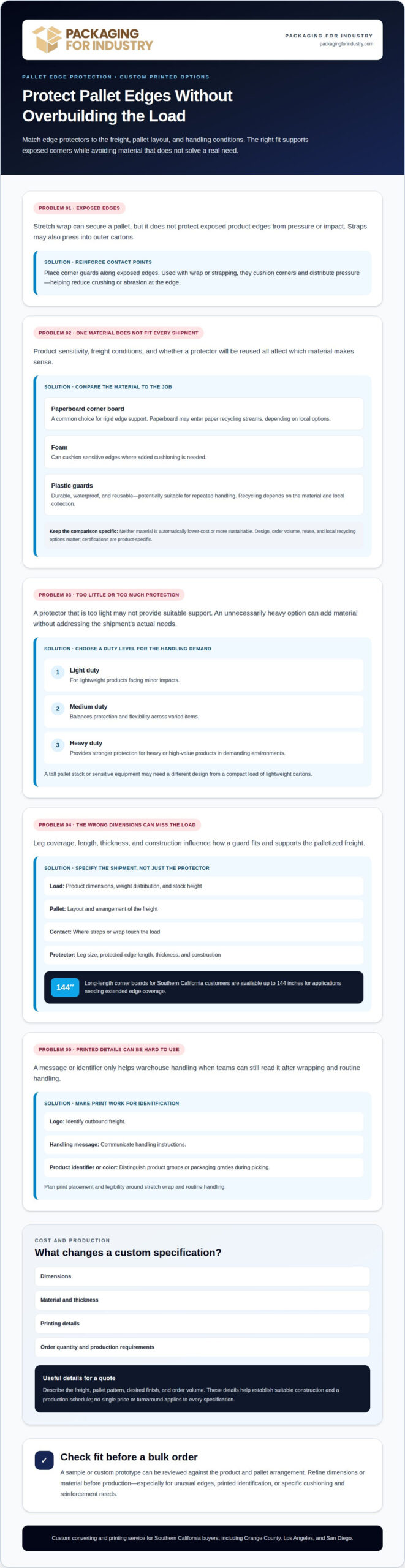
Corner guards sit along the edges of palletized goods, cushioning corners and distributing pressure during handling and transit. Used with stretch film or strapping, they help support the load and reduce crushing or abrasion at exposed edges. For example, guards on stacked cartons can help keep banding from cutting into the outer boxes.
Paperboard corner board is a common option for reinforcing loads. Foam can cushion sensitive edges, while kraft and white finishes provide different appearances for packaging and print. Plastic guards are reusable, waterproof, and durable, which can suit repeated handling. Choose material according to the product, load, shipping conditions, and whether the guard will be reused.
Paperboard and plastic differ in performance and end-of-life handling. Plastic guards are durable and reusable, while paperboard can provide rigid edge support. Neither is automatically the lower-cost or more sustainable option: design, order volume, reuse, and local recycling options all affect the comparison. Paperboard may enter paper recycling streams, while plastic recycling depends on its material and local collection. Certifications are specific to each product and cannot be assumed from material type alone.
Custom printing can add a company logo, handling message, or product identifier to guards. A warehouse might use different colors for product groups or handling instructions, while a logo can identify outbound freight. Keep print legible after wrapping and routine handling. Color coding can also help teams distinguish products or packaging grades during picking.
Design starts with the freight. The designer considers product dimensions, pallet layout, stack height, weight distribution, and how straps or wrap contact the load. Leg size determines how much of each face the board covers; length must match the protected edge. Thickness and construction influence support. Long-length corner boards for Southern California customers are available up to 144 inches, supporting applications that need extended edge coverage.
Match the protector’s strength to handling demands. Light-duty protectors suit lightweight products facing minor impacts. Medium-duty options balance protection and flexibility across varied items. Heavy-duty guards provide stronger protection for heavy or high-value products in demanding environments. A tall pallet stack or sensitive equipment may call for a different design than a compact load of lightweight cartons.
Pricing and production depend on dimensions, material, thickness, printing, order quantity, and production requirements. A custom design with multiple print details involves different work from a standard guard. When requesting a quote, describe the freight, pallet pattern, desired finish, and order volume. These details help establish a suitable construction and production schedule; no single price or turnaround applies to every specification.
For custom converting and printing, Southern California buyers can consider Packaging For Industry (PFI), serving Orange County, Los Angeles, and San Diego. Its local service area includes communities such as Anaheim and Irvine in Orange County and Carson and Torrance in Los Angeles County. Share the freight destination and delivery requirements when planning an order.
Samples or custom prototypes can help assess fit before a bulk order. A packaging design team can develop a prototype for review against the product and pallet arrangement, then refine the dimensions or material before production. This is especially useful for loads with unusual edges, printed identification needs, or specific cushioning and reinforcement requirements.
Industries Served
Custom printed edge protectors can help businesses palletize, store, or ship products with exposed edges. The right specification depends on the freight’s shape and weight, its handling route, and how the load is secured. A manufacturer shipping uniform cartons has different requirements from a warehouse moving mixed products or an aerospace supplier protecting large components. Match protection to the shipment rather than treating every pallet alike.
Manufacturers use edge protection on palletized finished goods, components, and materials moving between production sites or to customers. For boxed parts, guards can reinforce vulnerable carton edges where straps apply pressure. For irregular equipment, the design should follow the load’s contact points and how it rests on the pallet. Custom packaging design can account for these shipping conditions alongside the product packaging.
- Aerospace: Large or sensitive components may need carefully positioned edge and corner protection during handling and freight movement. A custom design can coordinate guards with the product’s supporting packaging.
- Electronics: Palletized cartons containing delicate equipment can benefit from edge protection where compression, shifting, or strapping threatens outer packaging. The load design should consider how products are stacked and restrained.
- Food businesses: Producers and distributors shipping case goods can use corner board to support pallet loads and protect package edges during warehouse handling. Guard dimensions should fit the case arrangement.
- Construction suppliers: Bundled building materials and palletized supplies may have long, exposed edges. Appropriate corner protection can help keep straps from bearing directly on product surfaces.
- Medical companies: Businesses shipping packaged devices or supplies can use guards to reinforce palletized cartons. The packaging design should suit the shipment’s handling needs and existing protective materials.
Warehouses, distributors, and fulfillment centers may also specify edge protectors for outbound pallets containing different products, packaging formats, or destinations. A consistent guard design can make pallet preparation easier to standardize, while printed identifiers can aid recognition during storage and dispatch. For mixed-SKU orders, ensure the protector fits the load without obscuring labels or shipment marks staff need to read.
For truckload shipments, distributors may prioritize edge protection that works with the pallet pattern and load-securing method. A stable, uniform arrangement can simplify loading and reduce the chance of exposed cartons making direct contact during handling. Businesses shipping between Southern California facilities and wider distribution networks should consider the entire route, including transfers and repeated handling, not just the initial move from the dock.
Construction, industrial, and manufacturing businesses may ship heavy equipment or materials that do not fit standard carton layouts. Design should account for edge locations, support surfaces, and how the freight is secured. Custom protection is most useful when it addresses a specific load condition, such as a long edge exposed to banding or a tall stack that needs reinforcement.
These requirements arise across Southern California in production, storage, and distribution operations. A tailored specification connects the product, pallet arrangement, and handling process, giving procurement and operations teams a practical basis for choosing protection. For aerospace shipments, industry-specific packaging design can account for the component and its shipping needs.
Benefits of Custom Printed Edge Protectors
A pallet can shift or sag when its weight is unevenly distributed. Edge protectors add support along exposed sides and corners, helping distribute pressure around stacked goods. For example, corner board around a pallet of cartons gives straps a firmer surface and helps limit crushing at the outer edges.
That support matters during warehouse moves, loading, and transit. Forklift handling can jostle a pallet, while tight strapping may press into cartons or product surfaces. A correctly positioned protector buffers the freight from the restraint. Strap protectors also help prevent banding from cutting into boxes, preserving the packaging around the shipment.
Edge guards are one part of a pallet reinforcement plan, not a substitute for proper load arrangement. Support beneath and around palletized goods helps distribute weight and reduce the risk of damage or sagging. Account for the pallet footprint, stacking pattern, and strap positions. A tall stack, for example, may need reinforcement along several exposed edges.
Heavy equipment and industrial components often have protruding corners or long surfaces vulnerable to contact. Position protection where the freight may meet straps, adjacent loads, or handling equipment. Foam cushioning can buffer sensitive contact areas, while reinforced board can support straight edges. A coordinated design protects the freight without obstructing how workers secure or move it.
- For pallet loads: Match protector placement to the pallet pattern, stack, and restraint points.
- For heavy equipment: Focus on exposed corners, projecting edges, and surfaces under strap pressure.
- For mixed freight: Keep guards positioned consistently so workers can identify protected edges during loading.
- For printed identification: Use visible marks to distinguish shipments or communicate handling information.
Bulk, pallet, and truckload orders each shape how protection fits into operations. Bulk orders can support consistent specifications across repeat shipments. Pallet quantities can standardize packing on a production or distribution line. Truckload freight needs protection suited to the complete load, including restraint placement and contact between neighboring pallets. Consistent guard dimensions can simplify replenishment and packaging management.
Custom printing can serve an operational purpose beyond branding. A clear logo or handling message can help warehouse staff identify freight during staging and dispatch. Printed marks should remain visible in the actual pallet arrangement, not hidden beneath wrap or facing inward. Distinct markings can help teams sort multiple product groups without changing the basic protection design.
Minimum order quantities for custom printed edge protectors vary by material, dimensions, print setup, and production requirements. Order volume also affects how a specification fits purchasing needs. When planning repeat orders for custom printed edge protectors in Southern California, consider these factors alongside expected usage.
To assess performance, packaging designers consider the load pattern, support surfaces, and restraint points together. A design that fits those conditions can reinforce pallets while helping reduce shipping damage. Coordinated corner and edge protection is especially useful when freight combines exposed edges, strapping, and repeated handling. Custom printed edge protectors in Southern California can also carry shipment identifiers that support warehouse sorting.
Why Choose Packaging For Industry (PFI)
Packaging For Industry (PFI) helps businesses coordinate packaging design with product protection, load security, and supply needs. For shipments requiring edge protection, cushioning, pallet wrap, and inventory availability also affect freight preparation. PFI’s Custom Packaging Design Services help align packaging with the product, packing process, and shipping conditions.
A design review can consider product contact points, pallet arrangement, and how packaging materials work together. For example, a manufacturer shipping a component with exposed corners may need cushioning around sensitive surfaces and stretch film to secure the palletized load. The goal is a practical packaging plan that meets the shipment’s needs without unnecessary complexity.
PFI’s custom packaging design services can support businesses assessing how protective materials fit into their packaging process. Design considerations may include product shape, handling, storage, and the packing steps employees follow. This approach is useful when standard packaging creates fit issues, freight arrives with damage, or several materials need to work together in a repeatable process.
Foam Packaging is useful when products need cushioning around delicate surfaces or components. Foam can be designed alongside edge protection to address different contact points in one shipment. The appropriate design depends on the item and packing method, rather than relying on a single protective material for every risk. A component, for example, may need cushioning at sensitive areas while pallet protection secures the overall load.
Stretch Film helps hold palletized goods together during unitizing. It complements edge protection, which reinforces exposed corners and edges. Coordinating these materials lets operations teams build a packaging setup around the actual pallet configuration. Select and use materials to suit the product, load, and warehouse process.
For businesses with recurring production or shipping needs, supply planning matters as much as packaging design. PFI’s Vendor Managed Inventory (VMI) for Packaging helps manage supply around operational requirements. Just-In-Time Inventory Management for Packaging can also support a planned flow of materials for ongoing needs. These services are useful when packaging availability affects production schedules, warehouse preparation, or outbound shipping.
PFI is most useful when a business wants to address a packaging challenge within its broader operation. A manufacturer may need a design that fits its packing line, a warehouse may need consistent pallet preparation, or a distributor may want better coordination between packaging materials and replenishment. In each case, the product and workflow guide the solution.
To prepare for a discussion, share what the shipment contains, how it is palletized, where protection is needed, and how often the packaging is used. Include relevant handling or storage conditions and describe the current packaging problem. This information helps focus the conversation on a design, cushioning, stretch film, or inventory support suited to the operation.
To request a custom edge protector quote, contact Packaging For Industry (PFI) with your requirements.
Frequently Asked Questions
What is an Edge Protector?
An edge protector guards a product’s corners or edges, cushioning contact and spreading pressure. On a pallet, it buffers freight from straps and helps protect cartons from compression or banding marks. For example, a manufacturer shipping stacked boxes can place guards along exposed sides where restraints press against the load. Edge protectors work together with the pallet’s packaging and securing method.
What materials, sizes, and profiles are available for custom printed edge protectors?
Custom printed edge protectors can be made from paperboard, plastic, or foam, with dimensions tailored to the freight. Key measurements include leg coverage, guard length, and thickness. The required profile and material depend on the pallet arrangement, contact points, and handling conditions. A long bundle of building materials, for example, needs edge coverage suited to its length, while carton loads may need protection where straps cross.
What printing options and branding methods are offered for edge protectors?
Printing can include a company logo, handling message, product identifier, or color coding. Choose what workers need to recognize during receiving, storage, or dispatch. A handling instruction can flag freight requiring careful movement, while a product code can distinguish similar pallet loads. Position and contrast matter because stretch wrap or the pallet arrangement may obscure some printed areas.
How much do custom printed edge protectors cost per unit or per order?
Pricing depends on the order and is provided after a quote request. Key cost factors include material, leg dimensions, length, thickness, print requirements, order quantity, and production needs. A repeat order using an established specification may differ from a first run that requires custom design work. For bulk packaging pricing, provide the expected quantity and say whether the specification will be used for recurring shipments.
What specifications are needed to request a quote for custom edge protectors?
Share the product or freight type, pallet arrangement, protected edge lengths, desired leg coverage, and any known thickness requirements. Include order quantity, expected reorder pattern, preferred material, and artwork or text for printing. A photo or drawing of the loaded pallet can clarify strap contact points. For custom printed edge protectors in Southern California, include the shipment destination and required timing.
Which Southern California suppliers offer custom printed edge protectors?
Look for Southern California industrial packaging suppliers that offer custom converting and printing. Packaging For Industry (PFI) is identified as a packaging provider with services that can support a coordinated packaging plan.
Are custom printed edge protectors recyclable, and what material certifications are available?
Paperboard may enter paper recycling streams, while plastic recycling depends on the material and local collection. Certifications are product-specific and cannot be assumed from material type alone.