
A damaged edge can compromise an otherwise well-packed load. Edge protectors reinforce corners and edges to help reduce damage during handling, storage, and shipping. For products moving through distribution centers, the right fit supports protection and consistent load preparation.
Custom edge protectors in Orange County can be designed around product dimensions, material requirements, and handling conditions. When comparing packaging pricing, consider the protector’s specifications and order quantity, not just its material.
This guide explains how edge protectors work, which materials and sizes suit different products, and what affects bulk packaging pricing. It also covers how custom protection fits into local packaging delivery and broader packaging operations.
Key Takeaways
- Match protector material, board grade, and dimensions to the product and the way it will be handled.
- Use appropriate edge and corner protection to help limit damage to furniture, glass, and mirrors during shipping and storage.
- Account for material, strength, size, shape, and order requirements when comparing pricing.
- Consider whether cushioning foam or reinforcing corner board better suits the product’s protection needs.
- Custom packaging design can help align edge protection with your products and packaging operations.
Custom Edge Protectors and Options
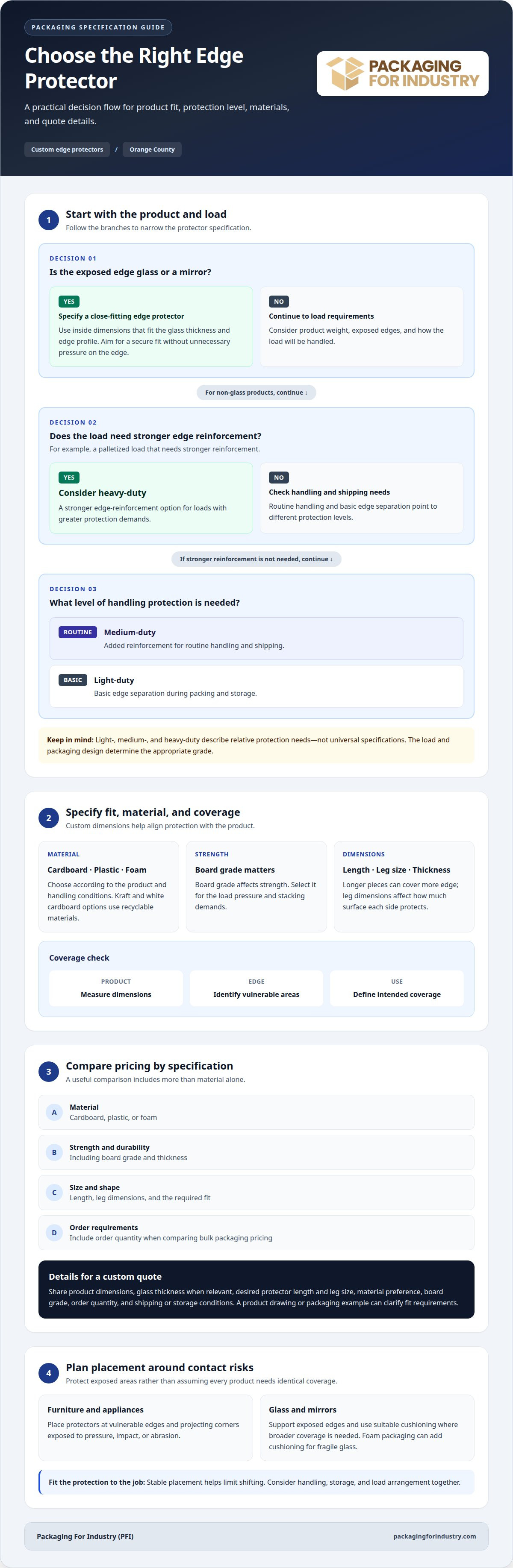
Custom edge protectors for Orange County manufacturers can be specified by material, strength, shape, and dimensions. The right combination depends on product weight, exposed edges, and handling conditions.
Light-duty protectors suit products that need basic edge separation during packing and storage. Medium-duty options provide added reinforcement for routine handling and shipping. Heavy-duty options support loads that need stronger edge reinforcement, such as palletized goods. These categories indicate relative protection needs, not universal specifications. The load and packaging design determine the appropriate grade.
Material options include cardboard, plastic, and foam. Kraft and white cardboard protectors use recyclable materials. Board grade affects strength, so select it according to load pressure and stacking demands. A packaging design review can match the grade to the product and shipping configuration instead of defaulting to the heaviest option.
For glass, the protector’s inside dimensions should fit the glass thickness and edge profile. A close fit helps keep it in position without putting unnecessary pressure on the edge. Custom specifications can account for different thicknesses, including mixed glass products, rather than assuming one standard size works for every shipment.
Custom lengths, leg sizes, and thicknesses determine how an edge protector fits and reinforces a product. Longer pieces can cover more of an edge, while leg dimensions determine how much surface each side protects. Specify the intended coverage and product dimensions so the design suits the application.
Which Orange County suppliers manufacture custom edge protectors? Industrial packaging manufacturers and packaging suppliers with custom converting or design capabilities can produce protectors to order. Their material and dimensional options depend on the project.
What are the lead times for custom edge protector orders in Orange County? Timing depends on design requirements, material selection, order quantity, and production scheduling. These factors determine how a custom order moves through production.
Which suppliers offer delivery or pickup in Orange County? Packaging suppliers serving Orange County may arrange local delivery or pickup, depending on their fulfillment options. Delivery requirements and receiving details help define the practical arrangement.
For a custom edge protector quote, provide product dimensions, glass thickness where relevant, desired length and leg size, material preference, board grade, order quantity, and shipping or storage conditions. A product drawing or packaging example can clarify fit requirements.
Furniture, Glass, and Mirror Protection
Furniture edges can take pressure during warehouse handling, stacking, and transit. Edge protectors create a buffer along exposed corners and sides, helping reduce dents, dings, and abrasion. On a table or cabinet, protection at vulnerable edges can limit contact with adjacent cartons or handling surfaces. Place protectors at the points most exposed to impact or compression.
Mirrors and glass panels need edge support, since chips or cracks can compromise the item. A protector cushions the edge and helps distribute pressure rather than concentrating it at one contact point. During storage, correctly positioned protection also separates glass edges from nearby products. Foam packaging can add cushioning for fragile glass and sensitive equipment.
Furniture protection also depends on the item’s shape. A long tabletop, cabinet corner, or appliance edge presents different contact areas. Strategically placed protectors can buffer those surfaces during handling and reduce abrasion where items touch packaging or neighboring loads. Pairing edge coverage with suitable cushioning helps limit movement and contact without treating every product as if it had the same shape.
Glass protector tops serve a different purpose from edge protectors. They lie flat on an existing flat surface without overhang, helping protect furniture from water spots and scratches. For example, a glass top can cover a finished tabletop, while an edge protector protects exposed glass edges during shipment. Keep these functions distinct to select the right protection for each part.
For shipping, packaging design should account for handling, storage, and load arrangement together. Edge protection can help absorb shocks and distribute pressure, while stable placement helps prevent shifting. A mirror packed beside other goods needs protection at its exposed edges and a buffer from neighboring items. Furniture with projecting corners may need protection at those points, rather than uniform coverage alone.
Plan protection around each item’s contact risks, rather than applying an identical layer across a mixed load. Strategically placed edge protectors can cushion or buffer furniture, appliances, glass, and sensitive equipment. Position them at edges and corners most exposed to pressure or contact, while arranging the package to limit shifting.
Edge protectors can help prevent damage from compression, impact, or abrasion. For shipments containing differently shaped items, match protection to exposed areas to provide a buffer where contact may occur. The goal is to reduce direct contact at vulnerable points, using suitable cushioning where broader coverage is needed. This focuses protection on surfaces most at risk instead of assuming every item needs the same placement or amount of edge coverage.
Edge Protector Pricing Factors
Custom edge protector pricing depends on the design and order requirements. Material is one factor: cardboard, plastic, and foam suit different protection needs. A cardboard protector for a pallet load has different requirements from foam cushioning for fragile glass. The material should match the product and handling conditions.
Strength and durability also affect the specification. A light-duty protector for basic separation differs from a heavy-duty option designed to reinforce a demanding load. Board grade, thickness, and shape determine how the protector responds to pressure. Specifying more strength than the application needs can add material without improving the fit.
Dimensions affect material use and the conversion work involved. Custom length, leg size, and thickness should suit the edge being covered. A protector running along a long panel requires a different design from one covering a compact corner. For glass, the protector’s fit should reflect the glass thickness and edge profile.
Graphics can also affect the order specification. A plain protector and one with custom graphics have different requirements. Graphics may help identify products in a warehouse, such as by distinguishing product groups, but should serve an operational purpose. The chosen shape and design should remain compatible with the protector’s function.
Order quantity and consistency matter, too. A repeated specification for a production run differs from an order with several sizes or grades. Multiple configurations can require separate production setups and handling. Consolidating compatible dimensions may simplify ordering, while distinct product needs may justify separate specifications.
Pricing is order-specific and provided after a quote request; material, strength, durability, size, shape, graphics, and quantity influence the calculation. A useful specification includes product dimensions, required coverage, material preference, load or handling context, and order quantity. Drawings or packaging examples can clarify unusual profiles. Reviewing corner and edge protection options alongside the product design can help align protection requirements with the packaging system.
Foam and Corner Board Protectors
Foam and corner board address different packaging problems. Foam-based edge protectors cushion fragile products, while reinforced cardboard corner board strengthens package edges and pallet loads. Choose based on the main risk: impact to a delicate surface or pressure on a stacked load.
Foam is useful for glass, electronics, and other sensitive products. Its cushioning helps absorb shocks at contact points, reducing the risk of chips, cracks, or surface damage. A foam protector can fit around an exposed edge or corner where a rigid board may not provide enough cushioning. Product shape and handling conditions determine where that cushioning belongs.
Corner board, also called angle board, reinforces vertical edges on palletized goods. Placed along a load’s corners, it helps distribute pressure and support stability during storage and transportation. For example, a pallet of boxed components may need corner board to reinforce the stack and help limit crushed corners. It can also help reduce shifting or collapse during transit.
Custom edge protectors can be made to suit a product’s dimensions, shape, and protection requirements. Standard corner and edge protection uses established formats that can suit straightforward applications. Custom sizing is more useful when an unusual profile, edge length, or glass thickness calls for a closer fit. Choose according to whether a standard format addresses the product’s risks.
For a mixed load, foam and corner board can work together. Foam cushions delicate item edges inside packaging, while corner board reinforces the palletized load outside. This layered approach gives each material a clear role. It avoids relying on a rigid protector alone for cushioning or on foam alone for pallet reinforcement.
Compare the product and shipment conditions before choosing. Fragile glass may need cushioning at exposed edges, while a stacked pallet may need structural reinforcement. For electronics, foam can address impact at product contact points. For cartons stacked on a pallet, corner board can support vertical edges and distribute pressure. Custom dimensions help align either option with the load.
Industries Served
Edge protection supports businesses moving products through production, storage, and shipping. In Orange County, furniture makers, glass fabricators, distributors, and manufacturers can use protectors to address exposed edges and pallet stability. The appropriate design depends on the item, packaging configuration, and handling conditions.
Furniture businesses handle cabinets, tables, and finished panels with corners vulnerable to abrasion or impact. Glass and mirror operations need protection suited to fragile edges and varying product profiles. For a shipment combining a framed mirror with boxed hardware, distinct protection for the glass and the load can address their different handling risks.
Manufacturers and aerospace suppliers package components that may have irregular shapes or sensitive surfaces. Edge protection can reinforce selected contact points, while other packaging for manufacturers can support the broader shipment design. Electronics producers may use cushioning near delicate components, while corner board can reinforce palletized cartons.
Warehouses and distribution centers have different needs. Products may be stacked, moved between storage and dispatch, or consolidated into pallet loads. Edge reinforcement helps support vertical load edges, while product-specific protectors can separate items during handling. Matching protection to warehouse workflows helps keep packaging practical for routine operations.
- Furniture makers: Protect exposed cabinet, table, and panel edges during packing and transit.
- Glass and mirror businesses: Cushion vulnerable edges and account for different product profiles.
- Aerospace and electronics suppliers: Pair targeted edge coverage with suitable protection for sensitive components.
- Distributors and warehouses: Reinforce pallet loads and organize products for storage and shipping.
Food, medical, and construction supply businesses also move products through industrial packaging and distribution. Requirements vary by product and handling process, so edge protection should address specific exposed surfaces or load edges. For example, a pallet of construction materials may need reinforcement, while delicate packaged equipment may need cushioning at contact points. Understanding the product, shipment, and warehouse process helps determine which protection fits.
Benefits of Custom Edge Protection
Custom edge protection targets areas most exposed to pressure, impact, or abrasion. Matching the protector to a product’s dimensions helps cover vulnerable edges without relying on a one-size-fits-all fit. For a long panel, a correctly sized protector can cover the exposed side; for a compact component, protection can focus on its corners.
Preventing damage is a practical benefit during handling and transit. Edge protectors can absorb shocks and distribute pressure, helping reduce dents, chips, cracks, and crushed corners. Glass, finished furniture, and packaged equipment face different risks, so material and shape should reflect the product and its route through storage, handling, and shipping.
On palletized loads, reinforcement can support more stable packaging. Corner board along vertical edges helps distribute pressure and reduce the risk of sagging, shifting, or collapse. A steadier load is easier to handle during warehouse staging and transportation, and can help protect cartons from compression at exposed corners.
Custom dimensions can also make packing routines more consistent. When protectors fit a product profile, workers can position them as intended instead of adapting a generic size for each shipment. Consistent placement supports repeatable packing for recurring orders and helps maintain a reliable packaging process across shifts.
Protection suited to the risk can also help control material use. A fragile glass edge may need cushioning, while a pallet stack may need structural reinforcement. Applying appropriate protection at each point avoids treating every surface as equally vulnerable. The result is a packaging design based on actual contact and load conditions.
For manufacturers and warehouses, these benefits connect product protection with supply reliability. Fewer damaged edges can mean fewer disrupted shipments and less time spent handling damage claims or repacking affected goods. Custom edge protection doesn’t replace a complete packaging system; it works alongside cushioning, cartons, and load stabilization to address specific weak points. Evaluating these components together helps align protection with day-to-day operations.
Packaging For Industry (PFI): Custom Packaging Design Services
Packaging For Industry (PFI) helps manufacturers address packaging challenges through custom packaging design services. This is a practical next step when standard protection doesn’t fit a product’s dimensions, handling process, or shipping configuration. The design process considers how edge protection works alongside the rest of the package.
For an Orange County manufacturer shipping glass panels, a packaging design can account for exposed edges, contact points, and how products are arranged for transit. Furniture makers may need packaging that protects projecting corners without leaving other surfaces exposed. Product dimensions and shipping conditions guide the design choices.
Packaging design is most useful when damage patterns, awkward product shapes, or inconsistent packing routines point to a fit problem. A packaging review can assess where impact or pressure occurs and how protection fits into the existing workflow. The goal is a practical configuration, not added material without a clear function.
PFI also offers foam packaging for applications that need cushioning around fragile products or sensitive surfaces. Foam and edge protection can serve different roles within one packaging system. For example, cushioning can protect an item inside its package, while load reinforcement supports packaged goods during storage and transit.
Packaging operations also depend on supply continuity. Packaging For Industry offers Vendor Managed Inventory (VMI) and Just-In-Time (JIT) inventory programs to help businesses coordinate packaging availability with production needs. Its kitting and assembly services can organize packaging components into a prepared process. Each service addresses a different operational need.
To begin a design discussion, provide product dimensions, the edges or surfaces needing protection, current packaging, and the shipment’s handling conditions. A drawing, product sample, or description of recurring damage can help clarify the design challenge. These details connect packaging decisions with protection and workflow needs.
For support with packaging design, contact Packaging For Industry (PFI).
Frequently Asked Questions
What sizes and thicknesses are available?
Custom specifications can reflect the protector’s intended position in your packaging setup. For repeat orders, keep an approved drawing or specification sheet as the reference for each product variation. Include the product or part identifier and revision so purchasing and warehouse teams use the same version. This helps prevent confusion when a shipment changes shape or a product line introduces a revised component.
What types of custom edge protectors are available in Orange County, California?
Options can include protectors designed for continuous edge coverage, corner coverage, or a specific product profile. The key distinction is how each piece fits into the packing sequence. A long protector may be positioned before a product enters its carton, while separate corner pieces can be applied during final packing. Defining the sequence helps determine a practical style for the operation.
What materials and thicknesses are used for custom edge protectors?
Specify material and thickness according to the product and packaging arrangement. For a useful comparison, document how the protector will stay in place and whether it contacts the product directly or sits between packaging components. These details distinguish the product’s surface-protection needs from the package’s structural needs, keeping the specification meaningful beyond a thickness value alone.
How do suppliers measure and specify custom edge protectors, and what information should I provide?
Along with the part identifier, provide a current drawing or a clear sample of the packaged product. Note any product variants, drawing revision, and where the protector fits in the packing sequence. If the same item ships in different configurations, identify each one separately. These records help keep purchasing, production, and warehouse teams aligned when specifications are reused for repeat orders.
What are typical prices and minimum order quantities for custom edge protectors in Orange County?
Prices and minimum order quantities depend on the order, so a general figure may not reflect your requirements. A quote should identify the requested configuration and order quantity, giving purchasing a basis for comparing the same specification across repeat orders. If demand varies, distinguish the initial order from expected replenishment needs so the purchasing plan reflects actual use.
Are custom edge protectors recyclable or available in sustainable materials?
Recyclability depends on the material and the waste collection options at your facility. Keep packaging components separated when your recycling process requires sorting, and include disposal needs when evaluating a packaging design. Sustainable material choices should still provide protection suited to the product and shipment. A packaging sustainability review can consider both material choice and how used packaging is handled.