
A tube that does not fit or protect a product can create avoidable handling and shipping problems. For manufacturers seeking custom fiber tubes in Southern California, start by defining the application, dimensions, end closures, and expected order volume. These details shape tooling needs, minimum order requirements, the quote, and production planning.
Buyers should also understand whether a custom design requires dedicated tooling and how order quantities fit the production setup. These choices can affect both the initial order and repeat purchases, so a useful quote request needs more than a tube length.
This article explains what to include in a quote request, how tooling and minimums affect a custom order, and what influences lead time. It also covers design considerations such as tube construction, wall thickness, end closures, and printing, helping your team assess whether the packaging suits its application. The goal is to connect those choices to reliable supply and practical cost management, without treating one specification as right for every shipment.
Key Takeaways
- A useful quote request describes the tube’s application, dimensions, construction, closures, printing needs, and order quantity.
- Production and delivery timing depend on the design requirements and order details, so clarify the schedule as part of the quote process.
- Wall thickness, materials, coatings, printing, and end caps can be tailored to the tube’s intended use.
- Fiber tubes serve selected product and packaging applications; matching the tube design to the product and shipping conditions supports protection and supply efficiency.
- Custom Packaging Design Services can help manufacturers align packaging design with product protection and operational needs.
Request a Custom Fiber Tube Quote and Confirm Turnaround Time
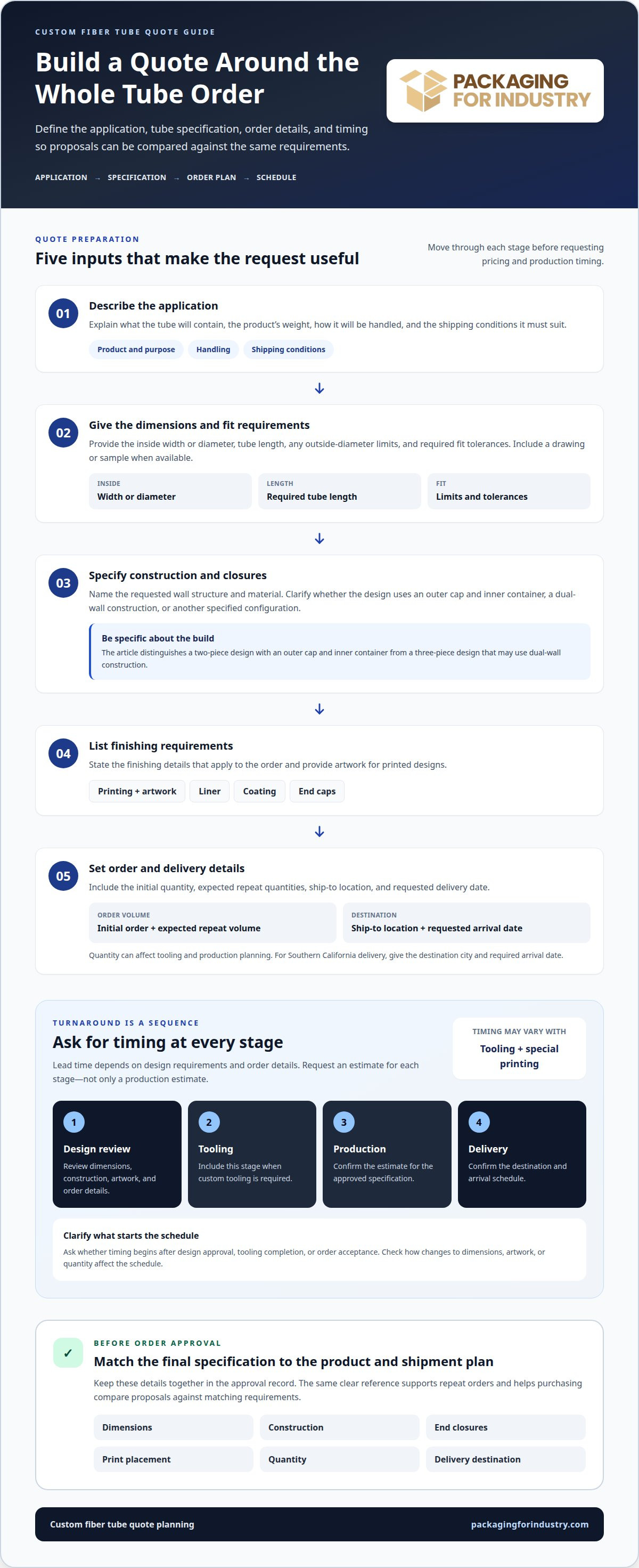
A useful fiber tube quote starts with the product and its purpose. Describe what the tube will contain, how it will be handled, and how it will ship. Include the required inside dimensions and overall length, as well as any limits on outside diameter. If you have a drawing or sample, include it so the manufacturer can assess fit and construction together.
Specify the tube’s construction and finish rather than relying on a general description. A two-piece design may use an outer cap and inner container, while a three-piece design may use dual-wall construction. State whether the application requires a laminate, lightweight structure, printing, liner, or specific end closures. Include the initial order quantity and expected repeat quantities, since both can affect tooling and production planning.
- Dimensions: Provide inside width or diameter, tube length, and any fit tolerances the product requires.
- Construction: Identify the desired wall structure, material, and whether the tube needs an outer cap, inner container, or dual-wall design.
- Finishing: Describe printing, liner, coating, and end-cap requirements. Include artwork for printed designs.
- Order details: State the initial quantity, anticipated repeat volume, ship-to location, and requested delivery date.
- Application: Explain product weight, handling, and shipping conditions so the design can address the actual use.
Lead time has several stages: design review, tooling when required, production, and delivery. Request timing for each stage, not just a production estimate. A design requiring custom tooling or special printing may follow a different schedule from a repeat order with an approved specification. Clear artwork, dimensions, and quantity help avoid delays during review and setup.
For delivery in Southern California, provide the destination city and the date the tubes must arrive at the receiving site. Confirm whether the quoted schedule starts after design approval, tooling completion, or order acceptance. Clarify how changes to dimensions, artwork, or quantity affect timing. This makes the estimate useful for coordinating packaging, inventory, and production.
Before approving an order, compare the final specification with the product drawing and shipment plan. Confirm dimensions, construction, end closures, print placement, quantity, and delivery destination in the same approval record. This creates a clear reference for repeat orders and lets purchasing teams compare proposals against matching requirements, rather than differing assumptions.
Which Manufacturers in Southern California Make Custom Fiber Tubes?
When evaluating custom fiber tubes in Southern California, distinguish the manufacturer from a supplier that sources finished tubes and coordinates delivery. Buyers in Los Angeles and Orange County should identify which company physically makes the tube and which organization manages the order. That distinction helps clarify production responsibility and communication.
This matters when designs change or production questions arise. A manufacturer makes the tube to its approved specification, while a distributor may coordinate the order with a separate production company. Ask each prospective source to identify the production facility and explain who handles specification changes, scheduling, and quality concerns.
Check that the company’s stated capabilities match the actual fiber-tube requirement. Experience with cardboard tubes or paper cores alone does not establish that a company produces custom fiber tubes. Requirements may include a particular construction, printed design, or closure. The producer should be able to address these details in its production process.
Use these points to evaluate a potential source:
- Manufacturing role: Establish whether the company makes the tube or resells products made elsewhere.
- Production location: Identify where the order will be manufactured and how it will reach your Southern California facility.
- Specification ownership: Clarify who records and approves design changes before production.
- Order coordination: Determine who communicates scheduling updates and shipment details.
A producer outside Southern California may still supply Los Angeles or Orange County through distribution. A nearby packaging company may also coordinate orders without making the tubes itself. Neither arrangement is automatically a better fit. Focus on who controls the production specification and how the order is managed.
Before choosing a source, compare its written proposal against the same approved design and delivery destination. Confirm that the producer, tube construction, finishing requirements, and shipping responsibilities are clear. This helps purchasing teams avoid treating a manufacturer’s production proposal and a distributor’s supply arrangement as equivalent. It also clarifies who should resolve production or specification issues.
Custom Fiber Tube Products, Sizes, Wall Thicknesses, and Materials
Fiber tube specifications depend on whether the application calls for paper-based packaging or a composite structure. Paper fiber tubes are made mostly from recycled paper, while composite tubes can use reinforced fibers. These are distinct construction categories, so define the intended use before selecting materials and specifications.
For paper fiber tubes, listed interior widths range from ¼ to 5 inches, with lengths up to 24 inches. Wall thicknesses are listed as 0.40 to 0.120, and multiple thicknesses are available. Because thickness affects fit and rigidity, the approved drawing should state the required measurement unit and dimensions clearly.
Composite tube specifications offer different design choices. Custom carbon fiber tubes can use carbon, fiberglass, or aramid fiber reinforcement. A pure laminate wall retains the reinforcement fiber’s mechanical, thermal, and electrical properties. A sandwich construction places a core between high-strength outer skins. Honeycomb and thermoformable materials are examples of cores, and the structure can increase local wall stiffness while keeping the tube lightweight.
Finishing choices affect how the tube functions and presents the packaged product. Options include grade foil or grease-proof liners. Printing also needs planning: provide the design as part of the specification before production. State the desired print placement and include approved artwork to align production with packaging requirements.
- End closures: Options include friction-fit plastic end plugs and metal end closures.
- Tube ends: Designs may have open ends or a telescoping format with metal ends.
- Surface and liner: Specify grade foil or a grease-proof liner when the application calls for one.
Construction choices should reflect performance needs. A sandwich-core wall can increase local stiffness while remaining lightweight, while a pure laminate retains the reinforcement fiber’s characteristics. For a paper fiber tube, set dimensions and wall thickness according to product fit and handling needs. Record each choice in the approved specification.
For a custom design, combine inside dimensions, length, wall construction, reinforcement or core, printing, liner, and end closures in one drawing or specification. This gives the production team a clear reference and helps prevent mismatches between the tube body and its closures. It also provides a consistent basis for reviewing revisions and repeat runs.
Industries Served by Custom Fiber Tubes in Southern California
Custom fiber tubes can suit manufacturers that need cylindrical packaging for specific goods. Common applications include candles, retail products, bath and skin care products, and promotional kits. Manufacturers in Los Angeles, Orange County, and nearby Southern California communities can assess these formats against product, presentation, and handling needs.
Candle manufacturers may use a tube to contain a candle or set. Match the dimensions and closure to the product arrangement. A secure fit helps keep the package together during handling, while printed artwork can identify a scent, product line, or brand when printing is included in the specification.
Retail product makers can use fiber tubes for items suited to cylindrical packaging. This format can create a distinctive presentation on a retail shelf or in a shipment. The application determines whether an open-ended tube, capped design, or telescoping format best suits product access and packaging requirements.
Bath and skin care companies may choose tubes for suitable products or coordinated sets. Define the package around product dimensions and presentation requirements. If a liner is needed, grade foil or grease-proof options may be relevant. Select a material that suits the contents and packaging purpose.
Promotional kit assemblers can use fiber tubes to group selected items in a presentation package. A tube may hold one promotional item or serve as the outer container for a kit. The contents, arrangement, and access needs guide the design. Printed graphics can also support a campaign or event identity.
- Retail and promotional packaging: Match the tube format to the product set, artwork, and presentation plan.
- Candle packaging: Align the interior fit and closure with the candle or set configuration.
- Bath and skin care packaging: Consider contents and liner needs when defining the package.
Fiber tubes are usually not used for food packaging because of the materials used to produce them. Food companies should assess whether this format suits the specific product and application before including it in a packaging plan. For other Southern California manufacturers, start by matching the tube’s role to the product category, presentation, and handling process, then define the design accordingly.
Benefits of Custom Fiber Tubes for Manufacturers
A package that fits its contents can make packing more consistent. For a long or narrow product, a tube provides an enclosed format that keeps the item together during handling. A suitable fit also helps avoid unused space inside the package. The right design depends on the product’s shape, handling process, and protection needs during shipment.
Protection depends on the complete package, not the tube alone. Coordinate the tube with cushioning, an outer carton, and the way shipments are handled. If a product can shift inside its tube, the packing arrangement may need additional restraint. If the tube moves within its shipping carton, the outer packaging should control that movement. Reviewing the full configuration helps identify weak points before regular use.
A custom specification can support cost management by matching packaging to the job. Excess material, unnecessary features, and poor fit can add purchasing and packing burdens. A consistent design can also help operators repeat the same packing method. Assess material use, packing time, storage needs, shipping damage, and replacement handling together, rather than comparing unit prices alone.
Standardization supports consistent shipping and replenishment. Once a design is approved, purchasing and operations teams can use the same specification for ordering and packing. This reduces the risk of different shifts or locations substituting different packaging without a shared standard. Clear identification of the approved tube and its application also helps receiving and warehouse staff handle goods consistently.
- Fit: Align the packaging format with the product’s shape and handling needs.
- Protection: Evaluate the tube, cushioning, and outer carton as one shipping configuration.
- Cost review: Consider material, labor, storage, damage, and replacement handling together.
- Repeatability: Document an approved specification for purchasing and packing teams.
The strongest operational case for custom packaging comes from matching the design to actual shipment conditions. A design review can compare the current packing method with a proposed configuration and identify issues with fit, handling, or workflow. This helps manufacturers make packaging decisions based on protection and operating requirements, while keeping the specification practical for repeat use.
Why Choose PFI for Custom Packaging Design Services
Packaging For Industry (PFI) provides custom packaging design services for manufacturers evaluating how packaging fits their products and shipping operations. A fiber tube is one part of a broader packaging system. Product dimensions, handling, protection needs, and the outer shipment package all affect performance. PFI can assess surrounding packaging requirements and identify where a tailored design may support the workflow.
This is a useful next step when a product has specific protection needs, current packaging creates handling problems, or a specification is changing. PFI’s design work focuses on practical fit: product protection, packing methods, and shipping. Clear requirements give the design process a concrete starting point, without assuming one tube style suits every application.
For example, a manufacturer shipping a delicate component may need protective cushioning in addition to its selected tube or container. PFI offers foam packaging for applications where cushioning can help protect products inside a larger package. If the shipment also needs stable unit loads, stretch film can support pallet wrapping. These options address packaging needs around the product without assuming PFI manufactures fiber tubes.
- Product protection: Connect the product’s handling risks with suitable cushioning and package design.
- Operational fit: Consider how packaging works at packing stations and during warehouse handling.
- Supply planning: Vendor Managed Inventory for Packaging can support packaging replenishment planning.
- Packaging consistency: Packaging Kitting and Assembly Services can help organize multiple packaging components into a defined process.
PFI is a practical resource when packaging changes affect more than the container itself. Bring product requirements, current packaging concerns, and the intended shipping process into the design discussion. That context connects packaging choices with protection, packing efficiency, and reliable supply. For manufacturers in Los Angeles, Orange County, and San Diego, this keeps design focused on real operating needs.
PFI’s Custom Packaging Design Services can help align packaging decisions with product and workflow requirements. To request a packaging quote, contact Packaging For Industry (PFI).
Frequently Asked Questions
What are typical prices and minimum order quantities for custom fiber tubes?
Custom fiber tube pricing depends on the design and production requirements, and a price is provided after a quote request. Cost factors include tube dimensions, wall construction, material, printing, liners, closures, tooling, and order quantity. Minimum order quantities also depend on the production setup and custom specifications. For a useful comparison, evaluate quotes against the same approved design and quantity for your Los Angeles or Orange County operation.
What are the lead times for custom fiber tube orders in Southern California?
Lead time depends on design approval, tooling requirements, production scheduling, order quantity, and delivery destination. A first order with a new design may require more setup than a repeat run with an approved specification. For a Southern California shipment, distinguish production time from transit and receiving time. Set the requested arrival date based on when the tubes must be ready for packing or production, not just the order date.
What information do manufacturers need to quote a custom fiber tube order?
Provide the product application, required dimensions, construction, order quantity, and delivery location. Include a drawing or sample if available, along with details about printing, liners, and end closures. For example, a manufacturer packing a promotional kit should describe its contents and how they will sit inside the tube. Clear specifications align the quote with the intended use and make proposals easier to compare.
How do fiber tubes compare with plastic and metal tubes for strength, cost, and sustainability?
Fiber tubes are made mostly from recycled paper and are described as more durable than regular paper tubes, but they are not suited to heavy industrial-scale uses.