
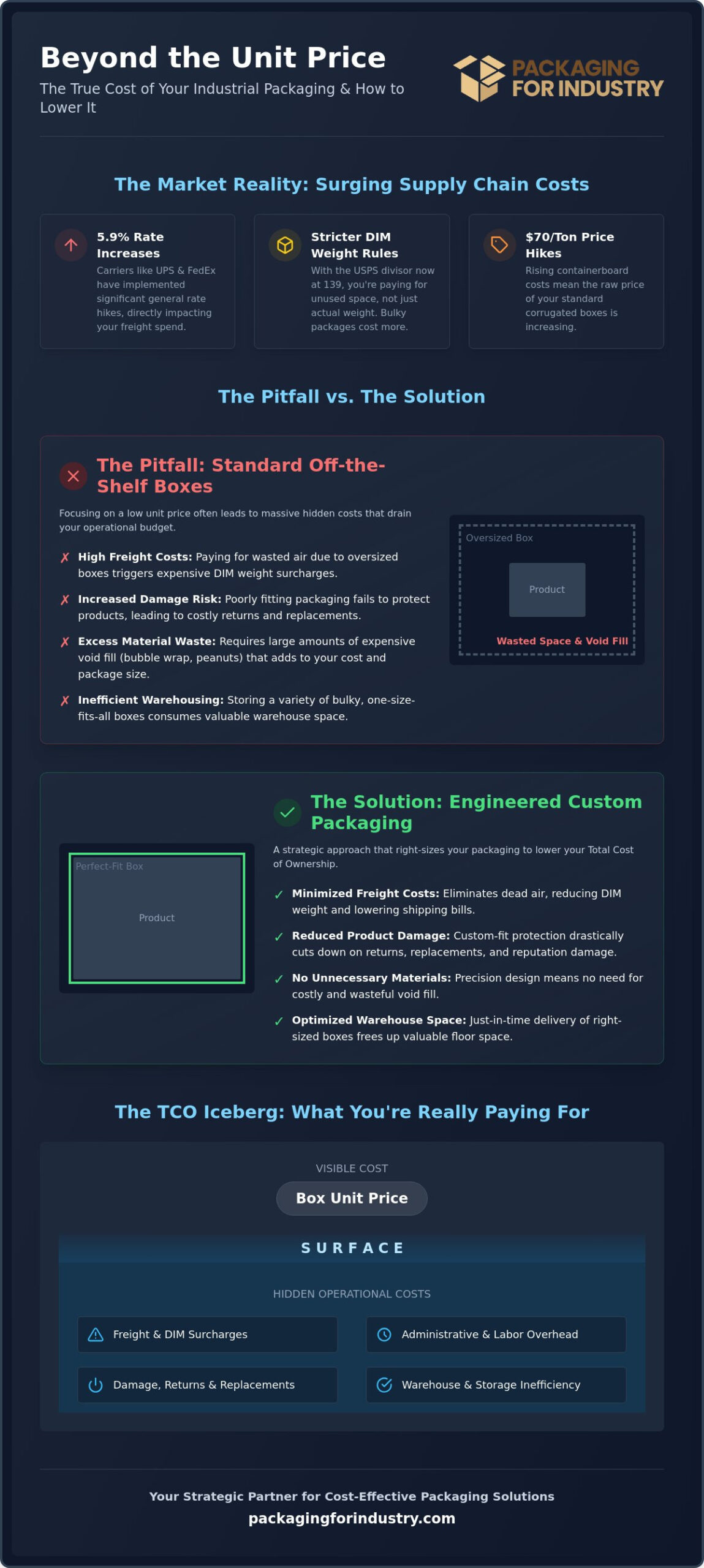
Is your “standard” shipping box actually your most expensive operational line item? Many Anaheim manufacturers are currently struggling with the 2026 General Rate Increases, where carriers like UPS and FedEx have implemented 5.9% average hikes. When you factor in the July 2026 USPS dimensional weight divisor change to 139 and recent containerboard price increases of up to $70 per ton, the cost of “off the shelf” packaging becomes unsustainable. Transitioning to a strategy that lowers costs through custom engineering is no longer optional for businesses dealing with rising freight surcharges and wasted warehouse space.
We understand that overpaying for air and storing excess material is a direct drain on your bottom line. This guide explains how engineered packaging solutions reduce the total cost of ownership by focusing on precision rather than just the unit price of a box. You’ll discover how right-sized corrugated designs and strategic inventory management can protect your margins. We will examine how custom engineering reduces dimensional weight fees, eliminates operational waste, and streamlines your entire purchasing process for better long-term stability.
Key Takeaways
- Learn to distinguish between the initial invoice price and the true operational cost of your packaging materials.
- Discover how right-sizing custom corrugated boxes lowers costs by eliminating dimensional weight surcharges and unnecessary freight fees.
- Understand how Vendor Managed Inventory (VMI) optimizes warehouse space and prevents the financial drain of emergency replenishment orders.
- Identify the most cost-effective cushioning materials by matching technical specifications to your product’s specific fragility and value.
- See how engineered prototyping ensures your packaging design is fully optimized for performance before you invest in high-volume production.
The Total Cost of Ownership: How Industrial Packaging Lowers Costs
In the 2026 manufacturing environment, procurement teams often fall into the trap of focusing solely on the unit price of a corrugated box or a roll of stretch film. However, a strategy that truly lowers costs requires a shift toward Total Cost of Ownership (TCO). TCO accounts for every dollar spent from the moment a package is ordered to the moment it arrives safely at the end user’s facility. While the “invoice price” is the most visible number, the “operational cost” includes freight, warehouse labor, storage efficiency, and the fallout from damaged goods.
High-quality materials, such as double-wall corrugated or custom-engineered foam, might carry a higher initial price point than generic catalog standards. Yet, these materials lead to lower overall expenditures by preventing failures in the supply chain. If a cheaper, thinner box results in even a minor damage rate, the savings on the invoice are immediately erased by the expense of replacements and expedited shipping. True fiscal responsibility in logistics means looking past the line item to see the entire lifecycle of the package.
The Hidden Drain of Shipping Damage
Calculating the real price of a damaged shipment involves much more than the cost of the broken product. You must account for return freight fees, the labor required to process the claim, the material cost of a replacement unit, and the long-term damage to your professional reputation. Utilizing precision-engineered foam packaging prevents this “hidden tax” on your revenue. By stabilizing products and absorbing transit shocks, these materials ensure that your first shipment is the only one you have to pay for. Protecting the product isn’t just about quality control; it’s a primary method that lowers costs by eliminating redundant shipping cycles.
Administrative and Labor Costs in Procurement
Managing a fragmented supply chain creates significant administrative overhead. When an Anaheim manufacturer juggles multiple vendors for boxes, pallets, and tapes, they increase the likelihood of stockouts and expensive emergency “rush” orders. Consolidating your supplies with a single local partner streamlines the entire procurement process. Implementing a system like Vendor Managed Inventory (VMI) allows for automated replenishment, which reduces the number of “touch points” in your warehouse. This optimization lowers labor overhead and ensures that your operations team focuses on production rather than tracking down missing packaging supplies. Reducing these administrative friction points is essential for maintaining a lean and profitable warehouse environment.
Engineering Custom Solutions to Combat Freight and DIM Surcharges
Carriers have shifted their pricing models to penalize bulky, lightweight shipments. Effective July 12, 2026, USPS adjusted its dimensional (DIM) weight divisor to 139, mirroring the standards of FedEx and UPS. This change means that unless your package is exceptionally dense, you’re likely paying for volume rather than actual weight. Transitioning to custom design packaging is the most effective way to mitigate these surcharges. By engineering a box that fits your product exactly, you eliminate the dead air that triggers higher freight bills. This precision engineering effectively lowers costs by ensuring you only pay for the space your product actually occupies.
Beyond dimensions, material weight reduction plays a vital role in logistical optimization. Using high-strength, lower-gauge corrugated sheets allows you to maintain structural integrity while reducing the total tare weight of your shipments. When you combine reduced dimensions with lighter materials, the cumulative savings on a single LTL shipment can be substantial. If your current shipping spend is exceeding your budget due to 2026 rate hikes, it’s time to request a packaging quote for a right-sized solution.
Right-Sizing Your Corrugated Boxes
Standard catalog boxes often force shippers to use excessive void fill to prevent product movement. This adds unnecessary material expense and increases the box’s outer dimensions. Reducing just one or two inches from a box’s width or height can save thousands in annual freight when multiplied across high-volume distribution. Furthermore, custom dimensions improve pallet stackability. Heavy-duty double-wall boxes designed for your specific footprint allow for taller, more stable loads. This maximizes trailer utilization and lowers costs by reducing the total number of shipments required to move your inventory.
Optimizing Load Stabilization
Stabilizing a load properly is just as critical as the box itself. Using high-performance machine stretch film ensures that pallets remain intact throughout the transit cycle. When you integrate corner and edge protection, you can apply higher tension to the film without crushing the underlying corrugated boxes. This prevents pallet shifts, which often result in costly re-stack fees from freight carriers. A Strategic Material Comparison: Protection vs. Price demonstrates that investing in superior stabilization components reduces overall material waste. By preventing shifts and damage before they occur, you eliminate the administrative and financial burden of carrier claims and rejected deliveries.
Lowering Costs through Vendor Managed Inventory (VMI)
For many Anaheim manufacturers, the most significant packaging expenses aren’t found on the invoice, but in the square footage required to store bulk orders. Vendor Managed Inventory serves as a primary driver for industrial cost reduction by shifting the burden of storage and monitoring from the client to the supplier. Instead of tying up thousands of square feet with “just-in-case” stock, businesses can repurpose that floor space for revenue-generating production lines. This systemic shift lowers costs by optimizing facility utilization and ensuring that capital isn’t sitting idle in a warehouse corner.
A well-executed VMI program utilizes scheduled replenishment to maintain optimal stock levels based on your actual usage. This eliminates the need for emergency “rush” orders, which often carry heavy premiums for both manufacturing and expedited freight. When your packaging partner monitors your levels and delivers on a just-in-time basis, you gain the peace of mind that comes with a stabilized supply chain. This proactive approach lowers costs by removing the administrative friction and financial penalties associated with reactive purchasing.
Eliminating Stockouts and Production Downtime
The true cost of a missing custom box is the value of the production line it brings to a halt. If an aerospace component or a medical device can’t be packed, it can’t be billed. PFI’s local stocking programs in Southern California ensure 100% packaging availability, effectively removing the risk of stockouts. By transitioning from a traditional bulk-purchase model to a just-in-time system, you ensure that your fulfillment center never stops moving. It’s a pragmatic solution for high-volume operations that cannot afford the “hidden tax” of idle labor and delayed shipments.
Improving Cash Flow and Capital Allocation
Buying in massive quantities to secure a lower unit price often backfires when you factor in the cost of capital. Reducing the amount of money tied up in months of inventory allows you to reinvest those funds into equipment, R&D, or payroll. VMI also provides a “clean inventory” benefit. You no longer have to deal with obsolete or damaged stock that has been sitting in your warehouse for six months. Because you only pay for what you use, the system simplifies your accounting with predictable, usage-based billing. Research indicates that Engineering Custom Solutions to Combat Freight and DIM Surcharges is only half the battle; the other half is managing the flow of those materials to maximize liquidity and operational agility.
Strategic Material Comparison: Protection vs. Price
Selecting the correct material is a balancing act between the unit price of the supply and the potential risk of product failure. For Anaheim businesses shipping high-value components, a strategic material comparison is essential to determine which substrate provides the best return on investment. Choosing a material that is too weak leads to damage; choosing one that is over-engineered leads to wasted capital. Precision selection lowers costs by aligning the protection level with the actual fragility of the product.
Industrial cushioning often comes down to Polyethylene (PE) versus Polyurethane (PU) foam. PE foam is a closed-cell material that is highly resilient and moisture-resistant, making it perfect for heavy-duty aerospace or automotive parts. PU foam is an open-cell, softer material designed to absorb shocks for lighter, more delicate items like medical sensors. While loose-fill packing peanuts are cheap, custom foam inserts provide a significantly better ROI. They eliminate product migration inside the box and reduce the labor time spent on packing, which streamlines the entire fulfillment cycle.
Corrugated Strength: Single-Wall vs. Heavy-Duty
Standard single-wall corrugated is sufficient for lightweight retail goods, but industrial applications often require the structural integrity of double or triple-wall sheets. In many cases, transitioning to triple-wall corrugated allows you to replace heavy wood crating, which reduces both the material price and the freight weight. Weather-resistant corrugated is another strategic choice for export shipments, as it prevents box collapse in high-humidity environments. Using custom die-cut inserts instead of plastic void fill also creates a more sustainable profile while providing superior internal bracing.
Stretch Film Efficiency and Yield
Purchasing the cheapest roll of stretch film often results in higher long-term expenses. Low-quality films have high breakage rates and poor load retention, forcing warehouse staff to use twice as much material to secure a pallet. Transitioning to high-performance, pre-stretched films allows for greater consistency in high-volume environments. By selecting the proper gauge and application method, most warehouses can reduce their film usage by 20% to 30%. This improvement in yield ensures that your pallets remain stable during transit without overspending on plastic, which lowers costs over time. To see how these material choices impact your bottom line, request a packaging quote for a comprehensive material audit.
Why PFI is the Strategic Partner for Cost-Effective Packaging
Selecting a packaging supplier in Anaheim involves more than comparing line-item prices. It requires a partner that understands the vital intersection of engineering and economics. PFI operates as a seasoned industrial consultant and a proactive problem-solver for Southern California manufacturers. We don’t just sell materials; we provide a comprehensive system of protection and logistical optimization. This integrated approach effectively lowers costs by addressing the root causes of operational waste, from shipping damage to warehouse congestion.
Our free prototyping service is a critical component of this partnership. By testing and validating a design in a real-world environment, we ensure the solution lowers costs and performs as expected before you commit to a full production run. This process eliminates the risk of costly redesigns or product failures after materials have already been purchased. With local next-day delivery across Orange County and Los Angeles, we provide the reliability needed to maintain a lean supply chain and reduce lead-time anxiety.
Bespoke Engineering for Complex Logistics
PFI handles the most demanding requirements, including custom mil-spec and aerospace packaging, without the excessive markups found in large catalogs. We offer a distinct advantage by sourcing and integrating combined materials, such as custom foam, corrugated sheets, and wood, from a single point of contact. For high-value international shipments, our expertise in Engineering Custom Crates ensures that your products survive the rigors of transit while remaining cost-effective. Consolidating these specialized needs with one local partner reduces administrative overhead and simplifies your entire procurement cycle.
Request a Packaging Cost Analysis
We encourage manufacturers to audit their current spending against our optimized models. Many businesses discover they’re overpaying for air or using materials that don’t align with their actual fragility requirements. Our team provides dedicated local support for operations in San Diego, Riverside, and San Bernardino counties, ensuring that your packaging strategy remains as efficient as your production line. We focus on tangible, real-world outcomes that protect your bottom line and improve your supply reliability.
The path to a more efficient warehouse starts with a professional assessment of your current materials and processes. To see how our custom engineering and inventory management can transform your operations, take the first step today. It is simple to Request a Quote and begin a comprehensive analysis of your packaging spend. We are ready to serve as your steady and dependable partner in logistical optimization.
Optimize Your Logistics Strategy for Long-Term Profitability
Navigating the 2026 logistical landscape requires a shift from reactive purchasing to proactive engineering. By prioritizing the total cost of ownership over simple unit prices, your operation can eliminate the hidden taxes of shipping damage and wasted warehouse space. Custom corrugated solutions and precision foam inserts ensure that you’re no longer paying for dead air or struggling with carrier surcharges. This systemic approach lowers costs while simultaneously improving the reliability of your entire distribution network.
PFI is ready to serve as your seasoned industrial consultant. We specialize in complex requirements, including Aerospace and Mil-Spec compliance, ensuring your most sensitive components are protected by engineered excellence. With free prototyping for custom designs and local next-day delivery across Southern California, we provide the stability your production line demands. It’s time to move past catalog standards and embrace a solution tailored to your specific operational goals.
Request a Custom Packaging Quote and Lower Your Costs Today. We look forward to helping your business achieve a leaner, more resilient supply chain.
Frequently Asked Questions
How does custom packaging actually lower costs compared to stock boxes?
Custom packaging lowers costs by eliminating the “dead air” that triggers dimensional weight surcharges from carriers like UPS and FedEx. Unlike stock boxes that require excessive void fill to secure products, custom designs fit the item exactly. This reduces material waste and speeds up the packing process. It allows your warehouse team to fulfill orders more efficiently without overspending on generic catalog standards that aren’t optimized for your specific products.
What is the most effective way to reduce freight surcharges on large shipments?
The most effective method is right-sizing your corrugated boxes to align with the 139 DIM divisor used by major carriers. By reducing the outer dimensions of your shipments, you avoid bulky package penalties. Additionally, optimizing pallet density through custom-engineered stacking patterns ensures you maximize trailer space. This is critical for mitigating the 2026 general rate increases affecting LTL and ground freight across Southern California.
Can Vendor Managed Inventory (VMI) work for small-to-medium manufacturers?
VMI is highly effective for manufacturers of all sizes who want to stabilize their supply chain. For smaller operations, it frees up valuable floor space that would otherwise be wasted on excess box inventory. By using a local Anaheim packaging supplier to manage replenishment, you improve cash flow and eliminate the need for emergency rush orders. This ensures 100% packaging availability without tying up capital in stagnant stock.
How much can I save by right-sizing my industrial corrugated boxes?
While exact savings depend on your shipping volume and product dimensions, right-sizing consistently lowers costs by reducing both material usage and freight fees. Eliminating even two inches of excess space can move a package into a lower dimensional weight bracket. Over hundreds of shipments, these incremental reductions in shipping fees and void fill expenses result in substantial operational savings for your distribution center or fulfillment house.
Is custom foam packaging worth the investment for low-value industrial parts?
It is often worth the investment if the cost of a single damage claim exceeds the price of the protective material. Custom foam inserts prevent product migration and absorb transit shocks better than loose-fill peanuts. Furthermore, pre-cut foam significantly reduces labor time during the kitting process. If your current damage rate is impacting your reputation or bottom line, custom foam provides a superior return on investment through reduced claims.
How do I request a packaging cost-reduction audit from PFI?
You can request a comprehensive cost-reduction audit by visiting our quote page. Our team of industrial consultants will evaluate your current materials, dimensions, and shipping data to identify areas where engineering can improve efficiency. We focus on tangible outcomes, such as reducing freight spend and minimizing material waste. This provides a clear path forward for your Southern California manufacturing operation to improve its overall fiscal responsibility.
Does PFI offer local delivery for bulk orders in Orange County?
PFI provides local next-day delivery for bulk orders throughout Orange County and Los Angeles. We maintain our own fleet to ensure reliable service and reduced lead times for our industrial partners. This local proximity allows us to support just-in-time inventory models and respond quickly to production changes in cities like Anaheim, Irvine, and Santa Ana. We provide a level of service that large catalog suppliers cannot match.
What is the difference between unit price and total cost of ownership?
Unit price is the amount you pay per box on an invoice, whereas total cost of ownership (TCO) includes every expense associated with that package. TCO accounts for freight surcharges, warehouse labor, storage costs, and the expense of replacing damaged goods. A box with a lower unit price can actually be more expensive if it leads to high damage rates or excessive dimensional weight fees during transit cycles.