Your shipping container is often the only thing standing between a successful delivery and a costly product rejection. For manufacturers in Southern California, high rejection rates due to transit damage aren’t just an inconvenience; they’re a direct hit to the bottom line. If you’re searching for custom foam cushioning Anaheim suppliers, you’ve likely realized that generic foam inserts often fail to meet the rigorous ASTM standards required for sensitive electronics or aerospace components. We understand that finding a partner who handles both precision engineering and high-volume production is a persistent challenge for procurement teams.
It’s frustrating when long lead times for packaging prototypes delay your product launches or leave inventory vulnerable. We agree that your protective packaging should be as precisely engineered as the product itself to ensure fiscal responsibility. This guide will show you how to specify the correct foam densities, select materials that comply with California’s SB 54 regulations, and source high-performance inserts that eliminate transit damage. We’ll examine the differences between polyethylene and polyurethane foams and explain how a local just-in-time delivery model can optimize your industrial supply chain.
Key Takeaways
- Learn how to select the optimal foam density and material, such as Polyethylene or Polyurethane, to match your product’s specific shock-absorption requirements.
- Discover the logistical benefits of sourcing custom foam cushioning Anaheim services, including reduced lead times and access to local next-day delivery across Southern California.
- Understand the importance of CAD-driven engineering and free prototyping in ensuring professional-grade protection and a perfect fit for complex industrial components.
- Identify specialized packaging solutions for the aerospace and medical sectors, focusing on ESD protection and moisture-resistant materials to meet strict industry standards.
- Explore how custom-engineered foam inserts improve supply chain reliability and lower total costs by significantly reducing product rejection rates and transit damage.
What is Custom Foam Cushioning and Why Does Your Supply Chain Need It?
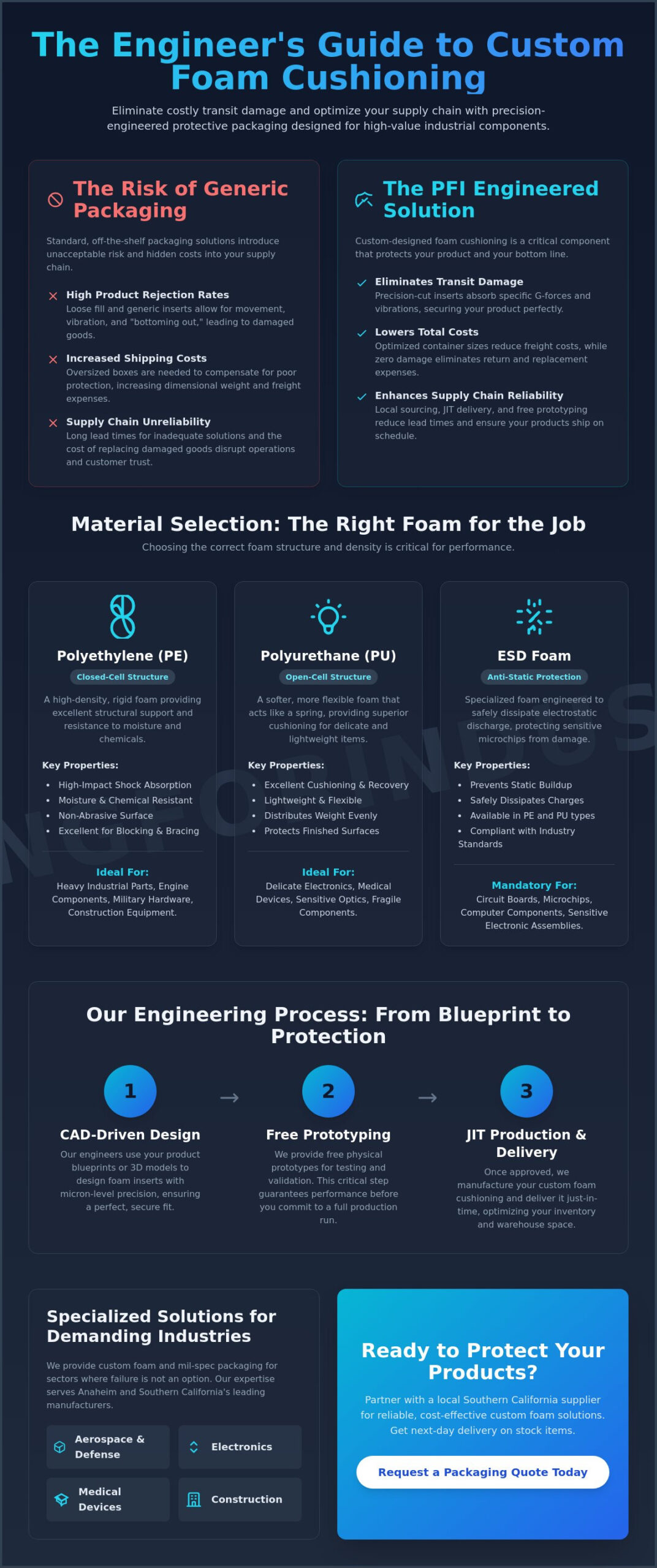
Industrial protection requires more than just filling a box with loose material. The custom foam cushioning Anaheim manufacturers rely on is a precision-engineered component designed to absorb specific G-forces and vibrations that occur during transit. Unlike generic void fill, these inserts are cut to the exact geometry of your product. This ensures that every sensitive corner and delicate surface remains stationary. At PFI, we treat packaging as a critical part of your product’s engineering, not an afterthought. When you use standard packaging for specialized equipment, you aren’t just buying boxes; you’re buying risk.
Standard packaging often fails because it’s designed for general use, not for the specific weight distribution or fragility of industrial goods. Generic foam or loose fill can shift during the turbulence of air freight or the constant vibration of long-haul trucking. This movement leads to “bottoming out,” where the product strikes the outer container wall. Precision blocking and bracing with custom foam eliminates this movement entirely. By securing the product in a fixed position, you create a controlled environment that maintains integrity from the assembly line to the end user.
The Economics of Product Protection
The true cost of a product rejection extends far beyond the price of the item itself. You must account for return freight, warehouse labor, and the potential loss of a long-term contract due to unreliability. Custom foam helps mitigate these expenses while also optimizing your dimensional weight. Loose fill often requires oversized boxes to provide adequate clearance, which increases shipping rates. Precision-cut inserts allow for smaller, more efficient corrugated containers that reduce your overall shipping footprint. The ROI of custom packaging is defined by the total elimination of preventable transit damage and the streamlining of your logistical costs.
Protecting High-Value Components
Packing peanuts and bubble wrap are insufficient for heavy industrial components or sensitive laboratory equipment. These materials compress under weight, leaving your product vulnerable to impact. For finished surfaces or sensitive optics, you need non-abrasive materials that won’t scratch or mar the product. We often utilize Polyurethane foam for its excellent cushioning properties and versatility in protecting fragile items. By investing in custom design packaging, you ensure that your high-value components arrive in factory-perfect condition. This level of protection is essential for sectors like aerospace and medical manufacturing, where even microscopic damage can lead to catastrophic failure.
Material Selection: Comparing Polyethylene, Polyurethane, and ESD Foam
Selecting the right material is the most critical step in the design of custom foam cushioning Anaheim operations require for high-performance protection. The distinction begins with cell structure. Closed-cell foams, such as polyethylene, feature sealed cells that provide high structural integrity and moisture resistance. In contrast, open-cell foams like polyurethane have interconnected pores that allow for greater flexibility and airflow. Choosing between these structures depends entirely on your product’s weight, fragility, and the environmental conditions it will face during transit.
Polyethylene (PE) foam is the industry workhorse for heavy-duty protection. It’s a high-density, closed-cell material that resists chemicals and moisture, making it ideal for heavy engine parts, construction equipment, or military hardware. For lighter, more delicate items, polyurethane (PU) foam offers soft, resilient cushioning. This material shares characteristics with NASA-developed foam, specifically its ability to distribute weight evenly and absorb significant kinetic energy without damaging the payload. When your supply chain involves sensitive electronics, specialized ESD (Electrostatic Discharge) foam is mandatory to prevent static buildup that could destroy sensitive microchips.
Density and Firmness: Finding the Sweet Spot
Foam density is measured in pounds per cubic foot and dictates how much weight the material can support before it compresses. We evaluate these properties using official testing procedures like ASTM D3574 for flexible materials. A common mistake is over-specifying density, which increases material costs without adding functional protection. We use the “G-Level” concept to match foam firmness to a product’s specific fragility. A rugged industrial pump might tolerate 50Gs, while a medical laser may only handle 15Gs. Getting this right ensures your product doesn’t bottom out during an accidental drop.
Specialized Additives and Mil-Spec Standards
Regulated industries often require additives for fire retardancy or anti-static performance. For defense and aerospace contractors in Southern California, meeting Mil-Spec standards is non-negotiable. These regulations dictate specific performance metrics for foam packaging to ensure reliability in extreme temperatures or high-vibration environments. If you are unsure which specification your project requires, you can request a packaging quote to consult with our engineering team. We’ll help you select the most cost-effective material that meets all regulatory and safety requirements.
The Engineering Process: From Blueprint to Prototype
Precision begins at the blueprint stage. For companies requiring custom foam cushioning Anaheim, the design process must be rooted in technical data rather than guesswork. We utilize CAD design to create a digital architecture of your packaging before a single piece of material is cut. This allows us to account for every protrusion, switch, and delicate surface of your equipment. By mapping the product’s geometry digitally, we ensure that the foam provides uniform support and eliminates the internal movement that causes most transit damage. This engineering-first approach is what separates professional industrial protection from simple box stuffing.
We believe you shouldn’t have to commit to a full production run based on a drawing alone. PFI provides physical prototypes so you can perform actual fit testing in your facility. This stage is critical for identifying potential stress points that might not be visible on a screen. While research into advanced 3D-printed foams shows how the industry is evolving toward higher performance, our focus remains on delivering reliable, mechanically cut solutions that perform under real-world logistics pressure. Prototyping reduces your procurement risk and ensures the final product meets your exact specifications.
Collaborative Design and Fit Testing
Our engineers work directly with your operations team to identify critical impact points. We don’t just look at how the product fits; we look at how your staff interacts with it. This collaborative phase often leads to the inclusion of finger wells and easy-access cutouts. These small design details improve end-user convenience and reduce the likelihood of accidental drops during the unboxing process. A well-designed insert protects the product while simultaneously improving the efficiency of your assembly and shipping departments.
Scalability from One to One Million
Once the prototype is approved, we transition to the most cost-effective manufacturing method for your volume. For complex, low-volume runs, waterjet cutting offers extreme precision without the need for expensive tooling. For high-volume wholesale production, die cutting provides the speed and consistency required to maintain a steady supply chain. These custom inserts are designed to integrate seamlessly with our heavy-duty corrugated boxes, providing a total solution from a single source. This integrated approach is a primary driver of packaging cost savings, as it reduces the number of vendors you manage and ensures all components work together perfectly.
Industry-Specific Applications for Custom Foam in Anaheim and Beyond
Anaheim is home to a diverse industrial base ranging from advanced defense contractors to medical device manufacturers. Each of these sectors requires a unique approach to custom foam cushioning Anaheim providers must deliver with precision. While a standard foam block might suffice for a heavy steel casting, it will fail a sensitive satellite component or a calibrated surgical laser. We understand that your packaging is a functional extension of your quality control process. Professional-grade protection is not a generic commodity; it’s a specialized tool tailored to the specific vulnerabilities of your product.
Aerospace Packaging Compliance
The aerospace sector demands strict adherence to weight and safety specifications. When shipping flight-ready components, every ounce matters for freight efficiency, yet protection cannot be compromised. Our aerospace packaging solutions utilize high-performance foams designed for multi-stage transit, where items move from truck to air cargo and back again. These environments subject avionics and precision-machined parts to varying atmospheric pressures and high-frequency vibrations. High-performance foam is a necessity for multi-stage transit to ensure that delicate internal alignments remain intact regardless of the handling conditions.
Medical Device Protection
Medical and laboratory equipment often features fragile glass and complex diagnostic sensors that cannot tolerate even minor shifts. We prioritize zero-movement transit for these instruments by engineering tight-tolerance inserts that lock the device in place. Cleanliness is equally critical. We utilize non-dusting foams to maintain the strict standards required in medical environments. This prevents particulate contamination of sterile kits and sensitive optical sensors. By integrating these materials into your manufacturing packaging strategy, you reduce the risk of re-calibration needs or sterile seal breaches upon arrival.
Electronics and Automotive Logistics
High-density server components and microelectronics are highly susceptible to electrostatic discharge. We use specialized ESD foams that dissipate static while providing the structural rigidity needed for heavy hardware. In the automotive sector, the focus shifts to high-volume dunnage and logistical flow. We support assembly lines with just-in-time delivery of custom foam inserts. This ensures that parts are protected during the shuttle between sub-assembly plants and the final factory floor. This level of coordination helps maintain production speed without sacrificing component safety.
If your operation requires specialized protection for high-value goods, request a packaging quote to see how our engineering team can secure your specific application.
Sourcing Custom Foam Cushioning: The PFI Advantage
Choosing a partner for custom foam cushioning Anaheim operations involves more than just comparing material costs. It’s about securing a logistical advantage. While national suppliers often struggle with rigid lead times and high freight costs, our local presence in Southern California allows us to respond with the speed your manufacturing schedule demands. We don’t just ship products; we provide a localized support system that understands the specific pressures of the regional supply chain. Whether you’re moving precision parts across town or coordinating a nationwide rollout, our infrastructure is built to scale with your needs.
The primary benefit of working with PFI is our single-source capability. Managing multiple vendors for foam, corrugated boxes, and heavy-duty shipping crates creates administrative friction and increases the risk of compatibility issues. We eliminate this by engineering the entire packaging system under one roof. This ensures that your custom foam inserts fit perfectly within your outer containers, providing a cohesive barrier against transit damage. This integrated approach simplifies your procurement process and ensures total accountability for the safety of your inventory.
Optimizing Your Procurement Strategy
We help businesses reclaim valuable warehouse space through our Vendor Managed Inventory (VMI) and Just-In-Time (JIT) programs. Instead of tying up capital in months of packaging stock, we manage the inventory levels for you and deliver exactly what you need when you need it. Our fleet provides local next-day delivery throughout Orange County, Los Angeles, and San Diego. This reliability is essential for urgent manufacturing runs where a delay in packaging supplies could halt an entire production line. If you’re ready to streamline your supply chain, you can request a quote to discuss a tailored inventory plan.
Why Industrial Buyers Choose PFI
Industrial buyers value direct access to expertise. At PFI, you work directly with packaging engineers who understand the technical requirements of your specific application, rather than just order takers. We offer competitive wholesale pricing on both custom-engineered solutions and stock materials, ensuring you don’t overpay for protection. Our commitment is to a long-term partnership focused on solving complex logistical challenges and reducing your total cost of ownership. We prioritize your operational uptime by delivering professional-grade materials that meet the highest industry standards for durability and performance.
Secure Your Supply Chain with Precision Engineering
Transitioning from generic packaging to a custom-engineered system is a critical investment in your operational stability. By matching specific material densities to your product’s unique fragility, you eliminate the professional stress and fiscal impact of high rejection rates. Our specialists in aerospace and medical packaging ensure your sensitive components meet all regulatory standards while simultaneously optimizing your warehouse footprint through efficient design. You don’t have to settle for one-size-fits-all protection that puts your inventory at risk during transit.
Leveraging custom foam cushioning Anaheim solutions provides your business with a distinct logistical edge. We offer local next-day delivery throughout Southern California and provide free prototyping services to guarantee a perfect fit before you commit to a full production run. This proactive engineering approach ensures that your high-value components arrive in factory-perfect condition, regardless of the shipping environment or handling intensity. It’s about building a system that supports your manufacturing goals and protects your reputation with every delivery.
Ready to eliminate transit damage and improve your supply chain reliability? Request a Custom Packaging Quote Today to see how our solution-oriented team can protect your bottom line and streamline your procurement. We look forward to partnering with you to build a more resilient and cost-effective industrial protection strategy.
Frequently Asked Questions
What is the best foam for protecting heavy industrial parts?
Polyethylene (PE) foam is the optimal choice for heavy industrial components. Its closed-cell structure provides superior load-bearing capacity and shock absorption compared to softer materials. It resists moisture and chemicals, ensuring that heavy equipment remains secure without the foam collapsing under high static loads during long-term storage or transit.
How much does a custom foam prototype cost?
We offer free prototyping services for qualified industrial projects to ensure a perfect fit before full-scale production begins. This allows your engineering team to verify dimensions and perform drop tests without an initial financial commitment. By providing a physical sample, we help you eliminate the risk of design errors and ensure the final custom foam cushioning Anaheim manufacturers receive meets exact specifications.
Can you provide ESD-safe foam for electronics?
Yes, we supply specialized anti-static and conductive foams designed specifically for sensitive electronic components. These materials prevent electrostatic discharge that can damage microchips and circuit boards during handling and shipping. We offer these in various densities to accommodate everything from lightweight PCBs to heavy server racks, ensuring both physical and electrical protection.
Do you offer local delivery for businesses in Anaheim or Orange County?
We provide local next-day delivery services throughout Anaheim and the greater Orange County area using our own fleet of trucks. This logistical advantage allows us to support just-in-time manufacturing schedules and urgent replenishment needs. Our proximity to Southern California industrial hubs reduces freight costs and lead times compared to out-of-state suppliers.
What information do I need to provide for a custom foam quote?
To receive an accurate quote, you should provide the dimensions, weight, and fragility of your product, along with a CAD file or physical sample if possible. We also need to know your anticipated order volume and any specific environmental requirements, such as moisture resistance or fire retardancy. This data allows our engineers to calculate the most cost-effective density and material thickness for your application.
Is there a minimum order quantity for custom-cut foam inserts?
While we specialize in bulk industrial orders, we maintain the flexibility to handle smaller production runs for specialized aerospace or medical projects. Our use of waterjet cutting technology allows us to provide custom sizes available without the high upfront cost of die tooling. We recommend discussing your specific volume requirements with our sales team to determine the most economical production method.
How long does it take to design and manufacture custom foam cushioning?
The typical timeline for design and prototyping is 24 to 48 hours, with full production runs often completed within one to two weeks depending on complexity. We prioritize speed in our engineering phase to help you avoid supply chain bottlenecks. Our integrated manufacturing process ensures that custom inserts and corrugated boxes are ready simultaneously for a seamless assembly experience.