
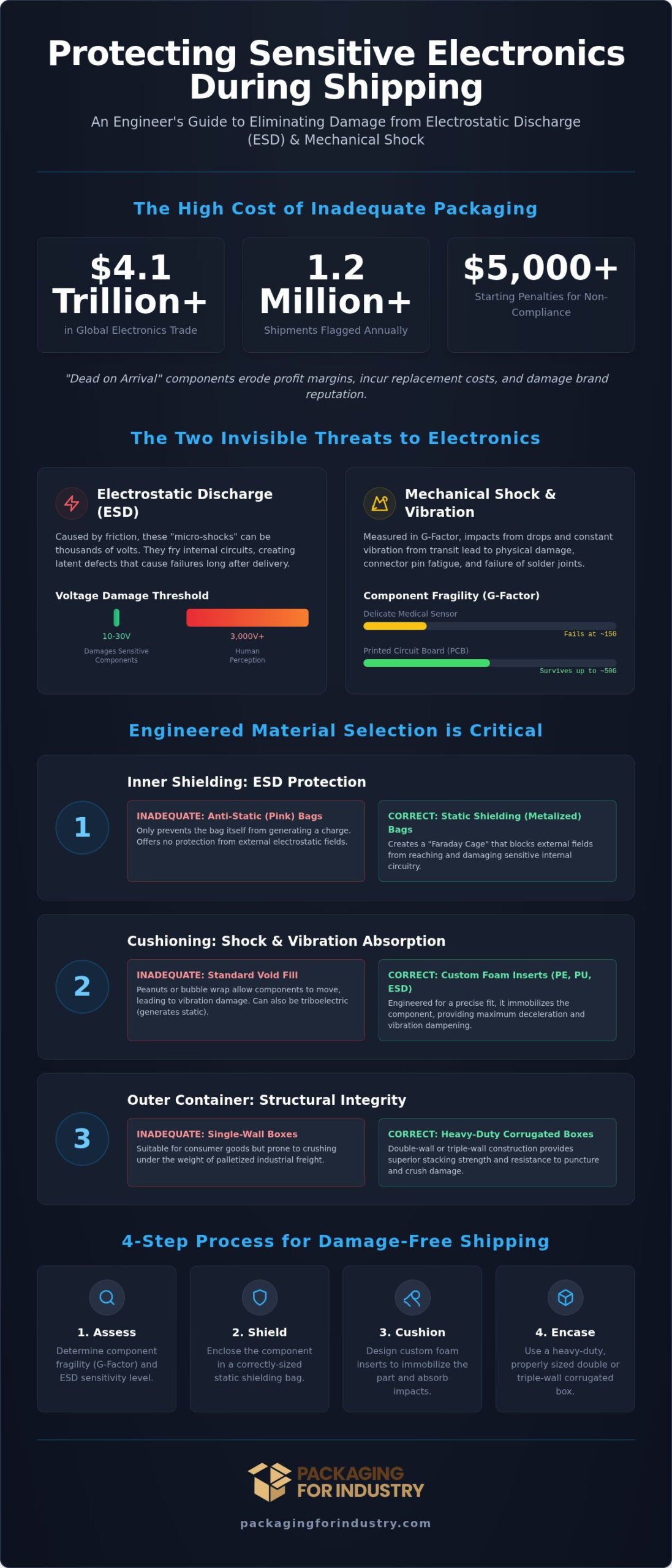
In 2025, global electronics trade surpassed $4.1 trillion, yet over 1.2 million shipments were flagged for non-compliance, often leading to administrative penalties starting at $5,000. For most manufacturers, the greater concern is the high rate of “dead on arrival” components that erode profit margins and damage brand reputation. Learning how to protect sensitive electronics during shipping is a technical challenge that requires more than just bubble wrap; it demands a precise understanding of deceleration and electrostatic discharge. You understand the frustration of balancing rigid Mil-Spec compliance with the need to reduce expensive over-packaging that drives up freight costs.
This article provides the engineering framework and material insights required to eliminate shipping damage for high-value components. We’ll examine the specific foam densities and corrugated strengths needed for impact protection, alongside the 2026 IATA regulations regarding lithium battery shipments. You’ll discover how to implement a repeatable packaging process that lowers your total cost of ownership through damage reduction. Whether you’re navigating tariffs on printed circuit boards or looking for a reliable Southern California supplier for specialized materials, this guide outlines the path to a more efficient, reliable supply chain.
Key Takeaways
- Identify the technical differences between anti-static and static shielding materials to prevent latent circuit failures caused by invisible electrostatic discharge.
- Compare the total cost of ownership between custom foam inserts and manual void fill to identify labor savings and reduced product return rates.
- Master the engineering principles of how to protect sensitive electronics during shipping by prioritizing precise deceleration and non-conductive primary shielding.
- Leverage Vendor Managed Inventory (VMI) to ensure a consistent supply of ESD-safe packaging materials without tying up capital in excess warehouse stock.
- Partner with a local Southern California supplier for specialized, Mil-Spec compliant packaging solutions and just-in-time delivery throughout Orange County and Los Angeles.
The Dual Threats to Sensitive Electronics: ESD and Mechanical Shock
Standard shipping protocols often fail when applied to high-value industrial electronics. While a heavy-duty corrugated box provides structural integrity, it offers no defense against the two primary causes of component failure: Electrostatic Discharge (ESD) and mechanical shock. Understanding how to protect sensitive electronics during shipping begins with recognizing that these threats are often invisible until the end-user attempts to power on the device. When a product arrives “dead on arrival,” the financial impact extends far beyond the cost of the hardware. You must account for expedited shipping fees for replacements, the labor hours required for technical troubleshooting, and the long-term erosion of your brand’s reputation for reliability.
ESD occurs when two surfaces move against each other, creating a charge that can exceed several thousand volts. While humans don’t feel a static shock below 3,000 volts, a modern semiconductor can be permanently damaged by as little as 10 to 30 volts. These “micro-shocks” fry internal circuits, creating latent defects that might not appear until the product is in the field. Mechanical shock is equally dangerous and is measured by the “G-factor,” which represents the maximum acceleration a component can withstand before failure. A printed circuit board might survive 50G, but a delicate medical sensor could fail at 15G. Engineering a solution involves selecting the right custom foam packaging to ensure that deceleration during a drop stays well below these critical limits.
Why Standard Packaging Fails High-Tech Components
Traditional materials like standard bubble wrap or polystyrene peanuts are triboelectric, meaning they generate static through friction. They essentially act as capacitors that discharge directly into your product. Additionally, standard corrugated boxes provide zero protection against electromagnetic interference (EMI). Electrostatic discharge is a silent killer of semiconductors that requires proactive shielding. To mitigate this, professional shippers use a specialized Antistatic bag to create a Faraday cage around the component, neutralizing external charges before they reach the circuitry.
Identifying Fragility Levels in Industrial Electronics
Fragility isn’t just about a single drop; it’s about cumulative stress. Long-haul freight exposes electronics to constant vibration, which can lead to fatigue in solder joints and connector pins. This is a primary concern for the aerospace and defense sectors, which often mandate military packaging standards to ensure survival in extreme logistical environments. Utilizing custom foam inserts allows for a repeatable, engineered fit that locks components in place. This eliminates the internal movement that leads to vibration-induced failures and is a core component of how to protect sensitive electronics during shipping successfully.
Essential Materials for Electronic Product Protection
Selecting the correct materials is the first step in operationalizing a damage-reduction strategy for high-value tech. Many procurement managers make the mistake of using standard anti-static bags for every component, but there’s a critical distinction between anti-static and static shielding. Anti-static materials, often identified by their pink color, simply prevent the packaging itself from generating a charge. Static shielding bags, however, utilize a metalized layer to block external electrical fields from reaching the internal circuitry. Knowing how to protect sensitive electronics during shipping requires matching the material’s resistance level to the component’s specific voltage sensitivity.
The structural integrity of the outer container is equally vital. While standard single-wall boxes suffice for consumer goods, industrial electronics require double-wall or triple-wall heavy-duty corrugated boxes as a baseline. These provide the stacking strength necessary for palletized freight and resist the “crush” damage that occurs during transit. To further secure these shipments, implementing corner and edge protection prevents the strapping from cutting into the boxes, maintaining the structural cage around your equipment. This multi-layered approach ensures that the “G-factor” limits discussed in the previous section are never exceeded during rough handling.
Specialized Foam: Polyethylene vs. Polyurethane
Pink anti-static foam is treated with a chemical agent that prevents the material from generating static through friction, making it ideal for cushioning the outer chassis of electronic units. For highly sensitive semiconductor wafers or unshielded PCBs, conductive black foam is the superior choice because it actively dissipates existing charges. You must select foam density based on the weight of the device; high-density polyethylene (PE) is necessary for heavy servers to prevent the item from “bottoming out” the cushion, while soft polyurethane (PU) is better for lightweight, fragile sensors that require high-frequency vibration dampening. Using custom foam packaging ensures these materials are placed exactly where the component is most vulnerable.
Corrugated Solutions and Outer Shields
Standard boxes often lead to over-packaging or excessive void fill, which increases your total cost of ownership through higher freight rates. Utilizing custom corrugated boxes allows for a precision fit that eliminates internal movement and reduces the amount of material required per shipment. For international sea freight, we recommend moisture barrier bags (MBB) to protect against the corrosive effects of salt air and humidity on delicate solder joints. Metalized static shielding bags utilize a multi-layer construction to create a Faraday cage, effectively redirecting external electrostatic charges around the bag’s perimeter to keep the internal components safe from electrical surges. You can request a packaging quote to compare how these specialized materials can lower your long-term damage rates.
Custom Foam Inserts vs. Standard Void Fill: A Cost-Benefit Analysis
When determining how to protect sensitive electronics during shipping, many operations managers focus solely on material unit price while ignoring the hidden costs of labor and dimensional weight (DIM) surcharges. Standard void fill, such as packing peanuts or bubble wrap, appears inexpensive on a purchase order but requires significant manual labor to apply correctly. Hand-wrapping a delicate circuit board or server component takes minutes; dropping that same component into a custom foam insert takes seconds. Over a high-volume production run, these labor savings directly improve your throughput and lower your total cost per unit shipped.
Standard void fill also introduces a high degree of human error into the packing line. The safety of your product depends entirely on the warehouse worker’s consistency. If a packer uses too little material or fails to secure the corners of a heavy chassis, the component is likely to fail during transit. Engineered inserts eliminate this variability by creating a foolproof, repeatable process that guarantees every unit receives the same level of protection. Additionally, custom kitting simplifies your inventory management. Instead of stocking five different cushioning materials, your team handles a single, integrated kit that houses all necessary electronic parts and accessories in one secure container.
The ROI of Engineered Protection
The financial impact of a single “dead on arrival” medical device or aerospace sensor can be devastating. Between the cost of the replacement hardware, the technician’s labor for troubleshooting, and the expedited freight for both directions, the expense far outweighs the cost of a precision-cut insert. Furthermore, using oversized generic boxes filled with loose void fill increases the cubic volume of your parcels. This triggers higher DIM weight surcharges from carriers like UPS and FedEx. Precision engineering allows you to use the smallest possible outer container without compromising the safety of the internal components. You can review our strategies for packaging cost savings to see how optimized design reduces both material waste and freight expenses.
Prototyping and Testing Your Solution
A reliable how to protect sensitive electronics during shipping strategy must be verified before a full production rollout. We utilize CAD/CAM support to design inserts for complex components, ensuring that every contour is supported and every vibration is dampened. This level of precision is essential for meeting ISTA shipping standards and aerospace compliance. We provide prototyping services to ensure a perfect fit, allowing you to test the packaging’s performance under real-world logistical stress. This proactive approach prevents the costly trial-and-error often associated with generic packaging supplies and ensures your high-value electronics arrive functional every time.
Step-by-Step: Best Practices for Packing Industrial Electronics
Establishing a standardized workflow for your warehouse team is the most effective way to eliminate variability in product safety. Before any packaging material is applied, technicians must clean and inspect every component to ensure no conductive debris is trapped within the primary shielding. This inspection process prevents physical abrasion and ensures that the electrical integrity of the device is maintained. Mastering how to protect sensitive electronics during shipping requires a disciplined, step-by-step approach to material application that prioritizes both electrical and mechanical security.
- Apply primary shielding using static barrier bags to create a Faraday cage around the circuitry.
- Secure the component within custom-cut foam inserts to prevent internal movement and absorb vibration.
- For high-value international transit, utilize foam-lined crates to provide a rigid, impact-resistant outer shell.
- Seal the outer corrugated box with industrial-grade adhesive tape to prevent moisture ingress and dust contamination during long-haul freight.
- Apply visible ‘Fragile’ and ‘ESD Sensitive’ labels to ensure carriers handle the shipment with the appropriate level of care.
The ‘Box-in-Box’ Method for High-Value Tech
High-value technology often requires a secondary outer container to maximize shock attenuation. This “box-in-box” configuration creates a vital buffer zone, typically requiring at least two inches of space between the inner and outer containers. This space should be filled with high-density foam to ensure the inner unit doesn’t shift. To prevent the outer carton from collapsing under the pressure of stacking in a warehouse, you should apply corner and edge protection to reinforce the vertical strength of the parcel.
Palletizing and Stabilization
Load stability is critical when moving bulk quantities of electronic components. You should stack boxes in a column pattern to align the strongest points of the corrugated material and avoid crushing the bottom layer. Use high-performance stretch film to secure the load to the pallet, preventing load shift during forklift maneuvers or sudden stops in transit. Implementing these palletizing standards is a final, vital step in how to protect sensitive electronics during shipping at scale, especially when utilizing pallet toppers to prevent other freight from being stacked on top of your sensitive equipment.
Why Manufacturers Partner with PFI for Electronics Packaging
Manufacturers in Southern California face unique logistical challenges that require a partner capable of moving at the speed of the global tech market. PFI provides the specialized expertise needed to navigate these complexities, serving industrial hubs across Los Angeles, Orange County, and San Diego. We don’t just supply materials; we engineer comprehensive systems for how to protect sensitive electronics during shipping. Our team understands that for high-value sectors like aerospace, medical, and defense, compliance with Mil-Spec standards is not optional. We provide the documentation and precision required to ensure your shipments meet every regulatory hurdle without unnecessary over-packaging.
One of the most significant advantages we offer high-volume electronics production lines is Vendor Managed Inventory (VMI). Managing a supply chain for sensitive components is difficult enough without worrying about stockouts of ESD-safe materials or custom foam inserts. Through our VMI program, we monitor your usage levels and replenish your stock automatically. This proactive approach ensures you always have the protective materials you need while improving your cash flow by reducing the amount of capital tied up in warehouse overhead. It’s a pragmatic solution designed to eliminate professional stress and keep your shipping department running at peak efficiency.
Local Expertise, Nationwide Reach
Anaheim-based manufacturers and distributors choose PFI because we provide immediate, hands-on packaging reviews that remote suppliers cannot match. If a new component design requires a rapid protection strategy, our engineers can provide fast turnaround on custom prototypes and CAD-designed foam samples. We offer local next-day delivery options throughout the Inland Empire and Riverside to support just-in-time manufacturing schedules. While our roots are in Southern California, we maintain the infrastructure to scale your operations for nationwide distribution, ensuring consistent protection levels across your entire supply chain.
Request Your Custom Packaging Quote
Optimizing your packaging process is a direct path to lowering your total cost of ownership. We invite you to contact our team for a detailed damage-reduction analysis to identify where your current process may be failing. Whether you need a custom packaging quote for a new product launch or a comparison of your current material spend, we provide the data-driven insights you need to make an informed decision. We offer free samples and precision-cut prototypes to demonstrate exactly how to protect sensitive electronics during shipping while reducing your freight and replacement costs.
Optimize Your Electronics Logistics Strategy
Effective electronics protection is an intersection of engineering and economics. You’ve seen how neutralizing electrostatic discharge and managing mechanical shock through custom foam densities can eliminate the professional stress of “dead on arrival” shipments. By moving away from generic void fill and adopting a repeatable, engineered process, you lower your total cost of ownership and protect your brand’s reputation for reliability.
Mastering how to protect sensitive electronics during shipping is easier with a partner who understands the technical requirements of Mil-Spec and aerospace compliance. PFI offers specialized ESD expertise and free CAD prototyping to ensure your components fit perfectly every time. Our local Southern California facility provides next-day delivery to Los Angeles, Orange County, and San Diego; this keeps your production lines moving without interruption. We don’t just sell boxes; we provide the precision tools your warehouse needs to succeed.
We’re ready to help you refine your packaging workflow and reduce shipping damage. Let’s build a more reliable and cost-effective supply chain together.
Frequently Asked Questions
What is the difference between anti-static and static shielding packaging?
Anti-static packaging prevents the material itself from generating a charge through friction, while static shielding blocks external electrical fields from penetrating the bag. Static shielding bags utilize a metalized layer to create a Faraday cage, which is essential for unshielded circuit boards. Anti-static materials are typically pink and serve as a secondary layer for non-sensitive components or the outer chassis. Choosing the wrong material can lead to latent defects that cause components to fail shortly after arrival.
Do I really need custom foam for shipping electronics, or is bubble wrap enough?
Custom foam is required for high-value electronics because it provides engineered deceleration that bubble wrap cannot match. While bubble wrap is a generic void fill, custom foam inserts are designed to meet specific G-factor requirements for your product. This precision engineering is the most reliable way to learn how to protect sensitive electronics during shipping and reduce the high costs associated with product returns. It eliminates the human error often found in manual wrapping processes.
How can I reduce shipping damage for my electronic products in Southern California?
Partnering with a local industrial packaging supplier near me allows for hands-on packaging reviews and onsite audits of your shipping department. PFI serves Los Angeles, Orange County, and San Diego with engineered materials that address the specific vibration and shock profiles of regional freight. Implementing a standardized, repeatable packing process with specialized foam and heavy-duty corrugated boxes will immediately lower your damage rates. This local presence ensures faster response times regarding how to protect sensitive electronics during shipping.
What are the Mil-Spec requirements for shipping sensitive defense electronics?
Mil-Spec packaging requires adherence to strict material standards, such as MIL-DTL-117 for bags and MIL-P-26514 for polyurethane foam. These regulations ensure that defense electronics can survive extreme temperatures, humidity, and rough handling in military logistical chains. PFI provides the necessary documentation and compliant materials to help aerospace and defense manufacturers meet these rigorous government contract obligations. We help you navigate the complexity of meeting Mil-Spec or aerospace compliance without increasing your total freight costs through over-packaging.
How does box size affect the cost of shipping electronics?
Box size directly impacts freight costs through Dimensional Weight (DIM weight) pricing used by carriers like FedEx and UPS. If your box is unnecessarily large, you’re paying to ship air rather than product. Using custom corrugated boxes allows you to utilize the smallest possible footprint that still provides adequate cushioning. This strategy lowers your shipping costs and reduces the amount of secondary void fill required. It’s a pragmatic approach to maintaining fiscal responsibility across your logistics operations.
Can PFI provide prototypes for custom foam inserts before I place a bulk order?
Yes, PFI provides CAD-designed prototypes and free samples before you commit to a bulk packaging supplier contract. We use precision cutting technology to create foam inserts that match the exact contours of your electronic components. This prototyping phase allows your team to verify the fit and performance of the packaging, ensuring it meets your internal quality standards before a full production rollout. It’s an essential step for high-value components that require a guaranteed level of protection during transit.
What is the best way to protect circuit boards from moisture during international shipping?
Moisture Barrier Bags (MBB) are the industry standard for protecting circuit boards from corrosion during international sea freight. These bags are constructed with multiple layers of foil and polyester to prevent water vapor from reaching the electronics. When combined with desiccant packets and humidity indicator cards, they provide a controlled environment that protects delicate solder joints from the corrosive effects of salt air. This prevents the oxidation that leads to premature board failure and costly product returns.
Does PFI offer local next-day delivery for packaging supplies in Orange County?
PFI offers local next-day delivery for stock packaging supplies throughout Orange County, Anaheim, and the Inland Empire. Our local fleet ensures that your warehouse never runs out of critical items like stretch film, anti-static foam, or heavy-duty boxes. For high-volume manufacturers, we also provide Vendor Managed Inventory (VMI) to automate replenishment and further improve your supply chain reliability. This service allows you to maintain lower inventory levels while ensuring you always have the protection materials required.