
A single millimeter of cardboard is often the only thing standing between a seamless production run and a total line collapse that costs your facility thousands in lost productivity. You’ve likely dealt with the frustration of cores buckling under high-tension winding or the irritation of overpaying for over-engineered specs that your application doesn’t actually require. With major North American containerboard producers recently announcing price increases of up to $70 per ton, getting your specifications wrong is more expensive than ever.
Learning how to choose the right wall thickness for cardboard cores is a critical step for any Los Angeles manufacturer aiming to balance structural integrity with operational efficiency. We understand that your goal is to eliminate downtime and find a reliable Southern California partner who can provide custom engineering. This article provides a technical roadmap to help you master thickness requirements, reduce material waste, and optimize your industrial winding processes for maximum reliability and cost-effectiveness.
Key Takeaways
- Understand the critical relationship between Inside Diameter (ID) and Outside Diameter (OD) to ensure your cores provide the necessary radial crush resistance for heavy loads.
- Learn how to choose the right wall thickness for cardboard cores by accurately calculating winding tension and total roll weight to prevent structural collapse.
- Identify industry-standard thickness ranges for your specific application, from light-duty label cores to medium-duty industrial film and paper mill specifications.
- Recognize the early warning signs of core failure and end-damage that lead to costly production downtime and unstable palletized shipments.
- Discover the operational advantages of sourcing custom-engineered cores from a local Los Angeles packaging supplier to reduce lead times and optimize material costs.
Defining Cardboard Core Wall Thickness and Its Role in Load Stability
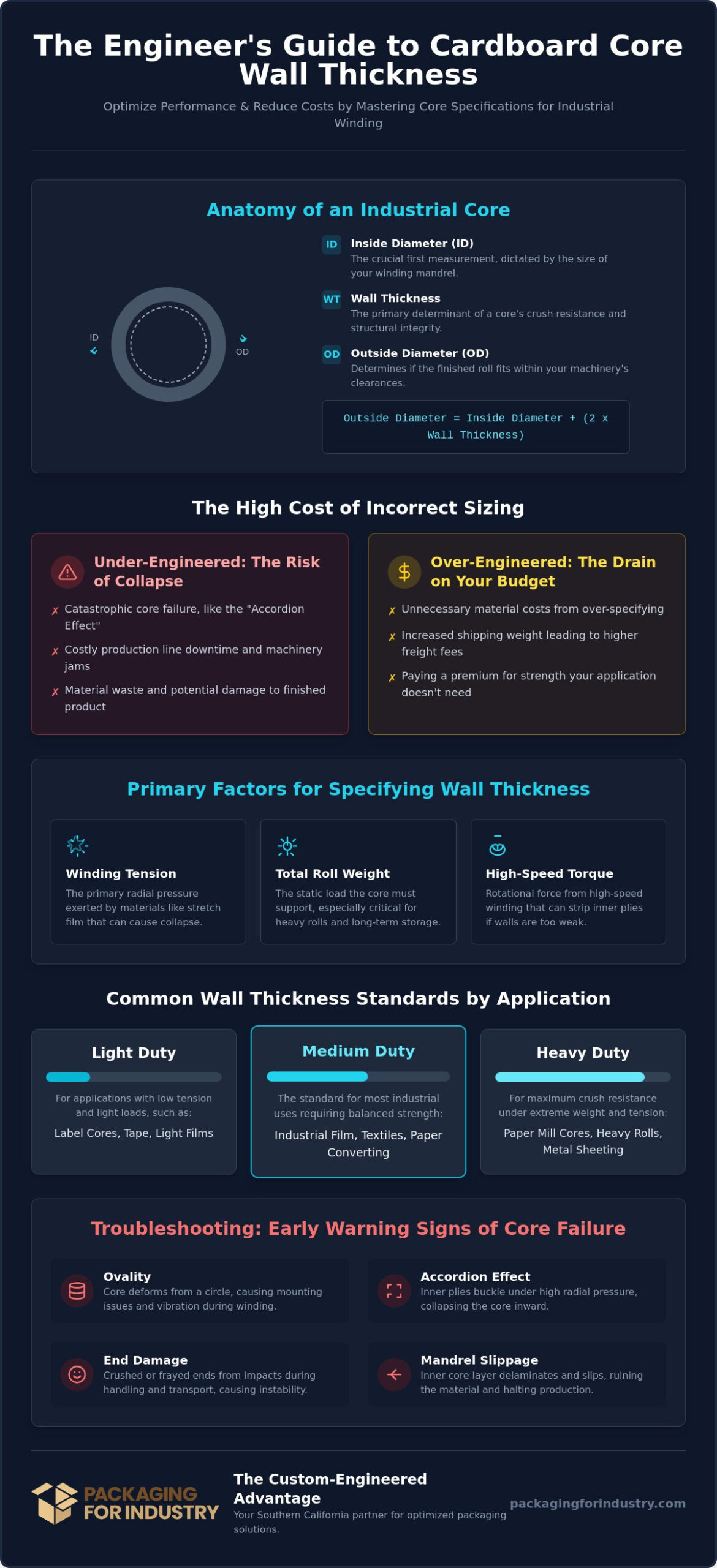
Industrial manufacturing in Los Angeles requires precision at every stage of the supply chain. When you order tubes and cores, understanding the anatomy of these components is the first step toward operational reliability. An industrial core is defined by three primary dimensions: the Inside Diameter (ID), the Outside Diameter (OD), and the Wall Thickness. While the ID is dictated by your winding mandrel, the wall thickness is the primary determinant of a core’s crush resistance. It’s the physical barrier that prevents the radial pressure of your material from collapsing the tube inward.
When engineering these products, we view the core as more than just paper. In the context of Defining Cardboard Core Wall Thickness, the core is a composite structure where multiple layers of paperboard are bonded with specialized adhesives. The “Ply Bond” strength describes how well these individual layers resist delamination under stress. To optimize your budget, we often utilize high-grade kraft paperboard. This premium material provides superior fiber density, allowing us to achieve higher structural integrity with thinner walls, which directly lowers your shipping weight and material costs.
The Relationship Between ID, OD, and Wall Thickness
Calculating the Outside Diameter is a critical step for ensuring machine compatibility. To find your OD, you must double the wall thickness and add it to the Inside Diameter. If you’re using a 3-inch mandrel and a 0.5-inch wall, your final OD is 4 inches. This measurement is vital because it determines if the finished roll will fit within the clearances of your conversion or packaging machinery. Beyond fit, wall thickness significantly impacts the total weight of your palletized shipments. In 2026, where freight costs are closely tied to fuel surcharges, over-engineering a core by just 0.125 inches can lead to thousands of pounds of unnecessary weight across a large production run. We help you balance this through custom design packaging solutions that match your specific machinery requirements.
Structural Integrity: Why Thickness Matters for Operations
Operational failures often stem from “ovality,” which is the deformation of a core from a perfect circle into an oval shape during transport or storage. If a core loses its shape, it won’t mount properly on your mandrel, leading to immediate production downtime. Furthermore, the wall thickness dictates the maximum torque a core can withstand. High-speed winding processes apply immense rotational force; if the wall is too thin, the mandrel may strip the inner plies, causing the roll to slip and ruin the material. Wall thickness serves as the structural spine of the winding process, ensuring the core remains intact under the immense radial pressure of high-speed industrial machinery. Understanding how to choose the right wall thickness for cardboard cores ensures your product remains secure from the initial wind to the final customer delivery.
Primary Factors for Specifying Wall Thickness
Selecting the correct specifications for your industrial cores requires more than a cursory glance at a catalog. Every millimeter of thickness must be justified by the physical demands of your production line and storage environment. If you specify a wall that is too thin, you risk catastrophic core collapse during high-speed winding. Conversely, over-engineering leads to unnecessary material costs and increased freight expenses. Given that North American containerboard prices rose by up to $70 per ton in June 2026, precision in your specifications is now a financial necessity for any Los Angeles manufacturer.
Winding tension is the most aggressive force your core will face. While many suppliers focus on static weight, the real challenge is radial pressure. Elastic materials like stretch film or certain textiles apply constant inward force long after the winding process ends. If your wall is too thin, you’ll experience the “Accordion Effect,” where the inner plies buckle and collapse toward the center. This failure ruins the product and can jam your machinery, leading to hours of production downtime. Understanding how to choose the right wall thickness for cardboard cores involves calculating this continuous inward pressure to ensure the core remains structurally sound.
Calculating Radial and Lateral Tension
Radial tension is the inward pressure exerted by the material as it is wound. Lateral tension involves the side-to-side forces during transport. For specialized sectors such as aerospace, where precision winding of composite fibers is standard, high wall density is required to maintain material integrity. If the core deforms even slightly, the tension of the wound material changes, which can lead to product defects. We focus on matching the ply-grade of the paperboard to these specific tension levels to ensure your cores don’t fail under the stress of high-speed industrial mandrels.
Weight Distribution and Stacking Requirements
Roll weight is a primary factor in determining beam strength. You must calculate the total weight of the material to ensure the core can support it without bowing or “ovality.” This is particularly important for manufacturing packaging where large master rolls are common. Stacking height also plays a role in your decision. The bottom-row cores on a pallet must support the static weight of the entire load above them during long-term storage. In Southern California warehouses, humidity can soften cardboard fibers over time, reducing their effective crush strength. If you’re storing inventory in non-climate-controlled facilities in Orange County or San Diego, you may need to increase wall thickness to account for this environmental softening.
Mandrel fit is the final piece of the puzzle. Ensure your wall thickness doesn’t interfere with automated loading equipment. A core with an OD that is too large might not clear the sensors or grabbers on your high-speed lines. If you’re struggling with core deformation or equipment compatibility, it’s time to request a packaging quote for a custom-engineered solution that balances strength with efficiency.
Common Thickness Standards by Industrial Application
Standardization in core manufacturing provides a baseline, but the specific demands of your sector dictate the final engineering. For many high-volume operations in Southern California, understanding these benchmarks is the most efficient way to begin the procurement process. When you evaluate how to choose the right wall thickness for cardboard cores, you must categorize your application based on the anticipated load and winding speed. Off-the-shelf catalog sizes often fail to account for the unique stresses of specialized machinery, leading to avoidable shipping damage and material loss.
Most industrial applications fall into three primary categories:
- Light-Duty (.060″ to .125″): These are optimized for high-volume, lightweight items. They are the standard for pressure-sensitive labels, adhesive tapes, and lightweight retail films where radial pressure is minimal.
- Medium-Duty (.125″ to .250″): This is the workhorse of the industrial sector. These cores provide the necessary crush resistance for industrial stretch wrap, paper mill master rolls, and standard-grade plastics.
- Heavy-Duty (.250″ to .500″+): Engineered for extreme environments, these cores support heavy textiles, metal foils, and thick-gauge construction plastics. They are designed to resist the massive inward pressure of tightly wound, non-elastic materials.
Industry-Specific Benchmarks
Precision is non-negotiable in aerospace and defense manufacturing. For these sectors, we often provide mil-spec cores with high-density walls that maintain their ID within tight tolerances under vacuum-sealing processes. In the textile industry, lateral strength is the priority. When winding fabrics at 100-inch widths, the core must resist bowing in the center to ensure the material remains flat and wrinkle-free. Conversely, e-commerce and fulfillment centers focus on balancing cost and protection for mailing tubes. In these cases, we optimize the wall thickness to prevent crushing during sorting and transit without adding unnecessary weight to the parcel.
Material Choice: Kraft vs. Recycled Board
The type of paperboard used in your tubes and cores is just as important as the thickness measurement itself. Virgin kraft fibers are longer and stronger than recycled fibers. This allows us to manufacture cores with thinner walls that still provide superior crush strength compared to thicker, recycled alternatives. While recycled board is a cost-effective choice for many applications, it can sometimes lead to inconsistent ply-bonding or softer walls. If your process involves high-torque mandrels or extreme stacking heights, switching to a higher-grade kraft board may allow you to reduce the total thickness while improving overall reliability. This material optimization is a key strategy for manufacturers looking to lower packaging costs while maintaining high performance standards.
Troubleshooting Core Failure: When to Increase Wall Strength
Identifying structural failure on your production line before it leads to a total shutdown is essential for maintaining operational efficiency. Core crush is the most common indicator that your current specifications are inadequate for your winding tension or material weight. When a core collapses, it ruins the wound material and can jam high-speed machinery, resulting in hours of expensive downtime. If you notice rolls becoming “out-of-round” or ovaled during storage, your wall thickness is likely failing to resist the radial pressure of the material.
End-damage is another critical failure point that often goes overlooked until the shipping stage. When the edges of a core collapse under the pressure of strapping or stacking, the entire roll becomes unstable on the pallet. While you can use corner and edge protection to stabilize these loads during transit, increasing the wall thickness at the source is often a more cost-effective long-term solution. Knowing how to choose the right wall thickness for cardboard cores involves analyzing these failure modes to determine if a minor increase in wall strength could prevent major logistical losses.
Visual Signs of Insufficient Wall Thickness
Operators should be trained to spot delamination, which occurs when the individual plies of the paperboard begin to peel or separate under stress. Delamination serves as the primary sign of adhesive or ply failure. Once the bond between layers is compromised, the core loses its beam strength and will quickly buckle. Another warning sign is mandrel slippage. If the core deforms even slightly, the winding mandrel cannot maintain a secure grip, leading to inconsistent tension and potential product defects. These visual cues indicate that your current core density is insufficient for the torque and pressure of your specific winding process.
Optimizing Costs Without Sacrificing Protection
Many Anaheim manufacturers fall into the “Over-Engineering Trap,” where they pay for excessively thick walls to avoid failure, resulting in inflated material and freight costs. We help you find the “sweet spot” by analyzing your specific application and providing prototypes for real-world testing. Testing a custom-engineered core on your own equipment before committing to a high-volume production run ensures you are using the exact thickness required. For example, PFI recently assisted a San Diego electronics distributor in eliminating transit-related core collapse by recalibrating their wall density rather than simply choosing the thickest option in a catalog. This consultative approach allows you to reduce shipping damage while keeping packaging costs under control. If you are experiencing inconsistent core performance, request a packaging quote for a custom core evaluation to optimize your specifications.
Custom Core Solutions and Procurement in Southern California
Local supply chains in Orange County and Los Angeles are essential for maintaining lean manufacturing operations. When your production facility is located in Southern California, the proximity of your packaging partner directly impacts your ability to respond to market shifts. Relying on out-of-state catalog suppliers often leads to lead-time surprises and high freight costs that erode your margins. By partnering with a local Los Angeles packaging supplier, you gain access to custom-engineered cores that are manufactured to your exact specifications, ensuring your machinery runs at peak efficiency without the risk of material shortages.
Precision customization of ID, OD, and wall thickness is the primary way to ensure a perfect match for your specific winding equipment. We don’t believe in a one-size-fits-all approach. Instead, we focus on the technical requirements of your mandrels and the radial tension of your materials. For businesses with recurring core needs, we offer Vendor Managed Inventory (VMI). This service allows us to monitor your stock levels and provide just-in-time delivery, which eliminates the need for you to dedicate valuable warehouse space to bulky core inventory. It’s a pragmatic solution designed to improve your logistical flow while ensuring you never face a production stoppage due to lack of supplies.
PFI’s Custom Engineering Advantage
Our engineering-minded approach starts with free prototyping services. We provide sample cores to ensure a perfect core-to-mandrel fit before you commit to a high-volume order. This phase is critical for determining how to choose the right wall thickness for cardboard cores, as it allows you to test the structural integrity under real-world tension on your own equipment. Furthermore, we offer integrated solutions by combining your core orders with custom corrugated boxes and protective foam. This holistic approach simplifies your procurement process and reduces the number of vendors you need to manage. With our strategic location, we provide next-day delivery capabilities for manufacturing hubs in Riverside and San Bernardino, keeping your supply chain moving with purposeful speed.
Next Steps for Operations Managers
To begin optimizing your packaging spend, we recommend performing a comprehensive packaging audit. This process helps identify core-related waste, such as over-engineered walls that add unnecessary weight or under-engineered cores that cause product damage. Our team is available to conduct a cost-reduction analysis on your current core specifications to find opportunities for fiscal improvement. We focus on the intersection of engineering and economics to ensure your packaging protects your product while supporting your bottom line. If you’re ready to eliminate production downtime and lower your packaging costs, Contact our Anaheim team today to request a packaging quote and secure a reliable partner for your industrial core needs.
Optimize Your Industrial Winding Efficiency
Precision in your core specifications is the difference between a high-speed production run and an expensive line stoppage. By balancing radial crush resistance with material weight, you protect your inventory while eliminating the waste associated with over-engineered packaging. Mastering how to choose the right wall thickness for cardboard cores ensures that your operations remain resilient against the physical demands of winding tension and warehouse stacking. This technical approach reduces product damage and keeps your production schedules on track.
PFI serves as your proactive partner in Southern California, offering the technical expertise needed to streamline your logistics. We provide expert CAD/CAM prototyping to ensure a perfect mandrel fit and offer specialized Vendor Managed Inventory (VMI) to keep your facility stocked without cluttering your floor space. With our reliable next-day delivery across Los Angeles and Orange County, you can maintain a lean supply chain with total confidence. It’s time to stop overpaying for catalog standards and start using cores engineered for your specific application.
Request a Custom Packaging Quote for Industrial Cores today to secure your production line. We look forward to helping you achieve greater operational stability and lower packaging costs.
Frequently Asked Questions
What is the most common wall thickness for industrial cardboard cores?
Medium-duty cores with a wall thickness ranging from .125″ to .250″ are the most common in industrial manufacturing. These specifications provide the necessary crush resistance for standard stretch wrap, paper mill master rolls, and industrial plastics. For lighter applications like labels or tapes, you might use .060″ to .125″, while heavy-duty textiles often require .250″ to .500″ or more to prevent collapse under high radial pressure.
How do I calculate the outside diameter if I know the wall thickness?
To calculate the Outside Diameter (OD), you must add twice the wall thickness to the Inside Diameter (ID). For example, if your winding mandrel requires a 3-inch ID and you specify a 0.25-inch wall, your final OD will be 3.5 inches. This calculation is vital for ensuring the finished roll clears your machine’s safety sensors and fits within the designated clearances of your conversion or packaging equipment.
Can high humidity in Los Angeles affect the strength of my cardboard cores?
High humidity in Southern California warehouses can significantly reduce the structural integrity of cardboard cores by softening the paper fibers. Cardboard is hygroscopic, meaning it absorbs moisture from the air, which can lead to a loss of beam strength and an increased risk of ovality. If you store inventory in non-climate-controlled facilities in Los Angeles or the Inland Empire, we recommend increasing your wall thickness to compensate for environmental softening.
What happens if my core wall is too thin for my winding machine?
If a core wall is too thin, the radial tension of the wound material will cause the core to buckle or collapse inward. This deformation, often called “core crush,” prevents the roll from being mounted on a mandrel for downstream processing. It leads to immediate production downtime and potential product waste. Specifying the correct density is essential to withstand the torque and pressure exerted by high-speed industrial winding machinery.
Does a thicker wall always mean a stronger cardboard core?
A thicker wall does not always guarantee a stronger core because the quality of the paperboard fiber is a primary factor. Cores made from high-grade virgin kraft fibers are often stronger than thicker cores made from lower-quality recycled board. When you learn how to choose the right wall thickness for cardboard cores, it’s important to consider the “Ply Bond” strength and fiber density rather than just the physical thickness of the tube.
How can I reduce shipping damage caused by core collapse?
You can reduce shipping damage by performing a packaging audit to ensure your cores have the necessary radial crush resistance for your specific load. Switching from generic catalog sizes to custom-engineered cores often eliminates the structural failures that cause rolls to collapse during transit. We also recommend using corner and edge protection to stabilize pallets and prevent end-damage to the cores during handling and long-distance shipping.
Does PFI offer custom wall thicknesses for aerospace packaging in Orange County?
PFI provides custom-engineered wall thicknesses specifically designed for aerospace and defense packaging across Orange County and Los Angeles. We understand that aerospace components often require high-density cores that maintain exact tolerances under vacuum-sealing or high-precision winding. Our Anaheim team offers expert CAD/CAM prototyping to ensure your custom cores meet stringent industry standards while optimizing your total material and shipping costs.
Are heavy-duty cardboard cores recyclable?
Heavy-duty cardboard cores are fully recyclable because they are manufactured from paperboard and water-based adhesives. Under California’s SB 343 and SB 54 regulations, uncoated mono-material paper products remain strong candidates for recyclability. This allows manufacturers to meet sustainability goals and comply with state mandates while maintaining the structural integrity required for industrial winding and heavy-duty shipping applications.