
The lowest price per unit in a glossy catalog often results in the highest total cost of ownership once you account for shipping damage and dimensional weight surcharges. While it’s tempting to rely on “big box” retailers for convenience, manufacturers in Los Angeles are finding that a local Alternative to National Packaging Catalog Suppliers offers a far more stable bottom line. You likely recognize that standard RSC boxes rarely provide the precision fit required for sensitive aerospace components or medical devices. With North American containerboard prices rising by $100 per ton in 2026, sticking with oversized, generic packaging is no longer a sustainable strategy for your operational budget.
We understand that your primary goals are to maintain production uptime and eliminate logistics headaches. In this guide, you’ll discover how custom-engineered foam, specialized crates, and local Vendor Managed Inventory (VMI) programs provide superior protection at a lower total cost than generic alternatives. We’ll examine the specific advantages of a Southern California partnership, including next-day delivery and the elimination of the hidden freight fees that often plague national catalog orders. By shifting from a transactional supplier to an engineering partner, you can reduce return rates and ensure your supply chain remains resilient against market volatility.
Key Takeaways
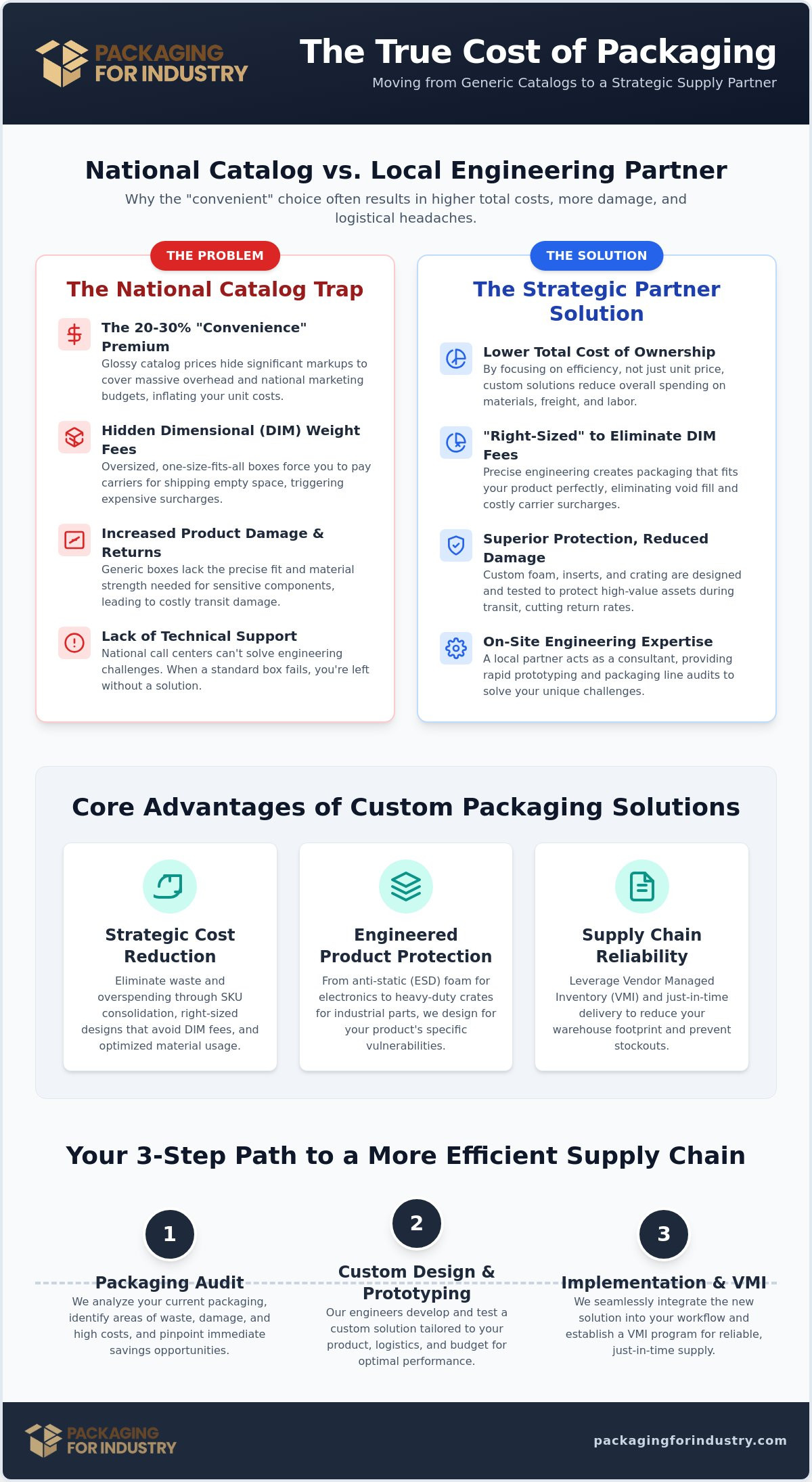
- Learn why the convenience of national catalogs often hides a 20-30% price premium and how to avoid excessive dimensional weight (DIM) fees.
- Discover how transitioning to a local Alternative to National Packaging Catalog Suppliers reduces shipping damage through precise prototyping and material selection.
- Understand the fiscal benefits of SKU consolidation and “right-sizing” to eliminate carrier surcharges and lower your total cost of ownership.
- Explore how Southern California manufacturers leverage Vendor Managed Inventory (VMI) and just-in-time delivery to improve supply chain reliability.
- Get a clear roadmap for conducting a packaging audit to identify immediate savings when transitioning from generic suppliers to custom manufacturing.
Why Purchasing Managers are Moving Away from National Packaging Catalogs
For many procurement teams, the convenience of a 1,000-page catalog has become a significant financial liability. While these massive retailers offer a broad range of products, the “catalog trap” often carries a 20% to 30% price premium. This markup isn’t just found in the unit price; it’s baked into the inefficiencies of using stock sizes for specialized industrial products. As containerboard prices rose by $100 per ton in early 2026, manufacturers can no longer afford the wasted material inherent in generic shipping supplies. Finding a local Alternative to National Packaging Catalog Suppliers is now a strategic necessity for maintaining operational margins.
The shift toward strategic sourcing over transactional buying is driven by the need for precision. National catalogs prioritize volume and standardized SKUs, which rarely align with the complex requirements of the aerospace or medical device sectors. When you rely on a generic vendor, you’re essentially paying for their massive overhead and national marketing budgets rather than the quality of the protection provided to your goods. Transitioning to a specialized manufacturer allows you to redirect those funds into better materials and more efficient designs.
The True Cost of ‘One-Size-Fits-All’ Supplies
Oversized boxes do more than waste corrugated material. They force your warehouse team to use excessive void fill, increasing both material spend and labor time at the packing station. More importantly, poorly fitting boxes trigger higher dimensional weight (DIM) fees from carriers like UPS and FedEx. If your product is small but your catalog box is large, you’re paying to ship air. Proper packaging and labeling strategies prioritize “right-sizing” to eliminate these surcharges entirely. When a standard box fails to protect a high-value component, the resulting transit damage and return logistics costs quickly eclipse any perceived savings from catalog ordering. Labor waste also accumulates when employees must “make things work” by cutting down boxes or over-taping seams to compensate for a poor fit.
Service Gaps in National Account Programs
National retailers operate through centralized call centers, not design labs. When a standard double-wall RSC fails under a specific load, a customer service representative cannot provide an engineering fix. This lack of technical support leaves purchasing managers stranded when shipping challenges arise. In contrast, a local partner functions as a logistical consultant. Local proximity in Southern California allows for rapid prototyping and face-to-face audits of your packing line. While a national hub might promise next-day delivery, those logistics often fail during regional supply chain disruptions. Transitioning to a strategic supplier ensures you have a dedicated expert who understands your specific industry requirements and can provide a comprehensive cost-reduction analysis. If you’re ready to stop overpaying for stock sizes that don’t fit your needs, you can request a packaging quote for a solution tailored to your specific operation.
Custom Packaging Engineering vs. Stock Catalog Supplies
Engineering is the primary differentiator between a box that simply holds a product and a system that guarantees its arrival. While stock catalogs offer a limited range of Edge Crush Test (ECT) ratings, a specialized Alternative to National Packaging Catalog Suppliers analyzes the specific static and dynamic loads of your cargo. We don’t just provide a container; we calculate the material density required to prevent crushing during high-stacking in a warehouse or impact during transit. This level of precision is particularly critical for manufacturers looking to strengthen their local logistics, aligning with broader SBA Initiatives for Domestic Suppliers that prioritize resilient, high-performing supply chains.
Prototyping plays a vital role in this process. Before a single production run begins, custom designs undergo rigorous testing to ensure they can withstand real-world shipping conditions. This proactive approach significantly reduces transit damage for high-value goods, a cost that national catalog retailers simply pass back to the consumer. By integrating multiple materials, such as combining corrugated outers with custom foam or wood reinforcements, we create a single, cohesive solution. This integrated design simplifies the kitting and assembly process on your production line, allowing your team to pack faster and with greater consistency.
Precision Protection with Custom Foam Packaging
Material selection is a technical decision that impacts both protection and cost. Polyethylene foam provides the rigid, closed-cell support needed for heavy aerospace parts, while Polyurethane offers the open-cell cushioning required for delicate medical instruments. For electronics manufacturers, anti-static (ESD) foam is a baseline requirement to prevent latent discharge damage during handling. Integrating these materials into custom foam inserts ensures that every component is immobilized. This level of detail is impossible to achieve with the generic bubble wrap or loose-fill peanuts found in national catalogs.
Right-Sized Corrugated: Beyond RSC Boxes
Standard Regular Slotted Containers (RSC) are versatile, but they are often inefficient for specialized industrial tasks. Custom die-cut boxes eliminate the need for excessive tape and labor, effectively streamlining your assembly line. For heavy industrial equipment, we utilize heavy-duty double and triple-wall corrugated boards that offer the structural integrity required for extreme loads. This “right-sizing” strategy directly impacts your freight spend by maximizing pallet density and eliminating the air pockets that drive up dimensional weight surcharges. If you’re ready to see how engineering can stabilize your logistics budget and reduce returns, you can request a packaging quote to begin a custom analysis of your current specs.
Strategic Cost Reduction: How Custom Solutions Beat Catalog Pricing
Traditional procurement often focuses on line-item matching, where purchasing managers attempt to find a cheaper version of a generic catalog box. This approach is flawed because it fails to address the underlying engineering inefficiencies. A true Alternative to National Packaging Catalog Suppliers looks at your entire logistics spend to identify where custom solutions can outperform stock items. By consolidating your packaging SKU list, you can leverage bulk wholesale pricing on fewer, more versatile designs. This shift reduces the complexity of your inventory and ensures that every dollar spent on materials is working to protect your specific product profile.
Indirect spend often accumulates in the form of carrier surcharges. When you use a stock box that is even one inch too large in any dimension, you risk triggering significant dimensional weight (DIM) fees from UPS or FedEx. Right-sizing your corrugated containers eliminates the “shipping air” problem, directly lowering your freight costs. To ensure these savings remain consistent, many Southern California manufacturers are prioritizing Supply Chain Resilience and Onshoring by partnering with local suppliers. Implementing a Vendor Managed Inventory (VMI) program further protects your bottom line by preventing emergency rush-order fees and ensuring production never halts due to a stockout.
The Economics of Damage Reduction
Industrial logistics follows the “1-10-100” rule: it costs $1 to prevent a problem, $10 to correct it after a failure, and $100 if the failure reaches the customer. Generic catalog supplies often fall into the $10 or $100 categories because they lack the specific structural integrity required for heavy or sensitive loads. For example, utilizing custom corner protection can save thousands of dollars in freight claims by reinforcing the most vulnerable points of a palletized shipment. We define Packaging ROI as the critical balance between material cost and the protection level required to eliminate the expense of returns and repairs.
Lowering Labor Costs with Smart Packaging Design
Labor is often the most overlooked component of packaging costs. Generic boxes frequently require extensive assembly or additional void fill, which slows down your warehouse floor. Transitioning to packaging kitting can reduce pack-out time by 40% by delivering all necessary components in a single, ready-to-use unit. Boxes designed for “Easy-Fold” and “Easy-Seal” functionality allow employees to move through high-volume shifts with greater speed and less physical fatigue. Even the quality of your stretch film matters; high-performance film provides better load containment with fewer wraps, improving palletizing efficiency and reducing material waste per shipment.
Local Supply Reliability: The Southern California Advantage for Manufacturers
Relying on a distribution center in New Jersey or a national hub in the Midwest is a significant risk for Southern California manufacturers. When your production line operates on a Just-In-Time (JIT) cycle, a forty-eight-hour delay in receiving corrugated boxes or protective foam can halt your entire operation. Local proximity is the most effective safeguard against supply chain volatility. By choosing a regional Alternative to National Packaging Catalog Suppliers, you gain the ability to respond to demand surges without the lead-time penalties associated with cross-country shipping. This proximity also allows you to reduce your own warehouse footprint. Instead of dedicating valuable square footage to bulky packaging inventory, you can utilize our stocking programs to keep your floor space clear for revenue-generating production.
The environmental and economic benefits of reduced shipping distances are substantial. Bulk supplies like double-wall RSC boxes and large pallets are expensive to transport over long distances due to their volume. Shorter transit routes from our facilities to your docks in Anaheim or San Diego directly lower your freight costs and carbon footprint. This localized approach ensures that your logistics stay lean and your supply remains predictable. It transforms packaging from a recurring headache into a reliable component of your broader manufacturing workflow.
Next-Day Delivery and Local Support in Orange County and LA
Speed and technical expertise are the pillars of our local service model. We support the dense aerospace hub in Southern California with specialized Mil-Spec packaging that meets rigorous defense and aviation standards. For manufacturers in Anaheim, Riverside, and Los Angeles, we provide the convenience of local next-day delivery on stock items. This rapid response is paired with face-to-face consulting. Our packaging engineers perform on-site reviews of your packing stations to identify hidden inefficiencies. These audits often reveal opportunities for material reduction or better ergonomics that a national catalog representative simply cannot see through a computer screen.
Inventory Peace of Mind: VMI and Stocking Programs
Stockouts are an unacceptable failure in industrial logistics. Our Vendor Managed Inventory (VMI) programs eliminate this risk by placing the responsibility for replenishment on our team. We manage your inventory levels for you, ensuring that long lead-time items like custom wood crates and specialized foam inserts are always ready for use. We offer flexible review cycles, whether weekly or monthly, to align with your specific production schedule. This proactive management allows your purchasing team to focus on high-level strategy rather than tracking box counts. To secure your supply chain and eliminate the stress of stockouts, you should request a packaging quote for a custom VMI program today.
Transitioning Your Procurement: How to Partner with a Custom Packaging Manufacturer
Moving away from the perceived convenience of a generic catalog requires a methodical approach to ensure your supply chain remains uninterrupted. Transitioning to a local Alternative to National Packaging Catalog Suppliers is a four-step process designed to replace “good enough” supplies with engineered protection. We begin with a comprehensive data collection phase, followed by engineering and prototyping, SKU optimization, and finally, a structured production rollout. This transition doesn’t just swap one vendor for another; it replaces a transactional expense with a strategic partnership focused on your specific operational goals.
The PFI promise is to guide your team from the initial design phase to a full production rollout without the typical friction of changing suppliers. By focusing on your highest-spend and highest-damage items first, we demonstrate immediate value. When you are ready to begin this process, you can provide your current specifications and volume requirements to request a custom packaging quote. Our team uses this information to build a baseline for your new, optimized packaging program.
Starting with a Packaging Review
The first step in any procurement transition is a detailed packaging audit. We ask your team to identify the top ten items that represent your highest annual spend or your most frequent damage claims. We then analyze your current carrier invoices to identify hidden DIM weight charges and “large package” surcharges that are often triggered by oversized catalog boxes. Once these pain points are identified, we provide free prototyping to test new designs. This allows you to verify the fit and protection level of a custom corrugated or foam solution before you commit to a bulk order. Testing these prototypes in real-world transit conditions ensures that the final production run will meet your durability standards.
Onboarding and Implementation
Successful implementation relies on seamless integration into your existing supply chain. Once designs are finalized, we establish your custom stocking program or Vendor Managed Inventory (VMI) schedule. This ensures that your facility in Los Angeles or Orange County always has the necessary materials on hand without overstocking your floor space. We coordinate with your operations team to set replenishment triggers that match your actual production cycles. This proactive oversight eliminates the need for the emergency rush orders that often inflate the costs of catalog purchasing. If you’re ready to stabilize your logistics budget and improve your shipping reliability, contact Packaging For Industry today to lower your total packaging costs.
Optimize Your Logistics with Custom Engineering
Transitioning to a local Alternative to National Packaging Catalog Suppliers is a strategic move that prioritizes long-term fiscal health over the deceptive convenience of a generic catalog. By moving away from one-size-fits-all stock boxes, you eliminate the recurring expenses of dimensional weight surcharges and avoidable transit damage. Our approach focuses on technical precision, utilizing specialized aerospace and defense expertise to ensure your high-value components remain protected throughout the entire supply chain.
We provide a tangible path forward through free prototyping for custom solutions and reliable local next-day delivery across Southern California. These services ensure your production line remains active while your warehouse footprint stays lean and organized. Partnering with a dedicated manufacturer allows you to reclaim lost margins and improve your overall supply chain resilience. It’s time to stop paying for air and start investing in engineered protection that stabilizes your bottom line.
Request a Custom Packaging Quote and Save on Total Costs today to begin your comprehensive packaging audit. We look forward to strengthening your logistical operations with a solution tailored to your specific industry needs.
Frequently Asked Questions
Are custom corrugated boxes more expensive than stock sizes from a catalog?
Custom corrugated boxes often result in a lower total cost of ownership compared to stock sizes. While a catalog box might appear cheaper on a line-item basis, the hidden costs of oversized packaging include excessive void fill and carrier DIM weight surcharges. Choosing a local Alternative to National Packaging Catalog Suppliers allows you to right-size your containers, which reduces both material waste and freight expenses.
How does a Vendor Managed Inventory (VMI) program help reduce my overhead?
A Vendor Managed Inventory (VMI) program reduces overhead by transferring the responsibility of stock management to our team. You don’t need to dedicate warehouse space for months of inventory or assign labor to track box counts. We monitor your usage and replenish supplies on a JIT basis, ensuring you never face a production halt due to a stockout.
What is the typical lead time for custom foam inserts or die-cut boxes?
Lead times for custom-engineered solutions like foam inserts or die-cut boxes typically depend on design complexity and material availability. Most custom corrugated projects move from prototype to production within one to two weeks. For high-volume clients, we integrate these items into a stocking program to ensure next-day availability regardless of manufacturing lead times.
Can you help our company meet Military-Spec (Mil-Spec) packaging requirements?
Yes, we provide comprehensive support for Military-Spec (Mil-Spec) and Aerospace packaging requirements. Our team understands the rigid standards for moisture vapor protection, ESD shielding, and specialized labeling required for defense contracts. We ensure every crate and box meets the specific durability and compliance metrics mandated by your contract or industry regulations.
Do you offer local delivery for businesses in Los Angeles or Orange County?
We provide local next-day delivery for manufacturers and warehouses throughout Southern California. Our service area includes Los Angeles, Orange County, San Diego, and the Inland Empire. This proximity allows us to support fast-paced JIT manufacturing cycles that national catalog suppliers cannot accommodate with standard freight schedules.
How do I know if my products are being over-packaged or under-packaged?
You can determine if your products are improperly packaged by conducting a professional packaging audit. Over-packaging is signaled by excessive void fill and high DIM weight fees; under-packaging is revealed by recurring damage claims and returns. We analyze your shipping data and transit history to find the precise balance of material density and box strength for your specific Alternative to National Packaging Catalog Suppliers strategy.
What industries does Packaging For Industry specialize in?
Packaging For Industry specializes in high-stakes sectors including aerospace, medical devices, electronics, and automotive manufacturing. We also serve the broader distribution and e-commerce fulfillment sectors. Our expertise is focused on industrial applications where precision engineering and reliable inventory management are critical for maintaining operational uptime.
Is there a minimum order quantity (MOQ) for custom-engineered packaging solutions?
Minimum order quantities vary based on the specific material and engineering requirements of your project. We focus on bulk industrial and commercial orders where custom design provides significant cost-reduction benefits. We encourage you to contact our sales team to discuss your specific volume needs and receive a tailored quote for your production run.