
How much is a “cheap” generic foam insert actually costing your operation when you factor in return shipping, replacement parts, and strained client relationships? If you’re searching for custom foam inserts near me, you’ve likely realized that standard catalog solutions can’t protect specialized industrial equipment during the rigors of transit. You already know that shipping damage isn’t just a logistical headache; it’s a direct hit to your bottom line and warehouse efficiency.
This guide will teach you how to specify, source, and optimize custom foam to achieve zero-damage shipping cycles and lower your total packaging spend. We’ll examine the critical differences between materials like ESD and standard polyethylene, explain how local prototyping in Southern California speeds up your production, and show you how to use just-in-time delivery to reclaim valuable floor space in your facility. By the end of this article, you’ll have a clear roadmap for selecting an engineering partner that prioritizes both product protection and logistical ROI.
Key Takeaways
- Learn to distinguish between Polyethylene, Polyurethane, and ESD foam to select the exact material density required for protecting high-value industrial assets.
- Discover the logistical advantages of sourcing custom foam inserts near me, such as reduced freight expenses and the ability to conduct on-site packaging reviews at your Southern California facility.
- Identify how specialized fabrication methods like CNC routing and die-cutting impact your tooling costs and production lead times.
- Understand how to eliminate “hidden costs” like excessive warehouse footprint by utilizing Vendor Managed Inventory (VMI) for just-in-time foam delivery.
- Leverage free prototyping and CAD/CAM support to ensure 100% fit-accuracy and eliminate shipping damage before your first production run.
Beyond Generic Cushioning: Why Custom Foam Inserts Are Critical for Industrial Assets
Custom foam inserts are precision-engineered components tailored to the specific geometry of your product. They function as more than simple padding. When local manufacturers search for custom foam inserts near me, they are usually seeking a solution to the failure of generic void fill. Standard materials like bubble wrap or packing peanuts lack the structural integrity to support heavy industrial assets. They shift during transit, leaving your most valuable components vulnerable to impact.
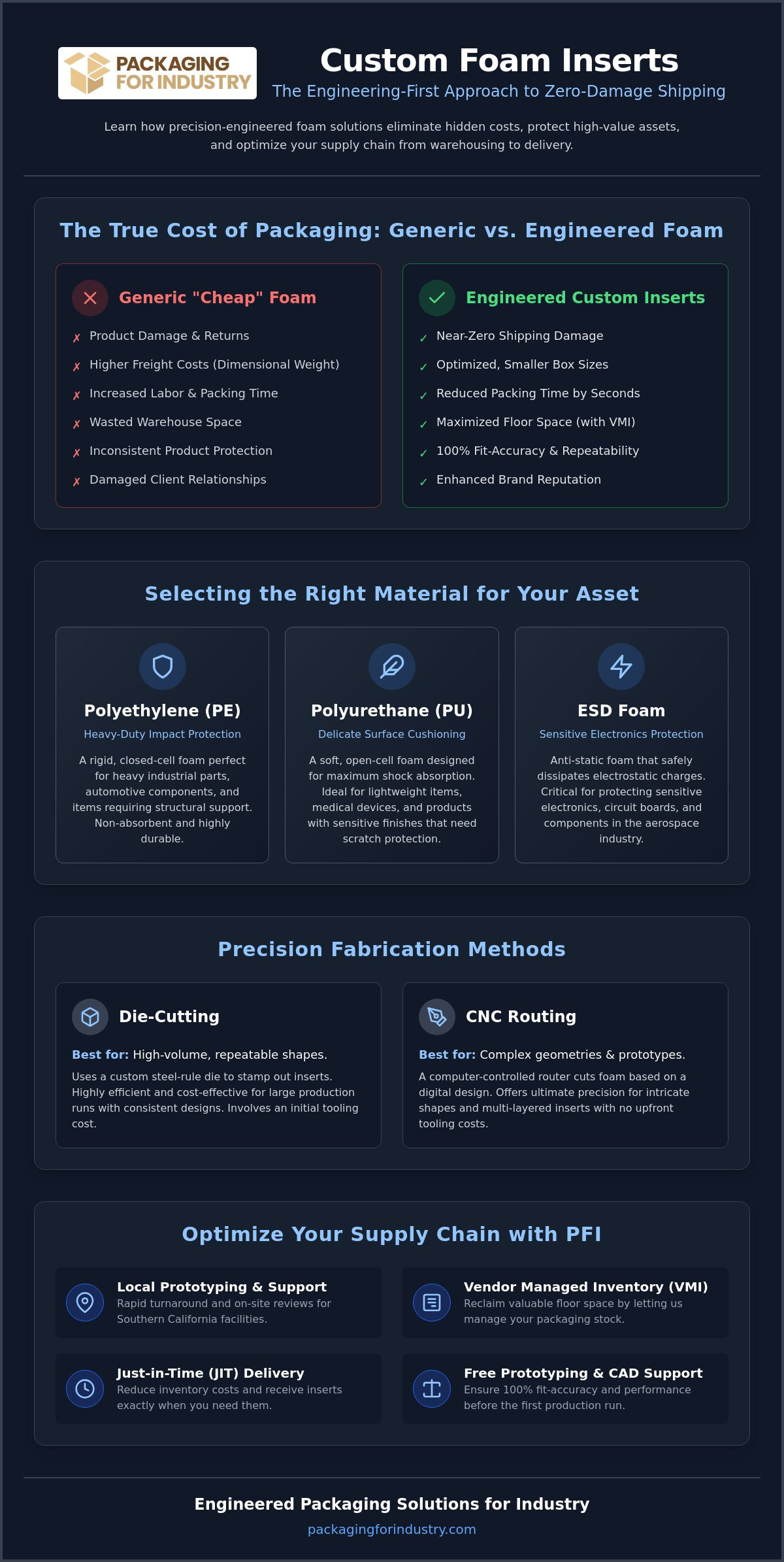
Moving to an engineered solution eliminates the “hidden costs” associated with generic packaging. Standard void fill often requires larger boxes to provide adequate cushioning, which leads to higher freight rates based on dimensional weight. It also increases labor; your team spends more time wrapping and taping than they do on actual production. Custom inserts allow for a smaller, more efficient box size while reducing packing time to seconds.
The Economic Impact of Shipping Damage
Damage in transit is a direct hit to your bottom line. Beyond the cost of the physical product, you must factor in the labor spent on customer service, the expense of expedited replacement shipping, and the potential loss of a long-term contract. By shifting from reactive packaging to proactive engineering, you achieve significant packaging cost savings. A one-time investment in custom foam inserts near me pays for itself by eliminating recurring damage claims and protecting your brand reputation in high-stakes industries like aerospace and defense.
Custom Engineering vs. Off-the-Shelf Foam
Off-the-shelf “pick-and-pluck” foam or generic planks are inconsistent. They don’t offer the repeatable precision required for medical device manufacturing or sensitive electronics. Professional-grade inserts are designed using CAD/CAM support to ensure a perfect fit every single time. This process allows engineers to select the best Package cushioning materials based on the fragility and weight of your specific item.
Unlike stock foam, custom-fabricated inserts are designed for durability and logistical flow. Whether you need closed-cell polyethylene for heavy parts or soft polyurethane for delicate finishes, the material density is matched to the item’s G-factor. This engineering-first approach ensures your products arrive in factory condition, regardless of the shipping environment. It provides a level of stability that generic cushioning simply cannot match.
Selecting the Right Material: Polyethylene, Polyurethane, and ESD Foam
Selecting the ideal material is the most critical step in engineering effective industrial packaging. When you search for custom foam inserts near me, you will typically choose between two primary categories: closed-cell and open-cell structures. Closed-cell foams, such as polyethylene, are rigid and non-absorbent, making them perfect for heavy structural support. Open-cell foams, like polyurethane, are breathable and soft, designed for maximum shock absorption for lightweight or highly finished items.
Material density is a key performance indicator measured in pounds per cubic foot (pcf). This metric determines the load-bearing capacity of the foam. A higher pcf indicates a denser material that can support significant weight without “bottoming out” during an impact. For example, a 1.2 pcf polyurethane foam might protect a lightweight sensor, whereas a 2.0 pcf polyethylene foam is required for a heavy metal casting. Matching the pcf to your product’s weight ensures the foam performs as intended throughout the shipping cycle.
Aesthetic choices also play a role in operational efficiency. Color-coding is frequently used for branded kitting solutions or tool organization. Using contrasting foam layers, such as a black top layer over a bright red base, provides an immediate visual cue if a component is missing from a kit. Additionally, environmental considerations are increasingly important for Southern California manufacturers. Many polyethylene foams are 100% recyclable, allowing your facility to maintain sustainability goals while ensuring maximum protection.
Polyethylene (PE) for Heavy-Duty Impact Protection
Polyethylene (PE) is the industry standard for heavy industrial parts and automotive components. Its rigid, closed-cell nature provides exceptional vibration dampening and structural integrity. Because PE resists chemicals, moisture, and mold, it is the ideal choice for long-term storage or international sea freight where humidity is a factor. You can find detailed technical specifications for different material grades on our custom foam packaging page.
Polyurethane (PU) and Anti-Static (ESD) Foam
Polyurethane (PU) is the soft, open-cell choice for lightweight, highly fragile items like glassware or sensitive medical sensors. Its flexibility allows it to wrap around complex geometries, providing a “cradle” effect. For the electronics and semiconductor sectors, Electrostatic Discharge (ESD) foam is a non-negotiable requirement. These materials are typically pink to signify their anti-static properties, which prevent the buildup of static electricity that can destroy sensitive printed circuit boards (PCBs). This level of technical precision is essential when selecting a fabrication method that balances material performance with manufacturing costs.
If you are uncertain which density or material structure is right for your application, you can request a packaging quote to receive a professional material assessment from our engineering team.
Comparing Fabrication Methods: Die-Cutting, CNC, and Custom Assemblies
Manufacturing custom foam involves a strategic balance between initial setup costs and long-term unit pricing. When you look for custom foam inserts near me, you need to understand which fabrication method aligns with your specific production volume and part complexity. While material choice is vital, the method used to shape that material dictates your lead times and total overhead.
For versatile protection across multiple product lines, convoluted foam provides a flexible solution. Often referred to as “egg-crate” foam, its nested peaks grip items of varying heights, eliminating the need for a different insert for every SKU. For even faster assembly, we provide foam-lined solutions where the protective layer is permanently bonded to corrugated boxes or wood crates. This integrated approach reduces the number of components your team handles, significantly streamlining the packing process on the warehouse floor.
Precision Die-Cutting for High-Volume Orders
Steel-rule die-cutting is the most efficient choice for large-scale production. This process uses a custom-made steel die to “stamp” shapes out of foam planks with absolute repeatability. While there is an initial tooling investment to create the die, it significantly lowers the per-unit cost for wholesale orders. This method is highly effective for our manufacturing clients who require thousands of identical, precision-cut inserts for standardized product lines.
CNC Routing and Prototyping for Complex Geometries
CNC routing is the preferred method for low-volume industrial projects or highly complex geometries that require multi-depth cavities. Because it is a computer-controlled subtractive process, there are no tooling costs, making it ideal for short runs or large foam planks that exceed standard die-cutting dimensions. It allows for rapid adjustments to the design without the expense of a new physical die.
For the aerospace and defense sectors, precision is non-negotiable. We utilize 3D scanning to ensure a “glove-fit” for irregular components. This level of accuracy is often required to meet Military specifications for ESD packaging when protecting sensitive electronic assemblies or specialized instrumentation. To eliminate the risk of a poor fit, PFI provides free prototyping for fit-testing. This allows your team to verify the design with the actual product before committing to a full production run, ensuring the final solution meets every technical requirement.
How to Source Custom Foam Inserts Locally in Southern California
Sourcing locally is a strategic decision that impacts both your speed to market and your shipping budget. When you search for custom foam inserts near me, you aren’t just looking for a product; you’re looking for a logistical partner that understands the Southern California manufacturing corridor. Proximity allows for on-site packaging reviews, where an engineer can physically inspect your equipment and identify potential failure points before they result in damage. This local access also eliminates the high freight costs associated with shipping bulk foam, which is essentially paying to ship air over long distances.
Anaheim serves as a critical logistical hub for Orange County, Los Angeles, and the Inland Empire. By sourcing from a local manufacturer, you move from lead times measured in weeks to those measured in days. This is especially vital for urgent production needs where a stockout could halt your entire assembly line. Local next-day delivery options ensure that your facility remains lean and responsive to customer demand without the risk of cross-country transit delays.
Reducing Lead Times with Anaheim-Based Manufacturing
Proximity to our Anaheim facility allows for rapid design iterations that national suppliers cannot match. Instead of waiting weeks for a sample to arrive from a cross-country warehouse, you can approve a prototype in days. This speed is critical for Southern California warehouses with limited storage space that rely on a just-in-time delivery model. Our local presence in Anaheim and Orange County ensures that your production line never stops due to a packaging stockout.
Integrated Solutions: Foam, Corrugated, and Crates
Sourcing your inserts and outer containers from a single vendor ensures total dimensional compatibility. When the foam and the box are designed together, you avoid the common issue of inserts being too loose or requiring excessive force to pack. For heavy machinery, we engineer custom foam-lined shipping crates that provide structural support and impact protection in one unit. This integrated design also helps you avoid the dimensional weight surcharges that UPS and FedEx apply to oversized, inefficiently packed boxes.
Ready to optimize your local supply chain? Request a packaging quote today to see how our Anaheim-based manufacturing can reduce your lead times and lower your freight costs.
Optimizing Your Supply Chain with PFI’s Managed Packaging Programs
Managing a supply chain requires more than just high-quality materials; it demands logistical precision. For many Southern California manufacturers, the primary challenge of using custom foam inserts near me is the physical volume of the material. Protective foam is inherently bulky, which means it occupies massive amounts of expensive warehouse floor space. PFI solves this through managed packaging programs that treat your packaging as a just-in-time asset rather than a storage burden. When you partner with a local supplier of custom foam inserts near me that offers VMI, you gain a competitive advantage in logistics.
Our “Fixer” approach focuses on total supply reliability. We prevent production halts by ensuring you never run out of critical inserts, even during peak seasons. By handling the bulk storage of your orders at our Anaheim facility, we deliver only the quantity needed for your current production cycle. This model improves your cash flow significantly. You pay for the packaging you actually use each week instead of tying up capital in months of stagnant inventory. It’s a pragmatic solution for businesses that prioritize fiscal responsibility and operational flow.
Vendor Managed Inventory (VMI) for Foam Logistics
Our VMI services provide a hands-off solution for recurring packaging needs. We monitor your stock levels and replenish them automatically based on your real-time usage data. This proactive management eliminates the stress of emergency orders and the high costs of rush shipping fees. It transforms your warehouse from a storage center for bulky foam into a lean, efficient production space. For industries like aerospace or medical device manufacturing, where precision and timing are everything, VMI ensures that the packaging is never the bottleneck in your delivery schedule.
Request a Custom Foam Quote and Free Prototype
Starting a project with PFI is a straightforward engineering process. To receive an accurate assessment, simply provide your product’s dimensions, total weight, and the required fragility level. We invite you to request a quote for your bulk or custom foam requirements today. Every quote is backed by our commitment to industrial reliability and total cost reduction. We don’t just sell foam; we provide the protection and logistical flow your operation needs to scale without interruption. Our team will work with you to engineer a solution that eliminates shipping damage while optimizing your total packaging spend.
Secure Your Supply Chain with Engineered Protection
Engineering the right protective environment for your assets is a critical step in stabilizing your industrial logistics. By moving beyond generic void fill and selecting precision materials like specialized ESD foam for electronics, you effectively eliminate the recurring costs of shipping damage. Choosing the correct fabrication method ensures that your per-unit costs remain aligned with your production volume and technical requirements.
When you search for custom foam inserts near me, the primary goal is finding a partner that balances engineering expertise with local logistical speed. PFI provides this through our Anaheim headquarters; we offer local next-day delivery in SoCal and free prototyping for fit-testing to ensure your production line never misses a beat. Our managed inventory programs further refine your operation by reclaiming warehouse space and improving your monthly cash flow.
Take the first step toward a more efficient, damage-free supply chain today. Our team is ready to help you lower packaging costs and improve reliability across your entire distribution network.
Request a Custom Foam Packaging Quote & Free Prototype
We look forward to optimizing your packaging strategy and protecting your most valuable industrial assets.
Frequently Asked Questions
What is the best foam for shipping heavy industrial parts?
Polyethylene (PE) is the industry standard for protecting heavy industrial components and automotive parts. Its closed-cell structure provides the necessary rigidity to support significant weight without collapsing under pressure. This material resists moisture and chemicals, making it ideal for long-term storage or sea freight. If your equipment has high G-factor sensitivity, we match the pcf density to ensure total impact absorption during transit.
How much does it cost to get a custom foam insert prototype?
PFI provides free prototyping for fit-testing to ensure your custom foam inserts near me are engineered with 100% accuracy. We believe that professional fit-testing is essential to eliminate shipping damage before you commit to a full production run. This allows your team to verify the design using the actual product, ensuring every cavity and support point performs as intended without any initial financial risk.
Do I need to provide CAD drawings for a custom foam quote?
You don’t need to provide professional CAD drawings to receive a custom foam quote. While existing files can speed up the engineering process, our team can work from physical samples or detailed product dimensions. We utilize advanced CAD/CAM support and 3D scanning to create precise digital models of your items. This ensures a “glove-fit” even for complex aerospace or medical components with irregular geometries.
What is the difference between polyethylene and polyurethane foam?
The primary difference lies in the cell structure and firmness. Polyethylene (PE) is a closed-cell, rigid foam designed for heavy-duty structural support and impact resistance. Polyurethane (PU) is an open-cell, soft foam that functions like a cushion for lightweight, highly fragile items. While PE is durable and non-absorbent, PU is preferred for delicate surfaces and products that require a gentle “cradle” during the shipping cycle.
Can I get anti-static (ESD) foam for electronics packaging?
Yes, we specialize in anti-static (ESD) foam solutions for the electronics and semiconductor sectors. These materials are typically pink or black and are engineered to prevent electrostatic discharge from damaging sensitive printed circuit boards or sensors. Our ESD foam meets stringent industrial standards, providing a safe environment for high-value components that are vulnerable to static buildup during handling or transit.
How long does it take to manufacture a custom foam order in Southern California?
Manufacturing lead times for custom foam inserts near me are significantly shorter than national catalog suppliers. Because our production facility is based in Anaheim, we can often move from design approval to final delivery in just a few business days. Local sourcing avoids cross-country shipping delays and allows for rapid prototype iterations. We also offer local next-day delivery across Orange County, Los Angeles, and San Diego for urgent requirements.
Is there a minimum order quantity for custom die-cut foam inserts?
Minimum order quantities for die-cut foam depend on the specific tooling requirements and material type. While die-cutting involves an initial investment in a steel-rule die, it offers the lowest per-unit cost for high-volume wholesale orders. For short-run industrial projects or low-volume prototypes, we utilize CNC routing. This method requires no physical tooling, making it a cost-effective alternative for smaller batches or complex, one-off assemblies.
Can you provide foam inserts that fit into my existing shipping boxes?
We can engineer custom foam inserts to fit perfectly within your existing corrugated boxes or wood crates. Our design team measures the internal dimensions of your current containers to ensure the new inserts provide a snug, secure fit. This integrated approach prevents product movement and helps you avoid the expense of purchasing new outer packaging. It’s an efficient way to upgrade your protection without overhauling your entire inventory.