
How much does a single damaged shipment actually cost your operation when you factor in replacement units, expedited freight, and lost client trust? For medical device manufacturers in Southern California, relying on generic catalog inserts often leads to high damage rates and inflated supply chain costs. You need a solution that balances precision engineering with fiscal responsibility, starting with the right protective foam packaging for medical devices to secure your high-value inventory.
We understand that protecting fragile components is your top priority, especially as the industry prepares for the February 2, 2026, FDA Quality Management System Regulation (QMSR) transition. This article explains how custom-engineered foam inserts eliminate the guesswork of shipping and help you achieve zero-damage results. You’ll learn how to leverage local prototyping to ensure a perfect fit and how Vendor Managed Inventory (VMI) can streamline your procurement. We’ll also break down the most cost-effective materials to help you move away from expensive catalog suppliers and toward a more reliable, local partnership in Orange County.
Key Takeaways
- Identify the technical differences between Polyethylene (PE) and Polyurethane (PU) foams to ensure your instruments receive the correct level of shock absorption.
- Learn how custom-engineered protective foam packaging for medical devices creates a secure “lock-and-key” fit that eliminates internal movement and prevents calibration shifts.
- Discover how precision-cut inserts allow for smaller outer containers, effectively lowering your DIM weight and reducing overall shipping costs.
- Understand the logistical benefits of partnering with a local Anaheim packaging supplier to implement Vendor Managed Inventory and solve warehouse space constraints.
- Find out how to lower procurement expenses by moving away from expensive catalog giants toward custom, industrial-grade solutions.
Why Protective Foam Packaging is Critical for Medical Devices
Medical devices represent some of the highest-value assets in the global supply chain. When a surgical robot or a diagnostic imaging component leaves a facility in Orange County, it’s not just a box; it’s a critical piece of healthcare infrastructure. Standard packaging often fails these sensitive instruments because it doesn’t account for the subtle forces of transit. Precision-engineered foam packaging serves as the primary defense against these forces, ensuring that equipment arrives in sterile, working condition.
Shipping damage in the medical sector carries consequences far beyond a simple insurance claim. A misaligned laser or a cracked sensor can delay life-saving procedures and erode your brand’s reputation with hospital procurement teams. Effective Package cushioning is essential to maintain the tight tolerances required for medical compliance. Our team focuses on “dust-free” foam options to ensure that packaging debris doesn’t contaminate sensitive electronic or mechanical interfaces, which is a common failure point in medical-grade logistics. This proactive approach to protective foam packaging for medical devices helps you avoid the hidden costs of replacement fees and expedited freight.
Vibration Dampening vs. Impact Protection
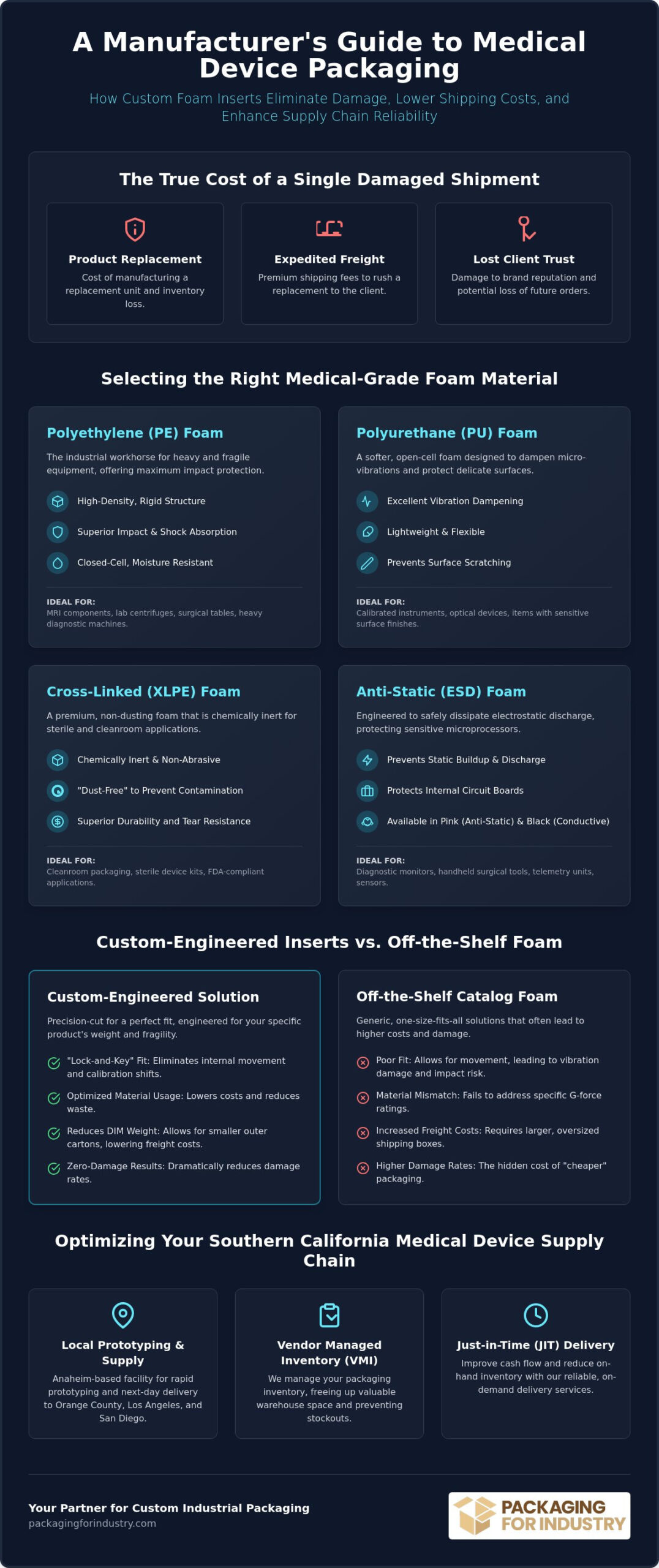
Many manufacturers confuse impact protection with vibration dampening. A single drop from a loading dock is an impact event, but the constant hum of a delivery truck creates high-frequency vibrations that can loosen internal fasteners or shift delicate calibrations. Protective foam packaging for medical devices must be engineered to handle both. High-density polyethylene (PE) foams excel at absorbing heavy impacts, while softer polyurethane (PU) foams are superior for dampening the micro-vibrations of long-haul transport. G-force attenuation is the measurement of how much energy a packaging material absorbs to reduce the peak force experienced by the device during an impact. By matching foam density to your equipment’s specific G-force rating, we eliminate the risk of internal mechanical failure during transit.
Anti-Static and ESD Requirements
Electronic medical devices containing microprocessors or sensitive sensors require specialized protection from electrostatic discharge. Standard foam can generate static electricity during movement, potentially damaging internal circuit boards before the device is even unboxed. We provide pink anti-static foam, which prevents the buildup of static, and black conductive foam for more demanding applications. Diagnostic monitors, handheld surgical tools, and telemetry units all require these ESD-safe materials to function reliably upon delivery. Choosing the right ESD foam isn’t just about safety; it’s about ensuring your product works perfectly the first time it’s turned on in a clinical setting.
Selecting the Right Medical-Grade Foam Materials
Choosing the correct material for protective foam packaging for medical devices is a decision that balances engineering requirements with economic efficiency. The weight, fragility, and surface finish of your equipment dictate which foam density and cell structure will perform best. Selecting an mismatched material doesn’t just increase your risk of damage; it often leads to bloated shipping costs due to excessive material use or increased DIM weight.
For manufacturers focused on high-performance standards, Cross-Linked Polyethylene (XLPE) represents the premium choice. Unlike standard foams, XLPE is non-dusting and chemically inert, making it ideal for cleanroom-compatible applications where particle contamination is a critical failure point. This material alignment is increasingly important as companies audit their supply chains to meet FDA guidance on medical device packaging and sterilization protocols. For operations with high SKU variability, convoluted or “eggcrate” foam provides a versatile solution. Its peak-and-valley design allows a single insert to secure devices of varying shapes and sizes, which simplifies your inventory and lowers procurement complexity.
Polyethylene (PE) for Heavy Equipment
PE foam is the industrial workhorse for heavy-duty medical machinery. As a closed-cell material, it’s remarkably rigid and resistant to moisture, which is vital for long-term storage or international transit. We typically engineer PE foam into custom end caps for MRI components, lab centrifuges, and surgical tables. Its high load-bearing capacity ensures that heavy equipment stays suspended within the corrugated box, preventing the “bottoming out” that leads to chassis damage. If you’re shipping from an Anaheim packaging supplier, PE foam is often the most cost-effective way to secure heavy skids without adding unnecessary bulk.
Polyurethane (PU) for Fragile Instruments
When you’re protecting lightweight, delicate instruments, PU foam is the superior option. This open-cell material is soft and highly flexible, allowing it to “nest” handheld monitors or surgical tools with precision. PU foam’s breathability and low density make it an excellent choice for e-commerce medical supplies where shipping weight directly impacts the bottom line. Beyond shock absorption, PU foam acts as a non-abrasive barrier. It protects polished medical surfaces and screens from scratches caused by movement inside the box. If you aren’t sure which density fits your specific device, you can request a packaging quote to have our engineering team analyze your product’s fragility and recommend the ideal material blend.
Custom Die-Cut Inserts vs. Off-the-Shelf Foam
While stock “pick and pull” foam might seem like a quick fix for small-scale projects, it’s often inadequate for recurring industrial medical shipments. These generic solutions lack the structural integrity needed to maintain consistent positioning during heavy transit. In contrast, custom die-cut protective foam packaging for medical devices provides a precise “lock-and-key” fit. This engineering approach eliminates internal movement, ensuring that every component, from surgical tools to diagnostic monitors, remains exactly where it belongs. By removing the air gaps found in generic packaging, you provide a superior level of security that off-the-shelf options simply can’t match.
The shift to custom inserts also provides a direct economic benefit by reducing your overall packaging footprint. When foam is engineered to the exact dimensions of your device, you can utilize smaller custom corrugated boxes. This reduction in volume significantly lowers your Dimensional (DIM) weight, which is a primary driver of shipping costs for manufacturers. Additionally, custom inserts improve kitting efficiency. By organizing cables, manuals, and devices into a single, organized assembly, you streamline the unboxing experience for healthcare providers and reduce the risk of lost accessories during the setup of critical equipment.
The Engineering Process: CAD/CAM and Prototyping
Precision starts with data. We utilize CAD design to create foam assemblies that match complex geometries, ensuring that even the most irregularly shaped medical equipment is fully supported. This process is critical for meeting the rigorous requirements of the ISO 11607-1 standard, which governs the materials and systems used in medical device packaging. To ensure a perfect fit before mass production, we offer free prototyping and samples. This local Southern California engineering support allows you to verify the design in person, which drastically reduces lead times compared to large catalog suppliers.
Integrated Packaging Assemblies
Most suppliers focus solely on the foam, but true protection requires an integrated approach. We function as a single-source packaging manufacturer that designs the foam insert and the outer container simultaneously. For high-value instruments destined for global markets, we combine foam inserts with custom shipping crates for international transit. These integrated kits simplify your assembly line. Instead of managing multiple vendors for foam, boxes, and pallets, your team receives a ready-to-use system. This unified procurement strategy reduces logistics friction and ensures that every layer of your protective foam packaging for medical devices works in harmony to eliminate damage.
Optimizing the Medical Device Supply Chain in Southern California
Manufacturers in Southern California face unique operational hurdles, from high real estate costs to congested freight lanes. Partnering with a local Anaheim packaging supplier allows you to transform your packaging from a storage burden into a just-in-time asset. When your protective foam packaging for medical devices is manufactured and stored locally, you eliminate the long lead times and high minimums typical of national catalog giants. This regional proximity supports lean manufacturing principles, ensuring that your assembly lines never stall due to a lack of custom inserts.
Optimizing your supply chain also involves managing the physical footprint of your materials. By refining the dimensions of your protective foam packaging for medical devices, we help you avoid the aggressive dimensional weight surcharges imposed by major carriers like UPS and FedEx. This engineering-led approach to logistics ensures that you aren’t paying to ship empty space, which directly improves your bottom line. We focus on the intersection of material performance and shipping economics to provide a solution that protects your product while minimizing your total cost of ownership.
Vendor Managed Inventory (VMI) for Medical Manufacturers
For high-volume medical device manufacturers, warehouse space is often at a premium. Our Vendor Managed Inventory (VMI) program solves this by housing your custom foam and corrugated stock in our facility. We monitor your usage levels and replenish stock automatically, preventing the production stops that occur during unexpected packaging stockouts. This system is particularly effective for managing recurring orders of medical disposables or diagnostic kits. It also improves your cash flow, as you only pay for the inventory when it’s delivered to your facility, effectively removing the financial burden of holding excess stock.
Local Logistics and Reliability
Reliability in the medical sector depends on speed and accountability. We provide next-day local delivery across Orange County, Los Angeles, and San Diego to keep your distribution schedule on track. While we offer nationwide shipping support for manufacturers with multiple distribution hubs, our local roots mean you have a dedicated account manager who understands the specific pressures of the Southern California market. You don’t have to navigate a generic call center to solve an urgent shipping issue; you have a partner who is proactively managing your logistical flow to ensure zero-damage shipments.
Why Choose PFI for Your Medical Device Foam Packaging
Selecting a partner for your protective foam packaging for medical devices requires more than just finding a vendor. It requires an engineering resource that understands the high-stakes requirements of specialized sectors like medical, aerospace, and defense. We don’t just sell boxes; we provide a system of accountability that treats your supply chain as our own. Our focus is on the intersection of technical performance and fiscal responsibility, ensuring your high-value equipment is protected without inflating your operational overhead.
Many manufacturers come to us after realizing that large catalog suppliers don’t offer the precision needed for sensitive medical gear. We provide a comprehensive cost-reduction analysis to find alternatives to these expensive, one-size-fits-all options. By engineering a custom foam packaging solution, we help you move away from generic materials that often lead to higher damage rates and wasted warehouse space. Our commitment to reducing product damage is backed by a methodical approach to design, ensuring that every insert we produce meets the specific fragility needs of your device.
Request a Packaging Review
We begin by analyzing your current damage rates and procurement data to engineer a better solution. Many operations suffer from “over-packaging,” where they pay for excess material and shipping weight they don’t actually need. Conversely, “under-packaging” leads to catastrophic product failure and lost client trust. Our team identifies these imbalances to create a “Goldilocks” solution that provides maximum protection at the lowest possible cost. We also customize foam solutions for recurring production line needs, ensuring that your packaging is as efficient for your assembly team as it is for the end user.
Get a Custom Quote Today
Our process for requesting a quote is straightforward and designed for busy procurement managers. We close the gap left by other suppliers by prioritizing the prototyping phase. For qualified medical device projects, we offer free prototyping and samples. This allows you to verify the fit and performance of your protective foam packaging for medical devices before you commit to a full production run. It’s a risk-free way to ensure that your packaging meets the new 2026 regulatory standards and your own internal quality benchmarks.
Don’t let shipping damage or high catalog prices erode your margins. Our local Southern California team is ready to help you optimize your logistics and lower your total cost of ownership. You can Request a packaging quote today to begin your custom engineering review and secure bulk packaging pricing that fits your budget.
Secure Your Medical Supply Chain with Custom Engineering
Implementing a strategic approach to protective foam packaging for medical devices is essential in a landscape of rising freight costs and the upcoming 2026 FDA Quality Management System Regulation (QMSR) transition. Moving away from generic catalog inserts to custom-engineered assemblies eliminates the internal movement that causes calibration shifts and mechanical failure. Our engineering team provides the free prototyping and CAD design services required to verify your packaging performance before mass production begins. Precision matters. Every instrument must be secured with absolute accuracy to ensure clinical reliability.
Choosing a local partner grants your operation access to local next-day delivery across Southern California and proactive support for ISO-standard compliance. This regional proximity allows you to maintain leaner inventory levels while achieving zero-damage shipments. Whether you’re distributing diagnostic monitors or specialized surgical tools, we’re here to help you reduce shipping damage and lower your total packaging costs through a more reliable, data-driven supply chain. We look forward to helping you optimize your logistics flow and improve your bottom line.
Frequently Asked Questions
What is the best foam for shipping sensitive medical electronics?
Polyurethane (PU) foam is generally the best choice for sensitive medical electronics because of its superior vibration dampening and soft cell structure. If your device requires a cleanroom-compatible environment, we recommend Cross-Linked Polyethylene (XLPE). This premium material is non-dusting and chemically inert, ensuring that no particles contaminate delicate sensors or mechanical interfaces during transit.
Can I get custom foam inserts for my existing medical device shipping boxes?
Yes, we can engineer custom foam inserts to fit your current corrugated boxes or shipping crates. This is a practical way to upgrade your protection levels without discarding your existing box inventory. Our team uses CAD design to ensure the new inserts provide a precise fit for your equipment while maintaining compatibility with your current outer packaging dimensions.
Does PFI offer anti-static (ESD) foam for medical devices?
We provide both pink anti-static foam and black conductive foam to protect diagnostic devices and monitors from electrostatic discharge. These specialized foams prevent static buildup that can occur when packaging materials rub against each other during transport. This protection is critical for any medical equipment containing microprocessors or sensitive circuit boards that could be compromised by a static event.
How do I reduce shipping damage for heavy medical equipment?
Reducing damage for heavy equipment requires high-density polyethylene (PE) foam end caps. Unlike softer foams, PE foam has the structural rigidity to suspend heavy machinery and prevent it from “bottoming out” during an impact. For international shipments, we often combine these PE inserts with custom-lined crates to provide multiple layers of shock absorption and structural support for the chassis.
Is custom foam packaging more expensive than standard bubble wrap?
While bubble wrap has a lower upfront material cost, custom foam is often more economical when you calculate the total cost of ownership. Custom inserts drastically reduce shipping damage claims and labor time on the assembly line. Additionally, precision-engineered foam allows for smaller box sizes, which lowers your DIM weight and helps you avoid expensive carrier surcharges from UPS and FedEx.
What are the lead times for custom die-cut foam inserts in Southern California?
Our lead times are significantly shorter than national catalog suppliers because we manufacture locally in Anaheim. While catalog giants often have long shipping windows for custom orders, our regional proximity allows us to respond quickly to production changes. We also provide next-day delivery for stocked items to manufacturers throughout Orange County, Los Angeles, and San Diego.
Do you provide free prototypes for medical device packaging designs?
We offer free prototyping and CAD design samples for qualified projects to ensure your protective foam packaging for medical devices fits perfectly. This phase is essential for verifying shock absorption and material compatibility before you commit to a full production run. By testing a physical sample, you can eliminate the risk of engineering errors and ensure compliance with your internal quality standards.
How can Vendor Managed Inventory (VMI) help my medical manufacturing plant?
VMI helps your plant by eliminating production stops caused by packaging stockouts. We monitor your usage of protective foam packaging for medical devices and replenish your supply automatically from our local warehouse. This system frees up valuable floor space in your facility and improves your cash flow since you only pay for the packaging inventory as you use it.