
What if the biggest drain on your logistics budget isn’t fuel or labor, but the empty space inside your shipping containers? For manufacturers across Southern California, shipping air is an expensive liability that triggers unnecessary dimensional weight surcharges and increases the risk of transit damage. You’ve likely felt the frustration of paying premium rates for oversized boxes, only to have high-value industrial components arrive compromised because they shifted despite excessive void fill.
At Packaging For Industry (PFI), your local Los Angeles packaging supplier, we believe that efficiency starts with a perfect fit. We agree that managing rising freight costs while meeting strict sustainability mandates like California’s SB 54 is a significant operational challenge. This article will show you how right-sizing packaging solutions can eliminate material waste, slash shipping fees, and secure your high-value components. We’ll preview the financial impact of DIM weight, the engineering behind multi-material integration, and how a professional packaging audit can identify immediate cost-saving opportunities for your facility.
Key Takeaways
- Understand how dimensional (DIM) weight calculations inflate freight budgets and how to eliminate the “air tax” through precise container selection.
- Explore the technical advantages of integrating custom die-cut foam with corrugated boxes to secure high-value parts and minimize shifting during transit.
- Learn how implementing right-sizing packaging solutions reduces material waste and supports compliance with new sustainability regulations like California’s SB 54.
- Follow a structured packaging audit to identify your most inefficient SKUs and replace oversized boxes with custom-engineered alternatives.
- Discover the benefits of local prototyping and VMI programs to maintain a reliable supply of custom-fit materials for just-in-time manufacturing needs.
What is Right-Sizing in Industrial Packaging?
Right-sizing is the engineering discipline of aligning a shipping container’s dimensions and material strength precisely with the product it holds. It moves away from the “closest fit” mentality common in many high-volume warehouses. Instead of selecting a standard stock box and filling the gaps with bubble wrap or paper, right-sizing packaging solutions focus on creating a secure, minimal-footprint environment. This process requires a detailed analysis of the product’s geometry, weight, and fragility to determine the exact specifications needed for safe transit.
The primary driver for this shift is fiscal responsibility. Shipping air is an expensive mistake. Major carriers now penalize volume as much as weight, meaning every inch of wasted space directly inflates your freight bill. Beyond the bottom line, this approach is a pillar of sustainable packaging strategies. By optimizing the container size, you reduce the raw material consumed per shipment and decrease the carbon footprint of your entire logistics chain. It is a pragmatic solution where economic efficiency and environmental stewardship intersect.
Manufacturers in Los Angeles, Orange County, and San Diego often rely on large catalog suppliers for “standard” boxes to maintain quick lead times. However, these stock sizes rarely match the complex dimensions of specialized equipment or industrial parts. This mismatch creates a reliance on excessive foam packaging or void fill. This adds unnecessary labor and material costs while offering inferior protection compared to a custom-engineered fit.
The Problem with One-Size-Fits-All Packaging
Standardized boxes are designed for general consumer use, not industrial precision. When a high-value part is placed in an oversized container, it is prone to migration. Shifting during transit leads to impact damage, regardless of how much loose fill you use. Additionally, oversized boxes waste valuable warehouse floor space. You’re effectively paying to store empty air in both your inventory racks and your outbound trailers. The perceived savings of “cheap” stock boxes are quickly erased by increased damage claims and inflated packaging costs.
Right-Sizing as a Competitive Advantage
Adopting a custom-fit approach provides a professional presentation that reflects the quality of your brand. For sectors like aerospace and medical manufacturing, where precision is non-negotiable, custom corrugated boxes engineered for specific parts ensure compliance with rigorous shipping standards. It also streamlines the packing line. When a box fits the product perfectly, workers spend less time taping, folding, and stuffing void fill. This reduction in labor hours improves your operational throughput and helps maintain a more reliable supply chain.
The Financial Impact: DIM Weight and Freight Savings
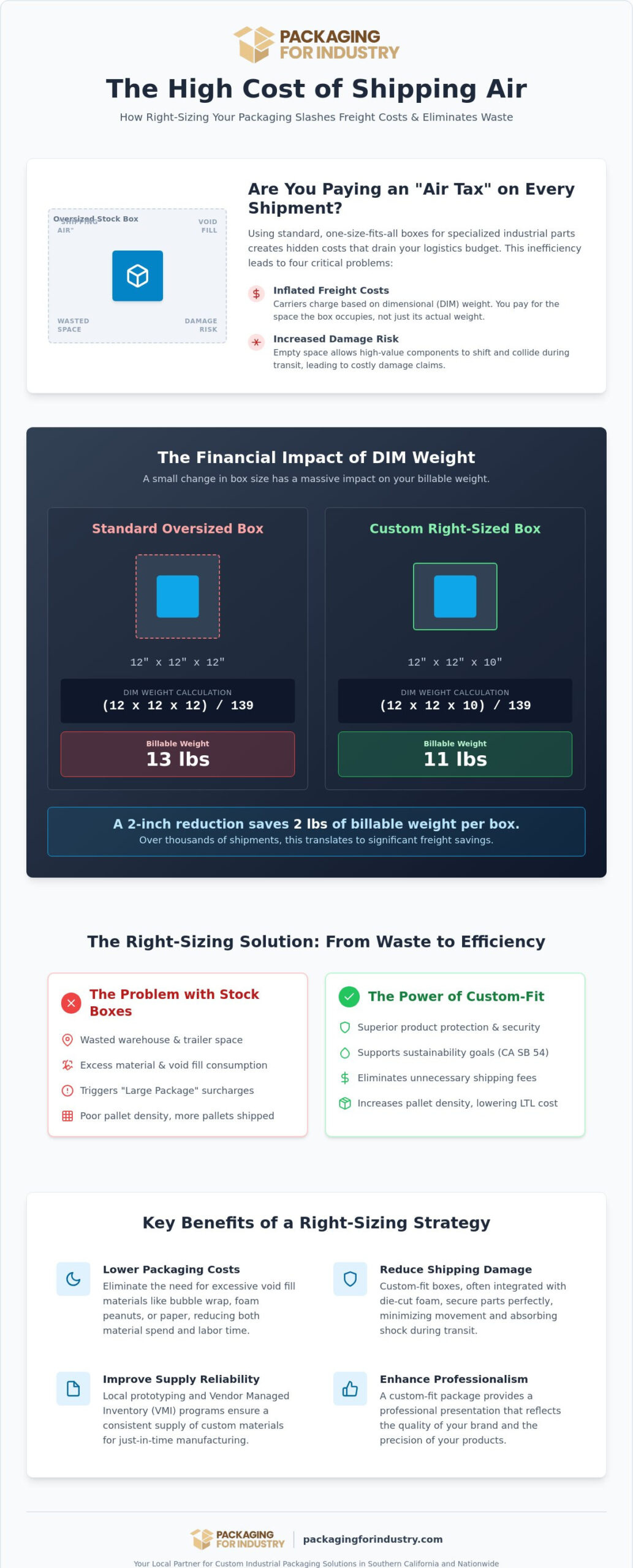
Logistics costs are no longer determined solely by the weight of your product. Carriers like UPS, FedEx, and USPS use Dimensional (DIM) Weight to ensure they’re paid for the space a package occupies in their trucks. If you ship a lightweight component in a large box, you’re paying an “air tax” on every shipment. Implementing right-sizing packaging solutions allows you to align the billable weight with the actual weight of the goods, directly protecting your bottom line.
A simple 2-inch reduction in box height can have a disproportionate impact on your freight expenses. For example, a standard 12x12x12 corrugated box has a DIM weight of 13 lbs based on the standard 139 divisor used in 2026. By engineering a custom 12x12x10 container, the billable weight drops to 11 lbs. Over a high-volume production run, this small adjustment saves thousands in unnecessary shipping fees. These right-sizing packaging solutions also improve pallet density. When boxes are smaller, you can fit more units on a single pallet, which reduces the total number of pallets shipped and lowers your LTL freight costs per unit.
Navigating UPS and FedEx Surcharge Structures
Carriers apply steep surcharges for packages that exceed specific size thresholds. “Additional Handling” and “Large Package” fees often range from $15 to over $30 per box. These charges are frequently triggered by a few inches of excess packaging material or bulky void fill that pushes a container over a size limit. By working with a custom box manufacturer, you can design containers that stay safely below these surcharge cliffs. Precise outer dimensions are equally critical for LTL and FTL freight to maximize trailer utilization and avoid “over-length” fees that can derail a logistics budget.
Reducing Material Waste and Procurement Costs
Right-sizing isn’t just about shipping; it’s about material efficiency. When you use a box that fits your product, you consume less corrugated material per unit. This strategy aligns with the principles of Sustainable Materials Management, which emphasizes reducing waste at the source. It also eliminates the need for secondary materials like bubble wrap, packing peanuts, or crumpled paper. If you’re looking for more ways to optimize your budget, you can explore detailed strategies for packaging cost savings that go beyond simple box selection. To see how these adjustments can impact your specific operation, you can request a packaging quote for a custom-engineered solution.
Engineering the Perfect Fit: Multi-Material Integration
While selecting the correct container size is a vital first step, the outer box is only half of the equation. True right-sizing packaging solutions require a focus on the internal architecture of the shipment. Without precise internal protection, products often require excessive void fill to prevent movement. This reliance on loose-fill materials like paper or bubble wrap often forces manufacturers to use larger boxes than necessary. By engineering custom foam inserts that mirror your product’s geometry, you can significantly reduce the required outer dimensions of the shipment. This integrated approach maximizes the environmental benefits of right-sizing packaging by minimizing both the corrugated and plastic materials used in every unit.
Prototyping is the most critical phase of this engineering process. For manufacturers in Los Angeles and Orange County, PFI provides free prototyping to ensure every component fits perfectly before full production begins. This “measure twice, cut once” philosophy eliminates the risk of shipping damage and prevents the procurement of thousands of ill-fitting containers. When the foam and the box are designed as a single, cohesive unit, the result is a compact package that offers superior protection while occupying the smallest possible footprint in a carrier’s truck.
Custom Corrugated Solutions
The choice of corrugated style depends on the weight and fragility of your industrial components. Standard Regular Slotted Containers (RSC) are effective for bulk goods, but custom die-cut designs offer tighter tolerances for precision parts. For heavy machinery or metal components, utilizing double-wall or triple-wall corrugated provides the necessary stacking strength without adding unnecessary bulk. If you are shipping multiple parts in a single container, custom partitions and dividers can keep items separated and secure. You can explore our full range of custom industrial corrugated boxes to find the right configuration for your specific application.
Protective Foam and Cushioning
Selecting the right material is a balance of engineering and economics. Polyethylene foam is ideal for heavy, high-value components due to its high load-bearing capacity and durability. Conversely, softer polyurethane foam provides excellent vibration dampening for lighter, delicate instruments. For electronics and semiconductor manufacturers, ESD (electrostatic discharge) foam is essential to protect sensitive circuits from static damage during transit. Our engineered foam packaging solutions are custom-cut to lock your products in place, ensuring they remain stationary regardless of how the package is handled. This precision is what allows for the most effective right-sizing packaging solutions in the industrial sector today.
Implementing a Right-Sizing Audit for Your Facility
Transitioning from standard stock boxes to a customized system requires a methodical approach. A right-sizing audit isn’t a one-time task; it’s a strategic review of your entire logistics footprint. You should begin by analyzing your top 20% of high-volume or high-damage SKUs. This data collection phase identifies exactly where right-sizing packaging solutions will deliver the fastest return on investment. By focusing on your most frequent shipments, you can address the root causes of inflated freight costs and product loss simultaneously.
The next step involves a rigorous dimensional analysis. You must measure the actual product geometry and compare it to your current box dimensions. If your team is filling significant gaps with void fill, you’re essentially paying to ship air. Following this, perform a protection review. Evaluate whether your current cushioning is necessary or if it’s simply compensating for an oversized outer container. This leads directly to prototyping, where you develop a custom-engineered sample for real-world testing. The final stage is a Total Cost of Ownership (TCO) comparison. This analysis looks beyond the per-unit box price to include freight surcharges, material volume, and the labor hours required for packing.
Identifying “Low Hanging Fruit” in Your Supply Chain
Start your audit by targeting dense, heavy items that frequently trigger high DIM weight charges. These products are the primary candidates for immediate savings. You should also review high-damage items that currently receive “over-packaging” as a temporary fix. Often, adding more bubble wrap doesn’t solve the problem; a better-fitting box does. Utilizing custom design and engineering services helps you replace these inefficient methods with precise, reliable alternatives that protect your margins as much as your products.
Leveraging CAD/CAM and Prototyping
Precision is a requirement for aerospace and medical components. CAD/CAM support allows engineers to design packaging that accounts for every contour of a high-value part. This ensures a perfect fit that generic catalog boxes can’t replicate. Prototyping is equally vital because it allows for rigorous drop-testing to validate the design before full production. Working with local Southern California design partners in Los Angeles and Orange County provides a significant advantage. You can iterate designs quickly and receive samples in days rather than weeks, which drastically reduces your time-to-market for new product launches.
Why Choose Packaging For Industry (PFI) for Your Right-Sizing Strategy?
Selecting a partner for your right-sizing strategy requires an engineering ally that understands the intersection of logistics and manufacturing. Packaging For Industry (PFI) specializes in high-performance solutions that prioritize fiscal responsibility and product integrity. We don’t just sell containers; we provide a comprehensive system of protection designed to lower packaging costs by eliminating the hidden expenses of shipping air and excessive material volume.
Our approach is built on integrated engineering. Because we design your custom corrugated boxes and protective foam inserts as a single unit, we ensure maximum volumetric efficiency. For manufacturers and distributors managing high-volume production runs, we offer competitive bulk packaging pricing alongside our Vendor Managed Inventory (VMI) programs. We take full accountability for your packaging supply chain, ensuring you never face a stockout of custom-fit materials.
Southern California Proximity and Reliability
Location is a critical factor in maintaining a lean operation. As a local Anaheim packaging supplier, PFI offers a level of responsiveness that national catalog companies cannot match. We provide local next-day delivery across Los Angeles, Orange County, and San Diego, ensuring your line never stops due to a packaging shortage. This proximity allows for just-in-time delivery, which frees up your valuable warehouse floor space for revenue-generating activities. You also gain direct access to our packaging engineers for rapid design iterations, moving from a CAD concept to a physical prototype in days.
Beyond the Box: A Comprehensive Partnership
PFI understands the rigorous demands of specialized sectors. We provide support for military-spec and aerospace-compliant packaging, ensuring that every design meets the durability standards required for high-value industrial transit. Our primary focus remains helping you reduce shipping damage through precision engineering rather than over-packaging. We provide sustainable industrial options that actually improve your bottom line by reducing DIM weight surcharges and material consumption.
Optimizing Your Industrial Shipping for 2026 and Beyond
Adopting right-sizing packaging solutions is no longer just a sustainability goal; it’s a fundamental requirement for maintaining healthy margins in a carrier environment that penalizes every cubic inch of wasted space. By aligning your container dimensions with your product’s actual geometry and integrating custom-engineered protective foam, you eliminate the “air tax” and drastically reduce material waste. This strategy ensures your high-value components remain secure while your logistics budget stays lean.
PFI serves as your seasoned industrial consultant for these operational transitions. We offer free prototyping to guarantee a perfect fit and provide local next-day delivery throughout Anaheim, Los Angeles, and Orange County. Our team specializes in high-value industrial protection, ensuring your sensitive equipment is secured in the smallest possible footprint to maximize pallet density and trailer utilization. We focus on the intersection of engineering and economics so you don’t have to choose between safety and savings.
Take control of your shipping budget and improve your brand’s reputation for reliability. We’re here to help you build a more efficient, cost-effective supply chain that’s ready for the future of industrial logistics.
Frequently Asked Questions
What is the difference between right-sizing and simply using a smaller box?
Right-sizing is a multi-material engineering discipline that aligns the container and internal cushioning with the product’s exact geometry. Simply picking a smaller stock box doesn’t account for the internal protection required for industrial components. Right-sizing packaging solutions integrate custom corrugated boxes with die-cut foam to eliminate the need for excessive void fill. This ensures the smallest possible shipping footprint while maintaining the structural integrity needed for heavy or fragile parts.
How much can right-sizing actually save on shipping costs?
Savings are primarily realized through the reduction of Dimensional (DIM) weight surcharges and lower material consumption. Carriers calculate costs based on the space a package occupies, so eliminating “air” in your boxes directly reduces your freight bill. You also save by removing the need for secondary materials like bubble wrap or packing peanuts. While per-unit box costs vary, the total cost of ownership typically decreases when accounting for freight and labor efficiency.
Does right-sizing increase the risk of product damage?
Right-sizing actually reduces the risk of shipping damage by eliminating product migration. Most damage occurs when a part shifts inside an oversized box during transit. Custom-engineered foam inserts lock the product in place, providing consistent protection that loose-fill materials can’t match. This precision is especially critical for aerospace and medical device manufacturers who must meet strict shipping standards for high-value equipment.
How long does it take to develop a custom right-sized packaging prototype?
Developing a custom prototype typically takes just a few business days at our local Southern California facility. Because we serve Los Angeles, Orange County, and San Diego, we can iterate designs quickly to meet your production deadlines. PFI provides free prototyping to ensure a perfect fit before you commit to a full production run. This local proximity allows your team to validate the design and perform drop tests without long lead times.
Are right-sized packaging solutions more expensive than stock boxes?
Custom right-sized boxes may have a higher per-unit price than bulk stock boxes, but they offer a lower total cost of ownership. The initial investment in custom-engineered packaging is offset by significant savings in freight surcharges, reduced material waste, and fewer damage claims. Additionally, using a box that fits perfectly streamlines the packing process, which reduces labor costs and improves warehouse throughput for high-volume distributors and manufacturers.
What industries benefit most from right-sizing packaging?
Industries shipping high-value, dense, or fragile components benefit most from optimized packaging. This includes aerospace, medical device manufacturing, electronics, and automotive sectors. These industries often face high DIM weight penalties and strict requirements for product protection. Right-sizing is also highly effective for e-commerce fulfillment centers looking to reduce shipping costs and improve brand perception through more professional, sustainable packaging presentations.
Can right-sizing help with sustainable industrial packaging goals?
Implementing right-sizing packaging solutions is a core component of any industrial sustainability strategy. By reducing the volume of corrugated material and eliminating plastic void fill, you decrease the environmental impact of every shipment. Better pallet density also means you can fit more products on a single trailer, which reduces the total number of shipments and lowers your supply chain’s carbon footprint. This helps companies comply with evolving regulations like California’s SB 54.
Do I need special equipment to implement right-sizing in my warehouse?
You don’t need any specialized equipment to implement these solutions in your facility. PFI handles the engineering, prototyping, and manufacturing of the custom boxes and foam inserts. We can even provide kitting services or Vendor Managed Inventory (VMI) to streamline your operations further. Your team simply receives the custom-fit materials and packs them as usual, often spending less time on the line because the perfect fit is already engineered.