
Is your current packaging strategy actually costing you more than the materials themselves? Many industrial operations in Southern California find that standard catalog boxes fail to protect high-value parts, leading to unacceptable damage rates and surging UPS or FedEx dimensional weight surcharges. With containerboard prices rising by up to $70 per ton and truckload freight rates forecasted to climb by 4% this year, relying on “good enough” shipping supplies isn’t a viable strategy. Understanding the benefits of custom engineered packaging is essential for any facility looking to protect its bottom line while ensuring zero-damage delivery.
You’ve likely felt the frustration of inconsistent supply and the hidden costs of shipping air. We’ll show you how moving beyond stock sizes to engineered solutions reduces your total cost of ownership by eliminating transit damage and optimizing logistics. This guide outlines the shift from viewing packaging as a material expense to treating it as a strategic operational asset that streamlines your warehouse flow.
Key Takeaways
- Learn how to lower your Total Cost of Ownership by optimizing packaging dimensions to eliminate unnecessary DIM weight surcharges.
- Discover the benefits of custom engineered packaging when shipping high-value industrial parts that require zero-tolerance protection.
- Understand how CAD-designed prototypes and integrated foam solutions support Lean manufacturing and Just-In-Time processes.
- See how precision engineering mitigates product launch risks and protects your brand reputation during the critical “last mile” of delivery.
- Explore why a local Southern California packaging partner provides a strategic advantage through expert consultation and rapid next-day delivery.
What is Custom Engineered Packaging for Industrial Use?
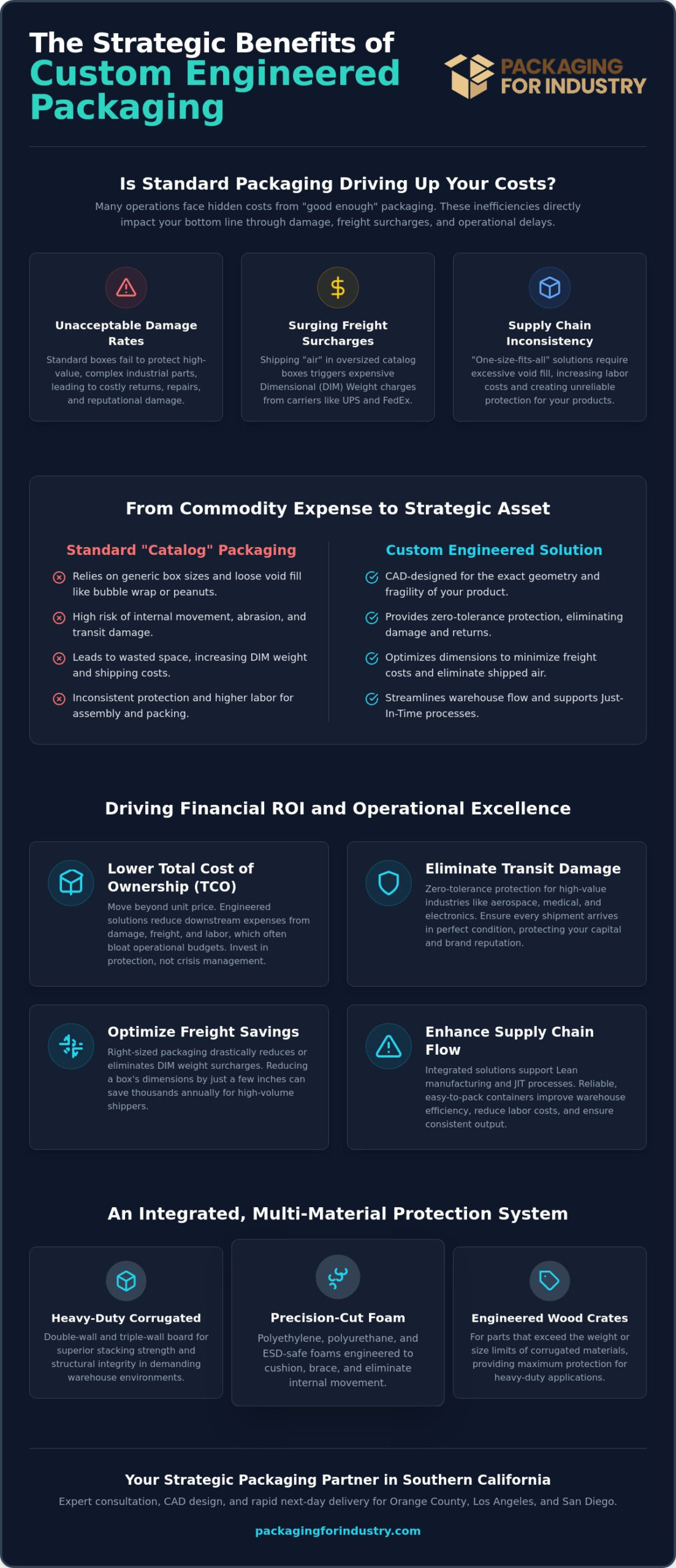
Custom engineered packaging is far more than a standard shipping container. It’s a comprehensive, integrated protection system designed through the lens of Packaging engineering. This discipline combines science and technology to ensure that high-value industrial parts reach their destination without damage. Unlike generic catalog options, these solutions use CAD-designed components tailored to the exact geometry and fragility of your product. One of the primary benefits of custom engineered packaging is its ability to account for the unique stresses of the industrial supply chain, from forklift handling to international freight vibrations.
Catalog suppliers often provide a “one-size-fits-all” approach that forces manufacturers to rely on excessive void fill. This leads to inconsistent protection and higher labor costs. Engineered solutions move beyond the simple box by integrating corrugated structures, precision-cut foam, and even wood crating into a single unit. This level of detail is necessary when dealing with the zero-tolerance requirements of the aerospace or medical sectors. It’s about creating a predictable outcome for every shipment leaving your facility.
Engineered Protection vs. Standard Shipping Supplies
Standard Regular Slotted Containers (RSC) often lack the structural integrity required for heavy industrial components. They don’t offer the compression strength needed for multi-tier stacking in a busy warehouse. Custom engineered designs replace generic “void fill” materials like packing peanuts or bubble wrap with fixed inserts. These inserts eliminate internal movement and abrasion, which are leading causes of transit damage. By ensuring a precise fit, you also optimize the external dimensions of the package. This directly addresses the pain of increasing UPS and FedEx dimensional weight surcharges by removing the “shipped air” that standard boxes require.
The Integration of Multiple Materials
Effective industrial protection requires a multi-layered approach. We often utilize double-wall or triple-wall corrugated board to provide superior stacking strength for heavy-duty applications. Within these outer shells, custom foam packaging plays a critical role. Material selection is based on the specific needs of the part. Polyethylene foam offers excellent durability for heavy items, while polyurethane is ideal for delicate components requiring soft cushioning. For sensitive electronics, we integrate ESD-safe foam to prevent static discharge. When parts exceed the weight limits of corrugated materials, the system transitions into custom-engineered wood crates. This integrated material strategy is one of the key benefits of custom engineered packaging for complex industrial operations across Southern California and beyond.
Financial ROI: How Engineered Solutions Lower Total Packaging Costs
To understand the true benefits of custom engineered packaging, you must look beyond the unit price of a single box. Industrial operations often fall into the trap of purchasing the cheapest available supplies, only to see those savings erased by high damage rates and logistical inefficiencies. Total Cost of Ownership (TCO) accounts for the entire lifecycle of the package. It includes the material cost, the labor required for assembly, the freight charges, and the potential cost of product failure. By investing in engineering upfront, you reduce these downstream expenses that typically bloat an operations budget.
The high cost of “cheap” packaging becomes evident when you factor in the expense of returns and repairs. A single damaged industrial part can cost ten times its shipping value to replace or refurbish, not to mention the damage to your professional reputation. Strategic packaging design ensures that your capital is spent on protection rather than post-delivery crisis management. For manufacturers in Southern California hubs like Orange County and Los Angeles, where freight and labor costs are high, this shift in focus is essential for maintaining a competitive edge.
Optimizing Dimensional Weight for Freight Savings
Freight carriers like UPS and FedEx calculate shipping costs based on Dimensional (DIM) weight, which prioritizes the volume of a package over its actual mass. Standard catalog boxes often force you to ship significant amounts of air, which triggers these surcharges. Reducing a box’s dimensions by just two inches can save thousands of dollars in annual freight expenses for high-volume distributors. Utilizing right-sized corrugated boxes ensures you aren’t paying to transport empty space. This precision is a cornerstone of modern distribution and e-commerce logistics, where every cubic inch impacts the bottom line.
Reducing Labor and Assembly Overhead
Labor efficiency is another critical component of the TCO equation. Standard packaging often requires multi-step processes involving wrapping, taping, and the application of loose void fill. Custom engineered inserts simplify this workflow. When packaging is pre-kitted or designed for intuitive assembly, warehouse teams can pack significantly faster. This streamlined process also simplifies training for temporary labor during peak seasons. Eliminating the need for complex taping patterns or manual cushioning saves time on the production line and reduces the risk of human error. If you’re ready to analyze your current shipping spend and find efficiencies, you can request a custom packaging quote to see how an engineered approach impacts your bottom line.
Eliminating Transit Damage in High-Value Industries
In sectors like medical device manufacturing and aerospace, shipping damage is more than a financial nuisance; it’s an operational catastrophe. One of the most critical benefits of custom engineered packaging is the ability to design for a zero-tolerance environment. High-value industrial parts often face the rigors of international freight, including multiple forklift transfers, sea-freight vibrations, and extreme temperature fluctuations. Engineering for the “last mile” requires a deep understanding of these stresses. We focus on creating solutions that protect your reputation as much as your product.
Rigorous prototyping ensures that every design meets real-world transit stresses before it reaches the production floor. This is particularly vital for Tier 1 and Tier 2 automotive suppliers in Southern California who must maintain strict delivery windows and part integrity to keep assembly lines moving. Standardizing protection through custom-designed trays or foam inserts ensures that every component remains secure. Whether you’re shipping precision sensors or heavy-duty machinery, an engineered approach provides the stability that standard catalog boxes lack.
Aerospace and Aviation Packaging Solutions
Precision-machined turbine parts and sensitive avionics require specialized handling that generic corrugated materials can’t provide. Our aerospace packaging solutions utilize custom foam end-caps and die-cut inserts to cradle irregular geometries. This prevents surface abrasion and structural misalignment during transport. We also address the specific security and non-disclosure needs of the aviation sector. Our designs provide discreet, high-strength protection that meets the industry’s stringent safety and handling protocols.
Military and Defense Compliance (Mil-Spec)
Defense contractors must navigate a complex landscape of military packaging standards that are mandatory for government contract fulfillment. These Mil-Spec requirements often dictate specific materials, such as moisture barrier bags to prevent corrosion during long-term storage or specialized ESD foam to protect defense electronics. Certified engineering is a prerequisite for these contracts. By leveraging the benefits of custom engineered packaging, contractors ensure their shipments comply with all regulatory codes while protecting sensitive equipment from the harshest field conditions imaginable.
Operational Advantages: Reliability and Supply Chain Flow
Operational reliability is the backbone of any successful industrial facility. One of the primary benefits of custom engineered packaging is how it integrates with Lean manufacturing and Just-In-Time (JIT) processes. When your packaging is designed to work in tandem with your production line, you eliminate bottlenecks and reduce the footprint required for packing stations. Custom solutions also allow you to maximize vertical storage space in your warehouse. Unlike mismatched catalog boxes that create unstable stacks, engineered containers are designed for uniform palletization and secure high-density storage.
Simplifying your procurement process with integrated, single-vendor solutions reduces administrative overhead. Instead of managing multiple suppliers for boxes, foam, and pallets, you consolidate your supply chain under one engineering-minded partner. This approach ensures that every component of the packaging system is compatible, reducing the risk of assembly errors on the warehouse floor. For operations in Southern California, this level of coordination is essential for maintaining a fast-moving and cost-effective distribution hub.
The Role of Prototyping in Design Accuracy
Design accuracy is critical when protecting specialized equipment. PFI provides free prototyping services to ensure a perfect product fit before you commit to a full production rollout. Our CAD/CAM support allows for rapid iterations of foam and box designs, ensuring that every angle of your part is accounted for. This process eliminates the risk of “mass-produced mistakes” that often occur when using high-volume, non-customized orders. By testing the prototype in real-world conditions, you confirm the structural integrity and fit, giving your operations team peace of mind.
Streamlining Procurement with VMI
Managing the lead times of custom items can be challenging without the right system in place. Our Vendor Managed Inventory (VMI) program is designed specifically to handle these variables. We track your usage rates and ensure that custom crates and boxes are stocked and ready for local next-day delivery in San Diego, Anaheim, or Los Angeles. This proactive approach prevents production stops caused by packaging stockouts. Additionally, VMI allows you to free up valuable warehouse floor space by stocking your custom supplies off-site at our facility.
Why PFI is the Preferred Custom Packaging Manufacturer in Southern California
PFI operates as an extension of your engineering and operations teams rather than just a vendor. While catalog suppliers provide a list of standard sizes, we focus on the fiscal and logistical benefits of custom engineered packaging. This means we prioritize your bottom line by addressing the root causes of shipping damage and freight overspending. Our local presence in Southern California allows us to provide a level of service that national catalog-only vendors cannot match. We understand that industrial reliability isn’t a commodity; it’s a requirement for your daily operations.
Our consultative approach begins with a deep dive into your current challenges. We don’t just sell boxes; we design systems that protect your capital and streamline your warehouse flow. By choosing a partner with local manufacturing and design capabilities, you gain the agility needed to respond to sudden shifts in demand or product changes. This responsiveness is a defining characteristic of our service model, ensuring your supply chain remains resilient. Whether you’re a startup or an established manufacturer, our team provides the technical expertise to optimize every aspect of your shipping process.
From Anaheim to Nationwide: Scalable Industrial Support
With deep roots in the Southern California manufacturing corridor, we serve as a dedicated Anaheim packaging supplier with reach across the entire region. Our local account managers understand the specific logistics challenges of the Los Angeles and Orange County areas, including the need for rapid turnaround and local next-day delivery. We provide critical support to aerospace and automotive hubs in San Diego and the Inland Empire, ensuring that Tier 1 and Tier 2 suppliers meet their strict JIT requirements. While our local expertise is unmatched, we also maintain nationwide shipping capabilities to support multi-location manufacturers who require consistent packaging quality across all their facilities.
Request Your Custom Packaging Analysis
If your operation is struggling with high damage rates or mounting freight surcharges, it’s time for a professional audit. We invite you to review your current shipping data and identify the hidden costs of your existing supplies. Our team provides a free design review and cost-reduction analysis to demonstrate the benefits of custom engineered packaging for your specific parts. We’ll help you transition from “off-the-shelf” solutions to a precision-engineered system that pays for itself through improved efficiency and damage elimination. Don’t let standard packaging compromise your operational success.
Optimize Your Industrial Logistics with Precision Engineering
Transitioning from a material-cost mindset to an operational-efficiency strategy is the most effective way to manage rising freight and material expenses. The benefits of custom engineered packaging extend far beyond the box; they encompass the entire lifecycle of your product from the production line to the final destination. By integrating specialized aerospace and defense expertise with precision CAD/CAM prototyping, you eliminate the risks and hidden costs associated with standard catalog shipping supplies.
Our team streamlines your operations with local next-day delivery across Southern California and proactive inventory management. We focus on the intersection of engineering and economics to ensure your high-value parts arrive in pristine condition every time. This approach moves your logistics from a source of professional stress to a steady, predictable component of your business growth. It’s time to stop paying for shipped air and start investing in a system that protects your bottom line.
Protecting your operational success starts with a partner who treats your challenges as their own. We’re ready to help you achieve zero-damage delivery and sustainable cost savings starting today.
Frequently Asked Questions
What is the difference between custom and stock packaging?
Stock packaging consists of generic sizes from a catalog, whereas custom engineered solutions are built around the specific geometry of your product. Using stock boxes often results in excessive void fill and increased damage risks during handling. Custom designs use CAD-driven precision to integrate materials like foam and double-wall corrugated, providing a secure fit that eliminates internal movement. This level of protection is essential for industrial parts that stock supplies fail to protect.
How much can I save by using engineered packaging?
Savings are achieved by lowering the total cost of ownership rather than just the initial material price. You reduce expenses by eliminating product damage and avoiding expensive dimensional weight surcharges from freight carriers. One of the major benefits of custom engineered packaging is its ability to stop the cycle of costly returns and repairs. This strategic investment protects your bottom line by ensuring every shipment arrives intact and optimized for transport.
Do you offer free prototypes for custom foam and boxes?
We offer free prototyping services to confirm the fit and function of your custom foam and boxes before you place a full order. Our engineers use CAD/CAM technology to create these prototypes, allowing your team to conduct real-world testing. This proactive step reduces the risk of design errors and ensures the packaging performs exactly as needed. It’s a critical part of our consultative process for manufacturers in Los Angeles and Orange County.
What industries benefit most from custom engineered packaging?
Industries that ship high-value, fragile, or precision-machined components benefit the most from these solutions. This includes the aerospace, medical, defense, and automotive sectors where damage is not an option. These fields require specialized materials like ESD-safe foam or moisture barriers to maintain part integrity. Custom engineering provides the structural reliability needed to meet the strict quality standards and delivery timelines typical of these specialized industrial environments.
Can custom packaging help reduce shipping surcharges?
Custom packaging reduces surcharges by right-sizing the container to eliminate the “shipped air” that triggers dimensional (DIM) weight penalties. Freight carriers calculate costs based on package volume, so oversized stock boxes are significantly more expensive to ship. By using engineered designs that minimize the exterior footprint, you ensure you’re only paying for the space your product actually occupies. This optimization can lead to substantial annual savings on your UPS and FedEx invoices.
How does custom packaging improve warehouse efficiency?
Custom packaging improves warehouse efficiency by simplifying the packing process and optimizing floor space. Pre-kitted inserts and intuitive designs allow staff to pack products faster, reducing labor costs and training time for temporary workers. Additionally, engineered boxes are designed for stable palletization, which allows for safer and higher stacking in your warehouse. This maximizes your vertical storage capacity and improves the overall logistical flow.
What is the minimum order quantity for custom engineered solutions?
Minimum order quantities vary based on the specific materials and design complexity of your custom solution. We focus on serving industrial manufacturers in San Diego and the Inland Empire who require bulk quantities for their ongoing operations. To help manage these requirements, we offer Vendor Managed Inventory (VMI) programs. These services allow you to maintain lower on-site inventory levels while ensuring that your custom-engineered supplies are always available for local next-day delivery.
How do you ensure custom packaging meets military or aerospace specs?
We ensure compliance by following the exact material and structural guidelines mandated by military and aerospace authorities. This includes the use of certified moisture barrier bags, specialized cushioning, and high-strength crates that meet Mil-Spec standards. One of the primary benefits of custom engineered packaging in these sectors is the assurance that your shipments will pass inspection and meet contract requirements. Our engineering team acts as a technical guide to navigate these complex regulatory landscapes.