
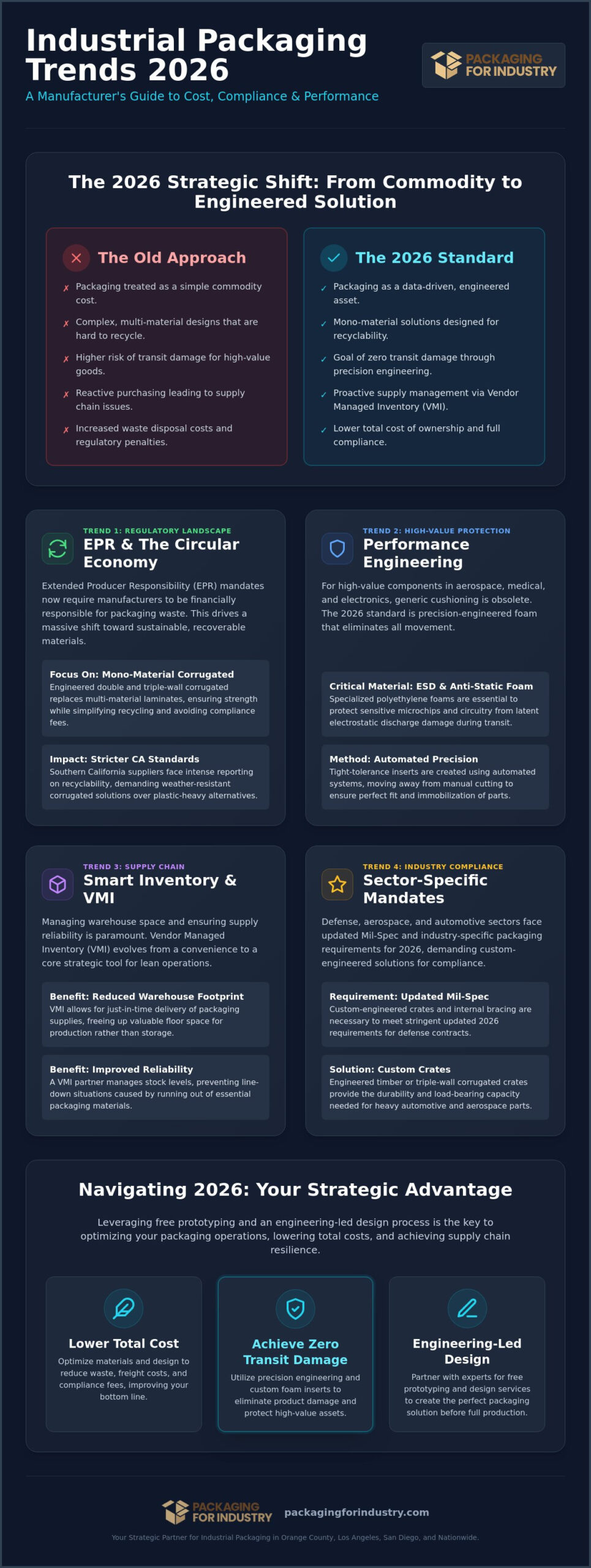
By 2026, treating a corrugated box as a simple commodity will be a costly mistake for any high-volume manufacturer. The landscape is shifting toward a strategic engineering model where every layer of protective foam and every inch of stretch film must justify its cost through performance. As you look ahead, understanding the industrial packaging trends 2026 is essential for maintaining a competitive edge in a market defined by volatile material prices and tightening environmental regulations. For those seeking a reliable Orange County packaging supplier, the focus has moved from simply purchasing supplies to building a resilient, data-driven supply chain.
We understand you’re facing increased pressure to eliminate transit damage for high-value components while managing limited warehouse space. It’s a difficult balance to strike when inflation and new mandates continue to drive up the total cost of ownership. This article outlines how to optimize your operations for both cost and compliance. You’ll discover how the move toward custom engineering, military-spec standards, and Vendor Managed Inventory (VMI) can help your business achieve zero transit damage. From Los Angeles to San Diego, these shifts are redefining how smart operations approach logistics and fulfillment.
Key Takeaways
- Understand how 2026 Extended Producer Responsibility (EPR) mandates are driving the transition from complex multi-material laminates to recyclable mono-material corrugated solutions.
- Learn how precision-engineered foam inserts, including ESD and anti-static polyethylene, are critical for protecting high-value aerospace and medical components in complex global logistics.
- Discover why these industrial packaging trends 2026 position Vendor Managed Inventory (VMI) as a vital tool for reducing warehouse space constraints and improving supply reliability.
- Identify the updated 2026 requirements for Mil-Spec packaging and how custom-engineered crates ensure compliance for defense and automotive sectors.
- Find out how leveraging free prototyping and engineering-led design can lower your total cost of packaging ownership while achieving zero transit damage.
The 2026 Regulatory Landscape: EPR and the Circular Industrial Economy
Extended Producer Responsibility (EPR) has transitioned from a policy concept into a mandatory operational requirement for industrial shippers. By 2026, these regulations require manufacturers to take financial and physical responsibility for their packaging waste. This shift is a primary driver behind the industrial packaging trends 2026; it moves the industry away from disposable mindsets toward measurable recovery. Circular industrial packaging is a system that prioritizes material recovery without sacrificing load integrity.
For operations dealing with bulk shipping, these standards significantly impact the use of Gaylord boxes and heavy-duty protective layers. The goal is to move away from multi-material laminates that are difficult to separate and recycle. Instead, the focus has shifted to high-performance paper-based systems that maintain the structural stability required for heavy industrial loads while meeting new recovery benchmarks.
California’s EPR Impact on Industrial Suppliers
Industrial suppliers in Southern California face some of the strictest reporting requirements in the country. Manufacturers in cities like Anaheim and Los Angeles must now track and report the recyclability of every pallet wrap and corner protector they use. These mandates have created a surge in demand for weather-resistant corrugated solutions. By engineering corrugated materials to withstand moisture and vertical compression, companies can replace plastic-heavy alternatives that would otherwise trigger higher compliance fees. This proactive approach helps local distributors maintain their margins while ensuring their shipping operations remain fully compliant with regional waste-reduction laws.
The Rise of Mono-Material Corrugated Engineering
The 2026 standard for recyclability centers on mono-material design. When a shipping container consists of a single material type, the recovery process becomes faster and more cost-effective. However, the challenge lies in maintaining the strength required for manufacturing logistics. Engineering teams are now utilizing advanced corrugated box solutions that rely on double-wall and triple-wall construction to achieve the necessary stacking strength.
This transition isn’t just about environmental compliance; it’s about economic optimization. By reducing the number of material types in a single shipment, warehouses can streamline their waste streams and lower their total cost of disposal. Modern triple-wall corrugated offers the durability needed for heavy automotive and aerospace parts, providing a viable alternative to traditional timber or plastic crates. This shift ensures that high-value goods remain protected during complex global transit without incurring the regulatory penalties associated with non-recyclable materials.
Performance Engineering: Custom Foam and High-Value Protection Trends
While the outer shipping container handles the rigors of the road, the internal engineering determines whether a high-value component arrives functional or as a liability. Precision-engineered foam has become a baseline requirement for aerospace and medical device logistics. These sectors cannot afford the dimensional variances found in generic cushioning. By 2026, the focus has shifted toward tight-tolerance inserts that immobilize sensitive equipment, preventing even microscopic shifts during high-vibration transit. This level of protection requires a move away from manual cutting toward automated precision.
The semiconductor industry is driving significant advancements in material capabilities. As microchips become more sensitive, the demand for high-performance ESD (Electrostatic Discharge) and anti-static foam has surged. These materials don’t just provide physical cushioning; they create a controlled environment that bleeds off static charges before they can reach delicate circuitry. Integrating these specialized foams into a total packaging system is one of the most critical industrial packaging trends 2026 for electronics manufacturers. Failure to account for static discharge during the design phase often leads to “latent defects” that aren’t discovered until the product is in the end user’s hands.
To ensure these designs work in the real world, CAD/CAM support has become a non-negotiable requirement for packaging suppliers. Prototyping allows engineers to test how foam end caps and pads interact with heavy-duty crates before a single production run begins. This data-driven approach eliminates the guesswork that lead to product damage in the past. If your current shipping process experiences frequent damage claims, you may want to request a packaging quote to see how an engineered approach can stabilize your bottom line.
Material Science in Protective Inserts
Selecting the right polymer is the first step in performance engineering. In 2026, we see a clear distinction between the use of polyethylene and polyurethane foams. Polyethylene is the preferred choice for heavy industrial components due to its high-density, closed-cell structure and superior compressive strength. It resists moisture and chemicals, making it ideal for long-term storage or international shipping. Conversely, polyurethane is utilized for lighter, highly delicate items that require a softer “deceleration” upon impact. Utilizing custom foam packaging tailored to the specific weight and fragility of your product is essential for reducing the total cost of ownership.
Multi-Material Integration in Crate Design
Modern protection strategies often require a hybrid approach. Combining timber or plywood crates with custom foam lining provides the ultimate defense for complex international transit. This multi-material integration is a hallmark of the industrial packaging trends 2026, favoring reusable, foam-lined crates for closed-loop supply chains. By engineering a crate that can be used for multiple trips, manufacturers can offset the higher initial cost of custom crating through long-term durability and the total elimination of transit damage. This strategy is particularly effective for automotive engines and aerospace assemblies that move between specialized production facilities.
Smart Inventory: The Evolution of VMI and Just-in-Time Delivery
Warehouse space is at a premium. Keeping months of bulky corrugated boxes on-site is an inefficient use of square footage that could be dedicated to production. This reality makes Vendor Managed Inventory (VMI) a cornerstone of the industrial packaging trends 2026. By shifting the burden of stock maintenance to the supplier, manufacturers can reclaim floor space for high-value machinery and finished goods. It’s no longer just about buying supplies; it’s about optimizing the physical footprint of your facility.
The financial benefits of this shift are immediate and measurable. VMI significantly improves cash flow because capital isn’t tied up in stagnant inventory sitting on a shelf. It also eliminates the operational stress and high surcharges associated with emergency rush orders. When your supplier actively monitors your usage levels, the risk of a stockout vanishes. For businesses in the Los Angeles and Orange County areas, local next-day delivery supports a true lean manufacturing model. You don’t need a massive safety stock when your packaging supplier functions as a seamless extension of your own warehouse operations.
Transitioning to a VMI Packaging Model
Moving to Vendor Managed Inventory services starts with a comprehensive usage audit. We analyze your monthly consumption of custom boxes, stretch film, and precision-cut foam to establish baseline replenishment levels. The process typically follows these steps:
- Usage Analysis: Reviewing historical data to determine peak demand periods.
- Stocking Agreement: Setting minimum and maximum on-hand levels for your specific SKUs.
- JIT Integration: Aligning deliveries with your production schedule to ensure materials arrive exactly when needed.
- Monitoring: Regular reporting to adjust stock levels as your business scales.
Predictive Replenishment and Data-Driven Purchasing
In 2026, inventory control relies on historical data to anticipate seasonal spikes or market shifts. This proactive approach prevents the supply chain shortages that have historically disrupted manufacturing. Your packaging supplier acts as a strategic partner, adjusting orders based on real-time consumption rather than manual guesswork. VMI eliminates the hidden costs of obsolete packaging inventory by ensuring you never over-order designs that are scheduled for engineering updates or regulatory changes. This level of oversight ensures that your packaging spend is always directed toward active, high-turnover materials.
Sector-Specific Shifts: Aerospace, Defense, and Automotive 2026
High-stakes industries like aerospace and defense operate under a zero-failure mandate. In 2026, the margin for error in shipping high-value components has narrowed. While the previously discussed shift toward mono-materials and VMI provides the operational framework, these specific sectors require specialized engineering to survive global distribution. For a San Diego aerospace supplier or a defense contractor in Orange County, compliance is just as important as physical protection. These industrial packaging trends 2026 reflect a move toward total accountability in the supply chain.
Aerospace logistics in 2026 continues to demand extreme precision. Aviation parts are often oddly shaped, heavy, and incredibly fragile. Standard double-wall corrugated boxes rarely suffice. Instead, these parts require custom-engineered interiors that account for center-of-gravity shifts and vibration frequencies. Medical device manufacturers face similar hurdles; packaging must maintain sterility while providing enough impact protection to survive the rigorous “last mile” of medical fulfillment. In these environments, the packaging is an extension of the product’s engineering.
Mil-Spec and Defense Packaging Standards
Military packaging is governed by rigid specifications that ensure materials withstand extreme environments, from desert heat to maritime humidity. The 2026 updates to Mil-Spec standards place a heavier emphasis on long-term preservation. This means moisture-barrier materials and specialized desiccants are no longer optional for many defense contracts. If you’re handling government-related fulfillment, utilizing Aerospace packaging solutions that meet these specific preservation requirements is the only way to avoid contract rejections and shipping delays. Weather-resistant materials are now the baseline for any defense-related logistics plan.
Automotive Logistics and Load Stabilization
Automotive Tier 1 suppliers are currently navigating the choice between returnable plastic bins and optimized expendable corrugated. While returnables work well in short, closed loops, international shipping often favors high-performance triple-wall corrugated for its weight savings and recyclability. A major focus within Automotive industry packaging is now load stabilization. Heavy components like engines or transmissions require more than just a standard pallet. Using high-performance stretch film with specific gauge consistency is vital for preventing load shifting. When combined with heavy-duty corner and edge protection, these loads remain intact during high-vibration transit. This integrated approach ensures that every component of the pallet works as a single engineered unit.
Navigating 2026: Why PFI is the Strategic Choice for Industrial Packaging
As 2026 approaches, the role of the packaging supplier must evolve from a passive vendor to a strategic engineering partner. Packaging For Industry (PFI) specializes in this transition by combining custom engineering with rigorous economic optimization. We don’t just provide a box; we design a system of protection that aligns with the most recent industrial packaging trends 2026. For manufacturers in Anaheim and across the greater Los Angeles area, this means having access to local experts who understand the nuances of Southern California logistics and the rising costs of industrial real estate. Our proximity allows for local next-day delivery and on-site consultations that nationwide catalog companies simply cannot match.
One of the most significant advantages we offer is free prototyping for custom designs. This capability is essential for reducing R&D costs during new product launches. By testing material density and structural integrity before committing to a full production run, you eliminate the risk of expensive redesigns or transit failures. We also focus heavily on material density analysis to ensure you aren’t over-packaging. Using the right grade of triple-wall corrugated or high-density polyethylene foam allows us to maintain protection levels while reducing the overall weight and footprint of your shipments. This data-driven approach ensures that every gram of material serves a functional purpose.
A Cost-Saving Alternative to Catalog Suppliers
Procurement teams in 2026 are increasingly moving away from generic, off-the-shelf catalogs. While catalog suppliers offer convenience, they often lead to higher freight costs due to poor box sizing. When you use a box that’s even slightly too large, you’re paying for air through UPS and FedEx dimensional (DIM) weight surcharges. We help you implement packaging cost savings strategies by engineering custom-sized solutions that fit your products perfectly. This approach reduces void fill usage and lowers your total shipping spend across your entire distribution network. As a dedicated Orange County packaging supplier, we prioritize your bottom line by eliminating the waste inherent in one-size-fits-all shipping supplies.
Requesting a 2026 Packaging Audit
A professional packaging review is the most effective way to identify damage-prone areas in your current supply chain. Many businesses continue to use off-the-shelf supplies that weren’t designed for the complexities of modern global transit. Our audit process moves your operation toward integrated industrial solutions that prioritize load stability and material recovery, keeping you ahead of the industrial packaging trends 2026 that are reshaping the market. Whether you’re shipping aerospace components or automotive parts, a data-driven audit ensures your packaging is a source of resilience rather than a liability. We analyze your current material usage, damage rates, and warehouse flow to provide a clear path toward optimization.
Future-Proofing Your 2026 Industrial Supply Chain
The transition toward engineering-led logistics is the defining characteristic of industrial packaging trends 2026. Companies that move away from generic catalog supplies toward custom-engineered solutions will see significant improvements in both cost control and product protection. Integrating advanced materials like ESD foam and high-performance corrugated with smart inventory systems like VMI allows your operation to navigate rising material costs and tightening environmental mandates effectively. It’s no longer enough to just ship products; you must engineer a protection system that supports your entire supply chain.
PFI provides the specialized expertise required for these high-stakes transitions. Our team offers free prototyping and CAD design to ensure your custom crates and foam inserts perform exactly as required. As specialists in aerospace and defense standards, we help you maintain compliance while optimizing your total cost of ownership. Our engineers work directly with your team to eliminate shipping damage and reduce warehouse overhead through precision design. For manufacturers in Los Angeles, Orange County, and San Diego, our local next-day delivery ensures your production line doesn’t face inventory bottlenecks.
We look forward to helping you build a more resilient and cost-effective shipping operation that meets the demands of tomorrow.
Industrial Packaging Trends 2026 FAQ
What are the biggest industrial packaging trends for 2026?
The most significant industrial packaging trends 2026 center on the integration of material science with data-driven supply chain management. Manufacturers are moving away from generic supplies toward precision-engineered solutions like custom foam inserts and triple-wall corrugated boxes. This shift prioritizes supply chain resilience, ensuring that high-value components survive complex transit while meeting strict new environmental and reporting standards.
How do EPR regulations affect my industrial packaging choices in 2026?
Extended Producer Responsibility (EPR) mandates in 2026 require businesses to take full responsibility for the lifecycle of their packaging materials. In practical terms, this means you must choose materials that are easily recyclable and provide documentation of their recovery potential. Shifting to mono-material designs, such as all-paper corrugated systems, helps you avoid high compliance fees and simplifies waste management for your end customers.
Is custom foam packaging more cost-effective than standard void fill in 2026?
Custom foam packaging provides a lower total cost of ownership than generic void fill by eliminating transit damage and reducing box size. While the initial material cost may be higher, the precision fit of polyethylene or ESD foam allows for smaller shipping footprints and fewer insurance claims. This engineering approach reduces dimensional weight surcharges and the labor costs associated with manual packing.
How can Vendor Managed Inventory (VMI) lower my packaging costs?
Vendor Managed Inventory (VMI) lowers your costs by optimizing your warehouse space and improving cash flow. Instead of paying for months of bulky inventory upfront, you only receive and pay for what you need on a just-in-time schedule. This model eliminates the risk of stockouts and the high surcharges typically associated with emergency rush orders, allowing your capital to be used for production rather than storage.
What are the current Mil-Spec packaging standards for 2026?
Current 2026 Mil-Spec standards focus heavily on long-term preservation and moisture protection for defense-related logistics. These requirements often mandate the use of specific barrier materials and desiccants to protect sensitive equipment from extreme environmental conditions. Working with a specialist who understands these rigid military specifications is essential for ensuring your shipments pass inspection and avoid costly contract rejections.
How can I reduce product damage during international shipping in 2026?
Reducing international shipping damage requires a combination of high-density protective foam and robust load stabilization techniques. Using custom-engineered crates lined with polyethylene foam ensures that heavy components remain immobilized during high-vibration transit across multiple modes of transport. Additionally, applying consistent-gauge stretch film and edge protection prevents pallet loads from shifting or collapsing during sea and air freight.
Are there sustainable alternatives for heavy-duty industrial crates?
Triple-wall corrugated boxes serve as a powerful sustainable alternative to traditional timber or plastic crates for many heavy-duty applications. These containers offer the necessary stacking strength and puncture resistance while being fully recyclable in standard waste streams. For closed-loop supply chains, reusable foam-lined crates provide long-term durability that offsets the environmental impact of single-use shipping materials.
What is the benefit of using a local Southern California packaging supplier?
Partnering with a local Southern California packaging supplier provides significant logistical advantages, including local next-day delivery and on-site engineering support. Suppliers in Los Angeles or Orange County understand the specific regional challenges, such as high real estate costs and California’s unique environmental reporting mandates. This proximity allows for faster prototyping and a more responsive Vendor Managed Inventory program that supports lean manufacturing models.