
Most manufacturers view protective materials as a simple line item expense, but for high-value industrial goods, precision-engineered styrofoam packaging is actually a high-yield investment. You’ve likely dealt with the frustration of rising LTL damage claims or the “sticker shock” of oversized packaging surcharges that eat into your margins. It’s a common struggle to balance the need for absolute product safety with the pressure to keep dimensional weight (DIM) fees under control, particularly as global resin prices continue to see significant volatility throughout 2026.
This guide will show you how custom foam solutions can achieve zero-damage transit while optimizing your footprint to reduce total shipping costs. We’ll examine the technical benefits of different foam types, the impact of free prototyping on your bottom line, and how a local Southern California supply chain can stabilize your lead times. By the end, you’ll have a clear roadmap for turning your protective packaging from a logistical headache into a streamlined, cost-saving operation.
Key Takeaways
- Learn why Expanded Polystyrene (EPS) is the industrial standard for shock absorption and how its cellular structure protects sensitive components.
- Compare styrofoam packaging with polyethylene and polyurethane to determine the most cost-effective material for your specific transit cycle.
- Discover how CAD/CAM design and custom-engineered foam inserts eliminate the need for bulky void fill while securing complex geometries.
- Understand the relationship between engineered foam and reduced dimensional weight (DIM) fees to lower your total shipping expenditure.
- Explore how local Southern California manufacturing and Vendor Managed Inventory (VMI) programs prevent stockouts and streamline your operations.
Understanding Styrofoam Packaging in Industrial Logistics
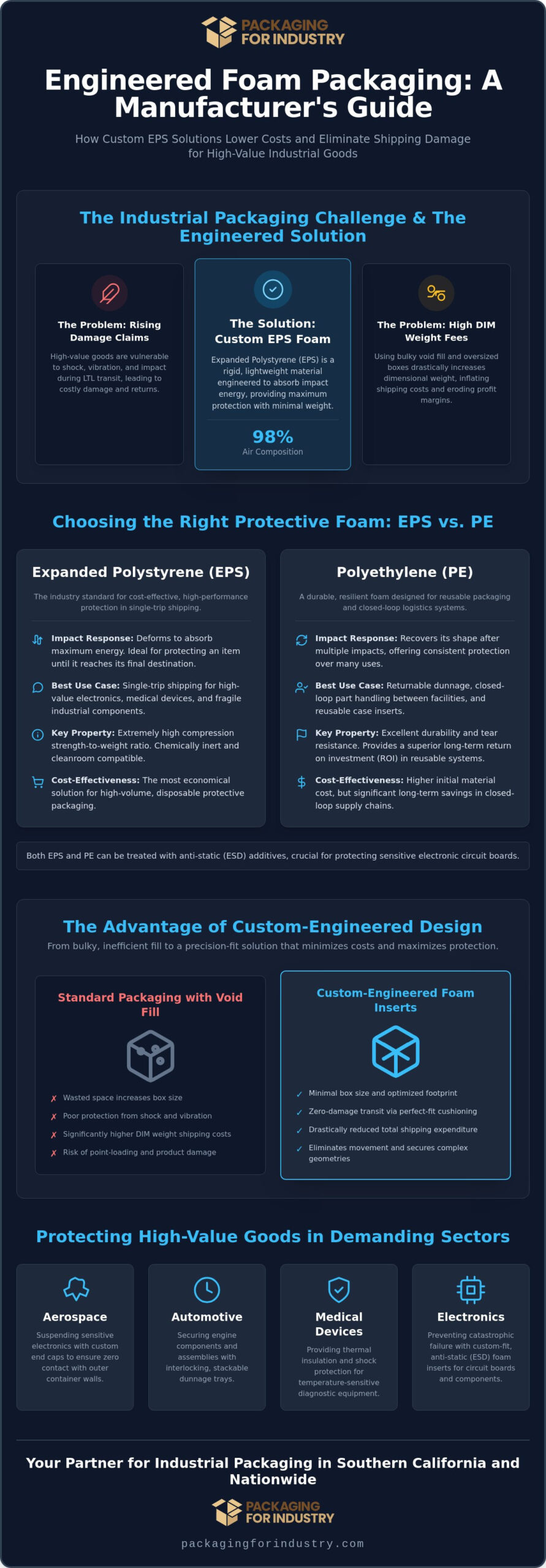
In the world of industrial logistics, the term “Styrofoam” is often used as a catch-all, but Styrofoam is a brand name for extruded polystyrene (XPS) typically used in construction. For shipping and cushioning, the technical standard is actually Expanded Polystyrene (EPS). This distinction matters to procurement teams because EPS is engineered specifically for energy management and protection. High-performance styrofoam packaging utilizes a unique cellular structure comprised of approximately 98% air; this makes it one of the most efficient materials for absorbing shock without adding significant weight to a pallet. It provides a rigid yet lightweight barrier that protects high-value goods from the vibrations and impacts inherent in LTL transit.
Manufacturers across Orange County and Los Angeles often choose between stock foam sheets and custom-molded components. While stock sheets work for basic void fill, they don’t provide the structural integrity required for heavy industrial parts. Custom-molded EPS is shaped to the exact geometry of a product, distributing pressure evenly across the surface area. This precision engineering reduces the risk of point-loading, where a single impact could crack a housing or misalign a sensitive internal sensor. By using custom shapes, companies can also reduce the overall box size, leading to significant savings on dimensional weight fees.
The Role of EPS in Modern Supply Chains
EPS serves as a dual-purpose material by offering both thermal insulation and superior impact resistance. For distributors, the lightweight nature of EPS is a direct contributor to fuel efficiency and lower carrier costs. Because it’s so light, it allows for more protective material to be used without triggering the weight-based surcharges common in long-haul shipping. The physical density of EPS determines its ability to dissipate kinetic energy and shield sensitive components from high G-force impacts during transit. This reliability is why it remains a staple for companies looking to lower packaging costs while maintaining high safety standards.
Common Industrial Applications
The versatility of custom foam packaging allows it to serve multiple specialized sectors. In the automotive industry, interlocking dunnage trays made of EPS are used to transport engine components safely between assembly plants; these trays are often designed to be stackable to maximize trailer space. Aerospace manufacturers rely on EPS end caps to suspend heavy, high-value electronics within corrugated boxes, ensuring zero contact with the outer walls during rough handling. Additionally, medical device companies in San Diego and beyond utilize the thermal properties of EPS for shipping temperature-sensitive diagnostic equipment, maintaining a stable internal environment regardless of external climate fluctuations during transit.
EPS vs. Alternative Industrial Packaging Foams
Selecting the right protective material requires a balance between material physics and the specific demands of your transit cycle. While styrofoam packaging (EPS) is the go-to for rigid support and high-volume cost efficiency, other foams like Polyethylene (PE) and Polyurethane (PU) offer distinct advantages for different industrial applications. EPS excels in single-trip shipping because its high compression strength keeps heavy components fixed in place. Because it’s chemically inert and safe for use in contact with food, EPS is also a preferred choice for medical device manufacturers who require cleanroom-compatible materials that won’t off-gas or degrade during storage.
Durability is the primary differentiator when comparing these materials. EPS is designed to absorb energy by deforming under impact; this makes it ideal for one-way transit but less suitable for returnable programs. In contrast, Polyethylene is a closed-cell foam that recovers its shape after multiple impacts. If your operation uses a closed-loop system for moving parts between facilities, PE foam provides a better long-term ROI. For electronics manufacturers, both EPS and PE can be treated with anti-static additives. These ESD-safe versions are critical for preventing electrostatic discharge from damaging sensitive circuit boards during handling and shipping. If you’re unsure which material fits your current shipping profile, you can request a packaging quote to receive a technical assessment from our engineering team.
Material Properties Comparison
- Expanded Polystyrene (EPS): This is the most economical solution for high-volume protection. It provides excellent thermal insulation and rigid support for heavy machinery or automotive parts.
- Polyethylene (PE): Best for non-abrasive protection. Its resilient nature makes it perfect for multi-drop shipping or returnable dunnage where the foam must withstand repeated use.
- Polyurethane (PU): This soft, open-cell foam is the standard for highly fragile or lightweight items. It provides a “cloud-like” cushion that prevents delicate surfaces from scratching.
Selecting the Right Density
Foam density is directly correlated to the weight and fragility of your industrial components. Using a foam that’s too soft for a heavy part will result in “bottoming out,” where the cushion fully compresses and transfers the impact energy directly to the product. Conversely, foam that’s too dense for a lightweight item won’t compress at all, leading to the same result. Engineering the correct density allows you to use less material overall. This optimization is key to reducing the outer dimensions of your corrugated boxes, which helps you avoid the unnecessary freight costs associated with high dimensional weight fees. Effective styrofoam packaging design focuses on using the minimum amount of material necessary to achieve a zero-damage transit.
Engineering Custom Styrofoam Inserts for High-Value Goods
Industrial procurement officers often view protective materials as a simple commodity, but high-value goods require a shift from generic void fill to engineered custom foam packaging. Generic solutions like packing peanuts or pre-cut blocks lead to inconsistent results and higher damage rates because they don’t account for the unique center of gravity or fragile points of a specific part. By utilizing CAD/CAM design, we create styrofoam packaging that matches the precise geometry of complex industrial components. This engineering-first approach eliminates the “guesstimation” often found at warehouse packing stations, ensuring that every sensitive component is secured against the vibrations and shocks of the modern supply chain.
Standardizing your packing process with custom inserts also simplifies kitting and assembly on the warehouse floor. Instead of workers spending minutes wrapping items in multiple layers of bubble wrap or searching for the right amount of paper fill, they simply drop the part into a pre-formed cavity. This speeds up throughput in San Diego and Los Angeles distribution centers. It also guarantees that the product is protected exactly as intended every single time, regardless of which employee is on the packing line. When protection is built into the design, human error is significantly reduced.
The Custom Design Process
The process begins with a detailed assessment of the product’s fragility and the specific transit hazards it will face, such as multi-stop LTL shipping or overseas freight. For oversized or heavy equipment, we often design foam-lined crates that combine the structural strength of wood with the shock-absorbing properties of EPS. Our team at PFI specializes in Custom Design Packaging, ensuring that the intersection of material science and logistical reality is addressed before the first box is even taped. This proactive design phase is where the most significant long-term cost savings are identified.
Prototyping and Testing
Digital models are useful for initial visualization, but they cannot replace the data gathered from physical drop testing. We provide free prototyping because a physical sample is the only way to verify how the foam reacts to real-world stress and compression. This iterative design process allows us to refine foam thickness to the exact millimeter, optimizing the overall box size to reduce DIM weight fees. Physical prototypes ensure that the final production run provides a precise fit, which directly prevents the long-term professional stress of managing expensive damage claims and product returns.
Reducing Shipping Costs and Transit Damage with Optimized Foam
Carriers like UPS and FedEx don’t just bill for weight; they bill for the space your package occupies. This is where engineered styrofoam packaging provides a distinct economic advantage. By designing foam inserts that hug the product’s contours, we eliminate the “dead space” that often forces manufacturers into larger, more expensive box sizes. Reducing the air inside the carton isn’t just about protection. It’s about optimizing the dimensional weight (DIM) factor to ensure you aren’t paying to ship empty volume. This focus on the intersection of engineering and economics is what separates a professional packaging strategy from a simple procurement expense.
The financial burden of transit damage goes far beyond the cost of the broken part. When a high-value industrial component arrives damaged, you face the expense of return freight, the labor costs of processing the claim, and the potential loss of a customer’s trust. Using precision-fit foam ensures that products remain stationary during the vibrations of LTL shipping. This reliability turns your packaging into a tool for fiscal stability. It’s often more cost-effective to invest in custom EPS than to absorb the recurring costs of insurance premiums and product replacements. By securing your goods properly, you eliminate the professional stress of managing avoidable shipping failures.
Optimizing pallet density is another area where precision-fit styrofoam packaging pays for itself. By reducing the external footprint of each carton, you can often fit more units per pallet. This decreases the number of pallet positions required for a shipment, leading to a direct drop in fuel and carrier costs. EPS serves as a highly cost-effective alternative to expensive molded plastic dunnage, providing the same level of structural support at a fraction of the material cost. This is particularly beneficial for manufacturers in Anaheim and Orange County who need to maximize trailer space for nationwide distribution.
Combatting UPS and FedEx Surcharges
Standard catalog boxes often leave several inches of unused space. This triggers oversized fees that can double the cost of a single shipment. Real packaging cost savings are found by moving away from bulky, oversized cartons toward slim-profile foam designs. For example, reducing a shipping container’s dimensions by just 2 inches can result in a 15% reduction in total freight costs. This optimization allows for higher pallet density, meaning you move more product for the same transportation spend.
Integrated Solutions: Foam and Corrugated
There is a powerful synergy between industrial corrugated boxes and custom foam inserts. Modern designs utilize interlocking foam components that snap into place, creating a rigid internal structure without the need for excessive tape or secondary void fill. This streamlined approach allows workers at the pack-out station to fulfill orders faster. It also ensures consistent protection across every shipment, regardless of the packer’s experience level. By integrating these two materials, you create a holistic system that protects your bottom line as much as your product.
Why Choose PFI for Your Industrial Foam Packaging Needs?
Selecting a partner for your protective requirements involves more than just a price comparison; it requires a logistical ally that understands the pace of Southern California manufacturing. Based in Anaheim, PFI operates as a dedicated packaging supplier near me for companies across Orange County, Los Angeles, and San Diego. We bridge the gap between high-level engineering and local delivery, ensuring that your styrofoam packaging is not only designed for zero-damage transit but is also available exactly when your production line needs it. Our local fleet provides next-day delivery, allowing you to maintain lean operations without the risk of long-distance supply chain disruptions.
To further safeguard your workflow, we specialize in Vendor Managed Inventory (VMI) programs. We take the guesswork out of procurement by monitoring your stock levels and managing replenishments automatically. This level of oversight is particularly critical for the Aerospace and Medical sectors, where compliance and supply reliability are non-negotiable. By maintaining a steady flow of materials, we help you avoid the professional stress of stockouts and the high costs associated with emergency rush orders.
Local Reliability and Nationwide Support
While our core strength lies in our Southern California footprint, we provide robust nationwide support for multi-location distributors and manufacturers. We offer strategic stocking programs that reduce lead times and stabilize your supply chain regardless of market volatility. Working with a local expert means you get a partner who understands regional shipping hazards and carrier tendencies. We combine this local insight with broad logistical capabilities to ensure that your styrofoam packaging remains a reliable asset to your bottom line, whether you are shipping across the Inland Empire or across the country.
A Partnership Approach to Packaging
At PFI, we function as more than just a vendor; we act as a consultative custom box manufacturer and foam fabricator that integrates directly with your operations team. We move beyond generic catalog ordering to provide tailored solutions that address your specific pain points, from reducing bulk packaging pricing to streamlining your kitting process. Our goal is to act as an extension of your procurement department, identifying efficiencies that lower your total cost of ownership. To see how our engineering expertise can transform your logistics, we invite you to take the next step in optimizing your protective strategy.
Optimize Your Industrial Logistics Strategy
Effective protection for high-value industrial goods requires a shift from viewing materials as a commodity to treating them as an engineered solution. We’ve explored how custom styrofoam packaging doesn’t just cushion your products; it actively reduces your total cost of ownership by eliminating expensive damage claims and minimizing dimensional weight surcharges. By choosing a partner with deep expertise in aerospace and medical sectors, you ensure that your shipping standards meet the highest levels of compliance and reliability.
PFI provides the local Southern California presence you need to keep operations running smoothly, offering free prototyping and next-day delivery to manufacturers in Los Angeles, Orange County, and San Diego. Our Vendor Managed Inventory programs prevent stockouts and allow your team to focus on production rather than procurement logistics. This partnership approach transforms your packaging from a simple expense into a strategic tool for fiscal stability and operational efficiency.
We’re ready to help you eliminate the professional stress of transit damage while lowering your overall shipping expenditure through precision-engineered designs.
Frequently Asked Questions
Is Styrofoam the same as Expanded Polystyrene (EPS)?
Styrofoam is actually a brand name for construction insulation, while the material used for shipping protection is technically Expanded Polystyrene (EPS). In the context of industrial logistics, EPS is the standard because of its high shock absorption and lightweight properties. It provides the rigid cushioning required to protect sensitive equipment without adding significant weight to your pallets during long-haul transit.
Can custom foam packaging reduce my UPS or FedEx shipping rates?
Engineered foam inserts can directly lower your shipping rates by reducing the dimensional weight (DIM) of your packages. Carriers like UPS and FedEx bill based on the space a box occupies, so eliminating dead space is critical. By using a custom-fit design, you can often move into a smaller corrugated box, which helps you avoid oversized surcharges and reduces your total freight expenditure.
Does PFI offer anti-static styrofoam for electronics?
Yes, we offer specialized ESD (Electrostatic Discharge) foam specifically for the electronics and aerospace industries. This material is treated with anti-static agents that prevent the buildup of static electricity during handling and transit. Protecting sensitive circuit boards and medical sensors from electrical damage is a top priority for our engineering team; we ensure all ESD materials meet rigorous industrial safety standards.
What is the minimum order quantity for custom foam inserts?
We focus on high-volume industrial accounts to provide the most competitive bulk packaging pricing available. While we don’t have a rigid minimum, our manufacturing processes are optimized for large-scale production that supports manufacturers and fulfillment centers. Requesting a custom quote allows our team to analyze your volume and design a cost-effective solution that scales with your specific business needs.
How long does the custom foam prototyping process take?
The custom prototyping process is typically completed within a few business days once we have your product specifications. We provide physical samples because they’re essential for conducting accurate drop tests and verifying the fit before full production begins. This proactive step ensures that the final design provides maximum protection and eliminates the risk of expensive modifications after the manufacturing run has started.
Can I combine custom foam with heavy-duty corrugated boxes?
Custom foam is frequently integrated with heavy-duty corrugated boxes to create a complete protective system. As a custom box manufacturer, we design end caps and internal dunnage that fit perfectly inside double-wall or triple-wall RSC containers. This combination provides both the stacking strength of corrugated and the shock absorption of foam. It’s the most reliable way to secure heavy industrial machinery or delicate medical devices.
Do you provide local delivery in Orange County and Los Angeles?
We provide local next-day delivery throughout Orange County, Los Angeles, and San Diego from our Anaheim facility. As a leading packaging supplier near me in Southern California, our own fleet handles these shipments to ensure reliability and faster turnaround times. This local proximity is a key advantage for manufacturers utilizing our VMI programs, as it allows for immediate replenishment of critical styrofoam packaging components whenever inventory levels run low.
Is EPS foam recyclable for industrial users?
EPS is 100% recyclable and can be densified into new plastic materials after its initial use. Many of our industrial clients implement site-specific recycling programs to manage their post-production foam waste. While curbside programs are limited, commercial recycling centers across Southern California accept clean EPS. We can assist your operations team in identifying local resources to manage your used styrofoam packaging responsibly and maintain your sustainability initiatives.