
Machinery damage and failure accounted for over half of all reported shipping incidents in 2025, totaling 1,505 documented cases. For many Southern California manufacturers, the true cost of transit isn’t the freight bill; it’s the hidden internal damage that leads to high return rates and rising insurance premiums. You’ve likely realized that standard, off-the-shelf void fill rarely provides the precision required for high-value industrial goods or sensitive electronics. Learning how to protect products from shock and vibration is no longer about simply adding more padding. Instead, it’s about engineering a solution that accounts for the specific G-forces and random vibrations your cargo will face in a modern logistics environment.
This guide will show you how to apply professional engineering principles and custom material strategies to achieve zero-damage shipping cycles while improving material efficiency. We’ll explore the latest ASTM D4169-23e1 standards, the role of custom foam assemblies like ESD polyethylene, and how precision-fit inserts can protect your bottom line. By the end of this article, you’ll have a clear roadmap for optimizing your packaging flow to eliminate professional stress and ensure reliable delivery to your customers nationwide.
Key Takeaways
- Differentiate between sudden impact shock and harmonic vibration to address both structural damage and internal component failure.
- Discover how to protect products from shock and vibration by matching engineered foam densities, such as polyethylene or ESD options, to your product’s specific G-limit.
- Replace unreliable generic void fill with custom-fit inserts that utilize blocking and bracing to eliminate product migration during long-haul transit.
- Reduce packaging waste and lower shipping costs by utilizing CAD/CAM prototyping to find the most efficient material-to-protection ratio for your cargo.
- Optimize your supply chain with integrated solutions that combine custom foam, corrugated boxes, and crates for total accountability and zero-damage cycles.
Understanding the Physics of Shipping Damage: Shock vs. Vibration
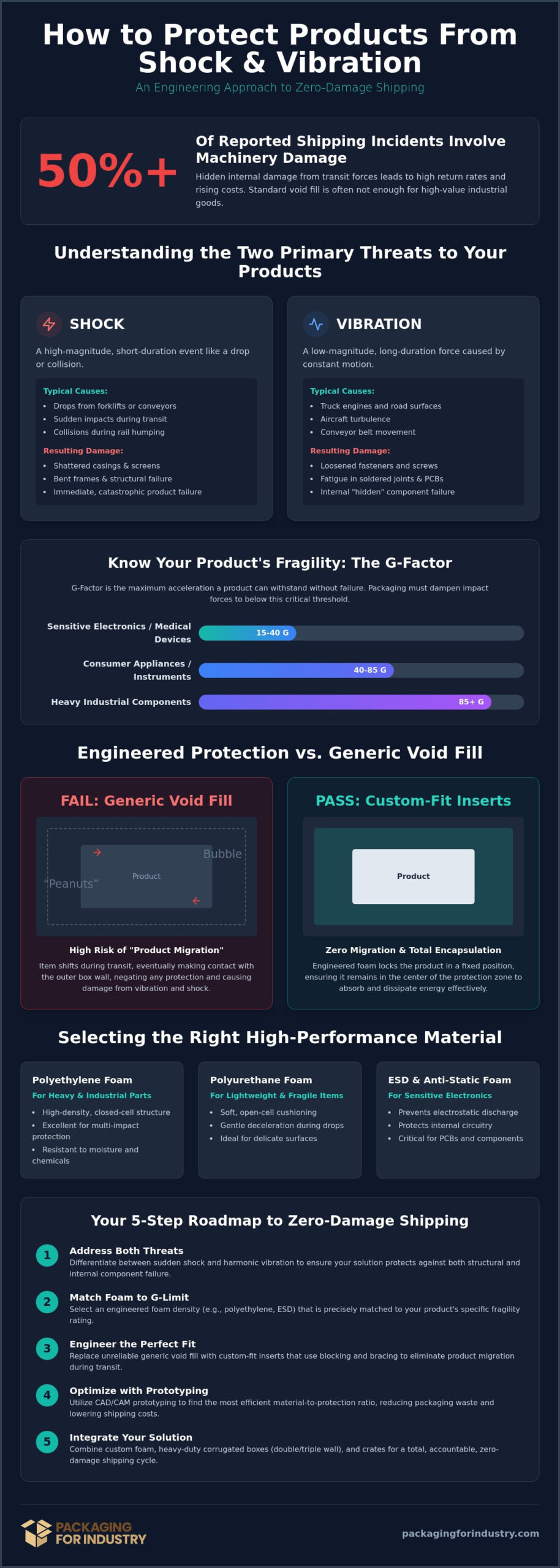
Understanding how to protect products from shock and vibration requires a fundamental shift in how you view the transit environment. While most logistics managers treat “damage” as a single category, the physical forces that cause it are distinct. Shock is a high-magnitude, short-duration event; think of a box falling from a forklift or a sudden collision during rail humping. Vibration is a low-magnitude, long-duration event caused by truck engines, road surface irregularities, or aircraft turbulence. If your packaging design doesn’t address both, you’re only solving half the problem.
The science of Package cushioning relies on absorbing these distinct energy types before they reach the product. Shock events threaten the structural integrity of your goods, often leading to shattered casings or bent frames. Vibration, however, is more insidious. It creates harmonic resonance that can loosen internal fasteners or cause fatigue in soldered joints. This is a critical distinction when determining how to protect products from shock and vibration over long distances, where cumulative stress often causes more returns than a single drop.
Defining G-Force Impacts in Modern Logistics
To engineer a reliable solution, you must first identify your product’s fragility rating. G-Factor is the maximum acceleration a product can withstand without failure. For example, sensitive medical electronics might have a G-limit as low as 15G to 40G, whereas heavy industrial components might withstand 50G or more. If a drop generates 60G of force and your packaging only dampens it to 50G, your sensitive electronics will fail internally even if the outer box looks pristine. Identifying whether damage is caused by a single impact or cumulative stress is the first step in reducing shipping damage and lowering your total cost of quality.
The Hidden Danger of Harmonic Vibration
Vibration damage is often “hidden” because it doesn’t leave obvious external marks. Truck engines and road conditions create specific vibration frequencies that can match the natural frequency of your product. When this happens, the product enters resonance, amplifying the motion and leading to hairline fractures in PCBs or loosened fasteners. Effective protection requires damping, which is the ability of a material to absorb and dissipate this kinetic energy. As an Orange County packaging supplier, we’ve observed that many manufacturers rely on generic void fill like bubble wrap or packing peanuts. These materials often fail because they allow “product migration,” where the item shifts through the material during constant motion until it makes contact with the outer corrugated wall.
Custom-engineered foam packaging prevents this migration by locking the product in a fixed position. By using CAD/CAM design to create a precise fit, you ensure the product stays in the center of the protection zone, allowing the material to perform its job of energy dissipation throughout the entire journey.
Selecting High-Performance Materials for Shock Absorption
Once you understand the physics of G-forces, the next step in determining how to protect products from shock and vibration is selecting the correct material density. Not all cushioning is created equal. Polyethylene foam serves as the industry standard for high-density, multi-impact protection. Its closed-cell structure makes it resistant to moisture and chemicals, which is vital for heavy industrial parts or aerospace components. Conversely, polyurethane foam offers an open-cell, soft cushioning ideal for lightweight, highly fragile items that require a gentle deceleration during a drop.
For sensitive electronics, standard foam isn’t enough. You must specify ESD (electrostatic dissipative) or anti-static foam to prevent static discharge from damaging internal circuitry. This material selection must be housed within a structural outer defense. Utilizing double-wall and triple-wall boxes provides the necessary stacking strength and puncture resistance for palletized shipments. According to the Guide to Packaging Freight Shipments, proper material selection is the cornerstone of reducing transit damage in complex supply chains.
Custom Foam Packaging Solutions
The effectiveness of your protection depends on material density, typically measured in pounds per cubic foot. A higher density foam supports more weight in a smaller footprint, whereas low-density foam requires more volume to achieve the same deceleration. When you review our foam packaging specifications, you’ll see options ranging from die-cut inserts, which provide a precise fit for complex geometries, to convoluted ‘egg crate’ foam for versatile, light-duty cushioning. Die-cutting allows for consistent, repeatable protection that eliminates the human error associated with loose-fill materials.
Integrated Protection: Combining Wood, Foam, and Corrugated
Heavy industrial equipment often exceeds the capabilities of a standard box. In these cases, we transition to custom foam-lined crates that combine the rigid strength of wood with the shock-absorbing properties of engineered foam. To stabilize these palletized loads, using corner and edge protection is essential. It prevents the strapping from crushing the corrugated edges and maintains the structural integrity of the entire unit. This integrated approach ensures that your how to protect products from shock and vibration strategy covers the product from the inside out.
PFI engineers these multi-material assemblies to ensure every component works in unison. We don’t just provide boxes; we design integrated systems that address the specific vulnerabilities of your cargo. If you’re struggling with inconsistent protection from off-the-shelf options, you can request a packaging quote to see how a custom-engineered material strategy can lower your long-term costs.
Engineering the Perfect Fit: Custom Inserts vs. Generic Void Fill
Many operations managers believe that filling a box with bubble wrap or packing peanuts is a sufficient strategy. However, these generic materials suffer from the “migration” problem. During long-haul truck or rail transit, constant vibration causes loose-fill materials to settle and shift. This allows the product to move through the void fill until it strikes the outer corrugated wall, rendering the protection useless. Learning how to protect products from shock and vibration requires moving beyond simple padding and implementing calculated blocking and bracing.
Blocking and bracing locks the product in the center of the “protection zone.” By using custom-engineered inserts, you ensure the item cannot migrate regardless of the transit duration or road conditions. This methodology is supported by technical research such as the Shock and Vibration Technical Design Guide, which outlines the analytical procedures for protecting sensitive cargo. There’s also a clear financial benefit to this approach; custom foam allows you to reduce the overall box size. Smaller boxes lead to lower dimensional weight (DIM) charges, effectively lowering your freight costs while increasing product safety. For high-stakes industries, these custom-engineered solutions are the logical choice for aerospace packaging, where precision and accountability are non-negotiable.
Why Die-Cut Foam Outperforms Packing Peanuts
Precision fit is the primary advantage of die-cut foam. It eliminates the “settling” effect common with loose-fill materials, ensuring the product remains suspended in the center of the box. Beyond protection, custom inserts provide a professional unboxing experience for B2B clients, which reflects the quality of your brand. From an operational standpoint, custom foam reduces labor costs in the warehouse. Packers don’t have to estimate void-fill amounts; they simply drop the product into a pre-cut slot, leading to faster kitting and assembly cycles.
Blocking and Bracing Techniques for Heavy Loads
Securing heavy industrial equipment requires a combination of rigid and flexible materials. We often use high-density foam planks and wood skids to prevent shifting within a crate. The importance of load stabilization using high-performance stretch film cannot be overstated when securing palletized cargo. This ensures the entire load moves as a single unit, reducing the risk of internal collisions. For companies shipping from Southern California to international destinations, PFI ensures all wood components are heat-treated and compliant with ISPM-15 standards to prevent customs delays.
- Custom Foam Planks: Provide targeted shock absorption for heavy baseplates.
- Integrated Skids: Facilitate safe forklift handling and prevent tipping.
- Edge Protection: Distributes strapping tension to avoid crushing the outer corrugated walls.
A Step-by-Step Strategy to Secure Sensitive Industrial Cargo
Engineering a resilient package requires a methodical workflow that moves from theoretical data to physical verification. If you want to master how to protect products from shock and vibration, you must follow a structured engineering path that eliminates guesswork. Relying on trial and error after a product has already shipped leads to expensive returns and damaged client relationships. A professional strategy follows these five essential stages:
- Step 1: Fragility Assessment. Determine the product’s critical drop height and G-limit to identify the exact point of failure.
- Step 2: Material Selection. Match the foam density to the product weight. Heavier industrial parts require higher density polyethylene to prevent “bottoming out” during an impact.
- Step 3: CAD Design. Create a digital blueprint of the custom insert. This ensures every cutout and clearance is mathematically sound before any material is cut.
- Step 4: Prototyping. Produce a physical sample. This step verifies the fit and allows for real-world handling checks.
- Step 5: Testing. Simulate transit conditions using updated standards. Adhering to ASTM D4169-23e1, updated in March 2024, or ASTM D7386-25 for parcel delivery, ensures your design survives the modern shipping environment.
Assessing Fragility and G-Factor
Design begins with data. You must use drop testing data to inform your packaging design, focusing specifically on the most vulnerable components such as glass screens, sensors, or calibrated optics. Consulting with a professional packaging manufacturer for a technical assessment allows you to quantify these risks early. By identifying the G-limit of your most sensitive part, you set the baseline for the entire protective system. This step-by-step strategy is the only reliable way to ensure you know exactly how to protect products from shock and vibration before the first pallet leaves your dock.
The Role of CAD/CAM Prototyping
Precision is the enemy of transit damage. CAD software allows for precise foam cutouts that mirror product geometry, ensuring there is no internal movement. We provide free prototyping to our Southern California clients, which significantly reduces the risk of a full production rollout for high-value goods. In our Anaheim facility, we use this prototyping phase to solve lead-time issues for custom orders. By finalizing the design digitally and testing a physical sample quickly, we move from concept to final delivery with maximum efficiency. This ensures your supply chain remains reliable and your packaging costs stay predictable. We offer local next-day delivery in Southern California once the design is finalized, supporting your just-in-time inventory goals.
Optimizing Your Protection Strategy with PFI’s Custom Design Services
Efficient logistics in the Southern California corridor require more than just standard supplies. Manufacturers in this region face specific challenges, from the high-frequency vibrations associated with heavy port traffic at the Port of Los Angeles to the stringent requirements of the aerospace corridor. Determining how to protect products from shock and vibration is a local challenge that demands a local partner. PFI provides the engineering oversight necessary to move your cargo safely through these complex environments, ensuring your operational goals align with your packaging spend.
Southern California’s Partner for Aerospace and Defense
Our Anaheim facility is strategically positioned to support the specialized needs of the aerospace and defense sectors. We understand the necessity of meeting strict Mil-Spec and aerospace standards for shock protection, where even a minor failure can result in catastrophic mission loss. We provide local next-day delivery across Orange County, Los Angeles, and San Diego. This allows you to maintain lean inventory levels without risking stockouts. For a detailed look at our technical capabilities in high-stakes environments, see our work on Engineering Custom Crates for International Transit.
Reducing Costs Through Engineered Reliability
Financial performance is directly tied to your damage rates. While many businesses accept a baseline level of transit failure as a cost of doing business, we view it as an engineering flaw. Reducing damage rates by even a small margin can save thousands in annual operations when you factor in the cost of replacement parts, expedited freight, and administrative labor. We identify over-packaging or inefficient designs through a comprehensive cost-reduction analysis. This ensures you pay for protection, not waste.
Streamlining your supply chain is further achieved through our packaging kitting services, which deliver pre-assembled protection components directly to your production line. You can also eliminate emergency rush orders through our reliable VMI programs. These systems ensure you never run out of critical protective supplies, providing the peace of mind that your shipping cycle remains uninterrupted. If you’re ready to refine your current strategy and learn how to protect products from shock and vibration with professional-grade precision, you can request a packaging quote to start your custom design review today.
Securing Your Supply Chain for 2026 and Beyond
Protecting high-value industrial cargo requires a fundamental shift from reactive padding to proactive engineering. By understanding your product’s specific fragility and implementing custom-fit foam inserts, you eliminate the migration issues common with off-the-shelf materials. This level of precision doesn’t just reduce shipping damage; it also lowers your overall packaging costs by optimizing box dimensions and increasing freight efficiency. Master the technical principles of how to protect products from shock and vibration to ensure your operations remain resilient against the evolving risks of modern transit.
PFI provides Southern California manufacturers with free CAD/CAM prototyping and specialized expertise in aerospace and Mil-Spec compliance. With local next-day delivery available in Anaheim, Los Angeles, and San Diego, you can maintain a lean, reliable supply chain that responds to your production schedule in real time. We focus on the intersection of engineering and economics to provide solutions that protect both your products and your bottom line.
We look forward to partnering with you to eliminate professional stress and achieve a zero-damage shipping cycle for your most sensitive equipment.
Frequently Asked Questions
What is the difference between shock and vibration in shipping?
Shock involves high-magnitude, short-duration forces like a box falling from a forklift or a sudden collision. Vibration is a low-magnitude, long-duration event caused by truck engines or road conditions. Addressing both is essential for learning how to protect products from shock and vibration because they damage goods differently; shock breaks structures, while vibration loosens internal components and causes fatigue.
How do I calculate the G-factor for my industrial product?
G-factor represents the maximum acceleration your product can withstand before failing. You determine this value through controlled drop testing or by consulting the original equipment manufacturer’s technical specifications. Sensitive medical devices often have a G-limit between 15G and 40G. Knowing this number allows our engineers to design foam inserts that decelerate the product safely within its specific tolerance.
Is polyethylene or polyurethane foam better for shock absorption?
Polyethylene is the industry standard for high-density, multi-impact protection for heavier industrial parts. It is a closed-cell material that resists moisture and chemicals. Polyurethane is an open-cell, softer foam best suited for lightweight, highly fragile items requiring gentle cushioning. We match the material density to your product weight to ensure the cushioning doesn’t bottom out during a shock event.
Can custom packaging actually reduce my overall freight costs?
Custom packaging reduces overall freight costs by optimizing the box size to match the product’s footprint. This lowers dimensional weight charges from carriers like FedEx and UPS. Additionally, reducing damage rates eliminates the hidden costs of replacement parts, administrative labor, and expedited return shipping. Engineered reliability ensures you aren’t paying to ship excess air or inefficient, heavy materials.
What are the best materials for vibration damping in electronics?
High-performance electronics require ESD or anti-static foam to prevent static discharge during transit. These materials provide the necessary damping to absorb harmonic resonance from truck engines or aircraft. Using custom-fit inserts prevents product migration. This ensures the sensitive components remain isolated from the outer corrugated walls throughout the entire journey, which is a key part of how to protect products from shock and vibration.
How does PFI’s prototyping process work for custom foam?
Our process begins with a CAD design that mirrors your product geometry. We then produce a physical sample in our Anaheim facility for fit and function verification. We offer free prototyping for Southern California manufacturers to reduce the risk of full production rollouts. This allowing you to test the design’s effectiveness and durability before committing to a bulk packaging order.
Does Southern California’s climate affect the choice of packaging materials?
Southern California’s coastal humidity near the Port of Los Angeles can weaken standard corrugated boxes over time. We often recommend moisture-resistant polyethylene foam for long-term storage or international transit. For local next-day delivery in Orange County or San Diego, we ensure materials are selected to maintain structural integrity despite fluctuations in warehouse temperatures and moisture levels.
What are the common causes of hidden transit damage?
Hidden damage is frequently caused by harmonic resonance that matches your product’s natural frequency, leading to internal component fatigue. Another major cause is the settling of loose-fill materials like packing peanuts. When these materials shift, the product migrates to the box wall. Custom inserts eliminate these vulnerabilities by locking the item in a fixed position, preventing internal collisions and structural failure.