
Shipping “air” is no longer just a minor inefficiency; it’s a direct hit to your bottom line following the recent alignment of carrier dimensional weight divisors. You’ve likely felt the sting of the 5.9% general rate increase implemented by major carriers this year, making every cubic inch of your shipping container a valuable financial asset. Most operations managers agree that waiting weeks for a custom design only to suffer transit damage or unexpected surcharges is an unacceptable operational risk.
By leveraging a custom foam packaging prototype service, you can eliminate this uncertainty by testing a physical sample with your actual product before you commit to a full production run. This proactive step ensures a perfect-fit insert that maximizes protection while minimizing the total footprint of your corrugated boxes. We’ll explore how precision-engineered prototypes serve as a strategic tool to lower your total cost of ownership and reduce labor. We will also discuss how our Anaheim-based team helps Southern California manufacturers achieve zero-damage logistics through faster lead times and expert material selection for the aerospace and medical sectors.
Key Takeaways
- Move beyond digital renderings to understand why physical CAD/CAM prototyping is essential for protecting sensitive industrial parts.
- See how precise material engineering and foam density selection can virtually eliminate shipping damage and transit failures.
- Learn how a custom foam packaging prototype service optimizes your container dimensions to reduce expensive carrier surcharges and freight costs.
- Discover the advantages of an integrated solution where custom foam, corrugated boxes, and crates are engineered simultaneously for maximum reliability.
- Gain insights into the PFI process that ensures your packaging is ready for full-scale production with zero design errors.
What is a Custom Foam Packaging Prototype Service?
A custom foam packaging prototype service is more than just a fabrication shop providing a physical sample. It represents a precise CAD/CAM engineering process where technical data meets physical reality. While many suppliers rely on generic templates, true prototyping involves creating a tangible model of your protective solution to verify fit, function, and durability before you commit to a full production run. This stage is critical in the custom design packaging lifecycle, especially for Southern California manufacturers who cannot afford the high costs of transit failure or logistical errors.
Digital renderings look impressive on a screen, but they cannot simulate how a heavy industrial part interacts with foam density under real-world stress. A physical prototype allows you to test the tactile resistance of Polyethylene (PE) for heavy machinery, the delicate cushioning of Polyurethane (PU) for sensitive optics, or the critical protection of Anti-Static (ESD) foams for electronics. You need to see how the material reacts to compression and recovery in a way that a 3D model simply cannot replicate. This hands-on verification is the only way to ensure your high-value components survive the rigors of the modern supply chain.
The Difference Between Stock Foam and Engineered Prototypes
Stock foam end caps or generic corner protectors often fail because they aren’t calibrated to the specific weight distribution of your product. Engineered prototypes are designed using fundamental Package cushioning principles to account for G-force impacts and harmonic vibrations during transit. For the aerospace and medical device sectors in Orange County and Los Angeles, a precision fit isn’t a luxury. It’s a requirement to prevent microscopic damage that could lead to catastrophic equipment failure. Our Anaheim-based engineering team focuses on these technical tolerances to ensure your product arrives in factory-perfect condition.
Prototyping for Multi-Material Integrated Solutions
Effective protection rarely relies on foam alone. Our custom foam packaging prototype service evaluates how custom foam inserts integrate with heavy-duty corrugated boxes or foam-lined custom shipping crates for international export. This holistic approach ensures that the outer shell and internal cushioning work in tandem. By testing these multi-material systems together, we verify that every component provides 360-degree protection. This process eliminates the risk of internal shifting or external puncture during the grueling logistics cycle, providing peace of mind for recurring bulk orders.
The Engineering Behind Protective Foam Prototypes
The technical foundation of a custom foam packaging prototype service lies in the application of CAD/CAM software to translate physical product dimensions into precise geometric cavities. This process is rooted in the academic and industrial discipline of Packaging Science, which combines materials engineering with logistical physics. At PFI, we utilize these technical principles to ensure that every insert is engineered to mitigate specific environmental stresses encountered during transit. Whether you’re shipping sensitive medical sensors or heavy aerospace components, the engineering phase identifies the exact foam density required to support the part’s weight while providing the necessary deceleration during an impact.
Engineering for industrial logistics also requires a focus on dimensional weight (DIM weight) optimization. With carrier rate increases averaging 5.9% in 2026, every inch of excess foam adds to your freight cost. Our engineers don’t just design for safety; they design for fiscal efficiency. By precisely calculating the minimum amount of material needed to protect your product, we help you avoid expensive carrier surcharges. If you’re ready to see how a technical design can impact your bottom line, you can request a packaging quote to begin the consultation process.
Material Selection: PE vs. PU Foam
Choosing the right material is a balance of economics and physics. Polyethylene (PE) foam is a closed-cell material preferred for heavy-duty support and repeated impacts. It provides excellent structural integrity, making it ideal for base pads in large containers. Conversely, Polyurethane (PU) foam is an open-cell material used for delicate cushioning of high-fragility items. For medical applications or products with Class A surfaces, we often recommend cross-linked polyethylene, which offers a smoother surface to prevent abrasion. We also prototype using specialized ESD (Electrostatic Discharge) foams for the electronics sector to prevent static damage during handling.
CAD Design and CNC Sample Cutting
The transition from a digital design to a physical prototype is managed via CNC (Computer Numerical Control) sample cutting. Unlike traditional manufacturing that requires expensive steel-rule dies, CNC tables allow for rapid iteration. We can adjust a design by fractions of an inch and cut a new sample in minutes. This agility is vital for ensuring that tolerances are tight enough to prevent product shifting. Even a minor amount of “play” inside a box can lead to damage over long-haul transit. By prototyping with CNC technology, we verify the fit before you invest in high-volume tooling. This precision is also how we ensure our prototypes meet strict military packaging standards for defense contractors in Southern California.
The ROI of Prototyping: Lowering Costs and Reducing Damage
Investing in a custom foam packaging prototype service is a calculated financial strategy rather than an experimental cost. When you weigh the expense of engineering a precise insert against the replacement value of a damaged aerospace component or medical device, the return on investment becomes clear. Shipping damage involves more than the price of the part; it encompasses the labor for processing returns, expedited freight for replacements, and the potential loss of a long-term contract. By refining the design during the prototyping phase, we ensure that your product is secured by the exact amount of material required. This allows you to lower packaging costs by eliminating redundant layers of bubble wrap or secondary void fill that often clutter warehouse operations.
Many businesses fall into the trap of “over-packaging,” where they use oversized boxes and excessive cushioning to compensate for a lack of engineering. This approach is both wasteful and expensive. A perfect-fit prototype ensures the foam performs its primary function: holding the product in a fixed position to absorb shock. This precision streamlines your packing line and reduces your overall material spend per unit. For our clients in Anaheim and the surrounding Inland Empire, this efficiency translates directly to a more predictable and profitable supply chain.
Avoiding Carrier Surcharges with Cube Optimization
The 5.9% carrier rate increase implemented in 2026 has made dimensional weight (DIM) a critical variable in your logistics budget. A physical prototype allows our engineers to shrink the outer corrugated box dimensions to the absolute minimum required for safety. Reducing the external footprint of your package even slightly has a massive impact on your freight bill. A single 1-inch reduction in box dimensions can save your operation thousands of dollars in annual freight costs by dropping the package into a lower DIM weight bracket.
Testing and Validation Before Mass Production
Before you commit to a full production run or invest in permanent die-cut tooling, the prototype must be validated through physical testing. We perform drop tests and vibration analysis on the sample to identify potential design flaws that a digital model might overlook. This step ensures the packaging is “production-ready” for your assembly or kitting line in Los Angeles or Orange County. Identifying a tolerance issue at the prototype stage prevents costly rework and ensures your logistics flow remains uninterrupted. This rigorous validation process is what allows us to offer zero-damage logistics for high-value industrial components.
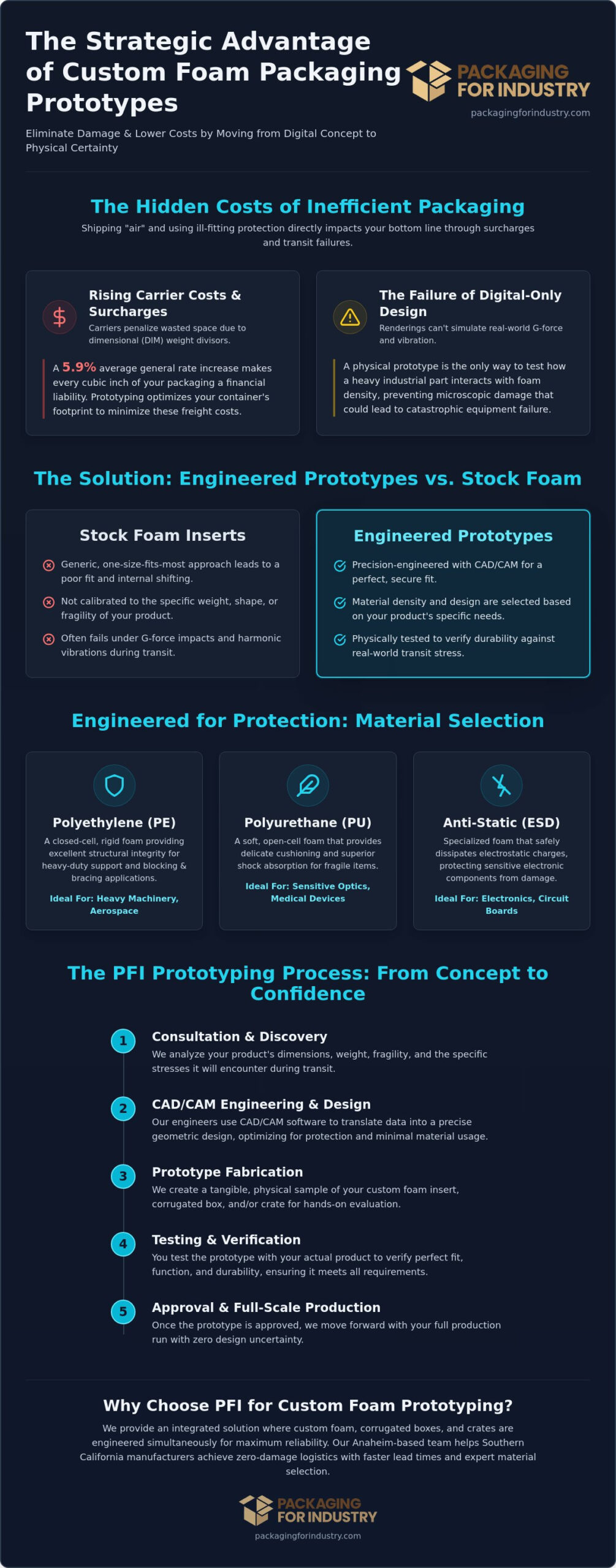
The PFI Prototyping Process: From Concept to Delivery
Our custom foam packaging prototype service follows a methodical, engineering-led workflow designed to move your project from concept to production without the bureaucratic delays common with large catalog suppliers. We prioritize direct communication between our designers and your operations team to ensure every technical requirement is met. This five-step process is built for industrial speed and precision.
- Step 1: Initial Technical Consultation. We identify the specific fragility, weight, and center of gravity of your product while accounting for your primary shipping methods.
- Step 2: Integrated CAD Engineering. Our team develops a digital model of the foam insert and the outer corrugated container or crate simultaneously to ensure holistic protection.
- Step 3: Rapid CNC Sample Cutting. We utilize CNC tables to produce a physical prototype from the engineered file; this eliminates the need for expensive die-cut tooling during the testing phase.
- Step 4: Client Fit-Testing. You receive the physical sample to test with your actual product, allowing you to verify tolerances and ease of assembly on your packing line.
- Step 5: Final Approval and Scaling. After any necessary adjustments are made, the design is finalized and approved for full-scale production.
Collaborating with Our Southern California Engineers
The primary advantage of working with a local Anaheim-based design team is the ability to maintain rapid feedback loops. If your project involves complex aerospace or medical device specifications, you can’t afford to wait weeks for samples to ship across the country. We offer the option for on-site reviews in Los Angeles, Orange County, or San Diego. This proximity allows us to troubleshoot fitment issues in real-time, ensuring your packaging is exactly right before the first production run starts. Our engineers act as an extension of your team, providing the technical expertise needed to meet rigid industry standards.
Transitioning to Production and Inventory Management
Once the prototype is approved, scaling from a single sample to thousands of custom foam inserts is a seamless transition. We maintain the digital CAD files to ensure that every recurring order matches the approved prototype with 100% accuracy. To further optimize your supply chain, we can integrate your custom packaging into a Vendor Managed Inventory (VMI) program. This ensures you always have the protective materials you need without overstocking your warehouse. We focus on just-in-time delivery to keep your production lines moving and your overhead low.
Why Choose PFI for Custom Foam Prototyping?
Choosing PFI as your custom foam packaging prototype service means partnering with a team that prioritizes technical accountability over transactional sales. We serve as a pragmatic alternative to large national catalog suppliers that often provide generic, overpriced solutions with no engineering support. Based in Anaheim, we’re uniquely positioned to provide Southern California manufacturers with the agility they need to stay competitive. Our local presence allows us to offer next-day delivery for approved designs across Los Angeles, Orange County, and San Diego, ensuring your production schedule never stalls due to packaging shortages.
Our primary strength lies in our ability to provide fully integrated protection. Unlike vendors that only specialize in one material, we design the foam inserts, the corrugated boxes, and the heavy-duty crates in-house. This comprehensive oversight eliminates the risk of component mismatch and ensures that the entire packaging system works in unison to absorb shock and vibration. We offer free prototyping for qualified industrial projects because we believe in proving our engineering value before you commit to a full production run. This partnership-focused approach helps you lower packaging costs while maintaining the highest standards of transit safety.
Specialized Industrial Sector Support
We provide specialized support for sectors where precision is a baseline requirement. Our team has extensive experience in aerospace packaging, providing the technical documentation and material certifications required for defense and flight hardware. For medical device and semiconductor manufacturers, we offer cleanroom-compatible foam options to prevent particulate contamination. We also assist high-volume manufacturing facilities in the Inland Empire by designing custom kitting solutions that streamline assembly line operations and reduce per-unit labor costs.
Request Your Custom Packaging Quote
Initiating the prototyping process is a direct and efficient experience. Our engineers require basic data regarding your product’s weight, dimensions, and fragility to begin the CAD design phase. We can work from your existing technical drawings or perform physical measurements at our facility to ensure a precision fit. Our goal is to create a reliable, recurring supply chain solution that eliminates the stress of shipping damage. Request a packaging quote today to secure your free prototype and see how our engineering-led approach can optimize your logistics budget.
Optimize Your Logistics with Precision Engineering
Precision-engineered packaging is a strategic asset that safeguards your high-value inventory and your professional reputation. By utilizing a custom foam packaging prototype service, you transition from guesswork to data-driven protection. This process ensures your materials are optimized for both safety and cost efficiency; it eliminates the financial burden of transit damage and the hidden expense of oversized shipping containers. It’s the most effective way to protect your bottom line in a high-rate shipping environment.
Our Anaheim team provides the aerospace and defense grade engineering required for the most sensitive industrial components. We offer free prototyping on custom designs to verify every tolerance before you commit to bulk production. Once approved, our local infrastructure supports your operations with next-day delivery across Southern California. You can rely on a system that prioritizes fiscal responsibility and logistical reliability. We’re ready to help you streamline your supply chain and eliminate professional stress through better design.
We look forward to engineering a solution that meets your exact specifications and improves your operational efficiency.
Frequently Asked Questions
How much does a custom foam packaging prototype service cost?
PFI provides free prototyping for qualified custom projects to ensure a perfect fit before you commit to bulk production. We view the prototyping phase as a critical investment in your long-term logistics success rather than an upfront fee. By validating the design early, we help you avoid the high costs of transit damage and material waste. This service allows you to test physical samples without the financial risk associated with unverified packaging designs.
What information do I need to provide for a custom foam prototype?
You should provide the exact dimensions, weight, and fragility level of your product, along with your primary shipping method. Providing a physical sample of the item or a 3D CAD file allows our engineers to achieve the tightest possible tolerances. This data helps us select the appropriate foam density and material type to ensure your custom foam packaging prototype service delivers a production-ready solution that minimizes dimensional weight surcharges.
How long does it take to receive a custom foam sample?
Our rapid CNC cutting capabilities allow us to produce physical samples much faster than traditional die-cut methods. Because we are based in Anaheim, our Southern California clients benefit from significantly reduced lead times and direct design feedback. Most prototypes are completed within a few business days once the initial CAD engineering is finalized. This speed ensures your production schedule remains on track while allowing for necessary design iterations or fit-testing.
Can you prototype foam inserts for existing corrugated boxes?
Yes, we can engineer custom foam inserts to fit your current stock boxes or specialized containers. If you already have a supply of corrugated boxes, our designers will calibrate the foam dimensions to provide maximum protection within that specific interior volume. This approach helps you maintain consistency in your shipping operations while upgrading your internal cushioning. We ensure the foam layout provides 360-degree protection without requiring you to replace your existing box inventory.
Do you provide ESD foam prototypes for electronics?
We offer both anti-static and conductive foam prototypes specifically for sensitive electronic components. These specialized materials prevent electrostatic discharge from damaging high-value circuitry during handling and transit. Our engineering team can create custom inserts using pink anti-static or black conductive polyethylene foam to meet your specific ESD requirements. We ensure these prototypes maintain their protective properties while providing the necessary mechanical cushioning for delicate hardware in sectors like medical devices and semiconductors.
Is there a minimum order requirement for custom foam production?
PFI focuses on serving recurring industrial orders and bulk quantities for manufacturers and fulfillment centers. While we provide prototyping to ensure design accuracy, our production facility is optimized for high-volume runs and ongoing supply needs. This focus allows us to offer more competitive pricing and reliable lead times for your regular packaging requirements. We work closely with purchasing departments to manage inventory levels through programs like Vendor Managed Inventory (VMI) or just-in-time delivery.
Can you engineer prototypes that meet Mil-Spec standards?
We have extensive expertise in engineering prototypes that comply with strict military and aerospace standards. Our designers understand the rigorous testing and material requirements necessitated by defense contracts and high-stakes aviation logistics. We utilize CAD/CAM technology to ensure every insert meets the precise tolerances and preservation standards required for these sectors. This technical oversight ensures your packaging is fully compliant with all relevant government and industry regulations before you start full-scale production.
Do you offer local delivery in Southern California?
We provide next-day delivery for approved designs to clients throughout Anaheim, Los Angeles, and Orange County. Our local fleet allows us to bypass the delays often associated with national freight carriers, keeping your production lines moving. This regional proximity also facilitates easier on-site reviews and faster design adjustments when necessary. Whether you are in San Diego or the Inland Empire, our local presence ensures your custom foam inserts arrive exactly when your warehouse team needs them.