
Most manufacturers believe the only way to lower their shipping spend is to buy cheaper, thinner materials, but that strategy usually backfires when damage claims and DIM surcharges start rolling in. You’re likely already feeling the pressure of rising material costs and the strict 2026 EPR regulations in California that penalize inefficient designs. Reducing packaging costs without sacrificing quality isn’t about finding the cheapest vendor; it’s about engineering waste out of your entire supply chain.
We understand that your goal is a leaner budget that doesn’t result in a single extra transit claim. This guide will show you how to optimize your industrial packaging to lower total landed costs while actually improving product protection. We’ll preview how custom CAD/CAM design, precision foam inserts, and Vendor Managed Inventory (VMI) can eliminate wasted warehouse space and speed up your kitting process. By applying these engineering principles, you can secure your bottom line and your cargo simultaneously.
Key Takeaways
- Shift your focus from unit price to Total Landed Cost to uncover how “cheap” materials often lead to expensive damage claims and returns.
- Learn the engineering principles behind reducing packaging costs without sacrificing quality, specifically through custom corrugated designs that eliminate the need for expensive void fill.
- Master the “Right-Sizing” audit to consolidate your inventory into high-efficiency footprints that bypass carrier DIM weight surcharges.
- Leverage Vendor Managed Inventory (VMI) to improve cash flow, free up valuable warehouse floor space, and ensure a reliable supply without emergency rush fees.
- Understand the ROI advantages of sourcing directly from a local manufacturer to secure faster lead times and factory pricing for specialized sectors like aerospace and medical.
The Hidden Costs of Industrial Packaging: Why ‘Cheap’ Is Often Expensive
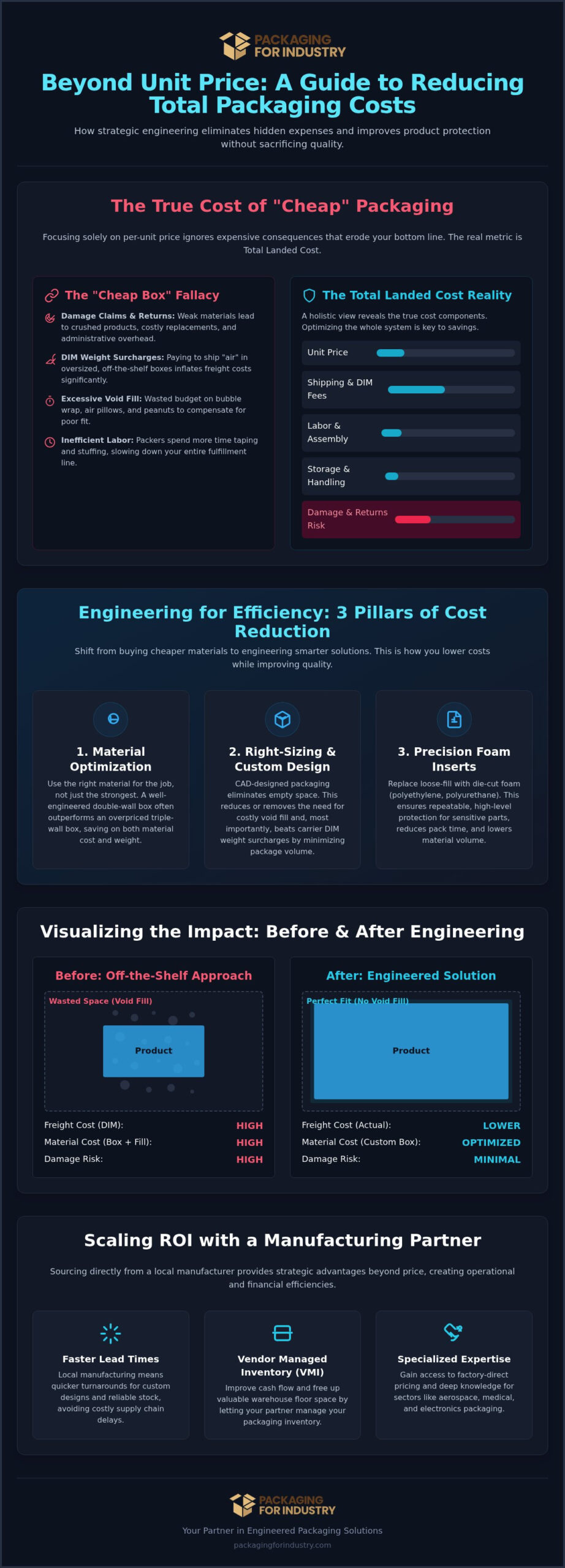
Many purchasing managers focus exclusively on the per-unit price of corrugated boxes. This is a mistake. Total Landed Cost encompasses the unit price, shipping freight, storage fees, labor for assembly, and the high price of transit failure. For manufacturers in Orange County or Los Angeles, these costs compound quickly when dealing with high-volume distribution. Cheap boxes often lack the structural integrity to withstand long-haul transit; they lead to crushed corners, compromised stackability, and expensive returns.
The #1 hidden cost in modern logistics is shipping air. UPS and FedEx use Dimensional Weight (DIM) surcharges to bill you for the space your package occupies, not just its actual weight. If your box is four inches too large, you’re paying a premium for empty volume. Adopting Packaging Engineering principles allows us to design custom footprints that eliminate this waste. This methodology is the most effective way of reducing packaging costs without sacrificing quality.
The True Price of Shipping Damage
Processing a single damage claim often costs more than the shipping container itself. You have to account for the administrative labor to document the claim, the replacement product cost, and the expedited freight required to repair a client relationship. For aerospace or medical device manufacturers, a damaged shipment is more than a line item; it’s a threat to a long-term contract. High-quality double-wall or triple-wall materials act as a financial insurance policy for your high-value components. Investing in durability upfront prevents the catastrophic “soft costs” of a tarnished reputation.
Identifying Waste in Your Current Packaging Line
Walk your packing line and look for signs of over-packaging. If your team uses three rounds of tape to secure a box or stuffs six feet of bubble wrap into a cavity, your box is the wrong size. Off-the-shelf solutions force you to over-spend on void fill to compensate for poor fit. A professional packaging audit is the first step toward a measurable ROI; it identifies exactly where your freight budget is leaking. This analysis helps in reducing packaging costs without sacrificing quality by identifying the “Goldilocks” zone where protection meets efficiency.
Engineering for Efficiency: Material Optimization and Custom Design
True efficiency in the warehouse isn’t achieved by simply buying cheaper materials. It’s achieved by selecting the precise grade of material required for the job. Many operations default to heavy-duty triple-wall corrugated for every shipment, but material science often proves that a well-engineered double-wall corrugated box provides identical protection at a lower weight and price point. By matching the board grade to the specific fragility and weight of your product, you’re reducing packaging costs without sacrificing quality.
Custom-tailored dimensions do more than just protect the product; they eliminate the need for secondary materials. When a box is engineered to fit, you remove the expense of bubble wrap, air pillows, and paper void fill. This also has a direct impact on your freight spend. As noted in recent discussions on managing shipping agreements, the volume of your package often dictates the price more than the weight. Custom designs ensure you aren’t paying to ship empty space.
The Power of Custom Foam Inserts
Protective foam packaging is a critical component of high-stakes industrial shipping. We often compare polyethylene and polyurethane to determine the best fit for a client’s budget and protection needs. Polyethylene is ideal for heavier, high-vibration loads, while polyurethane offers superior cushioning for lighter, fragile items. Using die-cut foam end caps instead of loose-fill peanuts significantly reduces material volume and pack time. This type of custom foam design ensures repeatable, high-level protection for sensitive electronics and medical devices, making the packing process foolproof for your warehouse team.
Prototyping: Testing Quality Before Bulk Production
Modern packaging engineering relies heavily on CAD/CAM design to ensure precision. We don’t believe in guesswork. Through free prototyping, you can physically test a design’s performance before committing to a full production run. This phase is a vital risk-mitigation tool that prevents expensive mid-stream corrections. Utilizing custom design services allows you to verify that your new, leaner packaging meets every safety standard required by your industry.
If you’re ready to see how an engineered approach can impact your bottom line, you can request a custom packaging quote to start your audit.
Right-Sizing to Beat DIM Surcharges: The ‘Goldilocks’ Zone
To achieve the “Goldilocks” zone—packaging that’s neither too large nor too weak—you must first audit your most common shipping dimensions and carrier DIM factors. Carriers prioritize volume over weight; if your team ships small industrial parts in oversized containers, you’re paying a premium for “ghost” weight. By consolidating your inventory into the 3-5 most efficient footprints for your specific product mix, you simplify procurement while reducing packaging costs without sacrificing quality. For high-volume, high-DIM items, switching to a custom-sized box often pays for itself within the first few shipping cycles.
Maximizing cube utilization also requires a review of your palletization patterns. Strategic use of corner and edge protection allows you to stack pallets higher and more securely. These reinforcements provide the necessary vertical stacking strength, which often permits the use of a lighter-weight outer carton. This approach maintains structural integrity during long-haul transit while stripping out unnecessary material weight and cost.
Understanding Dimensional Weight (DIM)
The math behind DIM weight is straightforward but punishing: (Length x Width x Height) / Carrier Divisor = Billable Weight. If the calculated DIM weight is higher than the actual scale weight, you’re billed at the higher rate. Reducing a box dimension by just one inch across a high-volume product line can save thousands in annual freight. Right-sizing is the most effective way to cut expenses because it removes the “air” from your budget without ever compromising the physical protection of the cargo.
Strategic Material Selection
Choosing the right format for your product geometry is essential for logistical efficiency. For heavy machinery components, heavy-duty corrugated boxes can often replace expensive, heavy wooden crates. This shift lowers both material costs and fuel surcharges. For long, narrow industrial parts like shafts or extrusions, specialized tubes and cores provide a snug fit that prevents internal shifting. Finally, using high-performance stretch film ensures these optimized loads stay secure on the pallet. This prevents the costly load failures that occur when pallets aren’t wrapped with the correct gauge or tension.
Optimizing your dimensions is a data-driven process that yields immediate results. If you need assistance calculating your potential freight savings, our team can help you compare packaging pricing for right-sized solutions.
Operational Savings: VMI and Process Improvements
Operational efficiency is often where the most significant “soft costs” reside. While material price is a visible line item, the labor required to manage inventory, assemble boxes, and process purchase orders often goes uncalculated. Implementing Vendor Managed Inventory (VMI) is a strategic move for reducing packaging costs without sacrificing quality. By allowing us to monitor and replenish your stock levels, you eliminate the need for emergency rush orders and the associated overnight freight premiums. This system simplifies your procurement cycle, moving you from dozens of individual purchase orders to a predictable, streamlined billing process.
Moving your packaging to a dedicated stocking program also has a physical impact on your facility. Industrial floor space in Southern California is a premium asset. When you stop warehousing months of bulky corrugated inventory, you free up valuable square footage for revenue-generating manufacturing equipment. Additionally, utilizing packaging kitting services can drastically increase your production line speed. Delivering a pre-assembled kit—including the box, custom foam inserts, and necessary labels—directly to the packing station removes assembly bottlenecks and ensures your team stays focused on throughput.
Improving Cash Flow with Just-In-Time Supply
“Dead” inventory is tied-up capital that could be better utilized elsewhere in your business. We help manufacturers maintain a leaner profile by offering local next-day delivery across Anaheim, Irvine, and Los Angeles. This proximity allows for a JIT inventory management approach where you only hold the stock you need for the immediate production cycle. This model improves cash flow and reduces the risk of inventory damage or obsolescence while you’re reducing packaging costs without sacrificing quality.
Training and Labor Efficiency
High turnover in warehouse environments makes training a recurring operational expense. Intuitive packaging design reduces the learning curve for new staff and ensures consistent protection levels across every shift. When we design ergonomic pack station setups, we focus on reducing repetitive motion and minimizing the time spent per package. Easy-to-assemble custom boxes reduce labor spend by cutting the number of touches required per shipment. By engineering the box to be “foolproof,” you maintain high quality standards even during peak seasonal volumes.
Why Partnering with a Local Manufacturer Scales Your ROI
Catalog distributors often rely on high-volume stock items that carry significant markups to cover their own warehousing and logistics overhead. When you partner directly with a custom manufacturer, you bypass these middleman fees and secure factory-direct pricing. This shift is a primary lever for reducing packaging costs without sacrificing quality. Beyond the unit price, local manufacturing provides the agility required for high-stakes sectors. For instance, aerospace and automotive facilities often operate on tight production schedules where a multi-week lead time for custom crates or foam inserts is unacceptable. Local production ensures your supply chain remains uninterrupted and responsive to sudden demand shifts.
Expertise is more than just a sales pitch. On-site packaging reviews by engineers who understand the nuances of Southern California logistics can uncover hidden inefficiencies in your dock-to-delivery flow. We look at how your pallets are wrapped, how your boxes are stacked, and where your team is wasting time on excessive tape or void fill. As your production volume increases, a direct manufacturing partner scales with you. We provide the CAD/CAM support and free prototyping necessary for high-volume rollouts, ensuring that your growth doesn’t lead to a proportional increase in packaging waste.
The PFI Advantage for Southern California Businesses
PFI provides a strategic edge for companies in Orange County, San Diego, and the Inland Empire through our next-day delivery capabilities. We understand the specific manufacturing and warehouse challenges unique to this region, from high real estate costs to strict environmental regulations like California’s SB 54. Instead of managing five different vendors for foam, corrugated, and pallets, you can consolidate your supply with a single partner. This consolidation reduces administrative friction and ensures that every component of your packaging system, from the heavy-duty box to the protective foam end caps, is engineered to work as a unified system of protection.
Ready to Lower Your Packaging Spend?
The path to significant operational savings follows a logical, engineering-led progression. You must first audit your current waste, engineer a custom solution based on your product’s actual fragility, optimize your material usage to avoid DIM surcharges, and manage your inventory through a VMI program. This holistic approach ensures you’re reducing packaging costs without sacrificing quality while simultaneously improving your shipping reliability. If you’re ready to identify the waste in your current line, we invite you to request a packaging cost-reduction analysis from our engineering team to see the potential ROI for your facility.
Secure Your Supply Chain and Your Bottom Line
For manufacturers in Southern California, PFI provides the security of local next-day delivery and specialized expertise in high-stakes sectors like aerospace and defense. Our free prototyping process allows you to verify performance before committing to bulk production. Reducing packaging costs without sacrificing quality is a matter of precision engineering and proactive inventory management. We’re ready to help you optimize your facility and eliminate logistical waste.
Frequently Asked Questions
How can I reduce packaging costs without sacrificing quality?
The most effective strategy is to focus on total landed cost rather than unit price. By utilizing precision engineering, such as custom corrugated boxes and foam inserts, you can eliminate material waste and shipping air. This approach achieves the goal of reducing packaging costs without sacrificing quality by ensuring your products are protected by the exact amount of material required, rather than generic, oversized options that risk transit damage.
What is the most expensive part of industrial packaging?
The most expensive component is often the hidden cost of shipping air and transit damage. While a heavy-duty box has a higher unit price, the cost of a single damaged aerospace component or medical device can exceed the price of an entire pallet of packaging. Additionally, paying for Dimensional Weight (DIM) surcharges on oversized boxes quickly drains your freight budget, making logistical inefficiency your largest recurring expense.
How does custom box sizing save money on shipping?
Custom sizing directly addresses carrier Dimensional Weight (DIM) surcharges by removing wasted volume. When a box is engineered to fit your product precisely, you stop paying for the empty space that carriers bill as “billable weight.” This also eliminates the need for expensive void fill materials like bubble wrap or air pillows. You lower your material spend while maintaining a professional and secure presentation for your clients.
What are the benefits of a Vendor Managed Inventory (VMI) program for packaging?
A VMI program improves cash flow and frees up valuable warehouse floor space. By allowing your supplier to manage and replenish stock levels, you eliminate the need to store months of bulky inventory on-site. This prevents emergency rush orders and the high freight premiums associated with them. It also simplifies the procurement process by consolidating multiple purchase orders into a predictable, streamlined billing cycle.
Can custom foam inserts actually be cheaper than bubble wrap?
Yes, custom foam inserts are often more cost-effective when you calculate labor and material volume. While bubble wrap is inexpensive per foot, the time it takes for a packer to wrap an item manually is a significant labor expense. Custom foam end caps or inserts allow for a “drop-in” packing process that is faster and provides repeatable protection. This reduces the overall pack time and the total volume of material used.
How do I know if I am over-packaging my products?
Common signs of over-packaging include excessive use of tape, thick layers of void fill, or boxes that are significantly larger than the product. If your team is struggling to fit items into containers or using multiple layers of protective wrap to fill gaps, your design is inefficient. A professional packaging audit can identify these waste areas and help in reducing packaging costs without sacrificing quality by right-sizing your materials.
What is the difference between direct manufacturer pricing and large catalog distributors?
Direct manufacturers eliminate the middleman markups that catalog distributors use to fund their broad logistics networks and massive advertising budgets. When you work with a custom manufacturer, you get factory-direct pricing tailored to your specific volume and dimensions. Catalog suppliers prioritize convenience for small, generic orders, but for high-volume industrial needs, a direct partner offers more competitive bulk pricing and custom-engineered solutions that stock catalogs simply don’t provide.
Does PFI offer local delivery in Southern California?
PFI provides local next-day delivery across Southern California, including Orange County, Los Angeles, San Diego, and the Inland Empire. Our proximity to major manufacturing hubs like Anaheim and Irvine allows us to support JIT inventory strategies and VMI programs with ease. This local presence ensures faster lead times and lower shipping costs compared to nationwide distributors who often ship from out-of-state warehouses.