
Shipping air is one of the most expensive mistakes an industrial manufacturer can make. When your pallets can’t be stacked safely, you’re effectively paying LTL carriers to transport empty space while your own warehouse floor becomes a bottleneck of wasted square footage. Mastering packaging design for stackability and transport is no longer just a logistical preference; it’s a financial necessity for any operation moving high-value industrial parts. You’ve likely dealt with the frustration of crushed bottom layers or the sting of carrier surcharges that eat into your margins.
We understand that your goal is a zero-damage delivery that doesn’t break the bank. In this guide, you’ll learn how to engineer custom solutions that maximize vertical density and slash freight costs. We will examine how heavy-duty corrugated materials, precision-cut foam, and structural crates work together to protect your inventory. From Southern California manufacturing hubs to nationwide distribution centers, these strategies ensure your products arrive intact while significantly lowering your cost per unit shipped. We’ll show you how to transform your packaging from a simple container into a strategic asset for your supply chain.
Key Takeaways
- Understand how non-stackable freight labels trigger expensive LTL surcharges and how to use vertical density to lower your total cost per unit shipped.
- Discover how engineered packaging design for stackability and transport utilizes heavy-duty triple-wall corrugated and specific flute orientations to prevent bottom-layer crushing.
- Learn to optimize 48×40 pallet layouts by eliminating overhang and selecting the correct stacking pattern to maintain structural integrity during transit.
- Explore the role of CAD/CAM prototyping and integrated foam-and-box solutions in creating precision-fit packaging that eliminates product movement.
- See how Southern California manufacturers leverage local next-day delivery and Vendor Managed Inventory to keep warehouse space clear and production lines moving.
The Logistics Impact of Packaging Design on Stackability and Freight Costs
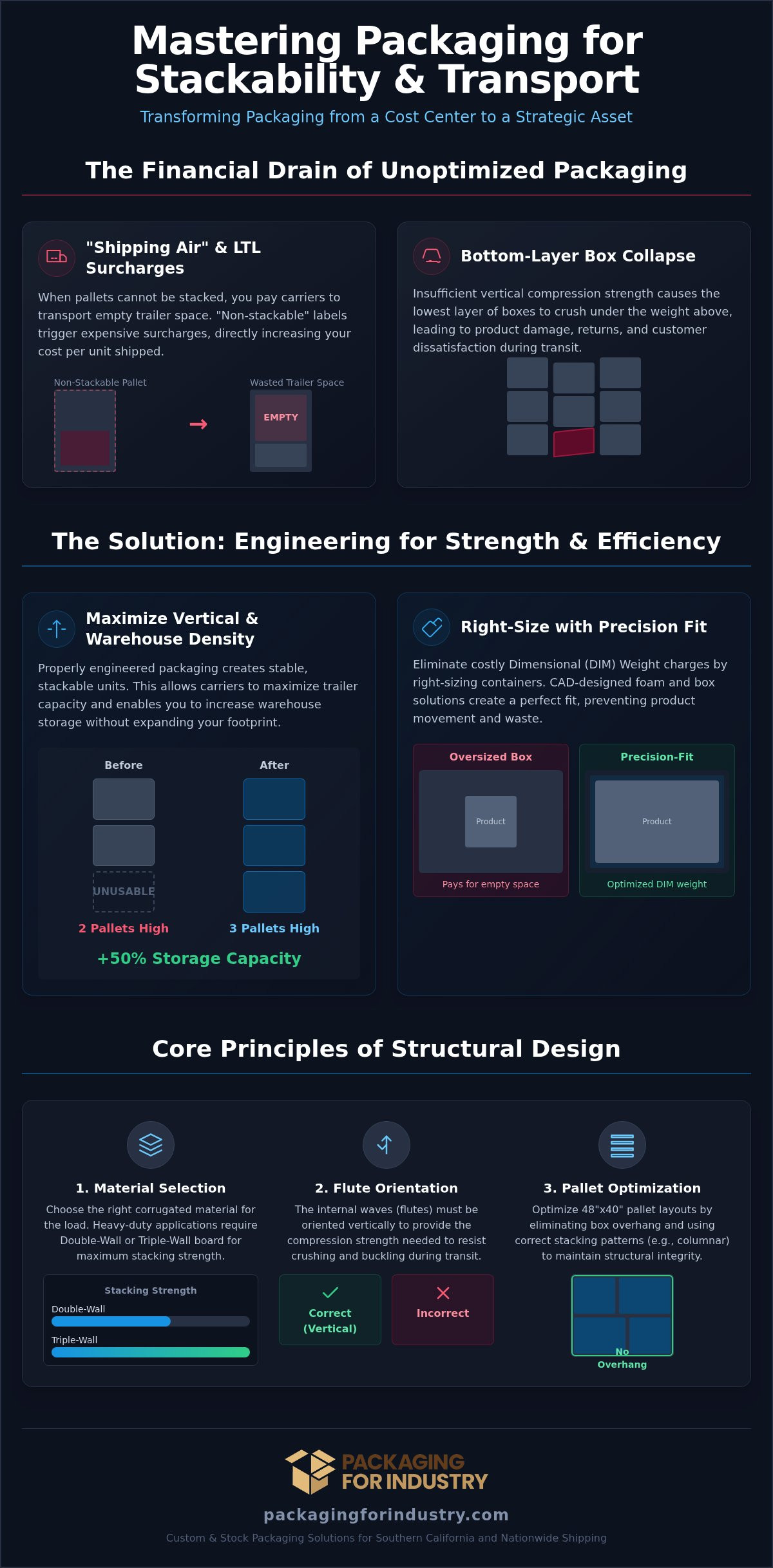
Vertical density is the most overlooked metric in industrial shipping. Many purchasing departments focus strictly on the unit price of a box, but the real expense is often found in how that box interacts with the carrier’s trailer. If your pallets are labeled “non-stackable,” you’re effectively paying a premium for the empty air above your cargo. LTL carriers calculate their profitability based on cubic capacity. When you align your pallet loads with intermodal container design and standards, you move closer to the efficiency that modern logistics demands.
The financial penalty for non-stackable freight is a preventable drain on your margins. Carriers use these surcharges to recoup the lost revenue from space that could’ve been occupied by another pallet. By investing in packaging design for stackability and transport, you turn your shipping units into predictable, stackable modules. This allows carriers to maximize their trailer space; this often leads to better negotiated rates and fewer logistical headaches during the loading process.
Dimensional Weight and Freight Surcharges
Carriers use Dimensional (DIM) weight to ensure they’re paid for the volume a package occupies, not just its pounds. If you’re shipping lightweight parts in oversized containers, you’re likely paying for weight you don’t actually have. Stackable designs enable cubic optimization, allowing you to fit more product into a smaller footprint while maintaining the strength to stack multiple levels high. Right-sizing your packaging prevents paying for the transport of shipped air. This strategy is essential for any manufacturer looking to achieve long-term packaging cost savings.
Reducing Damage Rates in High-Volume Distribution
Bottom-box collapse is a recurring nightmare for operations managers. It happens when the lowest layer of a stack lacks the vertical compression strength to support the weight above it during the vibrations of transit. Proper stackability design ensures that your corrugated boxes are engineered for the specific load they’ll carry. Optimized stacking also prevents the lateral shifting that leads to corner damage and punctured walls.
Beyond the trailer, stackable packaging drastically improves your warehouse density. If you can safely stack three pallets high instead of two, you’ve just increased your storage capacity by 50% without adding a single square foot of real estate. This level of efficiency reduces overhead and ensures that high-value industrial parts reach their destination in factory-perfect condition. Using a methodical approach to structural design isn’t just about protection; it’s about the fiscal health of your entire supply chain.
Structural Engineering for Maximum Vertical Load Strength
Engineering a package to survive the industrial supply chain requires more than just picking a box size. It involves a deep understanding of vertical load strength and how materials behave under constant pressure. The primary driver of packaging design for stackability and transport is the structural integrity of the container walls. Most standard boxes use a 200# test rating, but for industrial applications where pallets are stacked several levels high, this is rarely sufficient. Flute orientation plays a critical role here; the vertical alignment of the internal waves provides the compression strength needed to resist buckling during long-haul transit.
Material fatigue is another factor that often catches operations managers off guard. Even a well-engineered corrugated material loses strength over time, especially in humid environments. Moisture softens the cellulose fibers in the paper, which can reduce a box’s stacking strength by nearly half in extreme conditions. This is why we prioritize material selection based on the specific warehouse environment and the expected transit duration of your parts. If your inventory sits in a high-humidity distribution center for months, your packaging must be over-engineered to compensate for this inevitable degradation.
Double-Wall vs. Triple-Wall Corrugated Boxes
Choosing between double-wall and triple-wall depends on the total weight of the stack and the fragility of the contents. While double-wall is robust for many manufacturing needs, heavy-duty boxes made of triple-wall corrugated are the standard for aerospace and automotive components. We analyze Edge Crush Test (ECT) ratings to determine the precise vertical load a box can withstand before failing. Triple-wall provides the highest level of puncture resistance and burst strength, ensuring the bottom layer remains rigid even under the weight of heavy industrial equipment.
The Role of Custom Foam Inserts in Structural Support
Sometimes the box walls shouldn’t carry the load alone. By integrating custom foam inserts, we create internal pillars that transfer weight directly from the top of the box to the pallet base. High-density polyethylene foam is ideal for these load-bearing applications, while polyurethane provides superior cushioning for sensitive electronics. Foam end caps are particularly effective at preventing box bulging, which ensures a flat, stable surface for the next pallet in the stack. This holistic approach is a core principle in Design for Packaging Logistics, where the package is viewed as a functional component of the transport system rather than just a container.
If you’re seeing crushed corners or collapsed boxes in your facility, it’s time to re-evaluate your material specifications. You can request a packaging quote to see how an engineered solution improves your stack stability and reduces product loss.
Optimizing Palletization for Secure Transport and Warehouse Efficiency
Standardizing your pallet footprint is the first step toward a predictable supply chain. For most industrial operations, the 48×40 pallet is the foundation of every shipment. When your packaging design for stackability and transport ignores these dimensions, you create overhang or underhang. Overhang is particularly dangerous; it removes the support of the pallet deck from the box corners, which can lead to a significant loss in stacking strength. Conversely, underhang creates gaps between pallets in a trailer, leading to shifting and impact damage during transit. Precise alignment with the pallet edge ensures that the structural integrity we engineered into the box is actually utilized.
The choice between column stacking and interlocked stacking often depends on your specific product. For maximum vertical strength, column stacking is superior because it aligns the strongest parts of the box: the corners. While interlocked patterns provide more lateral stability, they often cause the corners of the top boxes to sit on the weak centers of the boxes below. To maximize your trailer cube, you must eliminate pyramid stacking. A flat top surface allows carriers to double-stack your freight safely, which is a key component of packaging’s role in supply chain efficiency. It turns a single pallet position into two, effectively doubling your transport capacity and reducing your cost per unit.
Corner Protection and Edge Guarding Strategies
Even the strongest boxes need help when they’re at the bottom of a three-high stack. Applying cardboard edge protectors is one of the most cost-effective ways to increase vertical stacking strength by up to 20%. These corner boards do more than just prevent strap damage; they act as an external skeleton for the entire pallet load. By distributing the tension of your strapping or stretch film, they prevent the box corners from crushing, which maintains the flat surface needed for safe stackability in the warehouse.
Stretch Film and Load Containment Standards
Load containment is the science of keeping your boxes from moving during the vibrations of transit. Whether you use hand film for low-volume needs or machine stretch film for high-speed lines, the goal is consistent containment force. Without enough force, your boxes will shift, causing the stack to lean and eventually collapse. Pre-stretched film is superior for load consistency because it delivers a high level of containment force without requiring the operator to manually pull the film to its breaking point. This ensures every pallet leaving your facility meets the same rigorous transport standard.
Designing for Distribution: Prototyping and Performance Testing
Moving from a conceptual drawing to a production-ready container requires a methodical engineering approach. You can’t rely on guesswork when the safety of high-value industrial parts is at stake. The process of packaging design for stackability and transport begins with a detailed analysis of your specific logistics environment. We follow a strict five-step engineering process to ensure every custom solution performs under pressure. This starts with load analysis to determine the maximum vertical force at the bottom of a stack and ends with stress simulation to identify potential failure points before bulk manufacturing begins.
Precision is the difference between a stable pallet and a collapsed load. We utilize CAD/CAM support to create custom design packaging that accounts for every millimeter of your product’s dimensions. This digital phase allows us to simulate how different materials, such as double-wall corrugated or high-density foam, will interact when stacked three or four levels high. Once the digital model is perfected, we move to free prototyping. Having a physical sample in your hands allows your operations team to verify fitment and handling before you commit your budget to a full production run.
CAD Design and Rapid Prototyping for Industrial Parts
CAD software is essential for calculating the exact weight distribution across the box walls. It helps us identify where internal reinforcements, like foam pillars or corrugated inserts, are needed to prevent buckling. Iterative design is a core part of our service; we refine box dimensions to ensure they perfectly match the 48×40 pallet footprint discussed earlier. This eliminates the risk of overhang and ensures that every unit contributes to the overall stability of the stack.
Understanding ISTA and ASTM Transit Testing Standards
Performance testing isn’t just about static pressure; it’s about the dynamic forces of the road. ISTA 3A testing protocols provide a comprehensive look at how your package handles the combined stresses of a distribution environment. While compression testing measures vertical strength, vibration testing simulates the constant movement inside a trailer. ASTM D4169 standards help us evaluate if your packaging can withstand these forces over long distances. Testing for vibration is just as important as testing for pressure because it reveals if the stack will shift or if the corrugated fibers will fatigue during transit.
PFI’s Custom Integrated Solutions for Southern California Manufacturers
PFI operates at the center of Southern California’s industrial corridor, serving the complex needs of aerospace and electronics hubs in Anaheim and Orange County. For organizations like JAS Global Industries that provide specialty chemical solutions for sectors like mining and water treatment, robust packaging is a critical component of their logistics. These sectors require more than generic catalog supplies; they need integrated systems that can withstand the rigors of global logistics. When we approach packaging design for stackability and transport for an industrial client, we aren’t just looking at a box. We’re looking at a total logistical unit that might combine heavy-duty triple-wall corrugated with precision-engineered foam and a wood pallet base. This integrated approach ensures that even the most delicate flight-critical or high-density components remain secure in a multi-tier stack during long-haul transit.
Our local presence across the Inland Empire, Los Angeles, and San Diego allows us to offer next-day delivery that national catalog suppliers simply can’t match. This proximity is a strategic advantage for manufacturers running lean operations. Instead of dedicating valuable warehouse floor space to massive stacks of empty boxes, our clients rely on us for rapid, localized replenishment. This local support is backed by our capability for fast nationwide shipping, which ensures your facilities across the country maintain the same high standard of stackable protection and logistical efficiency.
Custom Crating and Integrated Multi-Material Solutions
Standard corrugated solutions sometimes reach their physical limits when dealing with heavy machinery or oversized industrial parts. In these cases, we engineer custom crates designed for international transit and maximum vertical load. By combining high-density polyethylene foam, triple-wall corrugated, and heat-treated wood, we create the ultimate stackable unit. These systems are often designed as closed-loop, reusable packaging; this significantly lowers your long-term cost per shipment and reduces environmental impact.
Streamlining Supply Chains with JIT and VMI
Managing packaging inventory is a common administrative burden that we can effectively eliminate for your team. Through Vendor Managed Inventory (VMI), we take full responsibility for your stock levels, ensuring you never face a stockout of critical supplies. This works in tandem with Just-In-Time (JIT) management to free up your warehouse space for revenue-generating finished goods rather than bulky packaging materials. You can request a packaging cost-savings analysis today to identify gaps in your current stackability strategy and see how a localized, integrated supply chain improves your bottom line.
Optimize Your Industrial Supply Chain for Vertical Efficiency
Mastering packaging design for stackability and transport is a fundamental requirement for maintaining a lean and profitable operation. By prioritizing vertical compression strength and precision palletization, you eliminate the hidden costs of non-stackable freight surcharges and transit damage. We’ve seen how engineered solutions, ranging from triple-wall boxes to custom foam pillars, transform wasted trailer space into a streamlined logistical asset. Prototyping these designs through CAD/CAM support ensures your high-value parts remain secure from the warehouse floor to the final destination.
Packaging For Industry (PFI) provides the specialized expertise necessary for the aerospace and industrial manufacturing sectors. We offer free prototyping to verify your solution’s performance before you commit to bulk manufacturing. Our local next-day delivery across Orange County, Los Angeles, and San Diego, combined with fast nationwide shipping, ensures your supply chain remains uninterrupted and efficient. It’s time to stop paying for empty air and start maximizing your cubic capacity.
Our team is ready to help you lower your packaging costs and improve your delivery reliability today. Let’s build a more durable and cost-effective shipping strategy together.
Frequently Asked Questions
How do I calculate the maximum stacking height for my corrugated boxes?
You calculate the maximum stacking height by dividing the individual box’s compressive strength by a safety factor that accounts for environmental variables. This safety factor typically ranges from 3 to 8, depending on the humidity and the duration of storage. Our engineers use specialized software to model these variables; this ensures your bottom layer doesn’t collapse under the static load of the inventory stacked above it.
What is the difference between Burst Strength and Edge Crush Test (ECT) for stackability?
Burst strength measures the force required to puncture the box wall, while Edge Crush Test (ECT) measures the vertical compression strength of the corrugated board. For industrial stackability, ECT is the more critical metric because it directly relates to how much weight the box corners can support. We recommend high ECT ratings for any pallets destined for multi-tier stacking in a warehouse or trailer environment.
Can custom foam inserts really improve the stacking strength of a cardboard box?
Custom foam inserts significantly improve stacking strength by acting as internal structural pillars that transfer weight directly to the pallet base. When designed correctly, these inserts take the vertical load off the corrugated walls and prevent the “bulging” effect that leads to stack failure. This is particularly effective for heavy industrial parts that don’t naturally fill the entire volume of the shipping container.
Why do LTL carriers charge more for non-stackable freight?
LTL carriers charge more for non-stackable freight because it prevents them from utilizing the full vertical space in their trailers. Since carriers sell space by the pallet position and cubic volume, a non-stackable pallet effectively consumes two positions. These surcharges recoup the revenue lost from the empty air that could’ve been occupied by another customer’s cargo during transit.
How does pallet overhang affect the stackability and safety of my shipment?
Pallet overhang reduces a box’s stacking strength by as much as 32% because the strongest part of the container, the corner, loses the support of the pallet deck. This lack of support causes the boxes to lean or buckle under pressure. Proper packaging design for stackability and transport ensures that every box sits flush with the pallet edge to maintain its full structural integrity.
What are the best materials for high-density vertical stacking in humid warehouses?
Triple-wall corrugated board and high-density polyethylene foam are the most reliable materials for humid warehouse environments. Humidity softens standard paper fibers, but heavy-duty triple-wall maintains its rigidity longer under moisture stress. For extreme conditions, we often recommend integrated wood crates or plastic sleeves that provide a moisture-resistant barrier to protect the vertical load from structural fatigue over time.
How can CAD design help reduce my overall shipping and packaging costs?
CAD design reduces costs by identifying the exact material thickness needed to protect your product without over-engineering the container. It allows us to right-size the packaging to eliminate “shipped air” and maximize the number of units per pallet. By simulating the packaging design for stackability and transport before production, we prevent expensive damage claims and ensure you aren’t paying for unnecessary material weight.
Does PFI provide free prototypes for custom stackable packaging designs?
Yes, PFI provides free physical prototypes and CAD/CAM design support for qualified industrial and manufacturing accounts. We believe you should verify the performance of a custom solution before committing to bulk quantities. This prototyping phase allows your team to test the real-world stackability and fitment of our boxes within your specific Southern California operations before moving to full-scale production.