
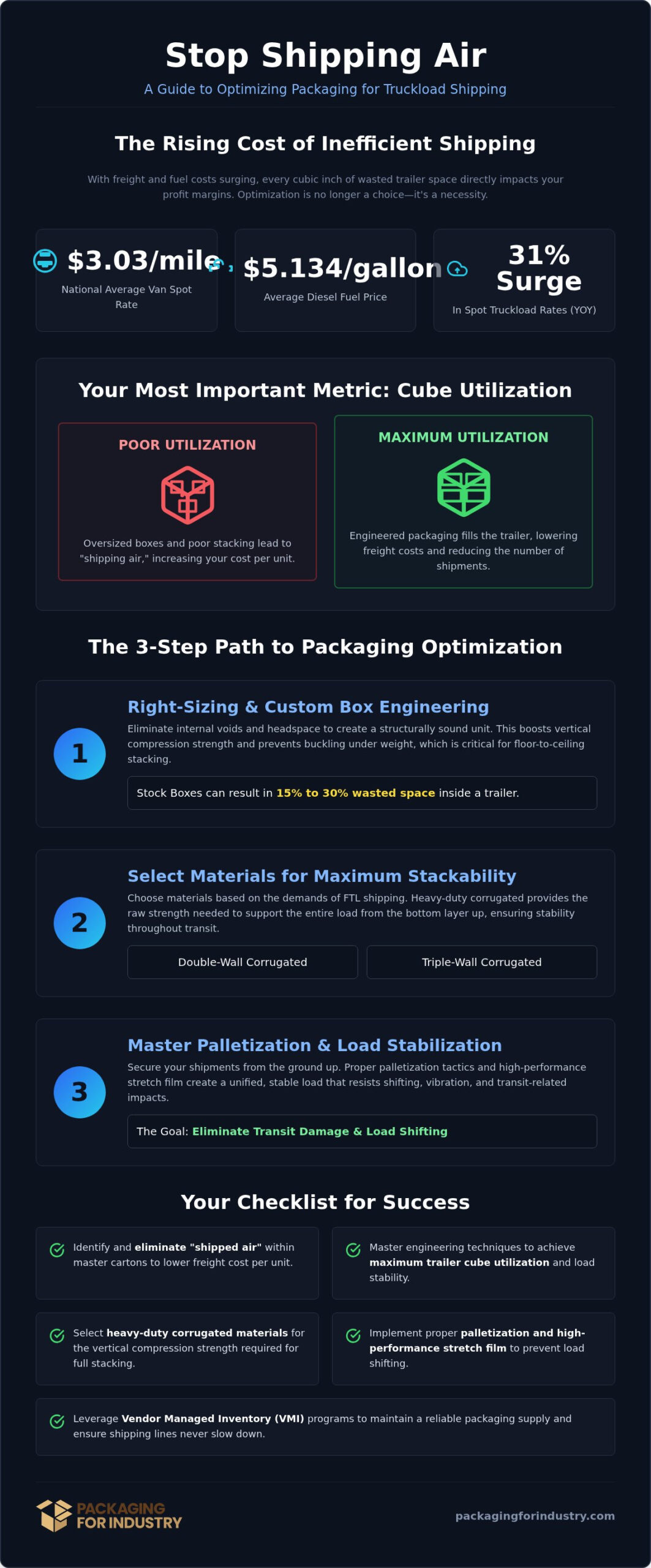
With national average van spot rates reaching $3.03 per mile and diesel fuel prices averaging $5.134 per gallon in July 2026, the cost of “shipping air” has never been more expensive. You’re likely managing the reality of spot truckload rates that have surged more than 31% over the last year. When every trailer represents a major operational expense, optimizing packaging for truckload shipping isn’t just a logistics task. It’s a fundamental requirement for maintaining your profit margins.
It’s frustrating to pay premium freight costs only to deal with the professional stress of product damage caused by poor stackability or shifting loads. You need a shipping strategy that balances maximum trailer density with the durability required for full truckload environments. This guide will show you how to engineer your packaging to maximize cube utilization and eliminate transit damage. We’ll examine the specific ways that custom corrugated designs and integrated foam protection can lower your cost per unit and ensure your shipping lines remain consistent and efficient.
Key Takeaways
- Identify and eliminate “shipped air” within your master cartons to significantly lower your freight cost per unit.
- Master the engineering techniques for optimizing packaging for truckload shipping to achieve maximum trailer cube utilization and stability.
- Select appropriate heavy-duty materials, such as double-wall or triple-wall corrugated, to provide the vertical compression strength required for floor-to-ceiling stacking.
- Implement proper palletization tactics and high-performance stretch film to prevent load shifting and eliminate transit damage.
- Leverage Vendor Managed Inventory (VMI) programs to maintain a reliable packaging supply and ensure your shipping lines never slow down.
The Economics of Truckload Packaging Optimization
Packaging optimization is the process of maximizing trailer cube while maintaining the structural integrity of your products. In an era of high freight volatility, you aren’t just shipping goods; you’re buying trailer volume. If your packaging isn’t engineered for density, you’re paying for empty space. Optimizing packaging for truckload shipping requires a shift in perspective from looking at the cost of a single box to analyzing the total landed cost of the entire shipment. This approach balances the price of materials with the efficiency of the logistical flow.
While optimizing truckload density is a key component of this process, some industries also require specialized terminal infrastructure and marine transport, such as that provided by DPP Logistics Company Ltd, to manage the bulk storage and movement of raw materials effectively.
As of July 2026, “shipping air” has become the primary driver of inflated freight budgets. With national average diesel prices holding at $5.134 per gallon and spot truckload rates up significantly year-over-year, every cubic inch of unused trailer space represents lost capital. While Less-than-Truckload (LTL) environments require ruggedized packaging to survive multiple touches and sorting hubs, Truckload shipping (FTL) presents a different challenge. In FTL, the primary goal is maximizing density and vertical compression strength to ensure loads remain stable during long-haul transit without wasting valuable “cube.”
Why Cube Utilization is Your Most Important Metric
Cube utilization is the ratio of product volume to available trailer space. For a standard 53-foot dry van, achieving high utilization is the most direct way to lower your cost per unit shipped. If you can increase your pallet density by just 10%, you effectively reduce the number of trucks required for large-scale distribution over time. This isn’t just a marginal gain; it’s a strategic advantage that offsets rising contract rates and carrier capacity constraints. Calculating this requires a precise audit of how your secondary packaging fits on a standard 48×40 pallet and how those pallets stack within the trailer’s height limits.
The Hidden Costs of Under-Packaging and Over-Packaging
Finding the “sweet spot” in material usage is critical for fiscal responsibility. Under-packaging is a high-risk gamble that often results in expensive damage claims, especially for high-value aerospace or medical components. If a bottom-layer box buckles under the weight of a full stack, the entire load can shift, leading to a total loss. Conversely, over-packaging creates its own financial drain. Using oversized boxes and excessive void fill leads to “shipping air” and unnecessary dimensional weight charges. By utilizing engineered custom corrugated boxes, you can eliminate headspace and ensure that every inch of the container is dedicated to protecting the product rather than filling a gap. This precision engineering reduces waste and ensures your shipments are as lean and stable as possible.
Step 1: Right-Sizing and Custom Box Engineering
The first step in optimizing packaging for truckload shipping is conducting a comprehensive dimensional audit of your current primary and secondary packaging. You can’t improve what you haven’t measured. Most shipping inefficiencies stem from using “close enough” stock sizes that leave significant headspace in master outer cartons (MOCs). When boxes have internal voids, they lose their vertical compression strength. The top flaps eventually buckle under the weight of the pallets above them, leading to crushed products and unstable loads. By transitioning to custom-engineered dimensions, you eliminate this air and create a structurally sound unit that supports the weight of the entire stack.
You should also consider incorporating internal partitions. These dividers increase the stacking strength of the carton without adding significant external bulk. This allows you to use more efficient corrugated grades while maintaining the integrity needed for floor-to-ceiling truckload density. This level of precision ensures that your packaging works as a system to protect the product while occupying the smallest possible footprint on the trailer floor.
Custom Corrugated vs. Stock Catalog Boxes
Standard catalog boxes are designed for general use, which often results in 15% to 30% wasted space inside a trailer. For high-volume manufacturers in Southern California, this waste translates directly into thousands of dollars in unnecessary freight spend every month. Using CAD/CAM design allows for the creation of a “perfect fit” tailored to your specific industrial parts. For instance, a precision manufacturer in Orange County recently reduced their annual shipping costs significantly by switching from stock boxes to custom-sized corrugated containers. This change allowed for an extra layer of product on every pallet, maximizing their trailer cube and reducing the total number of shipments required.
Prototyping for Precision Fit
You shouldn’t commit to a full production run without verifying the design. Prototyping ensures that your product fits securely and that the carton can withstand real-world warehouse stresses. Testing stackability and compression strength during the design phase prevents costly failures in the field. Our custom design packaging services provide free prototyping to ensure your solution is operationally sound before it hits the shipping dock. This proactive approach eliminates the professional stress of transit damage and ensures your logistics flow remains uninterrupted. If you’re ready to see how a custom fit can improve your bottom line, you can request a packaging quote to get started with a dimensional audit.
Step 2: Selecting Materials for Maximum Stackability
Once you’ve right-sized your box dimensions, the next step in optimizing packaging for truckload shipping is choosing materials that can withstand the physics of a full trailer. In FTL environments, your packaging faces sustained vertical compression and constant low-frequency vibration. Unlike LTL shipments that deal with frequent side-impacts during hub sorting, truckload shipments are often stacked floor-to-ceiling to maximize the 53-foot trailer’s capacity. This means the bottom layer of boxes must support the weight of the entire stack for hundreds of miles. If your material isn’t engineered for this specific stress, the load will eventually “bloom” or collapse, leading to unstable pallets and product damage.
You must assess your vertical compression needs based on the total weight of the palletized load. While single-wall corrugated might suffice for lightweight e-commerce goods, industrial components typically require double-wall or triple-wall construction. For high-volume industrial shipments, you should also evaluate the use of Gaylord boxes or bulk bins. These large-scale containers provide superior containment for loose parts and can be engineered with reinforced corners to allow for secure double-stacking in the trailer.
Heavy-Duty Corrugated for Industrial Loads
For heavy machinery, automotive drivetrain parts, or aerospace components, upgrading to triple-wall corrugated is often the most cost-effective alternative to heavy wood crating. Triple-wall corrugated provides the structural integrity of wood crates at a lower weight, which helps you stay under the 80,000-pound gross vehicle weight limit while maximizing unit count. It’s also important to consider environmental factors. Humidity and temperature fluctuations during long-haul transit can reduce standard box strength by up to 50%. Selecting heavy-duty corrugated with high-performance liners ensures your packaging maintains its Edge Crush Test (ECT) rating regardless of the climate zones the truck passes through.
Integrated Foam and Cushioning Solutions
Precision-engineered protective foam packaging allows you to reduce the overall footprint of your shipping container without sacrificing safety. By utilizing higher-density polyethylene or polyurethane foam, you can achieve the same shock absorption with a thinner profile. This “thinner but stronger” approach allows for smaller outer box dimensions, which directly increases the number of units you can fit on a pallet. For sensitive electronics, anti-static (ESD) foam is essential for protecting against electrostatic discharge and dampening the high-vibration environment typical of long-distance truck transport. This integrated approach ensures that your internal cushioning works in tandem with your heavy-duty corrugated to provide a total protection system that is both lean and durable.
Step 3: Palletization and Load Stabilization Tactics
Column stacking is the most effective way to maintain top-to-bottom compression strength. While interlocking patterns are common in warehouse environments to provide stability during forklift transport, they can reduce the weight-bearing capacity of corrugated boxes by a significant margin. By aligning the corners of every box vertically, you ensure that the strongest part of the carton, the vertical edge, carries the load. This is a critical component of optimizing packaging for truckload shipping, as it allows for taller pallet heights and better cube utilization without the risk of the bottom layer collapsing under the weight of the stack.
Zero overhang is equally vital for maintaining load integrity. When boxes extend past the pallet edge, they lose the structural support of the wood deck and are vulnerable to being crushed by adjacent loads in the trailer. A standard 53-foot trailer is 102 inches wide, leaving very little margin for error when loading two pallets side-by-side. Ensuring your load stays within the 48×40 footprint prevents “snagging” during loading and unloading, which is a major cause of transit damage claims in full truckload environments. It also ensures that the weight of the stack is transferred directly into the pallet’s stringers rather than the air.
Advanced Stretch Film and Pallet Wrap Techniques
The right application of stretch film is what holds your engineered system together. For high-volume operations, machine stretch film is superior to hand wrapping because it provides consistent containment force throughout the entire pallet. Pre-stretched film is an excellent choice for reducing material waste and lowering your cost per unit, as it requires less physical effort to apply while maintaining high tension. For heavy industrial loads, you must determine the correct gauge; typically, an 80-gauge or 90-gauge film is required to prevent “blooming,” where the load begins to lean or shift during transit vibrations.
Edge Protection and Structural Reinforcement
Installing corner and edge protection is a proactive way to increase stack stability. These cardboard or plastic protectors allow you to apply higher tension with strapping or stretch wrap without crushing the corners of your master shippers. They also distribute the weight of stacked pallets more evenly, which is essential for floor-to-ceiling truckload density. For irregular or high-value loads, using strap guards prevents metal or plastic bands from cutting into the corrugated, preserving the box’s integrity. When combined with custom-built pallets or skids, these reinforcement tactics ensure that your shipment arrives intact regardless of the distance.
The PFI Advantage: Local Expertise and Supply Reliability
Choosing a packaging partner is about more than just buying boxes; it’s about securing your supply chain. Packaging For Industry (PFI) is a Southern California leader in custom industrial packaging, offering the technical expertise required for optimizing packaging for truckload shipping. We position ourselves as a pragmatic, cost-effective alternative to large national catalog suppliers. While those distributors focus on volume, we focus on the intersection of engineering and economics. Our local next-day delivery across Anaheim, Orange County, and Los Angeles ensures that your warehouse operations remain fluid and your shipping deadlines are met without fail.
Reliability is often undermined by inconsistent packaging supply. We solve this through our Vendor Managed Inventory (VMI) program. By letting us manage your stock levels, you prevent the professional stress of packaging shortages that can halt your shipping lines. This proactive approach to inventory management is essential for manufacturers who rely on just-in-time logistics to maintain their competitive edge. It ensures that the specific heavy-duty materials and stabilization tools discussed in previous sections are always on hand when you need to load a trailer.
Southern California’s Partner for Aerospace and Manufacturing
Our team understands the rigorous demands of specialized sectors. We provide deep expertise in aerospace packaging and military-spec compliance, where even minor damage can lead to catastrophic losses. With local manufacturing and warehousing facilities strategically located in the Inland Empire and San Diego, we drastically reduce lead times compared to out-of-state suppliers. This regional presence allows us to offer personalized service and site-side consultations that large national distributors simply cannot match. You get a steady, dependable partner that understands the local logistical environment and the unique challenges of the Western shipping corridors.
Lowering Your Packaging Costs through Engineering
True cost reduction goes beyond the price per unit of material. PFI’s packaging cost savings analysis identifies hidden freight inefficiencies that are often overlooked. We look at your entire system, combining heavy-duty boxes, custom foam inserts, and pallets into a single, optimized shipping unit. This holistic approach ensures that optimizing packaging for truckload shipping translates directly into a lower total landed cost for your business. We don’t just sell components; we provide a complete system of protection and logistical optimization. If you’re ready to eliminate “shipped air” and improve your bottom line, request a custom packaging quote to optimize your truckload shipping today.
Maximize Your Trailer Capacity and Protect Your Bottom Line
Achieving total logistical efficiency through optimizing packaging for truckload shipping requires a shift from viewing boxes as a commodity to seeing them as an engineered asset. By eliminating headspace in your master cartons and selecting materials with high vertical compression strength, you directly combat the rising fuel and freight costs of 2026. Proper palletization and the application of high-performance stretch film ensure that your densest loads remain stable from the loading dock to the final destination.
Packaging For Industry (PFI) supports your operations with free prototyping and samples to ensure a perfect product fit before you commit to a full production run. As specialists in aerospace and industrial manufacturing, we provide the technical oversight needed to maintain compliance and eliminate transit damage. Our local next-day delivery across Orange County, Los Angeles, San Diego, and the Inland Empire ensures that your supply chain stays moving without interruption.
Your team deserves the peace of mind that comes with a reliable, engineered packaging system. We look forward to helping you lower your costs and improve your operational flow.
Frequently Asked Questions
What is the best way to calculate cube utilization for truckload shipping?
Cube utilization is calculated by dividing the total volume of your palletized product by the available cargo volume of the trailer. For a standard 53-foot dry van, you typically manage approximately 3,800 to 4,000 cubic feet of usable space. Optimizing packaging for truckload shipping involves ensuring your pallets are stacked to the maximum safe height and width to minimize unused “air” at the top and sides of the trailer.
How does right-sizing packaging reduce my overall freight costs?
Right-sizing reduces freight costs by increasing the number of units you can fit on a single pallet and, consequently, on a single truck. By eliminating internal voids and “headspace” in your cartons, you improve stackability and density. This allows you to ship more product per trailer load, which lowers your total landed cost and helps offset rising diesel prices and carrier fuel surcharges.
Should I use double-wall or triple-wall corrugated boxes for heavy industrial parts?
You should choose your corrugated grade based on the total vertical compression load and the weight of the contents. Double-wall corrugated is sufficient for many industrial parts, but triple-wall is necessary for heavy machinery or aerospace components that require wood crate levels of protection. Triple-wall provides superior structural integrity for floor-to-ceiling stacking while remaining significantly lighter than wood, helping you stay under gross vehicle weight limits.
How can I prevent my pallets from shifting during transit?
Preventing load shifting requires a combination of column stacking, high-performance stretch film, and edge protection. Column stacking ensures that the vertical edges of your boxes bear the weight, while 80-gauge or 90-gauge machine stretch film provides the containment force needed to stop “blooming.” Using corner protectors allows for tighter strapping, which keeps the entire load unified during sustained long-haul vibrations.
What are the benefits of custom-engineered packaging over standard stock boxes?
Custom-engineered packaging provides a precise fit that standard catalog boxes cannot match, typically reclaiming 15% to 30% of wasted trailer space. Custom designs also incorporate internal partitions and foam inserts that are engineered for the specific vibration frequencies of truck transport. This precision reduces product damage claims and ensures that optimizing packaging for truckload shipping results in maximum trailer density and unit protection.
Does PFI offer local delivery for packaging supplies in Southern California?
Yes, PFI provides local next-day delivery across Southern California for all industrial packaging supplies. Our fleet serves manufacturers and warehouses in Orange County, Los Angeles, San Diego, and the Inland Empire. This local proximity allows us to offer faster lead times than national catalog distributors and provides the flexibility needed for just-in-time manufacturing environments where supply reliability is a top priority.
Can optimized packaging help me avoid UPS and FedEx oversize surcharges?
Optimized packaging helps you avoid expensive dimensional weight (DIM) and oversize surcharges by reducing the physical footprint of your master shippers. By eliminating excessive void fill and using higher-density foam inserts, you can often move products into smaller box classifications. This approach is highly effective for e-commerce and distribution centers looking to lower their parcel and LTL shipping expenses through smarter engineering.
How does a Vendor Managed Inventory (VMI) program help with shipping efficiency?
A Vendor Managed Inventory (VMI) program improves shipping efficiency by ensuring you never run out of the specific boxes, foam, or film required for your shipping lines. When PFI manages your inventory levels, we eliminate the operational delays caused by packaging shortages. This consistency allows your shipping department to maintain a steady flow, preventing the professional stress of missed deadlines and expensive rushed freight charges.