
A damaged shipment is more than just a logistical error; it’s a direct leak in your company’s profitability that often stems from a single, overlooked engineering gap. You already understand that high product return rates and escalating freight surcharges are unsustainable for a lean operation. Troubleshooting common packaging failures requires moving beyond simple trial and error toward a methodical, engineering-first approach that accounts for the specific rigors of your supply chain.
This 2026 industrial guide identifies the root causes of transit damage and explains how to engineer resilient packaging solutions that protect your bottom line. We’ll examine how precision-fit corrugated boxes and custom foam inserts eliminate the movement that leads to breakage. You’ll also learn how to lower your total cost of ownership through optimized designs that reduce dimensional weight fees. We’ll preview how a streamlined procurement strategy, including Vendor Managed Inventory, can prevent production stops and ensure your warehouse in Los Angeles or Orange County remains efficient and fully stocked.
Key Takeaways
- Identify the root causes of transit damage by looking beyond simple breakage to analyze hidden costs like brand erosion and lost production time.
- Master the technical process of troubleshooting common packaging failures by diagnosing specific issues such as corrugated flute crush and foam insert bottoming out.
- Eliminate load instability by resolving the engineering gaps that lead to pallet drift and stretch film failures like snapping or neck-down.
- Implement a 5-step diagnostic framework to document damage at the point of delivery and evaluate your supply chain’s specific drop profile.
- Leverage custom-engineered prototypes and Vendor Managed Inventory (VMI) to prevent the high-risk packaging substitutions that occur during supply shortages.
Identifying the Root Causes of Industrial Packaging Failures
Troubleshooting common packaging failures requires a shift in perspective. An industrial packaging failure isn’t just a visible hole in a box; it’s any instance where the material fails to protect the product’s integrity, utility, or value. While a shattered component is the most obvious sign of trouble, silent failures like microscopic vibration fatigue or moisture ingress can be just as costly. For manufacturers in Los Angeles and across Southern California, these failures translate into high return rates, production line stops, and severe brand erosion that’s difficult to quantify but impossible to ignore.
Beyond the obvious replacement cost of a damaged unit, failures trigger a chain reaction of operational friction. You lose the labor hours spent on the original pack-out; you lose the shipping costs for the return; and you lose the opportunity cost of the replacement inventory. These hidden drains on your bottom line are often what distinguish a profitable operation from one struggling with logistics. A systematic approach to troubleshooting common packaging failures begins with a forensic look at where the protection failed during the journey from the warehouse to the end user. To diagnose these issues, engineers often look at established Package testing methodologies to simulate the shocks and stresses of the modern supply chain.
There is also a critical balance between under-packaging and over-packaging. Under-packaging leads to damage claims, while over-packaging results in bloated shipping costs and unnecessary warehouse waste. Over-packaging is a common but expensive reaction to shipping damage. Adding more layers of foam or moving to a heavier-walled box without a diagnostic reason simply trades damage costs for increased material spend and higher freight surcharges. A truly engineered solution optimizes the material to the exact point of safety, ensuring you aren’t paying to ship air or extra weight.
Structural vs. Environmental Stressors
Stacking height in a warehouse creates immense pressure on the bottom layers. If the Edge Crush Test (ECT) rating isn’t matched to the pallet weight, lower-box compression failure is inevitable. Environmental factors also play a massive role. High humidity can strip a corrugated box of up to 50% of its strength, turning a reliable container into a liability. For high-value electronics, vibration-induced fatigue during long-haul transport can cause internal component failure without leaving a single mark on the outer box.
The Role of Inadequate Material Specification
Many industrial failures happen because a “standard” box was used for a specialized application. Transport modes matter; the stress profile of an LTL (Less-Than-Truckload) shipment is vastly different from a small parcel delivery. Custom corrugated boxes must be specified based on the specific journey they will take. In sectors like aerospace, failing to meet mil-spec or high-tolerance standards isn’t just an operational risk; it’s a compliance failure that can halt an entire contract.
Troubleshooting Corrugated and Foam Packaging Failures
Industrial packaging failure isn’t always a mystery. When troubleshooting common packaging failures, you have to look at the geometry of the damage to find the root cause. Flute crush occurs when the internal arches of the corrugated board are flattened, usually due to side impact or excessive vertical pressure. In contrast, corner collapse typically points to a failure in stacking alignment or a lack of internal structural support. If your shipping tape is consistently peeling or popping, don’t assume the adhesive is the problem. Often, this is a sign of an over-packed box or a box that is slightly too small for its contents, creating outward pressure that the tape cannot sustain. To get to the bottom of these recurring issues, many operations adopt a Failure Mode and Effects Analysis framework to identify exactly where the material failed to meet the stress of the environment.
Solving Corrugated Crushing and Tearing
If your product is consistently arriving with crushed edges, it’s time to evaluate your board strength. Upgrading from standard single-wall to heavy-duty double-wall or triple-wall boxes provides the necessary stacking strength for long-haul LTL shipments. Watch for “scoreline cracking” at the box edges; this usually happens when the contents are too bulky, forcing the corrugated fibers to stretch and snap. Integrating custom-fitted partitions and dividers can redistribute the weight of the product away from the outer walls, effectively reinforcing the entire structure. If your Los Angeles manufacturing facility is seeing recurring damage, you can request a custom packaging quote to have an engineer review your current specs.
Fixing Protective Foam Deficiencies
Foam failure often manifests as the “bottoming out” effect, where the material compresses fully upon impact, allowing the product to strike the outer box. This indicates a mismatch between the product weight and foam density. When troubleshooting common packaging failures involving cushioning, you must choose between polyethylene vs. polyurethane foam based on the fragility and weight of your item. Polyethylene is ideal for heavier, more rugged parts, while polyurethane offers softer deceleration for delicate instruments. For sensitive electronics, ensure your foam has anti-static properties to prevent ESD damage during transit. Compression set is the permanent deformation of foam after a load has been applied, which causes the material to lose its protective shape and cushioning capability over time.
Resolving Load Instability and Stretch Film Failures
Pallet drift is a quiet profit killer. It occurs when the friction between the product and the pallet base is insufficient to overcome the centrifugal forces of transport. When troubleshooting common packaging failures, you must look at the containment force of your wrap rather than just the number of revolutions. If the load shifts even two inches, the center of gravity changes, which often leads to a complete load collapse in the back of a trailer. Integrating corner and edge protection provides the vertical columns of strength needed to prevent boxes from crushing under the pressure of tight strapping or heavy stacking.
Stretch film failures like snapping and puncturing usually point to improper gauge selection or sharp edges on the product itself. “Neck-down” is another common issue where the film narrows significantly under tension, reducing the surface area covered and leaving the middle of the load vulnerable. Research, such as this case study on reducing packaging defects, highlights that even minor adjustments in wrap patterns and tension settings can significantly lower damage rates. Base-level structural failure is often the result of improper pallet selection; a pallet with missing boards or weak lead decks cannot support the dynamic loads of a moving truck.
Optimizing Stretch Film Application
The choice between hand film vs. machine stretch film depends on your volume and the required consistency of tension. Machine applicators provide a repeatable containment force that hand-wrapping simply cannot match. If you notice your wrap isn’t sticking, you’re likely dealing with cling failure. This is often caused by dust in the warehouse or extreme temperature fluctuations. In the heat of the Inland Empire or the coastal humidity of San Diego, film performance can vary wildly, requiring adjustments to your tension settings to maintain a secure hold without wasting material.
Pallet and Crate Integrity Issues
For heavy industrial machinery, standard pallets often fail to provide the necessary rigid support. In these cases, custom crates are the only reliable way to ensure the product arrives intact. Troubleshooting common packaging failures in international shipping often reveals a lack of ISPM-15 compliance, which can lead to costly customs delays or rejected shipments. Watch for “forklift rash” on the bottom of your loads. This damage occurs when the bottom skid design doesn’t provide enough clearance or reinforcement, allowing the forks to puncture the product during transit. PFI provides local next-day delivery across Los Angeles and Orange County to ensure you always have the right spec of pallets and crates on hand.
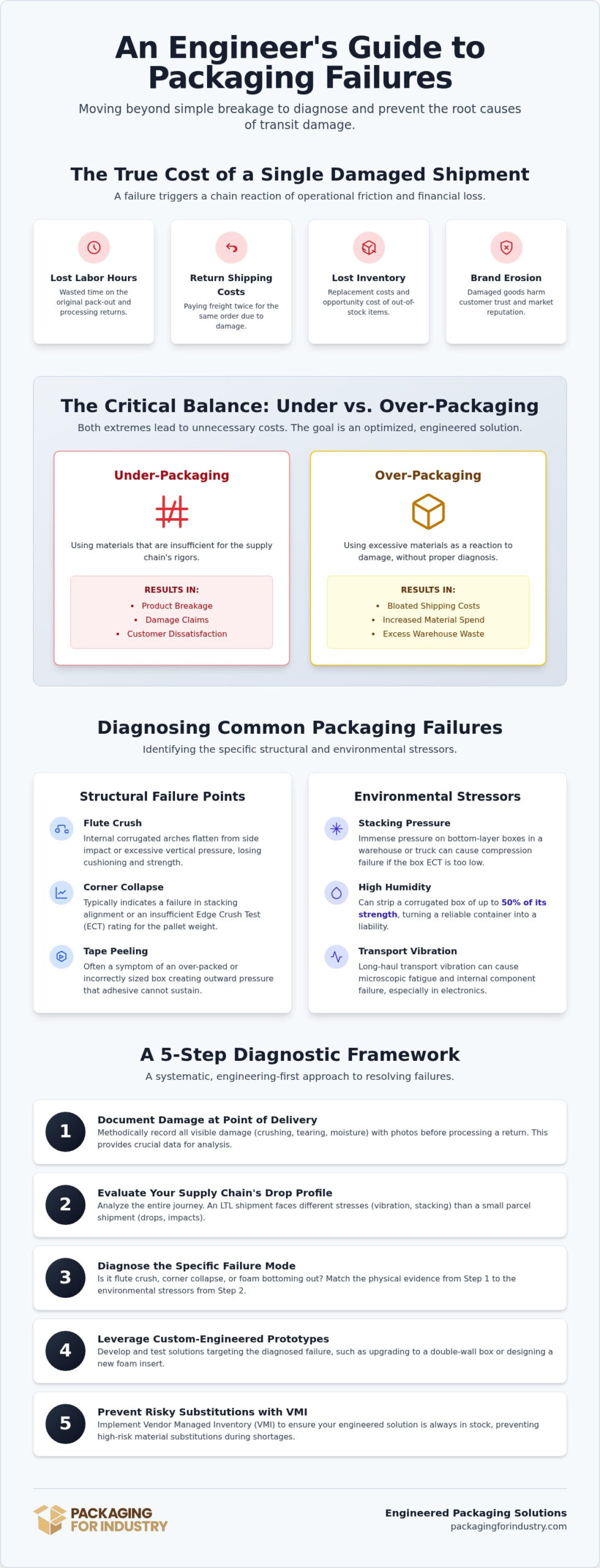
A 5-Step Diagnostic Framework for Packaging Performance
Effective troubleshooting of common packaging failures requires a standardized methodology rather than reactive guesswork. When a shipment arrives damaged at a facility in Los Angeles or Orange County, the priority is to move beyond the immediate loss and document the “why.” By following a disciplined diagnostic framework, operations managers can identify whether a failure was a one-time anomaly or a systemic engineering flaw. This process ensures that your corrective actions actually solve the problem instead of just adding unnecessary material costs.
- Step 1: Document the Failure. Capture high-resolution photographs of the damage at the point of delivery. This must include the outer container, internal cushioning, and the specific orientation of the product within the box.
- Step 2: Evaluate the “Drop Profile.” Map your supply chain to identify where the impact likely occurred. Is the damage consistent with a side-impact from a forklift or a vertical drop during a small parcel sortation process?
- Step 3: Audit Material Specs. Compare the actual product weight and dimensions against the original packaging specifications. Minor changes in product design can often render existing box sizes or foam densities obsolete.
- Step 4: Conduct a “Shake Test.” Identify internal movement by manually checking for void-fill gaps. If the product can shift more than a quarter-inch inside the container, the packaging is failing to provide adequate deceleration.
- Step 5: Review the Procurement Cycle. Determine if the failure coincided with the use of “emergency” stock substitutes. Using a generic box or a lower-grade stretch film during a shortage is a primary cause of troubleshooting common packaging failures.
Conducting a Packaging Review for Damage Reduction
An in-house drop test is an essential tool for prototype validation. By dropping a packed container from heights ranging from 12 to 36 inches on various faces and corners, you can simulate real-world transit stress before a full production run. This testing often reveals “Hidden Damage,” where internal components fail due to shock transmission even when the outer box remains intact. You should also leverage data from freight carriers to identify specific transit lanes with high damage rates, allowing you to reinforce packaging for those specific routes.
Specifying Requirements for Custom Solutions
To eliminate recurring issues, you must clearly communicate your collected failure data to your packaging manufacturer. Providing detailed photos and impact data allows engineers to use CAD/CAM support to design precise inserts that eliminate guesswork. Prototyping is the most cost-effective way to troubleshoot before a full rollout. It allows you to verify fit and function on a small scale, ensuring your final industrial solution is both resilient and economically optimized for your specific supply chain.
Preventing Failures with PFI’s Engineered Packaging Solutions
Troubleshooting common packaging failures shouldn’t be a recurring task for your operations team. While identifying the root causes of damage is a necessary first step, the ultimate goal is to implement a system that prevents these failures from ever reaching the loading dock. PFI serves as a technical partner for aerospace and manufacturing sectors, where the cost of a single damaged component can exceed the value of an entire year’s packaging spend. By moving from reactive fixes to custom-engineered protection, we ensure that your materials are precisely matched to the vibration, shock, and environmental stressors of your specific supply chain.
One of the most frequent causes of transit damage is the use of “emergency” packaging substitutes. When a warehouse runs out of a specific heavy-duty box or high-density foam insert, personnel often use whatever is available to keep the line moving. These substitutions are a primary driver of troubleshooting common packaging failures. PFI’s Vendor Managed Inventory (VMI) program eliminates this risk by maintaining your stock levels based on actual usage. This ensures that the high-spec materials your engineers approved are always on the shelf, preventing the stockout-induced failures that lead to costly returns and freight claims.
Beyond design and inventory management, we lower your total cost of ownership through packaging kitting and assembly services. By delivering pre-assembled kits that include the box, foam inserts, and labels, we reduce the complexity of the pack-out process. This reduces labor costs and eliminates the human error that occurs when complex protective components are incorrectly installed. For local businesses across Southern California, this level of oversight is backed by the reliability of next-day delivery from our Anaheim headquarters, serving Los Angeles, San Diego, and the Inland Empire.
Prototyping and Custom Design
Precision is the only way to guarantee zero-damage shipping cycles. PFI offers free prototyping to test-fit high-value components before you commit to a full production run. Our engineers integrate custom foam and heavy-duty corrugated materials to create multi-material protection systems that absorb energy more efficiently than off-the-shelf options. In specialized aerospace applications, these engineered interventions have helped clients reduce component damage rates by 40% by eliminating internal movement and bottoming-out effects during long-haul transport.
Reliable Supply Chain Management
Operational stability depends on a predictable supply of materials. We eliminate lead-time surprises through Just-In-Time (JIT) delivery, allowing you to free up valuable warehouse space for production rather than bulk packaging storage. Our local expertise in the Southern California logistics corridor means we understand the specific transit challenges of the region. Whether you are dealing with high-volume distribution or specialized low-volume manufacturing, we provide the on-site support and engineering depth needed to protect your products and your bottom line.
Engineering Resilient Supply Chains for 2026 and Beyond
Industrial logistics in 2026 demand a move away from reactive fixes. By adopting a diagnostic framework and matching material specifications to your specific transport mode, you eliminate the recurring costs of damage and returns. Solving these operational gaps through systematic troubleshooting common packaging failures ensures your shipments remain secure from dock to destination. Utilizing programs like Vendor Managed Inventory further protects your production schedule by preventing the use of inferior, stockout-induced material substitutes.
PFI provides the technical depth required for high-stakes sectors like aerospace, medical, and military-spec manufacturing. We offer free prototyping for all custom designs to guarantee product fit before you move to bulk production. With local next-day delivery across Southern California, including Los Angeles, Orange County, and San Diego, we act as a steady extension of your operations team.
You don’t have to manage these logistical stresses alone. Our team is ready to help you optimize your packaging strategy and secure your bottom line today.
Frequently Asked Questions
What are the most common causes of corrugated box failure?
The primary causes include moisture ingress, which reduces structural integrity, and Edge Crush Test (ECT) ratings that don’t match the pallet load weight. Troubleshooting common packaging failures often reveals that improper stacking or poor warehouse humidity control led to lower-box compression. Matching the board grade to the specific transport environment is essential to prevent these structural collapses.
How do I know if I need double-wall or triple-wall boxes?
You should upgrade to double-wall or triple-wall boxes when your product weight exceeds the stacking strength of single-wall corrugated or when shipping via LTL carriers. Single-wall is typically sufficient for small parcel shipments under 65 lbs. Triple-wall is reserved for heavy industrial equipment and international transit where maximum puncture resistance is required for high-value goods.
Why does my stretch film keep snapping during pallet wrapping?
Stretch film snapping is usually caused by excessive tension settings on the machine or sharp edges on the pallet load that puncture the material. If you’re using a thin gauge film for a heavy or irregular load, the material can’t sustain the required containment force. Reviewing your film gauge and adjusting the “neck-down” during application can solve most tearing and snapping issues.
What is the difference between polyethylene and polyurethane foam for protection?
Polyethylene foam is a closed-cell material used for heavier, rugged items that require high impact absorption and durability. Polyurethane foam is an open-cell, softer material designed for delicate instruments that need gentle deceleration and cushioning. Choosing the wrong density can lead to “bottoming out,” where the product strikes the outer container during a drop or impact.
How can I reduce UPS and FedEx surcharges related to packaging?
You can lower freight costs by reducing the overall dimensions of your outer shipping container to align with dimensional weight (DIM) pricing. Minimizing empty space inside the box reduces the need for expensive void-fill and helps you avoid large-package surcharges. Engineering a custom-fit solution ensures you aren’t paying to ship air or unnecessary volume.
What is a Vendor Managed Inventory (VMI) program for packaging?
A Vendor Managed Inventory (VMI) program is a service where PFI monitors and replenishes your packaging stock automatically based on your actual usage. This prevents production stops caused by unexpected shortages and eliminates the need for “emergency” material substitutions. It’s an efficient way to streamline procurement and maintain consistent packaging quality across all shipping cycles.
Does PFI offer custom foam inserts for specialized aerospace parts?
Yes, PFI provides custom-engineered foam inserts specifically designed for aerospace, medical, and military-spec applications. We use high-precision CAD/CAM technology to create inserts from polyethylene, polyurethane, and ESD-safe materials. These solutions are tailored to protect sensitive components from the vibration and shock profiles found in specialized industrial supply chains.
How do I request a quote for custom industrial packaging in Southern California?
You can request a custom packaging quote by contacting our Anaheim headquarters directly through our website. We provide local next-day delivery across Los Angeles, Orange County, San Diego, and the Inland Empire. Our team offers free prototyping for custom designs to ensure your solution is fully optimized and tested before you place a bulk order.