
The most expensive component of your supply chain isn’t the unit price of a corrugated box; it’s the cost of a production line sitting idle because you’ve run out of custom foam inserts. For manufacturers in Los Angeles, Orange County, and the Inland Empire, the logistical burden of tracking inventory levels manually often leads to two extremes: costly stockouts or a warehouse overflowing with over-ordered supplies. You know the frustration of paying expedited shipping surcharges just to fix a preventable inventory gap.
This guide will teach you how to streamline reordering custom packaging supplies to ensure you have exactly what you need without the constant manual oversight. We’ll focus on strategies to reduce lead times, lower your total cost of ownership, and implement systems like Vendor Managed Inventory to reclaim valuable floor space. By the end of this article, you’ll understand how to transform your packaging procurement from a reactive headache into a predictable, automated-feeling asset for your operation.
Key Takeaways
- Identify the operational triggers that shift your procurement from reactive firefighting to a proactive, systematic replenishment model.
- Master the process of reordering custom packaging supplies by setting accurate min/max inventory levels for every bespoke SKU in your warehouse.
- Evaluate the benefits of Vendor Managed Inventory (VMI) as a solution to eliminate the administrative burden and risk of manual stock tracking.
- Learn five actionable steps to consolidate your vendor base and establish firm lead-time expectations with a reliable Southern California partner.
The Challenges of Managing Custom Packaging Reorders
Custom packaging reordering is the systematic replenishment of bespoke shipping materials designed specifically for your product’s dimensions and protection requirements. Unlike stock items that are readily available in a catalog, custom supplies require a coordinated manufacturing process. If you treat custom corrugated boxes or precision-cut foam inserts like off-the-shelf commodities, you risk significant operational friction. Stockouts in this area are catastrophic; they don’t just delay a shipment, they halt your entire production line. When the line stops, your labor costs continue to accrue while your revenue sits on the warehouse floor.
The true cost of inefficiently reordering custom packaging supplies extends far beyond the invoice price. When inventory runs dry, you’re forced into a reactive “fire drill” mode. This leads to hidden expenses like rush manufacturing surcharges and expensive air freight to avoid missing contractual delivery dates. Additionally, your procurement team loses hours chasing orders and managing crises rather than focusing on strategic supply chain optimization. These administrative soft costs often outweigh the price of the packaging itself over a fiscal year.
The Lead Time Trap for Engineered Solutions
Precision packaging, such as custom die-cut foam or heavy-duty triple-wall corrugated, involves a multi-stage production cycle. For specialized sectors like aerospace or medical device manufacturing, these materials must often meet strict mil-spec standards, which further extends lead times. You can’t rely on last-minute orders for engineered solutions that require tooling setups and specific material sourcing. Beyond that, seasonal demand spikes can catch unprepared operations off guard, leaving you at the back of a long manufacturing queue during your busiest shipping months.
Space Constraints vs. Supply Security
Warehouse managers face a persistent dilemma: holding enough stock to prevent a shortage while minimizing the footprint used by bulky materials. Items like corrugated boxes and large foam planks take up valuable manufacturing floor space that could be used for revenue-generating production. Every pallet of “just in case” inventory carries a carrying cost in terms of facility rent and insurance. To solve this, many organizations shift toward a Vendor-managed inventory (VMI) model. This approach balances supply security with space management, ensuring you have enough material to keep lines moving without turning your facility into a graveyard for over-ordered supplies. For more details on how this works, see our page on Vendor Managed Inventory services.
Establishing a Systematic Reorder Process for Industrial Supplies
Efficiently reordering custom packaging supplies requires a shift from reactive “firefighting” to a proactive, data-driven strategy. Most warehouse managers wait until a pallet is nearly empty before placing an order. This creates a high risk of production delays. Instead, you should establish a replenishment system based on “Min/Max” inventory levels. The “Min” represents your safety stock plus the material needed during the supplier’s lead time; the “Max” is the upper limit that prevents overstocking and wasted floor space. By standardizing these trigger points, you eliminate human error and ensure that purchase orders are generated automatically when stock hits a specific threshold.
Success depends on tracking actual usage rather than relying on outdated annual forecasts. Production requirements change. A shift in your product mix might mean you’re using more polyethylene foam inserts and fewer double-wall boxes than you did six months ago. Monitoring this data allows you to adjust your reorder points in real time. According to the National Institute of Standards and Technology, a disciplined approach to Supply Chain Management helps manufacturers identify these shifts early, reducing risk and improving overall resilience. If you aren’t sure where your current system is failing, you can request a packaging cost analysis to identify potential gaps.
Inventory Tracking Methods for Busy Warehouses
Manual log sheets are often the primary cause of stockouts because they rely on consistent human input. While simple, they’re highly prone to error. Digital inventory systems or ERP integrations offer better accuracy but require more upfront investment. For many manufacturing floors, a visual Kanban system provides a practical middle ground. By placing a physical reorder card at the “Min” level within a stack of pallets, your team has a fail-safe visual cue. Integrating these packaging needs directly into your master production schedule ensures that supplies arrive exactly when the finished goods are ready for crating.
Audit Your Current Packaging Usage
A thorough audit often reveals “dead stock” occupying valuable rack space. This usually consists of custom boxes for discontinued product lines or specialized materials that haven’t moved in months. You can often simplify your reorder list by consolidating box sizes; using one slightly larger box with additional corner protection can sometimes replace three separate custom SKUs. A comprehensive packaging audit identifies material inefficiencies and inventory velocity issues to lower your total yearly spend through strategic SKU reduction. This streamlined approach is a core part of effective Just-In-Time inventory management.
Manual Reordering vs. Vendor Managed Inventory (VMI)
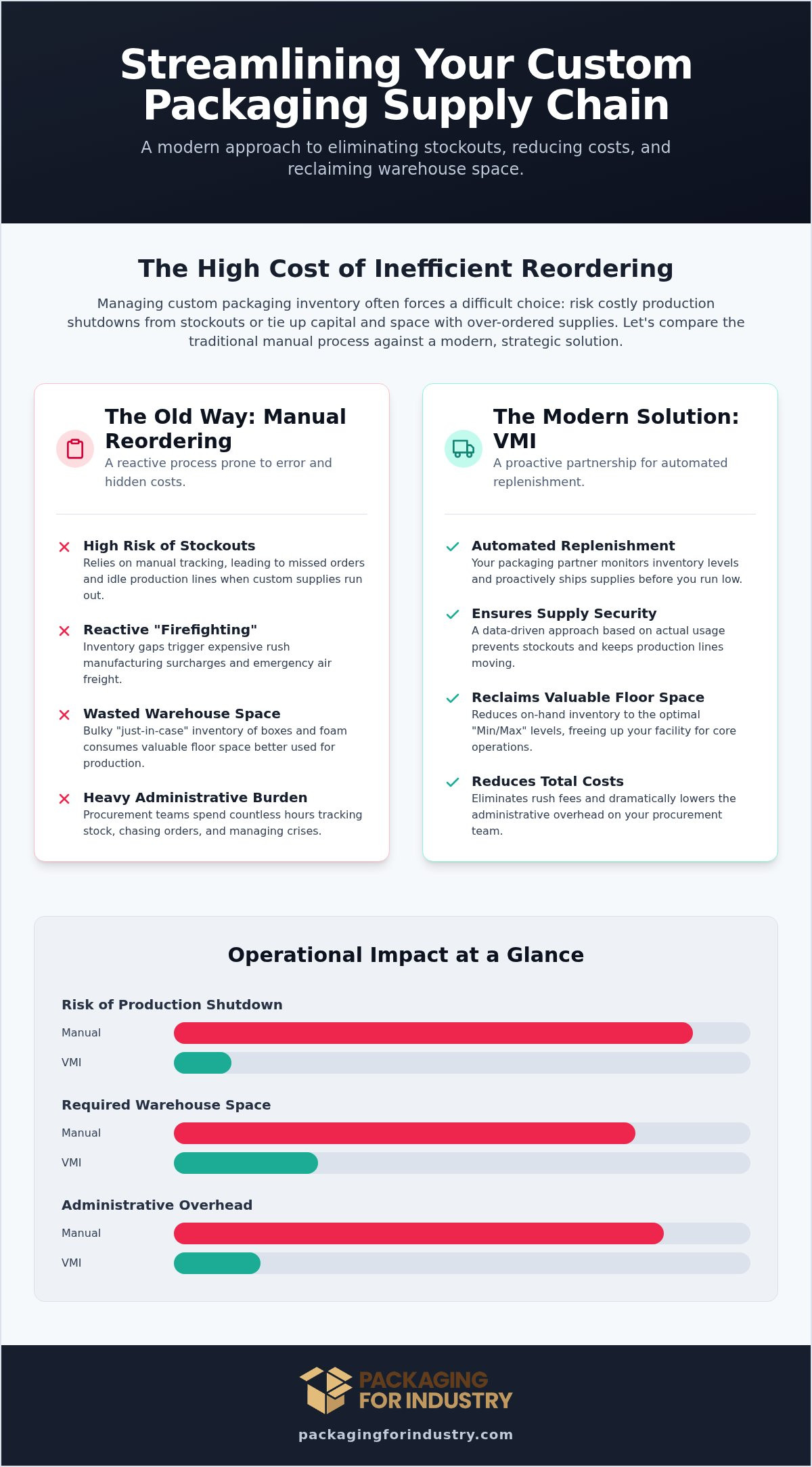
Deciding between manual and managed systems often comes down to how much risk your operation can tolerate. Manual reordering custom packaging supplies requires your team to catch every inventory dip before it becomes a crisis. It’s a high-stakes game of constant oversight. In contrast, Vendor Managed Inventory (VMI) shifts the responsibility of monitoring and replenishment to your supplier. This transition is essential for high-volume manufacturers in Southern California who cannot afford the “soft costs” of constant manual tracking and the inevitable human error that comes with it.
When you compare these models, look at the Total Cost of Ownership (TCO) rather than just the per-unit price of a corrugated box. Manual systems hide costs in administrative labor, accounting time, and emergency shipping fees when someone forgets to place an order. Managed programs eliminate these inefficiencies by making the supplier accountable for your stock levels. This is a critical component of a broader strategy to streamline operations. To understand the full scope of these efficiencies, it’s helpful to ask, What is Supply Chain Management? It’s the optimization of every touchpoint, from the manufacturer to the warehouse, to reduce waste and ensure reliability.
How VMI Solves the Shortage Problem
In a managed program, the supplier takes an active, hands-on role on your warehouse floor. This involves conducting regular on-site inventory counts to verify actual stock against your production schedule. Replenishment happens automatically based on pre-set safety stock levels, so you never have to manually place a purchase order for recurring items. This proactive oversight is particularly valuable for complex components like kitted packaging or custom inserts. You can find more technical details on how we implement these systems on our Vendor Managed Inventory page. This setup ensures that high-lead items are always staged and ready before your shipping deadline arrives.
Financial Advantages of Managed Stocking
Managed inventory significantly improves your company’s cash flow. Instead of making capital-heavy bulk purchases to secure a lower price, you pay for supplies only as they are pulled from the floor for use. This “pay-as-you-go” approach frees up working capital that would otherwise be tied up in stagnant pallets of stretch film or heavy-duty boxes. By eliminating the need for your purchasing department to constantly monitor reordering custom packaging supplies, you also reduce the labor costs associated with procurement, tracking, and accounts payable. It turns a variable, high-stress task into a fixed, predictable process that protects your bottom line.
5 Steps to Optimize Your Custom Packaging Supply Chain
Optimizing how you handle reordering custom packaging supplies requires a disciplined, step-by-step approach to procurement. Most operations lose money through fragmented ordering and poorly defined lead times. By following a structured optimization plan, you can shift from a reactive stance to a streamlined, cost-effective system that supports your production goals. Implementing these five steps ensures your supplies arrive exactly when needed without inflating your warehouse overhead.
- Step 1: Consolidate your custom packaging vendors. Working with a single reliable partner for all bespoke materials reduces administrative friction and simplifies your communication chain.
- Step 2: Establish clear lead-time expectations. You must define the production cycle for every custom SKU, from initial design to final delivery, to prevent last-minute shortages.
- Step 3: Implement a JIT (Just-In-Time) delivery schedule. Arrange for frequent, smaller deliveries that match your production velocity to reclaim valuable floor space.
- Step 4: Conduct a professional analysis. Use a packaging cost-savings analysis to identify material inefficiencies and hidden logistical expenses.
- Step 5: Schedule quarterly reviews. Regular audits allow you to adjust inventory levels and packaging specs based on product design changes or seasonal demand shifts.
Consolidating Custom Corrugated and Foam
Sourcing your corrugated boxes and foam packaging from the same supplier offers significant logistical advantages. When these materials are engineered and kitted together at a single facility, you reduce the risk of components not fitting correctly. This consolidation also lowers your total freight spend; shipping a complete packaging assembly is more efficient than managing separate arrivals from multiple vendors. It streamlines the entire process of reordering custom packaging supplies by giving your team one point of contact for complex assemblies.
Optimizing for Regional Logistics
For manufacturers in Southern California, regional proximity is a major competitive advantage. Sourcing from a local supplier in Orange County or the Inland Empire significantly reduces the risks associated with long-distance freight. Bulky items like heavy-duty crates and pallets are expensive to transport over long distances; local sourcing keeps these costs manageable. Furthermore, a regional partner can offer next-day delivery for urgent replenishment needs, providing a safety net that distant catalog suppliers cannot match. This proximity is vital for maintaining a reliable supply chain in high-precision industries like aerospace and electronics.
Why Southern California Manufacturers Partner with PFI for Recurring Supply
Choosing a partner for reordering custom packaging supplies shouldn’t involve a gamble on transit times or stock availability. PFI is strategically located in Anaheim. This position allows us to provide rapid response times across Los Angeles, Orange County, and the Inland Empire. Unlike national catalog suppliers who ship from distant central hubs, we operate in your backyard. This proximity eliminates the uncertainty of long-haul freight and ensures that your custom materials arrive exactly when your production schedule demands them.
Our expertise extends beyond standard containers. We specialize in custom-engineered solutions for high-stakes sectors like aerospace, automotive, and medical device manufacturing. These industries often require precision-cut foam inserts or heavy-duty triple-wall corrugated containers that meet rigorous protection standards. We combine this technical engineering with a robust logistical framework to prevent stockouts that could otherwise halt a high-value production line. The PFI difference lies in our ability to integrate custom design, local logistics, and managed inventory into a single, reliable system.
Local Service, Nationwide Capability
We offer local next-day delivery to industrial hubs in Irvine, Long Beach, and the Inland Empire. This speed serves as a critical safety net for operations that experience sudden demand spikes. While our local footprint is a primary strength, we also maintain a nationwide distribution network to support your facilities outside of Southern California. Our team consists of experienced specialists who understand the nuances of warehouse logistics and purchasing. You get personalized support from a partner who knows your specific SKU requirements and lead-time constraints.
Ready to Simplify Your Procurement?
Transitioning from a high-stress manual system to a managed PFI program is a straightforward process. We begin with a comprehensive audit of your current usage to identify where you can consolidate sizes or improve material efficiency. If you’re launching a new product, we offer prototyping sessions to ensure your custom design provides maximum protection at the lowest total cost. This methodical approach ensures that reordering custom packaging supplies becomes a background process rather than a daily administrative burden. We focus on the logistics so you can focus on your core manufacturing goals.
Transform Your Packaging Procurement Into a Competitive Advantage
Managing the procurement of industrial packaging shouldn’t be a source of operational stress. By shifting to a systematic approach for reordering custom packaging supplies, you eliminate the risk of production stops and the hidden costs of rush shipping. Whether you utilize VMI to automate your inventory or implement JIT schedules to reclaim warehouse floor space, the goal remains the same: total reliability at the lowest total cost of ownership.
PFI supports this transition with technical expertise in aerospace and medical-grade packaging combined with local next-day delivery across Southern California. We focus on the engineering and economics of your supply chain so you can focus on moving your production lines forward. Our proven cost-reduction strategies and hands-on inventory management provide the stability your operation requires.
We’re ready to help you build a more efficient, predictable, and cost-effective packaging system.
Frequently Asked Questions
How do I determine the right reorder point for my custom boxes?
You should calculate your average daily usage and multiply it by the supplier’s lead time, then add a safety stock buffer. If your production line uses 50 boxes per day and the lead time is 10 days, your base reorder point is 500 units. Adding a two-day safety buffer brings the trigger to 600 units. This formula ensures you don’t run out of materials during transit or unexpected production spikes.
What is the typical lead time for reordering custom foam inserts?
Lead times for custom foam typically range from two to three weeks depending on the material density and the complexity of the die-cut. Specialized materials like ESD-safe polyethylene or mil-spec polyurethane may require additional sourcing time. It’s best to establish firm lead-time expectations with your PFI specialist to ensure your replenishment schedule aligns with your master production schedule.
Can I change my custom packaging design during a reorder?
Yes, you can modify your design, though significant changes may require new tooling or a prototyping session. Minor adjustments to dimensions or printing are common as your product lines evolve. If you’re looking to lower packaging costs, a reorder is an excellent time to conduct a new analysis to see if material weights or box styles can be optimized for better efficiency.
How does Vendor Managed Inventory (VMI) work for packaging?
In a VMI program, PFI takes full responsibility for monitoring your stock levels and managing the replenishment cycle. Our specialists conduct regular on-site inventory counts at your facility and automatically trigger reordering custom packaging supplies when stock hits pre-set minimums. This approach eliminates manual tracking and prevents stockouts without requiring constant intervention from your purchasing department.
Is there a minimum order quantity for reordering custom corrugated?
Minimum order quantities (MOQs) vary based on the specific dimensions of the box and the type of corrugated board required. While custom manufacturing runs have higher MOQs than off-the-shelf items, we work with manufacturers to balance unit pricing with available warehouse space. Ordering in bulk quantities typically results in a lower total cost of ownership but requires more dedicated storage area.
How can I reduce the storage space needed for my packaging supplies?
Implementing a Just-In-Time (JIT) delivery schedule is the most effective way to reclaim valuable warehouse floor space. Instead of receiving one massive quarterly shipment, you receive smaller, more frequent deliveries that match your actual production velocity. This strategy reduces the footprint of bulky items like pallets and heavy-duty crates while ensuring you always have enough material on hand.
Do you offer next-day delivery for reorders in Orange County?
We provide local next-day delivery for established accounts across Orange County, Los Angeles, and the Inland Empire. Our strategic location in Anaheim allows us to respond rapidly to urgent replenishment needs. This local proximity is a key advantage for Southern California manufacturers who need a reliable partner for reordering custom packaging supplies without the delays of long-distance freight.
Can PFI manage reorders for both custom and stock items simultaneously?
PFI provides comprehensive management for both bespoke engineered solutions and standard stock items. Consolidating custom corrugated and foam with stock supplies like stretch film, corner protection, and mailing tubes simplifies your entire procurement process. This single-source approach reduces administrative labor and ensures that all necessary components for your packaging kitting arrive in a coordinated, timely fashion.