
Is your warehouse floor space being consumed by frequent, small-batch shipments that fail to keep pace with your production schedule? Many procurement managers in Los Angeles face the same cycle of rising consumable costs and the stress of potential stockouts. Relying on fragmented, case-quantity orders often results in inconsistent film quality, which leads to avoidable shipping damage and higher per-unit expenses. It’s a reactive approach that drains both time and budget while leaving your operations vulnerable to supply chain fluctuations.
Achieving stretch film cost savings purchasing by the pallet is about more than just securing a lower price point; it’s a strategic move to stabilize your entire logistical operation. In this guide, you’ll learn how transitioning to pallet-quantity procurement reduces your cost-per-load, optimizes your storage footprint, and ensures you have the right materials on hand for every shipment. We’ll also examine how Southern California manufacturers are leveraging tailored supply programs to maintain a reliable inventory without tying up excessive capital. Moving to bulk procurement allows you to shift from managing emergency orders to maintaining a steady, predictable supply chain that protects your bottom line.
Key Takeaways
- Identify the hidden “convenience tax” associated with case-quantity orders and how switching to bulk procurement eliminates repetitive administrative expenses.
- Calculate the total ROI of stretch film cost savings purchasing by the pallet by accounting for wholesale price breaks and reduced landed freight costs.
- Select the appropriate film technology, such as cast or blown material, to ensure load stability and prevent costly shipping damage.
- Leverage Vendor Managed Inventory (VMI) to maintain a reliable supply of high-performance film without cluttering your warehouse floor.
- Partner with a local Southern California supplier to access just-in-time delivery and expert technical support for your specific industrial applications.
Stop Overpaying: The Hidden Costs of Case-Quantity Stretch Film
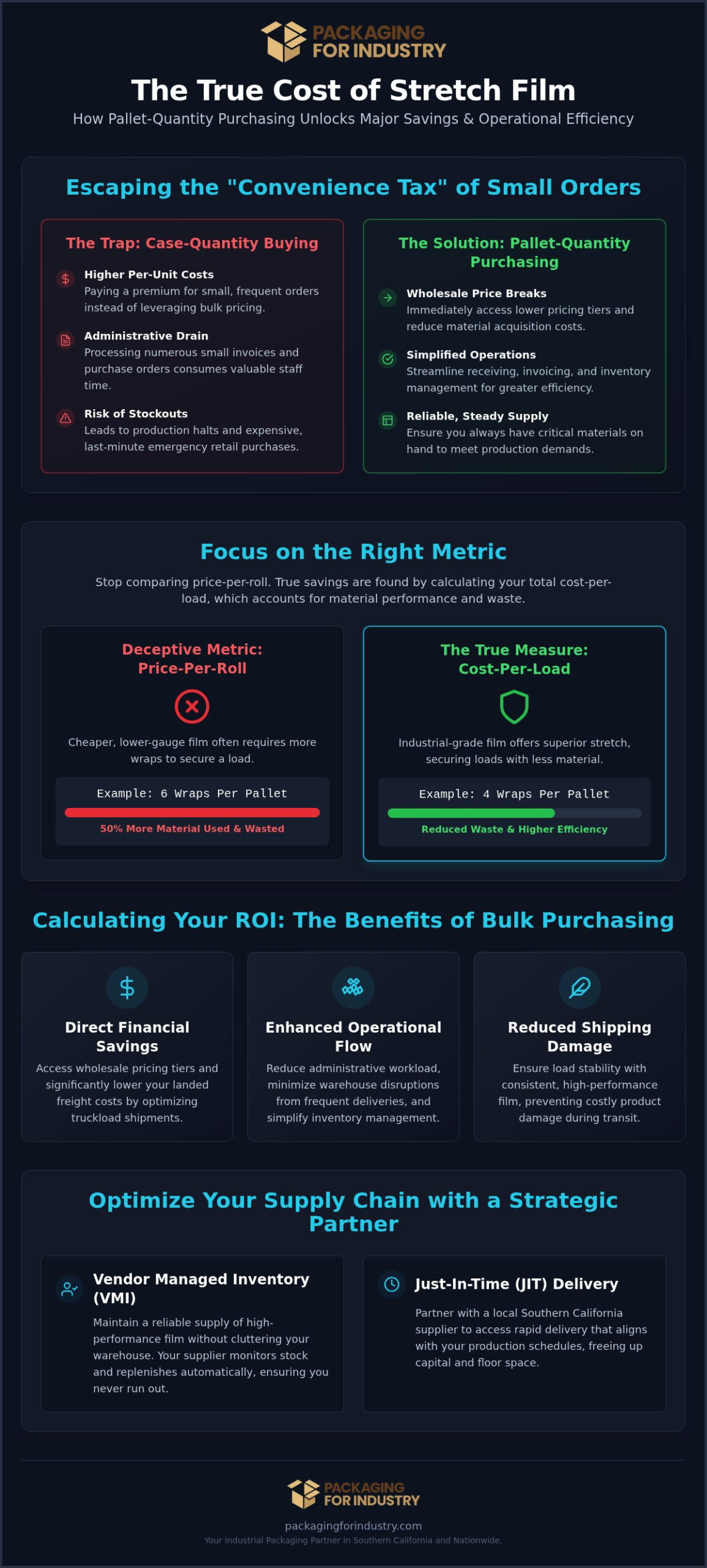
Buying industrial stretch film by the case often feels like a logistical shortcut, but it actually imposes a significant “convenience tax” on your operations. While small orders might seem manageable for a startup, high-volume warehouses in Los Angeles quickly find that these fragmented purchases drain their budgets through higher unit pricing and hidden labor costs. Real stretch film cost savings purchasing by the pallet come from eliminating these inefficiencies and moving toward a professional procurement model. Relying on generic catalog suppliers often means you’re paying a premium for convenience rather than investing in material performance.
The Administrative Drain of Frequent Small Orders
Every purchase order has a cost. Processing 52 weekly invoices for small case quantities requires significantly more administrative labor than managing 12 monthly pallet orders. This overhead often goes uncalculated, yet it directly impacts your bottom line. Beyond the front office, small shipments disrupt warehouse flow. Receiving crews must stop their primary tasks to unload, verify, and store minor deliveries multiple times a week. This constant interruption wastes valuable man-hours that could be spent on fulfillment. Relying on case-level inventory also increases the risk of stockouts. When a shipment of corrugated boxes needs to go out and the film runs dry, procurement teams often resort to expensive “emergency” retail buys just to keep the line moving. It’s a reactive cycle that creates unnecessary stress and drives up your landed costs.
Why Price-Per-Roll is a Deceptive Metric
Procurement managers frequently make the mistake of comparing suppliers based on price-per-roll. This is a deceptive metric because it ignores film yield and material performance. A cheaper, lower-gauge roll from a generic catalog supplier often requires more wraps to achieve the same load stability as an industrial-grade film. If your team has to wrap a pallet six times instead of four, you’re using 50% more material, effectively negating any initial roll-price discount. You aren’t just buying plastic; you’re buying load security. Inconsistent film quality leads to film breaks and re-wraps, which further inflate your waste and labor expenses. High-performance films, particularly those engineered for specific industrial applications, offer superior stretch ratios that allow you to wrap more pallets with less material.
Cost-per-load is the total material cost divided by successful shipments. By focusing on this metric, you can achieve genuine packaging cost savings while reducing the volume of plastic waste generated by your facility. Shifting your focus from the price of a single roll to the efficiency of the entire pallet allows you to stabilize your budget and protect your products more effectively during transit.
Calculating the ROI: Stretch Film Cost Savings Purchasing by the Pallet
Calculating the return on investment for your packaging consumables requires looking at the “landed cost” rather than the sticker price. When you transition to stretch film cost savings purchasing by the pallet, you immediately access wholesale pricing tiers that are unavailable to case-quantity buyers. These direct price breaks are only the beginning of the financial benefits. By aligning your procurement with actual production cycles, you reduce the administrative friction of constant reordering and stabilize your cash flow. It’s a pragmatic shift that moves your warehouse from a reactive “restock” mode to a proactive supply chain strategy.
Freight and Logistics: The Invisible Savings
Shipping costs often represent a hidden drain on your packaging budget. Carriers optimize their routes for standard pallet dimensions; therefore, shipping loose cases via small-parcel or inefficient Less-Than-Truckload (LTL) configurations results in a higher freight cost per unit. When you order full pallets, you maximize the cube space of the delivery truck. This efficiency is particularly advantageous for businesses in Anaheim, Irvine, and Los Angeles. Local delivery from a Southern California supplier reduces lead times and eliminates the long-distance freight surcharges often tacked on by national catalog companies. Consolidating your orders into fewer, larger deliveries also reduces the carbon footprint of your inbound logistics. This supports corporate sustainability goals without sacrificing operational speed.
Damage Reduction and Insurance Savings
The true cost of a failed pallet shipment far exceeds the price of the stretch film used to wrap it. A single load that shifts or collapses in transit can lead to thousands of dollars in product damage, insurance claims, and lost customer trust. High-performance, industrial-grade film purchased by the pallet provides the consistent tension and puncture resistance needed for heavy or irregular loads. This consistency allows your warehouse team to standardize load stability across all shifts. When you use uniform film specifications, you reduce “film break” downtime on the production line, ensuring that your machinery runs at peak efficiency. You can compare packaging pricing to see how these operational improvements contribute to a lower total cost of ownership.
Standardizing your film specs also simplifies training. Your operators don’t have to adjust their technique for varying film qualities found in different retail brands. This stability reduces the likelihood of human error, which is a leading cause of shipping damage in high-volume environments. By moving to a bulk procurement model, you ensure that every pallet leaving your dock is secured with the same high-performance material, protecting both your products and your reputation.
Beyond the Price Tag: Matching Film Specs to Your Industrial Loads
True stretch film cost savings purchasing by the pallet are realized only when the material specifications align with your specific load profile. Procurement managers often treat film as a generic commodity; however, using the wrong gauge or resin type for heavy industrial loads leads to material waste and shipment failure. Selecting the correct film technology ensures you aren’t paying for excess plastic while maintaining the necessary containment force for safe transit. It’s about engineering a solution that balances material physics with economic reality.
Cast vs. Blown: Choosing the Right Durability
Cast film is the industry standard for high-volume warehouses that prioritize clarity and quiet operation. It’s manufactured using a continuous extrusion process that results in excellent tear resistance and consistent thickness. For manufacturers handling heavy, irregular, or sharp-edged products, blown film is often the superior choice. Blown material offers exceptional puncture resistance and a higher degree of “cling,” making it ideal for securing loads that might shift during long-distance transit. When searching for an industrial packaging supplier near me, look for a partner who understands these technical nuances.
- Cast Film: Best for uniform loads, quiet warehouse environments, and barcode scanning through the wrap.
- Blown Film: Essential for heavy machinery, construction materials, or metal components with sharp corners.
- Pre-Stretch Film: Optimal for manual wrapping operations to reduce operator fatigue and material usage per pallet.
Specialized Requirements for Aerospace and Electronics
Specialized sectors like aerospace and electronics require more than just standard containment. For high-value components, anti-static stretch film is a necessity to prevent electrostatic discharge from damaging sensitive semiconductors. If you’re shipping proprietary aerospace parts, opaque films provide an extra layer of security by concealing the contents and deterring pilferage on the loading dock. These specialized materials are rarely found in generic retail catalogs, making a partnership with a dedicated stretch wrap supplier essential.
Compliance is non-negotiable for defense and medical contractors. Using films that meet military packaging standards ensures your shipments pass inspection and arrive intact at their destination. By purchasing these specialized materials by the pallet, you maintain a reliable inventory of the exact specs required for your most sensitive contracts without the risk of stockouts. If you need a custom packaging quote for high-performance or specialized films, our team can engineer a solution that protects your high-value assets while lowering your total packaging costs.
Operational Efficiency: Leveraging VMI and Southern California Logistics
Many manufacturers in Orange County and Los Angeles hesitate to transition to bulk procurement because of limited warehouse floor space. While stretch film cost savings purchasing by the pallet are significant, the physical footprint of multiple pallets can disrupt operational flow. This is where a localized supply strategy becomes a competitive advantage. By leveraging Vendor Managed Inventory (VMI), you can capture the economic benefits of high-volume purchasing without cluttering your facility with excess stock. It’s a pragmatic solution that balances fiscal responsibility with warehouse reality.
The VMI Advantage for Southern California Manufacturers
PFI functions as a proactive partner by monitoring your actual film consumption. We ensure you never face the hidden costs of production line stoppages caused by stockouts. A single hour of downtime on a high-speed production line can cost thousands in lost output, far outweighing the cost of the film itself. Our VMI programs act as an insurance policy against these disruptions. This level of oversight simplifies procurement for purchasing managers, who can consolidate invoices and move away from the administrative burden of frequent small orders. An Anaheim-based supplier understands regional logistics and traffic patterns better than a national catalog giant. This local expertise translates to more reliable lead times and a supply chain that responds to your specific manufacturing pace.
Strategic Stocking: Bulk Pricing Without the Clutter
Strategic stocking programs allow you to commit to pallet-quantity pricing while we store the material at our facility. We provide scheduled, Just-In-Time (JIT) delivery to manufacturers across the Inland Empire and San Diego. This approach improves your cash flow because you aren’t tying up capital in stagnant inventory. It also frees up your warehouse floor for revenue-generating activities like production or finished-goods storage. Utilizing local next-day delivery in SoCal significantly reduces the need for large safety stocks. You gain the agility of a small-batch operation with the fiscal power of a bulk buyer.
Integrating stretch film into a broader packaging cost savings strategy ensures every square foot of your facility is optimized for efficiency. We help you transition from managing individual rolls to managing a complete, cost-effective system of protection. By aligning your procurement with actual usage patterns, you eliminate waste and ensure that your shipping operations remain steady and predictable.
Partner with PFI: Industrial Stretch Film Solutions in Anaheim and Beyond
Choosing a bulk packaging supplier involves more than comparing price lists. While generic catalog giants offer convenience, they lack the technical expertise required to solve complex logistical challenges. These vendors focus on high-volume roll sales without considering how the material interacts with your specific equipment or load profiles. Packaging For Industry (PFI) operates differently. We function as a seasoned industrial consultant, prioritizing the intersection of engineering and economics to ensure your warehouse achieves maximum efficiency. By partnering with an industrial packaging supplier near me that prioritizes custom solutions, you unlock stretch film cost savings purchasing by the pallet that standard retail-oriented vendors simply cannot match.
The PFI Difference: Engineering Meets Economics
Our process begins with a comprehensive packaging review. We identify material waste, excessive labor cycles, and potential failure points in your current wrapping process. For many manufacturers in Los Angeles and Anaheim, the most effective way to reduce costs is to move away from one-size-fits-all materials. We often combine high-performance stretch film with custom corrugated boxes to create an integrated protection system. This holistic approach is essential for high-stakes industries like medical device manufacturing, aerospace, and defense, where a single shipment failure results in significant financial and reputation setbacks.
- Prototyping to Production: We don’t just ship rolls; we help you test and implement film specs that match your specific machinery and load weights.
- Damage Reduction: Our team engineers film tension and containment force levels to eliminate product shifting during long-distance transit.
- Accountability: From the initial design phase to final delivery, we maintain total oversight of your packaging supply chain.
Get Your Custom Stretch Film Quote
Transitioning your warehouse to a pallet-quantity procurement model is a straightforward process when you have the right data. We help you evaluate your current “cost-per-load” and demonstrate how switching to industrial-grade bulk supplies reduces your total spend. Whether you’re optimizing a manual hand-wrapping station or a high-speed automated line, our team provides the technical guidance needed to select the right gauge and resin type. We focus on providing a custom packaging quote that reflects your actual usage patterns rather than arbitrary retail quantities.
If you’re ready to stabilize your supply chain and eliminate the stress of frequent stockouts, our Southern California team is prepared to assist. We offer local expertise and reliable delivery across the Inland Empire, Orange County, and beyond. Taking control of your consumable spend starts with a professional assessment of your current operations.
Optimize Your Secondary Packaging Strategy
Transitioning from reactive case-quantity orders to a structured bulk procurement model is a direct path to operational stability. You can achieve significant stretch film cost savings purchasing by the pallet while simultaneously reducing the administrative burden on your procurement team. By matching high-performance film specs to your specific load profiles, you eliminate the hidden costs of shipping damage and production downtime. It’s a pragmatic shift that prioritizes long-term reliability over short-term convenience.
Leveraging local next-day delivery and VMI stocking programs in Southern California allows your facility to maintain bulk inventory without sacrificing valuable floor space. Our expertise in aerospace and industrial packaging ensures that every roll is engineered for maximum containment and fiscal efficiency. You don’t have to choose between cost and quality when you have a partner focused on your bottom line.
Our team is ready to help you lower packaging costs and improve your supply chain reliability today.
Frequently Asked Questions
How much can I save by purchasing stretch film by the pallet?
Purchasing by the pallet reduces your cost-per-roll by moving your procurement into wholesale pricing tiers. You’ll also see lower landed costs because full pallets optimize freight charges compared to shipping individual cases. This shift effectively eliminates the “convenience tax” associated with small orders and provides predictable stretch film cost savings purchasing by the pallet. It’s a strategic move for any warehouse looking to stabilize its consumable budget.
What is the difference between cast and blown stretch film for bulk orders?
Cast film is produced through a quiet extrusion process and offers high clarity for barcode scanning. Blown film is tougher and provides superior puncture resistance for irregular or sharp-edged industrial loads. When placing bulk orders, choose the material that matches your primary load profile to minimize material waste and shipping damage. Selecting the wrong material can lead to film breaks and costly re-wraps on your production line.
Does PFI offer local delivery for stretch film in Southern California?
Yes, PFI provides local next-day delivery for stretch film throughout Southern California, including Los Angeles, Anaheim, and the Inland Empire. Our proximity to these regions allows us to support just-in-time manufacturing schedules. This local service reduces the need for you to maintain massive safety stocks on your own warehouse floor. We focus on being a reliable industrial packaging supplier near me for regional manufacturers and distributors.
Can I mix different types of film on a single pallet order?
We frequently work with clients to customize their pallet configurations based on their specific operational needs. While ordering full pallets of a single SKU maximizes your wholesale discount, we can discuss mixed-quantity solutions during your consultation. This flexibility ensures you have the right mix of hand, machine, or specialized film without over-ordering a single type. It’s a pragmatic way to manage inventory for diverse shipping requirements.
How does Vendor Managed Inventory (VMI) work for stretch film?
VMI allows PFI to monitor your actual film usage and manage replenishment schedules on your behalf. We maintain your inventory in our local facility and deliver it just-in-time to your dock. This system ensures you capture stretch film cost savings purchasing by the pallet without the burden of storing multiple pallets on-site. It’s an ideal solution for manufacturers with limited floor space who need a reliable supply chain.
Is machine stretch film more cost-effective than hand film for my warehouse?
Machine stretch film is significantly more efficient for high-volume warehouses because it utilizes high pre-stretch ratios that hand-wrapping can’t achieve. This technology allows you to use less material to secure each load. If your facility wraps a high volume of pallets daily, the material savings from machine film quickly offset the initial equipment investment. We can help you compare packaging pricing to determine your specific return on investment.
What is the typical lead time for pallet-quantity stretch film in Anaheim?
Lead times for stock pallet orders in Anaheim and Irvine are typically within one to two business days. Our local distribution network is designed to support the fast-paced manufacturing environment of Southern California. By avoiding the long transit times of out-of-state suppliers, you can keep your inventory levels low and respond more quickly to changes in your production schedule. We prioritize reliability to prevent costly production stoppages.
How do I know if I am using the right gauge of film for my loads?
Determining the right gauge requires an evaluation of your load weight and the transit conditions your pallets will face. A load with sharp corners or uneven surfaces requires a higher-performance film with better puncture resistance. We provide technical consultations to test different gauges on your specific loads. This ensures you aren’t overspending on thick film when a thinner, high-performance option might provide better containment and lower material costs.