
Your shipping carrier doesn’t care how much your product weighs; they care how much space it occupies on their truck. If you’re still shipping small components in oversized standard boxes, you’re likely paying a premium for empty air. Most procurement managers and warehouse operators struggle with unpredictable freight surcharges and the mounting waste of excessive void fill. It’s a common frustration that directly erodes your bottom line.
Implementing strategic dimensional weight packaging solutions is the most effective way to regain control over your logistics budget. This article shows you exactly how to calculate DIM weight for 2026 and how to transition from generic catalog boxes to engineered packaging that fits your product perfectly. We’ll explore how custom corrugated designs and precision foam inserts reduce shipping damage while significantly lowering your total landed costs. From our Southern California distribution hubs to your facility, we’ll outline a repeatable process for auditing your shipments and eliminating carrier surcharges for good.
Key Takeaways
- Understand how 2026 carrier updates to DIM factors increase costs for bulky shipments and why standard stock boxes often trigger unnecessary surcharges.
- Implement engineered dimensional weight packaging solutions to reduce the total volume of your shipments and lower your per-unit landed costs.
- Transition from messy void fill to custom foam packaging to improve product protection while minimizing the exterior dimensions of your shipping containers.
- Follow a structured 5-step audit to calculate your “Void Ratio” and identify which high-volume SKUs offer the greatest potential for freight savings.
- Discover how Vendor Managed Inventory (VMI) and local Southern California delivery can resolve the warehouse space challenges associated with storing custom-sized boxes.
What is Dimensional Weight and Why is it the ‘Hidden Tax’ of 2026 Shipping?
Carriers have shifted the burden of logistics efficiency onto the shipper. Dimensional weight, often called volumetric weight, is a pricing technique used by freight companies to ensure they’re paid for the volume a package occupies on a truck or plane. It’s no longer enough to know your product’s actual weight. You must understand how its physical dimensions translate into a billable figure. This shift means that a box of lightweight filters can cost more to ship than a small, heavy crate of steel fasteners if the filters occupy more cubic space.
The 2026 landscape has become even more restrictive for industrial shippers. Carriers have systematically adjusted their pricing models to maximize revenue on bulky shipments. This change acts as a hidden tax on manufacturing operations that rely on standard, off-the-shelf corrugated boxes. If your facility hasn’t pivoted to engineered dimensional weight packaging solutions, you’re likely paying for empty space that provides zero value to your customers. For companies with tight margins, these surcharges can quickly turn a profitable contract into a loss-leader.
Modern logistics dictates that actual weight no longer determines your freight invoice. Instead, carriers focus on density. If your package is large but light, it takes up valuable real estate that could be used for other cargo. By billing based on volume, carriers force you to pay for the “air” inside your boxes. This makes packaging cost savings an engineering challenge rather than just a purchasing decision.
The Standard DIM Weight Formula
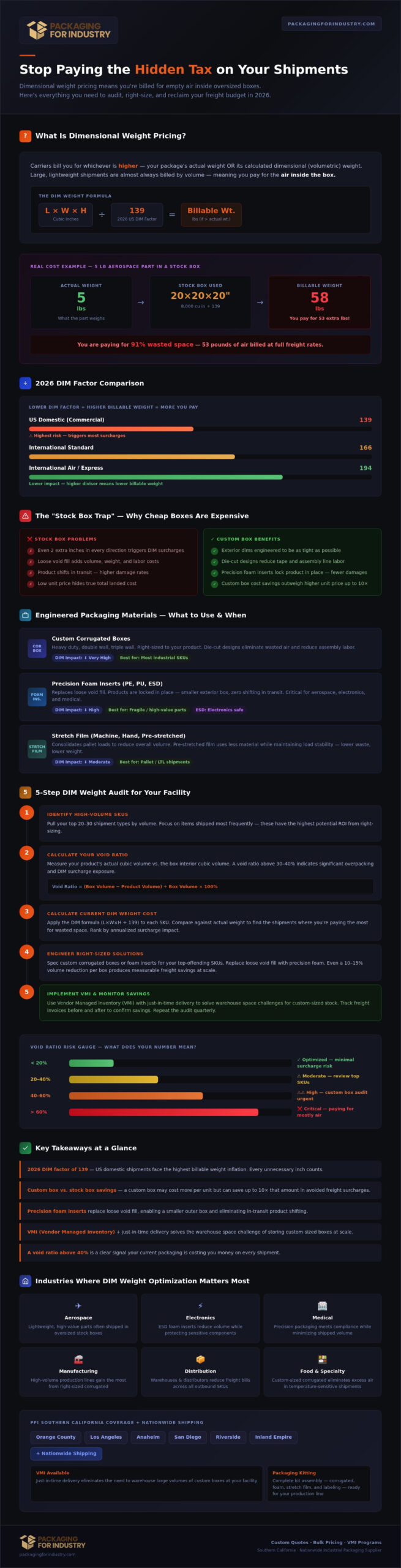
To calculate DIM weight, multiply the length, width, and height of your package to find the total cubic inches, then divide by the carrier’s specific DIM factor. For 2026, the standard DIM factor for most major US domestic carriers is 139 for commercial accounts. This divisor is lower than international factors, which often hover around 166 or 194, meaning domestic shipments are more likely to trigger higher volumetric charges. A smaller divisor always results in a higher billable weight, making it vital to minimize every inch of exterior box dimensions.
Billable Weight: Actual vs. Dimensional
Carriers determine your freight invoice by comparing the actual scale weight against the calculated dimensional weight; they bill you for whichever figure is higher. Consider a lightweight aerospace component. If you ship a five-pound part in a standard 20x20x20 stock box, the billable weight at a 139 factor is roughly 58 pounds. You’re paying for 53 pounds of wasted space because the box is oversized. While LTL freight still relies heavily on freight class, many carriers are moving toward density-based pricing models that mirror DIM weight logic. Transitioning to custom dimensional weight packaging solutions ensures your billable weight stays as close to your actual weight as possible.
Engineered Dimensional Weight Packaging Solutions: Material Matters
Standard stock boxes are the primary driver of inflated shipping costs. While a catalog supplier might offer a box for a low unit price, the “Stock Box Trap” occurs when that box is even two inches larger than necessary in every direction. In the world of industrial logistics, those extra inches trigger the DIM weight surcharges that erode your margins. High-volume production lines require dimensional weight packaging solutions that prioritize precision over convenience. Carriers bill for the air you ship; engineered materials help you stop shipping it.
Custom Corrugated vs. Stock Boxes
Using custom-sized corrugated boxes allows you to eliminate the wasted volume that carriers bill so aggressively. For industrial manufacturers, die-cut designs offer a double benefit. They reduce the amount of tape and labor required on the assembly line and ensure the exterior dimensions are as tight as possible. If you’re shipping hundreds of units daily, the cumulative savings from right-sizing your corrugated footprint can be substantial. A custom box might cost slightly more per unit than a stock box, but it can save ten times that amount in avoided freight surcharges.
Protective Foam Inserts: Maximizing Density
The shift from loose void-fill to precision-engineered custom foam packaging is a critical move for cost optimization. Bubble wrap and packing peanuts are inefficient because they require larger outer boxes to provide adequate cushioning. Polyethylene (PE) foam is often the preferred choice for industrial components because its high density provides superior protection with less material thickness. This allows for a smaller overall box footprint. For sensitive electronics, anti-static (ESD) foam inserts provide protection while maintaining a slim profile. Using foam end caps is another effective strategy; they suspend the product in the center of the box, often eliminating the need for a “box-within-a-box” configuration that balloons your billable weight.
Right-sizing doesn’t mean compromising on durability. Utilizing double-wall or triple-wall corrugated materials allows you to use a smaller box that still withstands the rigors of LTL freight. Additionally, integrating corner and edge protection reinforces the package at its most vulnerable points. This structural support lets you reduce the overall box size while ensuring the product arrives undamaged. It’s about engineering the smallest possible footprint that guarantees a safe delivery. If you’re ready to see how custom specs can impact your bottom line, you can request a custom packaging quote to compare your current costs against an optimized design.
How to Reduce Packaging Material Usage and DIM Weight: A 5-Step Audit
Operational efficiency starts with an objective look at your current fulfillment process. Many warehouse managers rely on “good enough” packaging, but rising carrier rates in 2026 make that a costly assumption. You can’t fix what you haven’t measured. By following a structured audit, you can identify precisely where your freight budget is leaking and implement dimensional weight packaging solutions that produce immediate results.
Start with a ‘Cube-Out’ audit of your top 10 most shipped SKUs. Measure the actual dimensions of your product against the exterior dimensions of the box you currently use. This leads to Step 2: calculating your ‘Void Ratio.’ If your box volume is significantly higher than your product volume, you’re paying to ship air. Step 3 involves replacing those oversized stock boxes with custom-engineered alternatives designed for a snug fit. For Step 4, evaluate your palletized loads. Switching to high-performance stretch film allows for tighter load containment, preventing the “bulge” that often triggers width surcharges on LTL trailers. Finally, Step 5 is prototyping; PFI offers free prototyping to ensure a perfect fit and survive the supply chain before you commit to a bulk order.
Analyzing Your Current Shipping Data
Your freight invoices hold the key to finding ‘DIM Weight Offenders.’ Look for shipments where the billable weight is consistently higher than the actual weight. This discrepancy is a clear signal that your current packaging is too large for the contents. We use CAD/CAM support to provide precision custom design packaging that accounts for every millimeter of space. Reducing box dimensions by just one inch can save up to 15% in shipping costs by moving the package into a lower billable weight bracket. These small adjustments at the design phase compound into massive annual savings for high-volume manufacturers.
Consolidating Shipments with Kitting
Efficiency isn’t just about the size of the box; it’s about the number of boxes. Implementing packaging kitting allows you to consolidate multiple components into a single, optimized container. Shipping one multi-component kit is nearly always more cost-effective than shipping three separate parts, as it reduces the total dimensional footprint and simplifies the carrier’s job. This approach is especially effective for industrial goods that require assembly at the destination. By kitting your products, you maximize the density of your palletized loads and ensure your stretch wrap and corner protection are used as efficiently as possible. This streamlined process reduces handling time in the warehouse and lowers the risk of individual boxes getting lost or damaged in transit.
Overcoming the Challenges of Custom Packaging Implementation
Transitioning from standard stock boxes to engineered dimensional weight packaging solutions often meets internal resistance. Procurement teams frequently worry about longer lead times, while warehouse managers fear that custom sizes will complicate floor space management. These concerns are valid, but they shouldn’t prevent your operation from capturing significant freight savings. Implementing custom packaging is a logistical shift that requires the right partner to ensure the transition is seamless and fiscally responsible.
The “Lead-Time Objection” is usually the first hurdle. Many operations rely on catalog suppliers because they offer next-day delivery on generic sizes. However, this convenience comes with a high price tag in the form of carrier surcharges. By working with a local Southern California partner, you can dramatically reduce transit times and shipping costs for your packaging materials. A supplier with regional hubs in Orange County or the Inland Empire can provide the responsiveness of a national catalog while delivering the precision of custom engineering. This proximity allows for a more agile supply chain that responds to production spikes without the need for massive safety stocks.
Vendor Managed Inventory (VMI) for Custom Boxes
The most effective way to manage warehouse space and eliminate stockouts is through Vendor Managed Inventory. Instead of cluttering your floor with months of custom-sized corrugated boxes, we handle the storage and replenishment for you. This just-in-time delivery model is particularly beneficial for manufacturers in Anaheim and Los Angeles where industrial real estate is at a premium. We monitor your usage levels and deliver exactly what you need, when you need it. This system ensures that long lead-time items, such as custom foam inserts and specialized crates, are always available without tying up your working capital in excess inventory.
Prototyping and Performance Testing
Precision is mandatory for high-value sectors like aerospace and medical electronics. A common fear is that reducing box dimensions to lower DIM weight might lead to increased shipping damage. We address this through a rigorous prototyping process. Before any design goes into bulk production, we create prototypes to verify the fit and protective capabilities of the materials. Our approach focuses on using high-density materials that offer superior protection in a smaller footprint. This performance testing ensures that your pursuit of lower shipping costs doesn’t compromise the safety of your product. A thorough packaging review identifies the exact point where material strength and volumetric efficiency intersect.
The cost-benefit analysis for custom packaging is straightforward. While a custom box might have a higher unit price than a mass-produced stock box, the engineering pays for itself through the elimination of “air” in your shipments. When you calculate the total landed cost, the reduction in freight surcharges almost always outweighs the incremental material cost. It’s a strategic investment in your bottom line that yields repeatable, monthly savings across your entire distribution network.
Why Choose Packaging For Industry (PFI) for DIM Weight Optimization?
PFI isn’t a catalog company that simply ships boxes; we’re an industrial partner focused on solving the economic challenges of logistics. While generic suppliers sell you whatever fits their inventory, we provide dimensional weight packaging solutions engineered for your specific products. Our expertise in complex manufacturing and industrial logistics allows us to look beyond the unit price of a box to find the true source of your freight surcharges. We provide comprehensive access to every material needed for a secure shipment. This includes heavy-duty corrugated, custom foam inserts, crates, and high-performance stretch film. We act as a single-source provider, ensuring all components of your packaging suite work together to minimize volume and maximize protection.
Located in the heart of Southern California, we prioritize local manufacturers with next-day delivery capabilities across Orange County, Los Angeles, and the Inland Empire. Our proximity allows us to integrate directly into your supply chain, providing a level of responsiveness that national catalog companies cannot match. We have a proven track record of delivering packaging cost savings for B2B clients by auditing their shipping lanes and right-sizing their entire packaging suite. Our team understands that every inch of wasted space is a direct hit to your profitability.
A Partner, Not Just a Catalog
Large catalog suppliers are built for convenience, not optimization. PFI serves as the professional alternative for companies that need more than a one-size-fits-all approach. You get direct access to packaging engineers who understand the nuances of your shipping challenges, whether you’re dealing with shifting products or excessive void fill. Our team designs custom solutions tailored to the stringent requirements of the automotive and defense sectors. We ensure that every container meets performance standards while minimizing volumetric weight. We carry the personality of a fixer; we’re resourceful and deeply focused on tangible, real-world outcomes for your warehouse operations.
Request Your Custom Packaging Quote
Starting your journey toward lower shipping costs begins with a comprehensive packaging audit. We analyze your current material usage and freight data to identify the “DIM weight offenders” that drive up your landed costs. Moving from stock boxes to an engineered solution is a methodical process involving prototyping, testing, and implementation. Our goal is to ensure your products are protected with the least amount of material possible, effectively lowering your billable weight and improving your supply chain reliability. Don’t let carrier surcharges dictate your margins for another quarter.
Secure Your Logistics Budget for 2026
Carrier pricing models in 2026 reward density and penalize wasted space. By auditing your high-volume SKUs and calculating your void ratio, you can identify precisely where shipping air is eroding your profits. Transitioning to engineered dimensional weight packaging solutions allows you to shrink your billable footprint without compromising the structural integrity of your shipments. It’s a pragmatic shift from buying generic boxes to investing in logistical efficiency.
Packaging For Industry (PFI) provides the technical expertise and material access required to navigate these complex logistics challenges. Our specialists in aerospace and industrial packaging use CAD design support and free prototyping to ensure every container is optimized for both safety and cost. With local next-day delivery across Southern California, we help you maintain lean inventory levels while eliminating unpredictable freight surcharges at the source.
Optimizing your packaging is a strategic move that pays dividends on every shipment you send. We’re ready to help you engineer a more efficient and reliable supply chain today.
Frequently Asked Questions
What is the standard DIM factor for 2026 shipping?
The standard DIM factor for most major US commercial carriers in 2026 is 139. This divisor converts the cubic volume of your package into a billable weight. International carriers often utilize a higher factor, such as 166 or 194, depending on the service level. You should verify your specific account terms, as carriers frequently adjust these factors to manage truck capacity and increase revenue on bulky shipments.
How much can I actually save by switching to custom-sized boxes?
Transitioning to custom-sized corrugated boxes leads to substantial freight savings by eliminating the “air” in your shipments. While exact amounts depend on your current void ratio, reducing box dimensions by even one inch can move a package into a lower billable weight bracket. This change often results in a double-digit percentage reduction in shipping costs per unit. These savings quickly offset the incremental cost of custom engineering for high-volume manufacturers.
Does dimensional weight apply to LTL freight or just small parcels?
Dimensional weight applies to both small parcel and LTL (Less-Than-Truckload) freight. While parcel carriers like UPS and FedEx are well-known for DIM surcharges, many LTL carriers have moved toward density-based pricing models. This means your freight class and final invoice are heavily influenced by the cubic space your pallet occupies. Implementing dimensional weight packaging solutions is just as critical for palletized industrial goods as it is for individual boxes.
How do I calculate the dimensional weight of a palletized load?
To calculate the dimensional weight of a palletized load, multiply the maximum length, width, and height to find the total cubic inches. You must include the pallet itself in these measurements. Divide this total by the carrier’s DIM factor, which is typically 139 for domestic freight. Carriers always use the outermost points of the load, so it’s essential to ensure your stretch film is tight and no product or packaging material overhangs the pallet edges.
Can custom foam inserts really help reduce my shipping costs?
Custom foam inserts are highly effective at reducing shipping costs because they provide superior protection with less bulk. High-density materials like polyethylene (PE) allow for a slimmer cushioning profile than generic bubble wrap or loose fill. This enables you to use a smaller exterior box, which directly lowers your dimensional weight. Precision-cut foam also prevents product shifting, which reduces damage claims and the associated costs of reshipping replacement items.
What is the best way to avoid FedEx and UPS dimensional weight surcharges?
The most effective way to avoid FedEx and UPS surcharges is to right-size your packaging through a professional audit. By moving from stock boxes to custom corrugated designs, you eliminate the empty space that triggers volumetric billing. Using high-performance stretch film and corner protection ensures your packages maintain their shape during transit. Consistent auditing of your freight invoices will help you identify which SKUs are triggering the highest surcharges for immediate optimization.
Does PFI provide local delivery for custom packaging in Southern California?
PFI provides local next-day delivery for custom packaging throughout Southern California, including Orange County, Los Angeles, and the Inland Empire. Our regional distribution model ensures that manufacturers in cities like Anaheim and Riverside have immediate access to their custom supplies. This proximity reduces transit times and eliminates the high shipping costs associated with ordering bulk packaging from distant national suppliers. We act as a reliable local partner for your entire supply chain.
How does a Vendor Managed Inventory (VMI) program help with custom packaging?
A Vendor Managed Inventory (VMI) program ensures you never run out of custom-sized boxes while freeing up valuable warehouse floor space. We store your custom dimensional weight packaging solutions at our facility and deliver them to your dock on a just-in-time basis. This eliminates the need for you to manage safety stocks of specialized items like custom foam or crates. It improves your cash flow by only billing for the materials you actually use.