
How much capital is currently tied up in your “damaged goods” quarantine area because a high-value medical instrument lacked precision-engineered protection during transit? Finding reliable medical device packaging solutions Southern California manufacturers can trust is often the difference between a successful delivery and a costly insurance claim. You’ve likely faced the frustration of long lead times for custom boxes or warehouse shelves cluttered with excess inventory that takes up valuable floor space.
It’s a challenge every operations manager understands, but your protective materials shouldn’t be a source of professional stress. This 2026 guide shows you how to secure your high-value instruments with engineered solutions that eliminate transit damage and lower overall supply chain costs. We’ll examine how combining custom-cut protective foam with heavy-duty corrugated and local Vendor Managed Inventory (VMI) programs can streamline your fulfillment and provide the consistent supply of medical-grade protective foam and corrugated your facility requires.
Key Takeaways
- Identify why zero-defect shipping is non-negotiable for medical logistics and how secondary packaging protects the integrity of sterile components.
- Evaluate material properties like PE and PU foam densities to properly secure delicate diagnostic sensors and high-value electronic components.
- Analyze the financial impact of dimensional weight (DIM) and determine when custom-engineered crates offer a better ROI than stock corrugated boxes.
- Leverage local Anaheim-based supply chains to reduce lead times and prevent production shutdowns caused by packaging inventory shortages.
- Discover how engineered medical device packaging solutions Southern California integrate custom foam and corrugated for total transit protection and lower costs.
Navigating Medical Device Packaging Challenges in Southern California
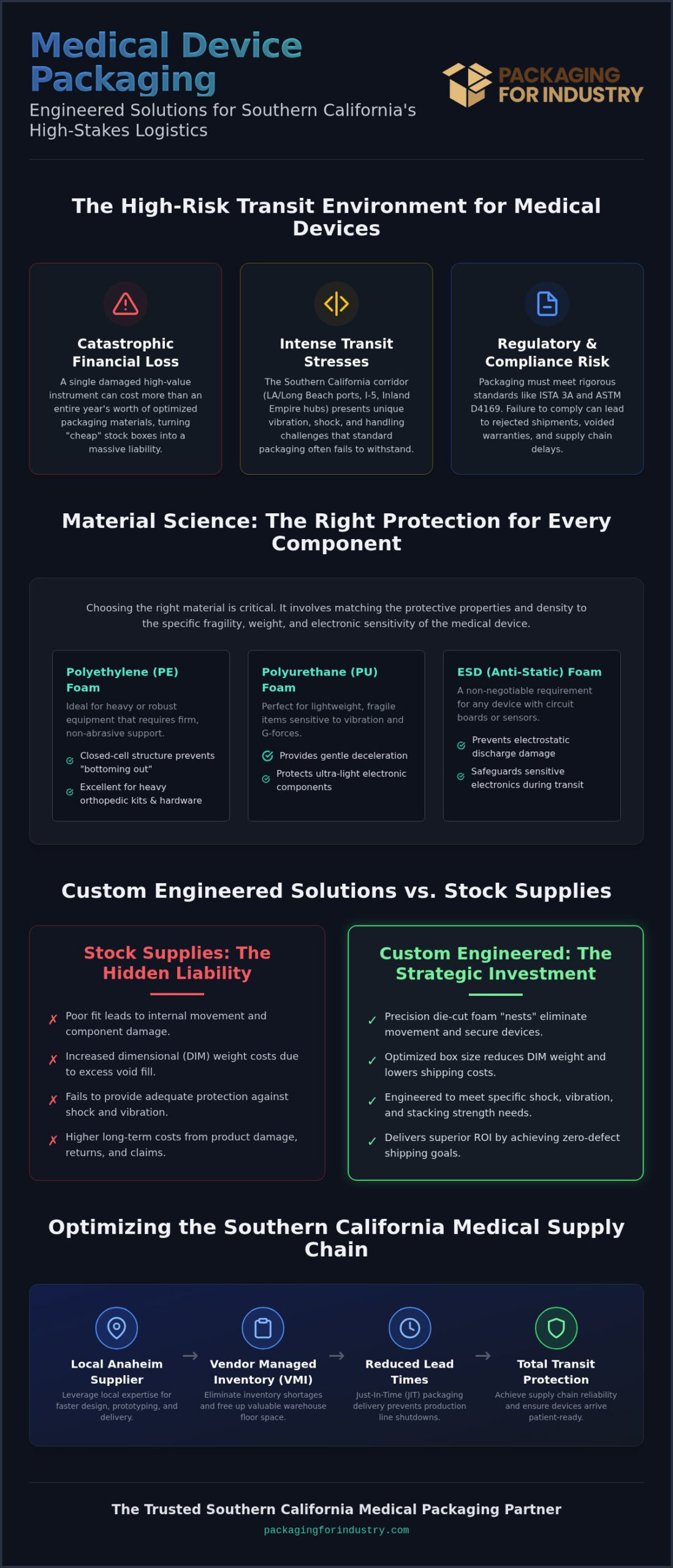
Shipping medical instruments through the Los Angeles and Long Beach port corridor isn’t just a logistical exercise; it’s a risk management operation. When high-value diagnostic equipment leaves a facility in Orange County or San Diego, it enters a high-stress environment. Southern California’s infrastructure, from the congested 405 to the vast distribution hubs in the Inland Empire, presents unique vibration and shock challenges. For manufacturers, securing effective medical device packaging solutions Southern California providers can engineer is vital to ensuring that life-saving technology arrives in patient-ready condition. Zero-defect shipping isn’t a goal; it’s the industry standard.
A single damaged unit often costs more than an entire year’s worth of optimized packaging materials, making the “cheap” stock box a massive financial liability. Relying on local expertise allows for real-time adjustments to design based on actual transit data from the Southern California corridor. This proactive approach identifies potential failure points before they result in a rejected shipment at a hospital or clinic.
The Critical Role of Secondary and Tertiary Packaging
While primary packaging maintains the sterile barrier, secondary and tertiary layers are what get the product to the hospital floor intact. A micro-perforation in a sterile pouch, often caused by poor internal cushioning or a crushed outer box, renders a surgical kit useless. We see off-the-shelf boxes fail medical-grade shock tests because they lack the structural integrity to handle the stacked weight in a crowded trailer. Integrating protective foam packaging with heavy-duty corrugated boxes provides the necessary deceleration for sensitive diagnostic sensors. Adding corner and edge protection further ensures that heavy medical crates remain structurally sound during rough handling at local transload facilities.
Compliance and Regulatory Standards for Medical Transit
Compliance doesn’t stop at the manufacturing line. Shipping containers must adhere to rigorous medical device packaging standards like ISTA 3A or ASTM D4169. These protocols simulate the exact stresses of the Southern California supply chain, from temperature fluctuations to the intense vibrations of long-haul trucking. Documentation and material traceability are equally critical for procurement managers who must account for every component in the assembly. Industrial-grade materials that meet ISO standards are vital for medical device safety in 2026 because they provide the predictable performance required to eliminate the risk of catastrophic transit failure. By choosing medical device packaging solutions Southern California specialists provide, you ensure that your secondary packaging is as compliant and reliable as the device itself.
Material Science: Selecting the Right Protective Components
While sterile pouches maintain the biological integrity of a device, the material science behind secondary packaging ensures the device remains functional upon arrival. Choosing the right medical device packaging solutions Southern California manufacturers require involves more than just picking a box size. It’s about matching the density of the protective materials to the fragility of the instrument. Polyethylene (PE) foam is the standard for heavy orthopedic kits or diagnostic hardware because its closed-cell structure doesn’t bottom out under significant weight. Conversely, Polyurethane (PU) foam provides the gentle deceleration needed for ultra-light electronic components that are sensitive to high G-forces.
For any device containing a circuit board or sensitive diagnostic sensors, ESD (Electrostatic Discharge) foam is a critical requirement. It prevents the buildup of static electricity that can fry sensitive electronics during the friction of transit. When these foam inserts are paired with heavy-duty corrugated, the level of protection increases exponentially. While a single-wall box might suffice for consumer goods, medical machinery often demands double-wall or even triple-wall corrugated construction to provide the stacking strength necessary for the Southern California logistics corridor.
Custom Foam Inserts for Precision Protection
Die-cut foam offers the highest level of precision by creating a custom “nest” that locks the device in place. This is far more effective than convoluted foam for complex shapes like surgical robots or laboratory computers, where any internal movement can lead to calibration errors. Using custom foam packaging allows you to combine different foam densities within a single insert, providing rigid support at the base and soft cushioning at the top. This engineered approach eliminates the need for messy loose-fill materials and ensures a professional presentation when the package is opened in a clinical setting.
Industrial Corrugated and Moisture Barrier Solutions
The FDA’s Quality System Regulation specifies that packaging must be designed to protect the device from foreseeable storage and shipping conditions. In Southern California, this often means accounting for humidity during long-term storage or cross-climate shipping. Weather-resistant corrugated and moisture barrier bags are essential for preventing the structural degradation of the box. Many Anaheim manufacturers now opt for custom corrugated boxes because they’re designed to the exact dimensions of the device. This precision reduces the box’s footprint, which directly lowers shipping costs by optimizing dimensional weight. If you’re looking to optimize your current setup, you can request a packaging quote to compare engineered material options for your specific product line.
Custom Engineering vs. Stock Supplies: A Cost-Benefit Analysis
Procurement managers often face a choice between the low upfront cost of stock boxes and the long-term savings of custom engineering. While a catalog box might seem efficient for a shipping budget, it rarely accounts for the stringent requirements of federal device packaging regulations. When you choose medical device packaging solutions Southern California specialists provide, the focus shifts from unit price to total cost of ownership. Custom-engineered boxes are designed to the exact footprint of your device, which eliminates the “dead air” that leads to inflated dimensional weight (DIM) charges. In the medical distribution sector, paying to ship empty space is a significant drain on quarterly margins.
Optimizing your packaging footprint doesn’t just lower freight costs; it also maximizes your warehouse capacity. Using a Vendor Managed Inventory program allows you to store custom-sized boxes and foam inserts in a smaller footprint than bulky, oversized stock supplies. By matching the corrugated strength and foam density to the specific weight of your diagnostic hardware, you reduce the risk of structural failure during stacked transit in the Southern California logistics corridor.
The Hidden Price of Shipping Damage
The true cost of a returned medical device includes the logistics of the return, the labor for inspection, the price of repair, and the potential damage to your brand’s reputation. If a surgical kit arrives with a compromised sterile barrier or a miscalibrated sensor, the financial fallout far exceeds the cost of an engineered box. Professional packaging reviews for damage reduction identify these specific weak points before they impact your bottom line. The ROI of engineered foam inserts in the medical sector is realized the moment a single high-value diagnostic unit arrives functional instead of requiring a total factory rebuild.
Prototyping: Testing Before Full-Scale Rollout
Transitioning to custom designs shouldn’t be a financial gamble. We utilize a rigorous CAD/CAM design process to create bespoke medical device crates that meet exact specifications. Physical prototypes are essential because they allow your team to verify the “fit and feel” of the protection levels before committing to a bulk run. Working with local custom design packaging teams in Anaheim streamlines the approval process, allowing for rapid iterations that national catalog suppliers simply can’t match. This local proximity ensures that your medical device packaging solutions Southern California rollout happens on schedule without the delays of cross-country shipping for sample designs.
Optimizing the Medical Supply Chain in Southern California
Production lines in the medical sector can’t afford “out of stock” notifications for secondary packaging. When a manufacturer in Orange County or the Inland Empire scales up production for a new diagnostic tool, the packaging supply must keep pace or risk a total shutdown. While national catalog suppliers offer a broad range of products, they often struggle with the specialized lead times required for medical-grade foam or heavy-duty triple-wall corrugated. By utilizing medical device packaging solutions Southern California providers offer, manufacturers gain a logistical hedge against supply chain volatility. A local Anaheim hub ensures that your fulfillment center isn’t waiting on a cross-country shipment that might be delayed by weather or rail congestion.
Managing the long lead times associated with custom-engineered materials requires a proactive partnership. Local providers understand the specific cadence of the Southern California market, from the busy ports to the rapid-turnaround needs of the region’s biotech hubs. This proximity allows for next-day delivery in Los Angeles and Orange County, ensuring that your warehouse always has the protective materials needed to keep high-value instruments moving toward their final destination.
Vendor Managed Inventory (VMI) for Medical Manufacturers
Inventory management is a significant operational burden that often distracts from core manufacturing goals. By implementing Vendor Managed Inventory programs, manufacturers shift the responsibility of stock levels to the supplier. This model effectively eliminates the risk of stockouts while freeing up valuable warehouse floor space previously occupied by months of excess safety stock. Scheduled replenishment cycles, whether weekly or monthly, simplify the procurement process and allow your team to focus on device assembly rather than box counts. It’s a pragmatic approach to fiscal responsibility that centers on the elimination of professional stress.
Just-In-Time (JIT) Delivery and Kitting Services
Efficiency in 2026 is defined by lean operations and the reduction of unnecessary overhead. Just-In-Time inventory management ensures that materials arrive exactly when they’re needed on the production floor, reducing the capital tied up in sitting inventory. For high-volume assembly lines, packaging kitting services provide pre-assembled sets of boxes, foam inserts, and labels. This reduces labor time during the final packaging phase and ensures every component is accounted for before the device leaves the facility. PFI’s dedicated local delivery routes cover San Diego, Riverside, and the Inland Empire, providing a level of responsiveness that national distributors can’t match.
Why Packaging For Industry is the Trusted SoCal Medical Partner
PFI operates with the mindset of a seasoned industrial consultant rather than a simple material supplier. We understand that your operational challenges require more than a catalog number; they require a “fixer” who can address complex shipping vulnerabilities for high-value gear. By combining deep engineering expertise with the logistical speed of our Anaheim headquarters, we provide medical device packaging solutions Southern California manufacturers use to stabilize their bottom line. Whether you are dealing with recurring shipping damage or seeking to lower packaging costs through better design, our team focuses on tangible, real-world outcomes that eliminate professional stress.
Our facility serves as a one-stop shop for the entire protective stack. We don’t just provide the outer container; we engineer the internal environment. This includes custom-cut foam, heavy-duty corrugated, and specialized corner and edge protection to ensure that even the heaviest diagnostic machinery remains immobile during transit. This integrated approach ensures that every component of your packaging works in unison, providing a seamless system of protection and logistical optimization.
Integrated Solutions: From Custom Foam to Heat-Treated Pallets
Efficiency is found when you can source your full tertiary stack from a single local partner. We provide everything from precision foam inserts to export-compliant, heat-treated crates and pallets. Our expertise in mil-spec and aerospace-grade protection allows us to apply high-performance engineering standards to the medical device sector. This crossover knowledge is vital for protecting sensitive surgical robots and laboratory computers that share the same fragility profiles as aerospace electronics. Local accountability matters for Southern California procurement teams. When a design needs an adjustment or a shipment is required for a next-day production surge, having a partner in Anaheim provides a level of responsiveness that national distributors cannot replicate.
Get Your Custom Medical Packaging Quote Today
Starting your packaging cost-reduction analysis is a straightforward process. You can submit your product dimensions and fragility requirements for a comprehensive custom engineering review. The PFI commitment is simple. We provide no fluff and no hype; we deliver industrial-grade reliability and a steady, dependable partnership that values long-term supply chain stability. We’ll help you identify where “dead air” is costing you in freight and where engineered inserts can eliminate the quarantine of damaged goods.
Securing Your 2026 Medical Supply Chain
Optimizing your secondary packaging is a strategic investment in your facility’s bottom line. By moving away from oversized stock boxes and embracing engineered medical device packaging solutions Southern California manufacturers can depend on, you eliminate the fiscal drain of shipping damage and inflated freight costs. Our Anaheim-based headquarters provides the local responsiveness your operations team requires to prevent production shutdowns and maintain strict regulatory compliance. It isn’t just about finding a box; it’s about engineering a system that protects your high-value technology from the assembly line to the hospital floor.
From our free prototyping and CAD/CAM support to our specialized expertise in high-value aerospace and medical protection, we focus on delivering tangible results. We act as your industrial “fixer,” solving complex logistical hurdles through integrated foam and corrugated systems. Transitioning to a local partner ensures your supply chain remains resilient against global delays while providing the precision your instruments deserve. We’re ready to help you lower packaging costs and improve reliability across your entire Southern California distribution network.
We look forward to helping you streamline your fulfillment and achieve zero-defect transit for your life-saving technology.
Frequently Asked Questions
What is the best foam for shipping sensitive medical electronics?
Anti-static or ESD-grade polyethylene and polyurethane foams are the most effective materials for sensitive medical electronics. These specialized foams prevent the buildup of static electricity while providing the necessary G-force deceleration to protect diagnostic sensors. We typically recommend closed-cell polyethylene for heavier hardware and soft polyurethane for lighter, highly fragile components that require gentle cushioning during transit.
How do Southern California medical companies reduce shipping damage?
Manufacturers reduce shipping damage by replacing generic catalog boxes with precision-engineered medical device packaging solutions Southern California specialists design for specific transit stresses. By utilizing custom foam inserts that lock the device in place, companies eliminate the internal movement that leads to calibrated sensor failure. Local testing also accounts for the specific vibration profiles found in the Los Angeles and Long Beach logistics corridors.
What are the benefits of custom corrugated boxes over stock sizes for medical gear?
Custom corrugated boxes provide superior structural integrity by eliminating the “dead air” found in oversized stock containers. This tight fit prevents the box from collapsing when stacked in a trailer and significantly lowers freight costs by reducing dimensional (DIM) weight charges. Additionally, custom sizing allows for the use of heavy-duty double-wall or triple-wall board only where it is functionally required for the device’s weight.
Can PFI handle both small-batch custom prototypes and high-volume bulk orders?
Our Anaheim headquarters is equipped to handle the full product lifecycle, from free CAD/CAM prototyping for a single unit to high-volume bulk production. We understand that medical device launches often start with small-batch clinical trials before scaling to global distribution. Our facility provides the flexibility to adjust designs during the prototyping phase and the manufacturing capacity to support your largest recurring orders.
Do you offer next-day delivery for medical packaging in Orange County?
Yes, we provide local next-day delivery for industrial packaging supplies throughout Orange County and the surrounding Southern California region. Our dedicated fleet of trucks operates out of our Anaheim hub to ensure that manufacturers in Irvine, Costa Mesa, and Huntington Beach receive their materials without the delays of national carriers. This local proximity is a vital component of a reliable just-in-time supply chain.
How does a Vendor Managed Inventory (VMI) program work for packaging?
A Vendor Managed Inventory program shifts the responsibility of stock monitoring and replenishment to PFI, ensuring your facility never faces a production shutdown. We monitor your usage levels and automatically replenish your custom boxes and foam inserts based on pre-set minimums. This system frees up your warehouse floor space and reduces the administrative burden on your procurement team, allowing them to focus on core operations.
Are your wooden crates compliant with international medical export regulations?
Our custom-engineered wooden crates are fully compliant with international export standards, including ISPM-15 heat-treatment requirements for wood packaging. This compliance ensures that your high-value medical machinery passes through international customs without delays or quarantine issues. We provide the necessary documentation and markings to verify that your crates meet the global standards required for safe, legal cross-border transit.
What information is needed to get a custom medical packaging quote?
To provide an accurate medical device packaging solutions Southern California quote, we require the physical dimensions, weight, and fragility rating of your device. It’s also helpful to know your expected order volume and whether the device requires specialized protection like ESD foam or moisture barriers. Our engineering team uses this data to recommend the most cost-effective combination of corrugated and foam for your specific application.