
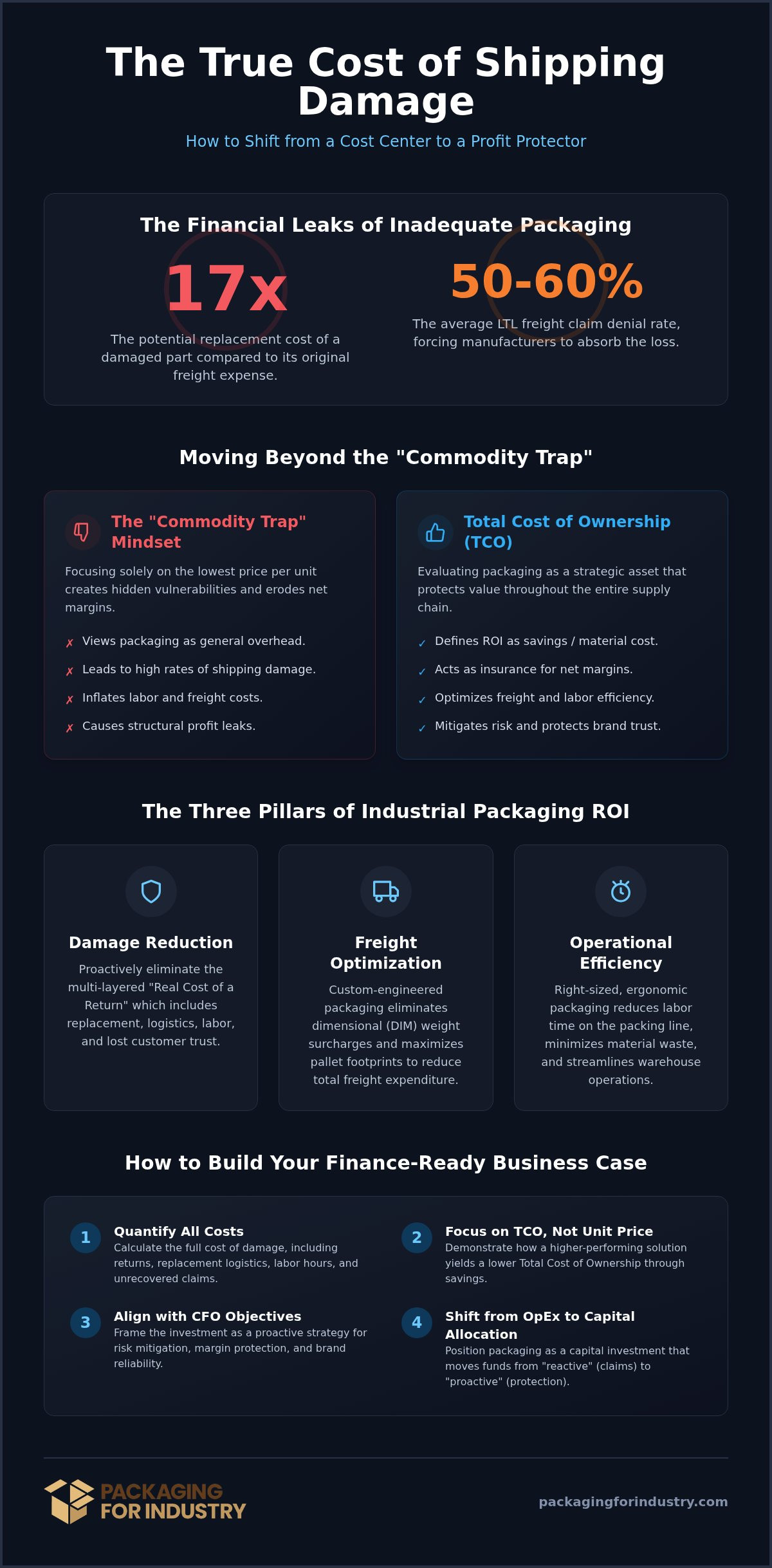
Did you know that replacing an industrial part damaged during transit can cost your company up to 17 times the original freight expense? With LTL claim denial rates currently sitting between 50% and 60%, many manufacturers are forced to absorb these losses directly into their net margins. It’s easy to see why finance teams often view packaging as a mere commodity overhead; however, this perspective ignores the structural profit leaks caused by inadequate protection and inefficient logistics.
We understand that you’re likely facing pressure from rising operational costs, including California diesel prices at $6.49 per gallon and the recent 5.9% general rate increases from major carriers. Learning how to calculate the cost of shipping damage is no longer just a logistical task; it’s a financial necessity. This article will provide you with a clear framework to quantify hidden costs and build a professional business case for custom-engineered foam or heavy-duty corrugated solutions.
By mastering our Total Cost of Ownership (TCO) formulas, you can move beyond reactive claims management. We’ll show you how to optimize dimensional weight (DIM) surcharges and leverage proactive engineering to improve customer trust while protecting your bottom line through every stage of the supply chain.
Key Takeaways
- Define Packaging ROI as the ratio of total operational savings to material costs to move beyond the “commodity trap” of low-bid stock boxes.
- Learn how to calculate the cost of shipping damage by quantifying hidden variables like labor hours, replacement logistics, and unrecovered carrier claims.
- Identify how custom-engineered foam and corrugated inserts eliminate DIM weight surcharges to significantly reduce your total freight expenditure.
- Leverage free prototyping to validate high-performance packaging designs and de-risk your investment before full financial commitment.
- Build a finance-ready business case that positions industrial packaging as a strategic cost-reduction engine rather than a simple overhead expense.
The Commodity Trap: Why Finance Miscalculates the Cost of Shipping Damage
Finance departments often categorize industrial packaging as a line-item expense under general overhead. This classification creates a “commodity trap” where procurement teams are incentivized to secure the lowest price per unit, often at the expense of structural integrity. However, true Packaging ROI is defined as the ratio of total operational savings to the cost of packaging materials. When a company ignores this ratio, they overlook the fact that the cheapest stock box frequently yields the highest total cost due to transit failures. To move beyond this trap, leadership must learn how to calculate the cost of shipping damage as a function of the entire supply chain rather than just the invoice from a box vendor.
Contrasting “Price Per Unit” with “Total Cost of Ownership” (TCO) is essential for aligning with finance logic. While a custom-engineered solution might have a higher upfront price, it serves as a strategic insurance policy for your net margins. A low unit price is irrelevant if the product arrives unsalable; the goal is to protect the value of the shipment, not just minimize the cost of the container.
The Hidden Cost of the “Cheapest” Option
Standardized packaging and labeling standards provide a baseline for containment, but they rarely account for the specific mechanical stresses of your unique logistics network. Sub-standard corrugated materials often suffer from insufficient edge crush test (ECT) ratings. This leads to crushed corners and compromised structural integrity during stacking, which is a major contributor to the industry-wide 1.24% LTL damage rate.
Beyond physical damage, generic void fill and oversized boxes increase labor time on the packing line. Workers spend extra minutes wrestling with ill-fitting materials, which compounds into significant annual labor waste. Furthermore, stock boxes that don’t fit pallet footprints perfectly increase transit risks and lead to wasted trailer space, directly inflating your freight bills.
Aligning Packaging Performance with CFO Objectives
Modern CFOs prioritize risk mitigation and margin protection. High-performance packaging cost savings are realized when the expense of custom-engineered solutions is weighed against the reduction in replacement units and freight claims. In B2B sectors like aerospace or manufacturing, packaging durability is a direct reflection of your brand’s reliability. A single damaged shipment can jeopardize a multi-million dollar contract and erode customer trust.
When you understand how to calculate the cost of shipping damage, you can frame packaging as a capital allocation decision rather than a simple operational expense (OpEx). This shift allows finance to see that investing in better protection is a proactive strategy to eliminate the “structural leaks” in the company’s profitability. It’s about moving capital from a “reactive” bucket (claims and returns) into a “proactive” one (engineering and protection).
The Three Pillars of Industrial Packaging ROI
To build a bulletproof business case for better protection, you must look beyond the box. A comprehensive packaging cost savings analysis rests on three distinct pillars: damage reduction, freight optimization, and operational efficiency. Each pillar represents a specific area where engineered solutions turn a necessary expense into a profit-driving asset. By understanding these categories, finance teams can move away from reactive spending and toward a proactive model of margin preservation.
Quantifying Damage, Returns, and Lost Opportunity
The “Real Cost of a Return” is a multi-layered calculation that often escapes standard accounting. It includes the initial freight cost, the labor to inspect and restock the item, and the potential loss of a customer’s lifetime value. When high-value industrial parts are compromised, the replacement cost can reach 17 times the original freight expense. While the official process for filing indemnity claims for loss or damage is available, the 50% to 60% denial rate for LTL claims makes this a poor strategy for margin recovery.
Using custom foam inserts provides the precision needed to isolate delicate components from vibration and shock. When determining how to calculate the cost of shipping damage, you must include the “Transit Protection ROI.” This is found by dividing the total avoided replacement costs by the incremental cost of the improved packaging. With the industry average LTL damage rate sitting at 1.24%, even a small reduction in failure rates leads to significant annual savings.
Freight and DIM Weight Optimization
Carriers like UPS and FedEx utilize dimensional (DIM) weight to charge for the space a package occupies rather than just its physical weight. Oversized stock boxes often trigger these surcharges, essentially forcing you to pay for “shipping air.” In 2026, general rate increases reached 5.9%. This makes it more expensive than ever to use inefficient containers that don’t match your product’s footprint.
Right-sized custom corrugated boxes eliminate this waste. By engineering a box that fits the product and its protective cushioning exactly, you can often drop a package into a lower DIM weight tier. This optimization has a massive cumulative effect on national logistics budgets. If you’re unsure where your current baseline sits, you can request a custom packaging review to identify specific areas for freight reduction. This proactive approach ensures your logistics spend is focused on the product, not the empty space around it.
Operational Efficiency and Warehouse Flow
The final pillar focuses on the hidden labor costs associated with packing. Generic void fill and complex multi-piece stock solutions slow down the packing line. Custom-engineered kits allow for faster assembly and standardized packing procedures. Furthermore, utilizing programs like Vendor Managed Inventory (VMI) can free up warehouse floor space and capital, allowing your team to focus on production rather than managing a bloated inventory of packaging supplies.
Custom Engineering vs. Catalog Commodities: A Financial Comparison
Buying from a catalog feels like a shortcut for procurement teams. It offers immediate availability and a familiar ordering process. However, this convenience often masks significant engineering inefficiencies that inflate your total cost of ownership. When you analyze how to calculate the cost of shipping damage, you must factor in the labor required to “over-pack” a generic box with excessive bubble wrap or tape. These manual additions are inconsistent and expensive. In contrast, a custom-engineered solution from a packaging manufacturer provides a standardized, repeatable process that eliminates human error and material waste.
For high-value sectors like Aerospace and medical manufacturing, the stakes of transit failure are too high for catalog commodities. One-size-fits-all solutions rarely provide the precision required to protect sensitive instrumentation from the G-forces of LTL transit. PFI offers free prototyping to de-risk this transition for your finance team. This allows you to validate the performance of a custom design before committing to a full production run, ensuring the investment is backed by tangible data rather than catalog promises.
The ROI of Custom Foam and Specialized Crating
Labor is one of the most significant “hidden” costs in any warehouse operation. Relying on bubble wrap and tape requires your team to spend minutes per package, leading to inconsistent protection levels. Utilizing a drop-in foam insert or a custom-molded interior significantly increases packing speed while ensuring a perfect fit every time. This reliability is vital for margin protection.
Furthermore, switching to heavy-duty double-wall boxes can often remove the need for expensive secondary outer-wraps or additional corner protection. For high-value machinery, custom shipping crates provide a level of durability that stock options simply cannot match. When you include the cost of claims and lost production time in your analysis of how to calculate the cost of shipping damage, the engineering-first approach consistently proves more cost-effective than catalog buying.
Inventory Management as a Cash Flow Tool
Beyond the materials themselves, the way you manage your packaging inventory has a direct impact on cash flow. We offer Vendor Managed Inventory (VMI) as a finance-friendly service to optimize your balance sheet. By utilizing VMI, you can maintain lower on-hand stock levels and free up valuable warehouse floor space for production.
This Just-In-Time (JIT) delivery model ensures you have the supplies you need without tying up working capital in months of excess inventory. It also eliminates the need for emergency rush orders and their associated fees. For a CFO, this means more predictable operational expenses and a leaner, more efficient supply chain that responds to actual demand rather than inventory guesswork.
How to Build Your Finance-Ready Business Case
Building a business case for high-performance packaging requires translating logistical failures into precise financial metrics. You must demonstrate exactly how to calculate the cost of shipping damage in a way that resonates with your finance department’s priorities. This process moves the conversation from “better boxes” to “margin protection.” Follow these five steps to secure approval for custom-engineered solutions.
- Step 1: Gather the ‘Dirty Data’. Document your current damage rates, dimensional weight surcharges, and the specific labor hours required to pack each shipment.
- Step 2: Establish a Baseline. Request a custom packaging review and quote to compare your current catalog-based expenses against an engineered alternative.
- Step 3: Model the Payback Period. Calculate how many months it will take to recover custom design and tooling fees through reduced failure rates.
- Step 4: Present the ‘Worst Case’ Scenario. Quantify the financial risk of maintaining the status quo, including the high cost of replacement units and potential contract loss.
- Step 5: Leverage Local Expertise. For Southern California manufacturers, utilizing PFI’s Anaheim-based delivery and support eliminates long-distance freight costs for your packaging supplies.
Mastering the Language of the CFO
To win over a skeptical finance team, you must speak their language. Focus on the “Payback Period,” which is the time required for the savings from reduced damage to exceed the initial investment in custom tooling. Distinguish between “Direct Cost Savings,” such as lower freight bills from DIM weight optimization, and “Cost Avoidance,” which involves stopping the profit leaks caused by transit failures. Additionally, discuss “Capital Efficiency” by highlighting how a Vendor Managed Inventory program reduces the amount of cash tied up in on-hand stock. These concepts shift the narrative from spending money to optimizing capital.
Visualizing the Data for Approval
Executives often prefer high-level summaries over dense spreadsheets. Create a simple “Before vs. After” cost table that clearly displays the total cost of ownership for both your current system and the proposed engineered solution. Include rows for material costs, freight surcharges, and estimated damage expenses. During your presentation, use physical prototypes as a “proof of concept.” Seeing and feeling the durability of a custom foam insert or a heavy-duty crate provides tangible evidence of protection that a catalog description cannot replicate. This physical demonstration, backed by your data on how to calculate the cost of shipping damage, makes the decision logical and low-risk.
Why Partnering with Packaging For Industry (PFI) Secures Approval
PFI operates as a seasoned industrial consultant rather than a traditional commodity vendor. We understand that finance teams require more than just a lower price per unit; they need a partner who understands the intersection of engineering and economics. By providing an integrated solution that covers everything from custom corrugated boxes to precision foam inserts and stretch film, we eliminate the complexity of managing multiple vendors. This holistic approach ensures that every component of your packaging system works in unison to protect your margins. When you engage our team to determine how to calculate the cost of shipping damage, you’re gaining access to a comprehensive engineering partner.
We position ourselves as a dedicated cost-reduction partner for Manufacturing and Warehousing operations. Our expertise allows us to identify the specific structural leaks in your logistics chain that stock solutions simply can’t address. When our engineers analyze your current workflow, they don’t just look at the box. They examine the entire lifecycle of the product to show you exactly how to calculate the cost of shipping damage based on real-world transit stresses and carrier behaviors.
Local Expertise for Southern California Manufacturers
Our Anaheim-based facility provides a significant logistical advantage for businesses in Orange County and Los Angeles. We offer next-day delivery for local clients, which drastically reduces lead-time risk and allows for leaner inventory levels. Sourcing locally also lowers your total cost of procurement by minimizing freight miles and associated fuel surcharges. While we maintain nationwide shipping capabilities for multi-site industrial operations, our Southern California roots allow us to provide the hands-on, proactive support that national catalog vendors lack. You get the stability of a traditional partner with the precision of modern custom engineering.
Start with a Zero-Risk Cost-Reduction Analysis
Securing executive approval for new packaging initiatives is easier when you start with a clear, data-driven baseline. We invite you to a comprehensive packaging review to identify “low-hanging fruit” savings in your current operation. This might involve optimizing your DIM weight profile or standardizing your void-fill materials to reduce labor hours. Our free prototyping service remains a cornerstone of our value proposition. It allows you to test and validate a high-performance design before any major financial commitment is made. This removes the risk from the design phase and provides the “proof of concept” your CFO needs to authorize the transition.
Secure Your Margins with Engineered Protection
Transitioning from stock commodities to custom-engineered solutions is a move toward long-term fiscal stability. By focusing on the total cost of ownership, you protect high-value aerospace and industrial components from the structural leaks inherent in generic packaging. Mastering how to calculate the cost of shipping damage allows you to transform your logistics operation from a cost center into a profit-preservation engine.
Our Anaheim-based team provides local next-day delivery across Southern California, ensuring your supply chain remains lean and responsive. We specialize in the exacting standards of the medical and industrial sectors, offering free prototyping to guarantee a perfect fit before you commit capital. This engineering-first approach eliminates the “commodity trap” and aligns your packaging strategy with your CFO’s objectives for risk mitigation and margin protection.
Take the first step toward eliminating transit failures and optimizing your freight spend today. We’re ready to help you build a bulletproof business case that satisfies your finance team and secures your operational peace of mind.
Frequently Asked Questions
How do I calculate the ROI of switching to custom packaging?
You calculate the ROI by dividing your total annual savings by the incremental cost of the new packaging materials. Total savings should include the reduction in damaged goods, the elimination of freight surcharges, and the labor hours saved on the packing line. If your savings exceed the cost of the custom design and tooling within a few months, the investment is considered highly efficient from a capital allocation perspective.
Will finance really care about dimensional weight surcharges?
Yes, finance teams care deeply about dimensional weight (DIM) because it represents a structural inefficiency in the logistics budget. These surcharges are essentially a tax on “shipping air” and provide no value to the customer. When you demonstrate that right-sized custom boxes can drop a package into a lower weight tier, you’re presenting a direct way to reduce OpEx without impacting product quality.
Is custom packaging always more expensive than stock boxes?
No, custom packaging is often more cost-effective when you analyze the total cost of ownership. While a stock box might have a lower unit price, it usually requires excessive void fill, extra tape, and more labor to pack securely. Custom solutions eliminate these secondary costs and reduce the risk of transit failure, which makes the “cheaper” catalog option more expensive in the long run.
How long does it take to see a return on investment for custom foam inserts?
Most industrial companies see a return on investment within three to six months. The payback period is even shorter for high-value sectors like aerospace or medical manufacturing, where a single avoided damage claim can pay for an entire production run of custom foam. The speed of ROI depends on your shipment volume and the current frequency of your freight claims.
What is the best way to present packaging damage data to my CFO?
The most effective method is to present a margin-impact report. When you show your CFO how to calculate the cost of shipping damage by factoring in replacement inventory and unrecovered freight claims, the logic becomes undeniable. Use a simple table to contrast the status quo with the proposed engineered solution, focusing on the reduction of “lost opportunity” costs and improved customer retention.
Can a VMI program actually improve our company’s cash flow?
Yes, a Vendor Managed Inventory (VMI) program improves cash flow by reducing the amount of working capital tied up in on-hand stock. Instead of paying for months of inventory upfront, you only pay for what you use as it’s delivered. This just-in-time model frees up warehouse floor space for production and eliminates the need for emergency rush orders that carry exorbitant fees.
How does PFI help me build a business case for the finance department?
We act as industrial consultants to provide the hard data your finance team requires. We help you identify how to calculate the cost of shipping damage within your specific supply chain by auditing your current failure rates and freight expenses. Our team provides the cost-benefit analysis and performance data needed to prove that engineered protection is a strategic asset rather than an overhead expense.
Do you provide prototypes to help prove the ROI to my team?
Yes, we provide free prototyping to ensure your custom packaging fits perfectly before you make a full financial commitment. These physical prototypes serve as a “proof of concept” for your internal stakeholders, allowing them to see the durability and precision of the design. This de-risks the investment and provides tangible evidence that the proposed solution will perform as expected in the field.