
Specifying the highest burst strength on your RFQ might be the very thing causing your pallet stacks to lean and your shipping costs to climb. It’s a common mistake in industrial procurement: assuming that a “stronger” material rating automatically translates to a safer arrival for your goods. If you’re managing logistics for an aerospace firm in Orange County or a medical device manufacturer in San Diego, using the wrong metric doesn’t just waste money. It creates unpredictable shipping damage that your team has to solve after the fact.
We understand the frustration of technical spec confusion during vendor comparisons. This guide provides a clear framework for the ECT vs Mullen test for corrugated boxes so you can stop over-paying for over-engineered supplies. We’ll examine why Mullen tests for puncture resistance while ECT focuses on stacking integrity. By the end of this article, you’ll know exactly how to specify box strength to reduce material waste and improve the reliability of your entire supply chain.
Key Takeaways
- Understand the fundamental difference between burst resistance and stacking strength to prevent crushed corners or punctured liners in your supply chain.
- Learn how to choose between the ECT vs Mullen test for corrugated boxes based on whether your product is shipped as individual parcels or on palletized loads.
- Identify opportunities to reduce material waste and lower total packaging costs by specifying the correct board grade for your handling profile.
- Discover how Southern California manufacturers in Anaheim and Los Angeles can mitigate humidity-related strength loss through custom-engineered board selection.
- Explore how Vendor Managed Inventory (VMI) and custom prototyping help verify box performance before moving to high-volume production.
Understanding Box Strength Standards: Mullen vs. ECT
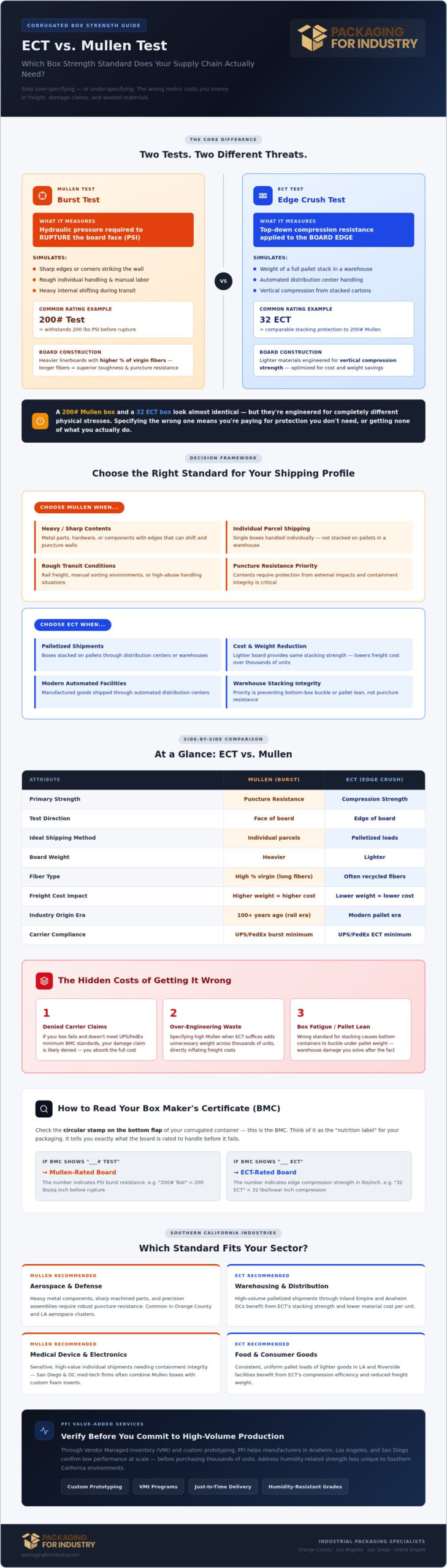
The Mullen test served as the primary industry benchmark for over a century. It was developed during an era when goods were handled individually and moved via railcars or manual labor. In those conditions, the biggest threat to a package was a sharp object or a rough corner strike. However, the modern supply chain has evolved. Today, most industrial products move on pallets through automated distribution centers. This shift from individual handling to palletized stacking created a fundamental need for a different metric. This led to the rise of the Edge Crush Test (ECT).
Many procurement managers still default to specifying a “200# test” box because it sounds like a safe, heavy-duty standard. This is often a mistake. A 200# Mullen box and a 32 ECT box may appear similar, but they’re engineered to withstand different types of physical stress. You can identify which standard your current supplier uses by checking the Box Maker’s Certificate (BMC) printed on the bottom flap of your container. This circular stamp is the “nutrition label” of the packaging world; it tells you exactly what the board is rated to handle before it fails.
The Core Difference: Puncture vs. Compression
The Mullen test, often called the Burst Test, measures the hydraulic pressure required to rupture the face of the corrugated board. It’s a measurement of toughness and puncture resistance. If you’re shipping heavy, loose metal parts or items with sharp edges that might shift during transit, Mullen-rated corrugated boxes are often the superior choice. They utilize heavier, high-quality linerboards to prevent the product from breaking through the side of the box.
The Edge Crush Test (ECT) measures a completely different attribute: vertical compression strength. Instead of testing the face of the board, the lab applies top-down pressure to the edge. This simulates the real-world weight of a stacked pallet in a warehouse. For most manufacturers in Anaheim or the Inland Empire, stacking integrity is the priority. ECT allows for the use of lighter materials that provide the same stacking strength as heavier Mullen boards. This optimization is a key factor in how we help clients lower packaging costs without compromising safety.
Why the Standard on Your Box Matters to Your Bottom Line
Choosing the wrong standard creates hidden costs that erode your margins. If your boxes aren’t rated correctly for your specific handling profile, you risk shipping damage claims. Carriers like UPS and FedEx have strict insurance requirements based on the BMC. If a box fails and it doesn’t meet the carrier’s minimum burst or ECT standards, your claim will likely be denied. This leaves your company responsible for the total cost of the damaged goods and the replacement freight.
The ECT vs Mullen test for corrugated boxes also impacts your freight class and material spend. Over-engineering a box with a high Mullen rating when an ECT board would suffice adds unnecessary weight to every shipment. Over thousands of units, that extra weight increases your total cost of ownership. By selecting the right test standard, you ensure your packaging is built for the modern palletized environment, reducing both waste and the risk of warehouse “box fatigue” where bottom containers buckle under the weight of the stack.
The Mullen Test (Burst Test): Protecting Against Rough Handling
While modern logistics often prioritize stacking, the Mullen test remains the definitive measurement for material toughness. During the laboratory process, a piece of corrugated board is clamped into a testing machine where a rubber diaphragm applies hydraulic pressure to the face of the material. The test measures the exact pounds per square inch (PSI) required to rupture the board. If a box is rated at “200# test,” it means the material withstood 200 pounds of pressure before bursting. This metric is critical for industrial buyers because it focuses on the containment of the product and the durability of the outer linerboard.
Mullen-rated boxes typically utilize heavier, high-quality linerboards made from a higher percentage of virgin fibers. These long fibers provide superior “toughness” compared to the shorter, recycled fibers often found in standard ECT materials. This structural difference makes Mullen-rated containers the industry gold standard for protection against internal shifting and external punctures. If you are comparing ECT vs Mullen test for corrugated boxes, remember that the Mullen rating tells you how much abuse the box wall can take before a sharp object or a heavy component pierces through it.
How the Mullen Test Measures Puncture Resistance
The technical hero of a Mullen-rated box is the linerboard quality. Because the test measures burst resistance, the thickness and weight of the outer paper layers are paramount. This makes Mullen boxes ideal for shipping sharp industrial components, heavy fasteners, or irregular machinery parts that might concentrate pressure on a single point of the box wall. While an ECT box might provide the stacking strength you need, it may lack the puncture resistance to keep a heavy metal flange from tearing through the side during a sudden stop or impact. If you aren’t sure which material your product requires, you can request a packaging quote to have our team evaluate your specific handling risks.
When Mullen is Non-Negotiable: Industrial and Export Use
Certain supply chain environments make Mullen-rated board a strict requirement. Export shipping is a prime example. International transit involves multiple touchpoints, varying humidity levels, and unpredictable manual handling. A box with high burst resistance is better equipped to survive this “conveyor belt gauntlet” and the rough handling typical of ocean freight and international ports. For manufacturers in the Inland Empire or Orange County shipping overseas, the puncture resistance of a Mullen box provides necessary peace of mind.
Military and aerospace sectors also rely heavily on these standards. Many mil-spec packaging requirements specifically mandate burst strength over stacking strength to ensure critical components remain contained regardless of how the crate is oriented. In the small parcel environment of UPS or FedEx, where boxes are dropped and tossed onto sorting slides, the burst strength of a 200# or 275# Mullen box often proves more resilient than a standard ECT equivalent. It’s about protecting the integrity of the wall as much as the integrity of the stack.
The Edge Crush Test (ECT): Optimizing for Stacking and Pallets
The Edge Crush Test (ECT) evaluates the structural integrity of a corrugated box from a top-down perspective. Unlike the Mullen test, which targets the puncture resistance of the linerboard, the ECT lab process applies vertical pressure to the edge of a small board sample. The test continues until the fluting inside the board buckles. This provides a precise measurement of how much weight a box can sustain before the walls collapse. When evaluating the ECT vs Mullen test for corrugated boxes, it’s clear that ECT is the language of the modern, pallet-driven supply chain.
In a warehouse environment, the primary stress on a box isn’t a puncture; it’s the static weight of other boxes stacked on top of it. ECT allows packaging engineers to calculate exactly how many containers can be safely stacked on a pallet. This data is essential for facilities in the Inland Empire or Orange County that utilize high-density racking and automated sorting systems. By focusing on edge crush strength, you ensure your bottom layer of boxes doesn’t fail under the pressure of a full pallet load.
Why ECT is the Standard for Modern Warehousing
Vertical compression strength is king for uniform, palletized loads. Most industrial shipments today move as unitized pallets rather than individual parcels. Because ECT measures the strength of the entire board structure, including the fluting, it’s a more accurate predictor of warehouse performance than a burst test. This allows operations managers to maximize vertical space safely. To predict potential failures, engineers often use the McKee Formula. This calculation uses the ECT value, the box perimeter, and the board thickness to estimate the total stacking life of a container under real-world conditions. This scientific approach eliminates guesswork and prevents the leaning stacks that often lead to warehouse accidents.
Material Efficiency and Cost-Reduction Benefits
ECT-rated boxes offer significant advantages in material efficiency. Because the test focuses on the structural performance of the fluting, manufacturers can use a higher percentage of recycled content while maintaining high stacking ratings. This makes ECT a more sustainable choice for high-volume manufacturing sectors. Additionally, ECT board is often lighter than its Mullen-rated equivalent. While a 32 ECT box and a 200# Mullen box may offer similar performance in certain scenarios, the ECT box typically uses less fiber. This weight reduction has a cumulative effect on nationwide freight costs, especially for bulk shipments. See our packaging cost savings guide for more optimization tips on how to right-weight your inventory without compromising safety. By specifying ECT, you’re often paying for performance rather than just raw material weight.
Decision Framework: Choosing the Right Rating for Your Supply Chain
Selecting the correct board grade requires more than a simple price comparison. It’s about defining your “Handling Profile.” If you treat the ECT vs Mullen test for corrugated boxes as an interchangeable choice based solely on the lowest quote, you risk either over-paying for material you don’t need or under-protecting your assets. The decision depends on three variables: how the product is shipped, the weight of the contents, and the level of internal support provided by your protective inserts.
Weight thresholds are a primary indicator for board selection. While single-wall boxes suffice for lighter components, heavy industrial machinery or bulk automotive parts often require the structural reinforcement of double-wall or triple-wall boxes. These multi-layered configurations can be engineered using either Mullen or ECT standards, but the choice should align with the specific stresses of your distribution cycle.
Mullen vs. ECT: A Side-by-Side Handling Comparison
- Scenario A: Palletized LTL Freight. When products are unitized, stretch-wrapped, and moved via forklift, vertical stacking strength is the priority. In this environment, ECT usually wins because it allows you to specify the exact compression strength needed for your pallet height.
- Scenario B: Individual Small Parcel Shipping. If your goods are moving through a high-velocity sorting hub where they face drops, slides, and side-impacts, Mullen usually wins. The higher burst resistance prevents the box from rupturing when it hits the corner of another package on a conveyor belt.
- Scenario C: Heavy Industrial Equipment. For high-value, high-weight items, we often recommend a hybrid approach. Using a double or triple-wall board with a high Mullen rating ensures the box won’t puncture from internal shifting, while the thickness of the multi-wall fluting provides the necessary ECT for stacking.
The Financial Impact: Freight Costs and Damage Reduction
The financial return on switching from a 200# Mullen box to a 32 ECT box can be significant when viewed across your entire annual spend. Because ECT-rated board often uses less raw fiber to achieve the same stacking strength, the material cost is typically lower. Beyond the unit price, consider the impact on freight. Lighter boxes reduce the total shipment weight, which helps mitigate rising carrier rates. However, you must also account for “dimensional weight” surcharges. Over-packaging with a box that’s too large or too heavy for the contents doesn’t just waste material; it triggers higher shipping fees from carriers who charge based on the space your package occupies.
Your internal protection also dictates your board requirements. If you utilize custom foam packaging, the foam inserts often provide their own structural support, allowing you to “downgrade” to a lighter ECT board without increasing damage risk. PFI’s prototyping service identifies the lowest-cost board that guarantees safety by testing how your specific product and internal cushioning work together as a complete system.
Custom Corrugated Solutions: Engineering Performance for Southern California
Manufacturers in Anaheim and Orange County operate within one of the most demanding logistical hubs in the world. Shipping out of Southern California involves more than just selecting a box size; it requires an understanding of the environmental stresses that affect material performance. One often overlooked factor is the “Port Effect.” High humidity levels near the ports of Los Angeles and Long Beach can reduce the effective stacking strength of corrugated board by as much as 30% to 50% depending on exposure time. When evaluating the ECT vs Mullen test for corrugated boxes, local expertise is essential to ensure your board grade accounts for these coastal moisture fluctuations.
We don’t just supply containers; we engineer systems of protection. Through our free prototyping service, we test your specific product inside a custom-engineered box to verify performance before you commit to a full production run. This process allows us to determine if a high-ECT board provides enough vertical stability for your warehouse racking or if a Mullen-rated material is necessary to survive the rough handling of local LTL carriers. By identifying the exact specification required, we help you eliminate the costs of over-packaging while preventing the professional stress of shipping damage claims.
Specialized Requirements for Aerospace and Electronics
The aerospace and electronics sectors in San Diego and the Inland Empire require specialized packaging that meets rigorous safety standards. For high-value components, we often combine high-performance ECT-rated outer containers with precision-cut foam inserts to provide multi-axis protection. In electronics manufacturing, we integrate anti-static protection with robust corrugated walls to safeguard against both physical impact and ESD events. Partnering with a local Southern California packaging supplier allows for a more responsive supply chain, supporting just-in-time production schedules that national vendors often struggle to meet.
How PFI Reduces Your Professional Stress
Purchasing complex corrugated specifications shouldn’t be a bottleneck for your operations. We simplify the procurement process by providing clear technical guidance and reducing lead times for custom-size, heavy-duty boxes. To further optimize your workflow, our Vendor Managed Inventory (VMI) program ensures you never run out of critical supplies. We monitor your stock levels and manage the replenishment, freeing your team to focus on production rather than packaging inventory. Whether you need double-wall protection for heavy machinery or lightweight ECT boxes for high-volume distribution, we provide the engineering oversight to guarantee your supply chain reliability.
Ready to optimize your packaging specifications and lower your total cost of ownership? Request a custom corrugated quote today to receive a technical evaluation of your current board grades and handling requirements.
Optimize Your Industrial Packaging Strategy
Choosing between the ECT vs Mullen test for corrugated boxes is a strategic decision that directly impacts your operational efficiency and bottom line. While Mullen ratings provide the toughness needed for individual parcel transit and sharp industrial parts; ECT standards offer the structural integrity required for modern palletized warehouses. Selecting the wrong specification leads to either avoidable shipping damage or unnecessary material spend. Our goal is to ensure your board grade matches your specific handling profile perfectly.
PFI provides the engineering expertise to help you navigate these technical standards with confidence. We offer free prototyping and samples to verify board performance before you commit to high-volume production. Our team specializes in high-performance solutions for aerospace and industrial sectors, ensuring your custom boxes meet every safety requirement. We focus on the intersection of engineering and economics to provide you with total peace of mind.
With local next-day delivery across Southern California, we help you maintain a lean inventory while improving supply chain reliability. We look forward to helping you right-weight your packaging and eliminate professional stress through better engineering and dedicated local support.
Frequently Asked Questions
Can I convert an ECT rating to a Mullen rating using a chart?
You can use industry conversion charts as a general reference, but they don’t represent an exact physical equivalence. While a standard chart might suggest that a 32 ECT board is comparable to a 200 lb Mullen board, these tests measure different physical properties. Use these charts only for preliminary planning. You should always verify your specific requirements through custom prototyping to ensure your product remains protected throughout the distribution cycle.
Is a 32 ECT box as strong as a 200 lb test Mullen box?
A 32 ECT box provides comparable stacking strength to a 200 lb test Mullen box but typically offers less puncture resistance. Because ECT boards often use more recycled content and lighter linerboards, they’re optimized for vertical compression rather than side impacts. If your industrial product is heavy and prone to shifting internally, the 200 lb Mullen rating is usually the safer choice for preventing wall ruptures.
Which test is better for heavy-duty industrial shipping?
The better test depends entirely on your handling profile. For palletized industrial loads where stacking integrity is the primary concern, the Edge Crush Test is the superior metric for calculating warehouse safety. If you’re shipping heavy, loose components like aerospace fasteners or metal flanges that might pierce the box wall during transit, the Mullen test’s focus on burst strength provides the necessary puncture protection.
Does the ECT rating affect the price of the box?
Yes, ECT-rated boxes are often more cost-effective because they allow for material optimization. Since the test focuses on structural performance rather than raw paper weight, manufacturers can use lighter liners and more recycled fibers. This reduces the total material spend and lowers your total cost of ownership by reducing the overall weight of the container, which can mitigate rising freight surcharges from national carriers.
Why do shipping carriers prefer Mullen-rated boxes for small parcels?
Carriers prefer Mullen-rated boxes for small parcels because they’re better at surviving the unpredictable manual handling and conveyor belt impacts. In a sorting facility, boxes face frequent side-impacts and drops that test puncture resistance more than vertical stacking strength. The heavier, higher-quality linerboards used in Mullen-rated boxes ensure the container doesn’t rupture when it strikes a sharp corner or a high-velocity sorting slide.
How do I know which rating my current boxes have?
You can identify the rating by checking the Box Maker’s Certificate (BMC) printed on the bottom flap of your container. This circular stamp lists the specific burst strength or the Edge Crush Test value. If the stamp mentions a “Bursting Test” with a pound rating, it’s a Mullen-rated box. If it explicitly lists “Edge Crush Test” or “ECT,” the box was manufactured to meet modern vertical compression standards.
Should I use double-wall corrugated for high ECT requirements?
You should consider double-wall corrugated when your ECT requirements exceed the capabilities of single-wall board, which typically occurs for loads over 65 pounds. Double-wall configurations provide significantly higher vertical compression strength and improved side-wall cushioning. This is essential for heavy-duty manufacturing and aerospace applications where pallet stacking heights are high and the value of the internal components justifies the extra layer of protection.
How does humidity in Southern California affect ECT vs Mullen ratings?
High humidity near the ports of Long Beach and Los Angeles can reduce the effective stacking strength of an ECT-rated box by 30% or more. Moisture softens the fluting, which is the primary source of edge crush strength. When comparing the ECT vs Mullen test for corrugated boxes in Southern California, you must specify a higher rating to compensate for this environmental degradation and ensure your stacks don’t lean or collapse.