
What if the reason your shipping costs are skyrocketing isn’t your carrier’s rates, but the air trapped inside your boxes? For many manufacturers in Southern California, high product damage rates and excessive DIM weight surcharges aren’t just operational annoyances; they’re direct drains on your bottom line. You might be wondering, what is a packaging engineer and when do I need one in Los Angeles to fix these systemic issues? It’s a critical question for operations managers who are tired of slow lead times for custom prototypes and inefficient warehouse space usage.
You likely already realize that standard, off-the-shelf solutions rarely fit specialized industrial needs or protect high-value components during transit. We’ll show you how a dedicated packaging engineer optimizes your supply chain, eliminates shipping damage, and lowers your total cost of ownership. This article explores the intersection of material science and logistical efficiency, identifying the specific moments when Los Angeles businesses should move beyond stock boxes to custom-engineered protection. We’ll preview how specialized foam, corrugated designs, and CAD/CAM support can streamline your entire procurement process.
Key Takeaways
- Understand the fundamental difference between graphic design and industrial packaging engineering, focusing on material science and logistical protection.
- Identify the specific triggers—such as high damage rates or new product launches—that answer the question: what is a packaging engineer and when do I need one in Los Angeles?
- Learn how an engineered approach shifts your focus from “price per box” to “total cost of ownership” by reducing shipping damage and DIM weight surcharges.
- Discover the logistical advantages of local Southern California engineering, including faster prototyping and designs optimized for the Port of Long Beach and LAX.
- Explore how integrated solutions, like custom foam inserts paired with heavy-duty corrugated boxes, streamline your warehouse operations and procurement.
What is a Packaging Engineer and What Do They Actually Do?
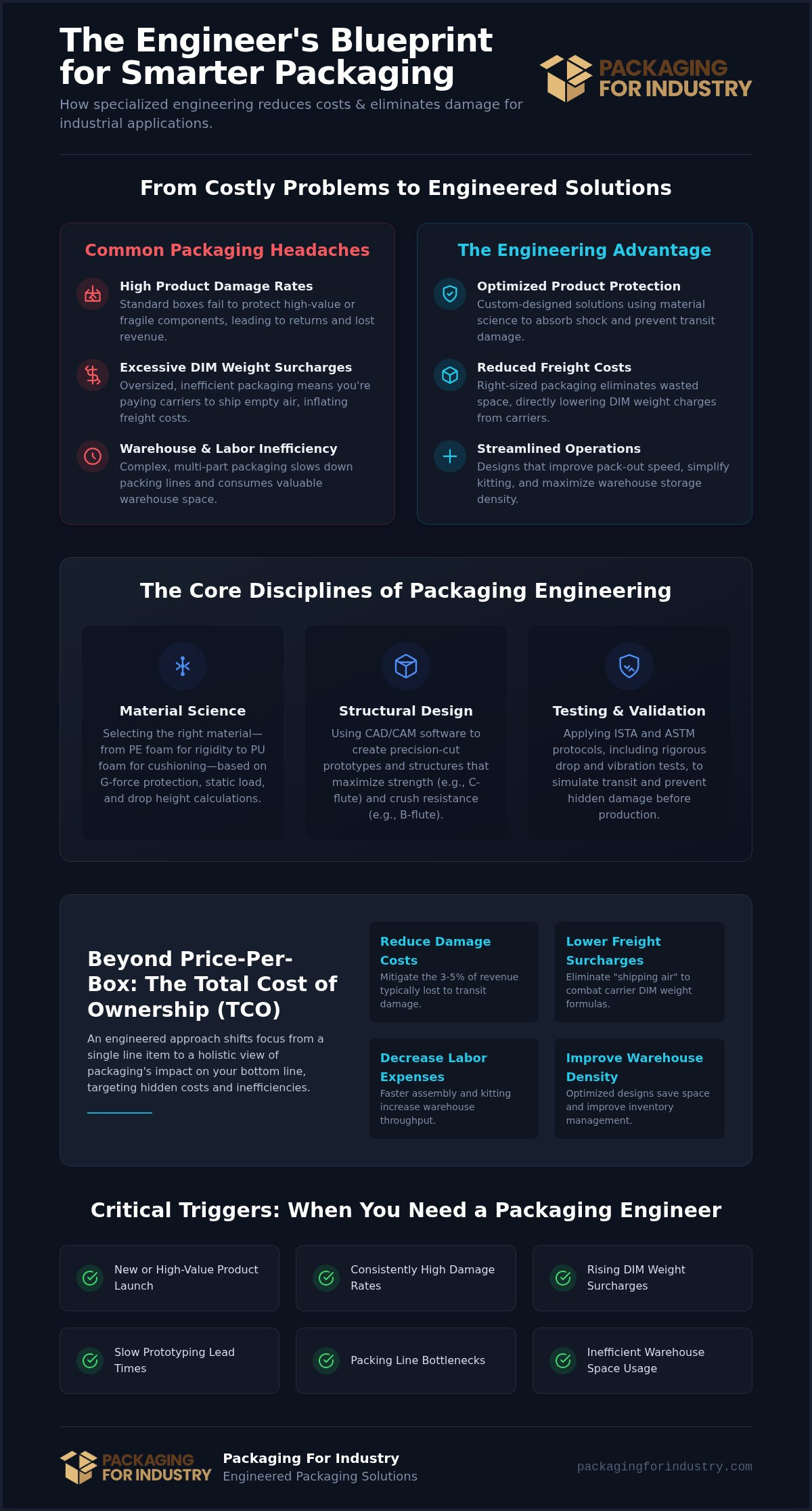
A packaging engineer is a technical specialist who applies the principles of physics, material science, and logistics to design protective systems for industrial goods. Unlike a graphic designer who focuses on brand aesthetics and shelf appeal, a packaging engineer prioritizes structural integrity and fiscal efficiency. They are the “fixers” who ensure a 500-pound piece of medical equipment survives a cross-country haul without a scratch. If you’ve been struggling with high damage rates or inflated shipping costs, understanding what is a packaging engineer and when do I need one in Los Angeles is the first step toward stabilizing your operations.
These professionals use CAD/CAM software to create precision-cut prototypes, allowing for rapid testing before a single production run begins. Their core focus areas include material selection, structural integrity, and environmental sustainability. By leveraging engineering data, they can recommend solutions that reduce the total weight of a package, which directly lowers DIM weight surcharges from carriers like FedEx and UPS. When you ask what is a packaging engineer and when do I need one in Los Angeles, you’re really asking how to safeguard your margins through technical precision.
Material Science and Structural Design
Material selection is the foundation of effective engineering. Choosing between Polyethylene (PE) and Polyurethane (PU) foam isn’t about preference; it’s about G-force protection. PE foam offers high-density rigidity for heavier items, while PU foam provides softer cushioning for delicate components. Integrating these materials into protective foam packaging requires precise calculations of static loading and drop heights. Structural design also extends to corrugated fluting. An engineer might specify B-flute for its superior crush resistance or C-flute for better stacking strength in a high-density warehouse. This level of detail ensures that your packaging is never over-engineered (wasting money) or under-engineered (risking damage).
Testing and Validation Standards
Validation separates a guess from a solution. Packaging engineers utilize ISTA and ASTM testing protocols to simulate the actual rigors of transit. These standards involve rigorous drop testing and vibration analysis to identify “hidden” damage that might not be visible until a customer opens the box. This level of precision is especially vital for the Southern California aerospace corridor. Engineering prevents micro-fractures in aerospace components by neutralizing the specific resonant frequencies encountered during flight and ground transport. By validating designs through these standards, manufacturers can significantly reduce the 3-5% average revenue loss typically associated with transit damage. This methodical approach provides the peace of mind that your products will arrive in factory-perfect condition.
The Economic Impact: How Engineering Reduces Your Total Cost of Ownership
For many procurement managers, the primary goal is often finding the lowest price per box. This narrow focus frequently backfires because it ignores the Total Cost of Ownership (TCO). When you evaluate what is a packaging engineer and when do I need one in Los Angeles, you’re looking for a partner who can reduce the 3% to 5% revenue loss typically associated with transit damage. Engineering isn’t an added expense; it’s a vital cost-recovery strategy that addresses the hidden leaks in your supply chain.
Beyond damage reduction, a packaging engineer focuses on operational efficiency. This includes reducing labor costs through kitting and designing easy-to-assemble custom inserts. If your warehouse team spends three minutes folding a complex box, that’s a labor bottleneck. An engineered solution might reduce that to thirty seconds. By optimizing the physical design of your packaging, you improve throughput and lower the total cost of every unit shipped. This pragmatic approach ensures your packaging works for your bottom line, not against it.
Combatting DIM Weight and Freight Surcharges
Dimensional (DIM) weight formulas used by carriers like UPS and FedEx are profit killers for manufacturers. These formulas calculate shipping costs based on the box’s volume rather than its actual weight. If your box is larger than necessary, you’re effectively paying to ship air. A packaging engineer ‘right-sizes’ your containers to fit the product’s footprint exactly while maintaining necessary protection. With carrier formulas becoming more aggressive in 2026, this optimization is essential for maintaining margins. You can explore more specific cost-reduction strategies to see how right-sizing impacts your annual freight spend.
Damage Reduction and Brand Reputation
The cost of a damaged product extends far beyond the item itself. You must account for the freight for the return, the administrative labor for processing the claim, and the potential loss of customer trust. Custom foam end caps provide a clear example of how engineering solves these issues. A local manufacturer was experiencing recurring transit cracks in high-value electronic housings. By engineering a specific foam density to absorb the exact G-forces encountered during transit, the failure rate dropped to near zero. This ‘sweet spot’ avoids the waste of over-packaging while eliminating the disaster of under-packaging. If your current shipping costs are exceeding your projections, it’s time to compare packaging pricing and see how an engineered approach stabilizes your logistics.
When Do You Need a Packaging Engineer in Los Angeles?
Many Southern California manufacturers wait for a logistical crisis before seeking technical expertise. If you’re launching a high-value medical device or a fragile electronic component, you shouldn’t rely on stock corrugated boxes. This is a primary scenario for asking what is a packaging engineer and when do I need one in Los Angeles. Specialized sectors like aerospace and military manufacturing require strict adherence to compliance standards that generic suppliers simply cannot meet. If your customers are reporting recurring damage despite your use of “heavy-duty” materials, your design, not the material itself, is likely the failure point.
Expanding into international shipping or rigorous 3PL environments also triggers the need for an engineered approach. Global transit involves multiple touchpoints, varying humidity levels, and aggressive handling that standard domestic packaging isn’t designed to survive. When you’re questioning what is a packaging engineer and when do I need one in Los Angeles, look at your return rates. If your “cost of doing business” includes a steady stream of credits for transit cracks or broken seals, you’re essentially paying for an engineer’s salary through lost revenue without receiving the benefits of their expertise.
Trigger Events for Manufacturers
Moving from manual packing to automated lines is a major operational trigger. Automated systems require tight tolerances; a box that’s off by a fraction of an inch can jam a machine and halt production. Similarly, a transition to e-commerce fulfillment requires packaging that survives the “last mile” while maintaining a professional unboxing experience. When material costs for corrugated or foam spike, a design audit becomes a fiscal necessity. An engineer can analyze your current specs to see if a different fluting or foam density provides the same protection at a lower price point, effectively neutralizing market volatility.
Scaling and Operational Efficiency
Operational clutter often signals the need for engineering. If your warehouse is overflowing with 50 different box sizes, you’re wasting valuable square footage and complicating your procurement. An engineer can consolidate 10 disparate SKUs into 3 versatile, multi-depth designs that accommodate your entire product line with minimal void fill. This consolidation simplifies your purchasing process and improves inventory turns. Implementing a Vendor Managed Inventory (VMI) program allows you to sync these engineered designs with your actual production schedule. This ensures you never run out of custom inserts while simultaneously reducing the amount of cash tied up in sitting stock.
The Los Angeles Advantage: Why Local Packaging Engineering Matters
The Southern California manufacturing sector moves faster than almost any other industrial hub in the country. When you’re managing tight production schedules, waiting for an East Coast engineer to ship a sample or respond to a design change is an unacceptable bottleneck. This local urgency is the primary reason to understand what is a packaging engineer and when do I need one in Los Angeles. Having an engineering partner in Anaheim means you can conduct on-site reviews and receive same-day prototypes, allowing you to iterate in hours rather than weeks. This proximity is vital for the aerospace and defense corridor, where precision and compliance with strict military standards aren’t optional.
Designing for the unique rigors of the Port of Long Beach and LAX requires more than just generic knowledge. These hubs present specific environmental and mechanical stressors, from the high-frequency vibrations of air freight to the extreme temperature fluctuations in local distribution centers. A local engineer understands these variables because they see the results of these stressors every day. By choosing a partner who lives and breathes the Southern California logistics landscape, you ensure your protective systems are optimized for the exact path your product takes from the factory floor to the end user.
Local Prototyping and Rapid Iteration
Seeing a physical sample in person is far more valuable than reviewing a 3D render from an overseas supplier. Renders don’t tell you how a foam insert feels or how easily a box folds under pressure. At PFI, we utilize a free prototyping model to remove the barrier to entry for local manufacturers and startups. This allows you to verify the exact fit for specialized custom corrugated boxes before committing to a full production run. Rapid iteration ensures that any design flaws are caught in the design phase, preventing costly mistakes once the product hits the assembly line.
Southern California Logistics Hubs
The “last mile” in Los Angeles is famously difficult. High-volume distribution centers and heavy traffic mean your products spend more time on trucks, increasing the risk of “hidden” damage from constant low-level vibration. Local engineering accounts for these factors, alongside the specific humidity and temperature challenges found in Inland Empire warehouses. Meeting California-specific environmental standards or industry-specific compliance also becomes much simpler with a local guide. When you stop asking what is a packaging engineer and when do I need one in Los Angeles and start leveraging local expertise, you turn your packaging from a liability into a logistical advantage.
How Packaging For Industry (PFI) Delivers Engineered Protection
Packaging For Industry (PFI) functions as your external engineering department. By providing direct access to technical specialists, we eliminate the need for manufacturers to maintain a high-salary, in-house position. This is the ultimate solution when you’re determining what is a packaging engineer and when do I need one in Los Angeles. Our team serves the entire Southern California region, including Orange County and the Inland Empire, providing the local expertise needed to navigate complex supply chains. We don’t just sell boxes; we design integrated systems that combine protective foam packaging with custom corrugated structures to create a single, efficient SKU for your warehouse.
Our process begins with a comprehensive “Packaging Review.” During this audit, we identify specific cost-reduction opportunities that most catalog suppliers overlook. We analyze your current damage rates, material waste, and carrier DIM weight surcharges to build a data-driven case for re-engineering. This pragmatic approach ensures that every change we propose is rooted in fiscal responsibility. We prioritize the intersection of material science and economics, helping you lower packaging costs while simultaneously improving the reliability of your shipments. As a local industrial packaging supplier, we’re positioned to provide the steady, dependable support that large, impersonal distributors cannot match.
The PFI Custom Design Process
The transition from a design concept to a finished product is seamless and highly efficient. Our engineers start with precise product measurements to create detailed CAD designs. We then provide free prototyping services, allowing you to test the physical fit and durability of the solution before committing to a production run. For manufacturers of heavy industrial machinery, we often specify heavy-duty double and triple-wall boxes to ensure maximum stacking strength. To further streamline your operations, we can integrate packaging kitting services. This ensures that all components, from foam inserts to labels, arrive ready for immediate assembly on your production line.
Ready to Optimize Your Packaging?
If you’re tired of dealing with slow lead times and recurring transit damage, a professional packaging audit is the next logical step. PFI offers a consultative partnership that focuses on tangible, real-world outcomes rather than flashy innovation. We understand the unique pressures of the Los Angeles market and provide the proactive problem-solving required to keep your supply chain moving. Stop overpaying for air and start protecting your margins with precision-engineered solutions. Whether you need custom boxes in Los Angeles or specialized aerospace protection, our team is ready to deliver. Take the first step toward a more reliable shipping process today.
Optimize Your Supply Chain with Local Engineering Expertise
Transitioning from stock supplies to engineered protection is a strategic shift that pays dividends through reduced damage and lower freight costs. You’ve learned that a packaging engineer is a cost-reduction specialist who bridges the gap between material science and logistical reality. Understanding what is a packaging engineer and when do I need one in Los Angeles allows you to replace high-overhead in-house positions with a specialized local partner who understands the specific stressors of the Port of Long Beach and LAX.
PFI provides the technical oversight and specialized aerospace and defense expertise required to navigate strict compliance standards. We remove the risk from your procurement process through free prototyping and samples, ensuring every custom foam insert and corrugated box fits your product perfectly. Our commitment to local next-day delivery in Southern California ensures your production line never stalls due to packaging lead times. We’re here to help you move beyond the “price per box” mindset and focus on total logistical efficiency.
It’s time to stop overpaying for air and start protecting your margins with precision-engineered solutions. We’re ready to help you build a more reliable and cost-effective supply chain today.
Frequently Asked Questions
What is the difference between a packaging designer and a packaging engineer?
A packaging designer primarily handles the visual branding, graphics, and shelf appeal of a container to attract consumers. A packaging engineer focuses on the structural integrity, material science, and logistical durability required to protect industrial goods. While the designer makes the box look professional, the engineer ensures it survives the physical stressors of a high-volume distribution center or international transit.
How much money can a packaging engineer actually save my business?
An engineer saves your business money by reducing the average 3% to 5% revenue loss from transit damage and optimizing your total freight spend. By re-engineering a design to eliminate unnecessary void space, you can significantly lower your total cost of ownership. These savings also manifest as reduced labor hours when your team uses easy-to-assemble custom inserts instead of complex manual packing methods.
Does a packaging engineer help with sustainable or eco-friendly materials?
Yes, engineering is a core component of modern sustainable packaging strategies. An engineer reduces environmental impact by right-sizing containers to use less material and selecting recyclable corrugated fluting or biodegradable foam inserts. This technical approach ensures your sustainability goals don’t compromise the structural protection your product requires during its journey through the supply chain.
Can a packaging engineer help reduce my UPS or FedEx shipping costs?
Packaging engineers directly reduce carrier costs by minimizing the dimensional (DIM) weight of your shipments. Carriers charge based on box volume; an oversized box is a direct drain on your profit margins. If you’re asking what is a packaging engineer and when do I need one in Los Angeles, a primary reason is to audit your current box sizes against the latest carrier rate formulas to stop paying for empty space.
What industries in Los Angeles most commonly use packaging engineers?
The most common sectors in Southern California include aerospace, medical device manufacturing, electronics, and automotive parts. These industries require precision-engineered protection to meet strict safety and military compliance standards. E-commerce fulfillment centers and food distributors also use engineers to stabilize pallet loads and ensure high-value goods arrive without “hidden” vibration damage.
How long does the custom packaging engineering process take at PFI?
The custom engineering process at PFI is built for the rapid pace of the Southern California market. Once we have your product measurements and fragility requirements, initial CAD designs and physical prototypes are often ready within a few business days. This proximity allows Los Angeles manufacturers to move from the design phase to full production without the long lead times associated with out-of-state suppliers.
Do I need to hire a full-time packaging engineer for my small manufacturing firm?
Most small to mid-sized manufacturing firms don’t need the overhead of a full-time, in-house engineer. Partnering with a specialized supplier like PFI gives you access to high-level engineering expertise on a project-by-project basis. This model provides the technical benefits of a seasoned “fixer” without the high salary and benefits costs of a permanent staff member.
What information do I need to provide for a packaging engineering review?
To begin a review, you should provide the physical dimensions, weight, and G-force tolerance of your product. It’s also helpful to share your current damage history and typical shipping destinations. This data allows our team to determine what is a packaging engineer and when do I need one in Los Angeles to solve your specific logistical bottlenecks and stabilize your shipping costs.