
Shipping damage isn’t just an operational headache; it’s a direct tax on your company’s bottom line that erodes profit margins and damages customer trust. You’re likely facing constant pressure to lower material costs while simultaneously being told that returns and insurance claims must disappear. It’s a difficult balance to strike, especially when you’re unsure if your current corrugated boxes and foam inserts are truly engineered for the rigors of the road. Validating a packaging design with ISTA testing in Southern California provides the data-driven certainty you need to stop guessing and start optimizing.
We understand that navigating laboratory standards can feel like an unnecessary hurdle in your production timeline. However, this process is actually your most effective tool for reducing freight costs and proving your designs are transit-ready. This article will show you how to leverage ISTA testing to eliminate damage and refine your packaging dimensions for maximum efficiency. We’ll examine the specific protocols required for industrial sectors like aerospace and medical manufacturing; ensuring your supply chain remains reliable and cost-effective from the warehouse to the final destination.
Key Takeaways
- Learn how to obtain certified proof that your packaging is transit-ready, effectively reducing insurance claims and expensive product returns.
- Understand the specific requirements of ISTA 1 and 2 series protocols to ensure your designs meet the necessary durability standards for industrial shipping.
- Discover the engineering process for validating a packaging design with ISTA testing in Southern California to secure your supply chain before mass production.
- Identify ways to optimize corrugated and foam dimensions, allowing you to lower freight costs while maintaining superior protection for high-value components.
- Leverage local expertise and free prototyping to navigate the unique environmental stresses of the Southern California logistics network, from port handling to desert heat.
What is ISTA Testing and Why Does Your Packaging Design Need Validation?
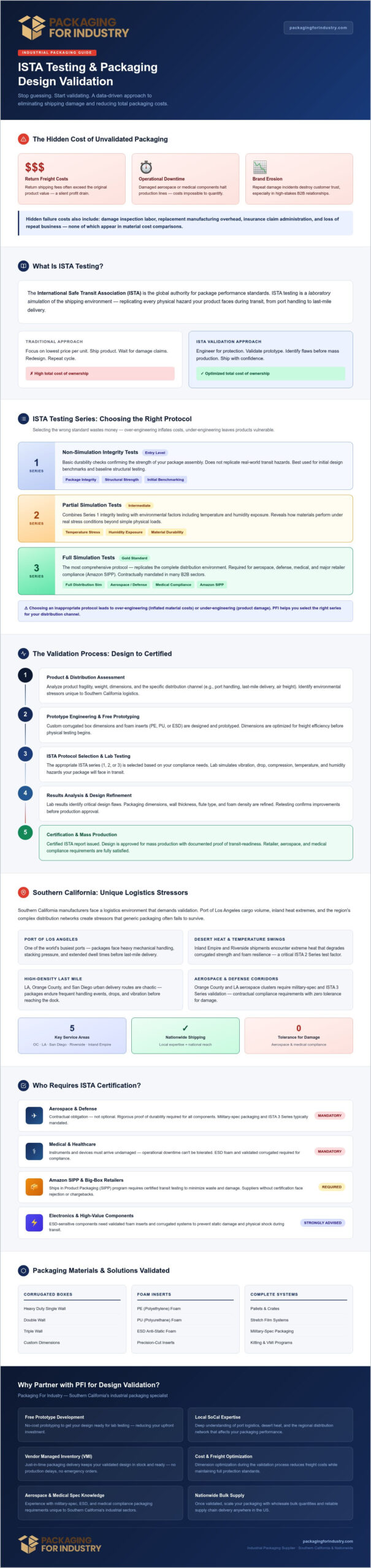
The International Safe Transit Association (ISTA) serves as the global authority for package performance standards. ISTA testing is a laboratory simulation of the shipping environment, designed to replicate the physical hazards your products face during transit. For manufacturers in Orange County or Los Angeles, validating a packaging design with ISTA testing in Southern California is a strategic move that moves beyond simple procurement. While many procurement managers focus solely on sourcing wholesale packaging supplies at the lowest price per unit, validation focuses on the total cost of ownership. It transforms your packaging from a simple container into a verified protection system that guards against the unpredictable stresses of the road.
Validation ensures that your custom corrugated boxes are engineered to survive both the chaotic “last mile” of local delivery and the sustained rigors of long-haul transit. By subjecting prototypes to these simulations, we identify critical design flaws before you commit to high-volume production. When you prioritize validating a packaging design with ISTA testing in Southern California, you’re investing in a reliable outcome rather than a hopeful guess. This proactive approach prevents the costly cycle of shipping, failing, and redesigning after your product has already reached the customer’s dock.
The Cost of Failure: Shipping Damage vs. Validation
In the B2B industrial sector, the impact of shipping damage extends far beyond the cost of a single broken item. It erodes brand reputation and compromises customer retention, especially when dealing with high-stakes aerospace or medical components. If a specialized instrument arrives damaged, the client faces operational downtime that can’t be easily quantified. The financial drain of failure is often underestimated by those who only look at material costs.
The hidden costs of returns often exceed the value of the product itself. These expenses include return freight management, labor costs for damage inspection, and the administrative overhead of replacement manufacturing. Validating your design acts as a specialized insurance policy. It provides the technical assurance that high-value gear will arrive in pristine condition, eliminating the financial drain of avoidable claims and protecting your profit margins from the “damage tax” that unvalidated designs often incur.
Meeting Retailer and Industry Compliance
Adhering to ISTA standards is frequently a prerequisite for doing business with major entities. Programs like Amazon SIPP (Ships in Product Packaging) and requirements from big-box retailers mandate certified transit testing to minimize waste and damage. In the aerospace and defense industries, compliance isn’t optional; it’s a contractual obligation that requires rigorous proof of durability. Southern California manufacturers face unique pressure to optimize their packaging due to the high volume of cargo moving through the Port of Los Angeles. Implementing a validated design ensures your business meets these strict industry standards while maintaining a competitive edge in a demanding logistics network.
Understanding Key ISTA Series Standards for Industrial Packaging
Selecting the right test protocol is a critical step in validating a packaging design with ISTA testing in Southern California. Choosing an inappropriate standard can lead to over-engineering, which inflates your material costs, or under-engineering, which leaves your products vulnerable to damage. The International Safe Transit Association organizes these protocols into numerical series based on the level of simulation required for your specific distribution channel. We help you navigate these choices to ensure your test results are both accurate and actionable.
- ISTA 1 Series: These are non-simulation integrity tests. They serve as basic durability checks to confirm the strength of your package assembly. While they don’t replicate real-world hazards, they’re useful for initial design benchmarks.
- ISTA 2 Series: This series introduces partial simulation. It combines the integrity testing of Series 1 with environmental factors like temperature and humidity to see how materials hold up under stress.
- ISTA 3 Series: Often considered the gold standard, this is a general simulation of actual shipping hazards. It’s designed to mimic the physical rigors of parcel and LTL distribution environments.
- ISTA 6 Series: These are custom standards developed for specific member organizations. This includes protocols like Amazon SIPP, as well as specific requirements for retailers like Walmart and Sam’s Club.
Parcel vs. LTL: Choosing the Right Test
The way your product travels determines the stresses it must survive. ISTA 3A is the primary standard for small parcel shipments moved by carriers like UPS or FedEx. It focuses on high-impact drops and the intense vibrations found in automated sorting facilities. In contrast, ISTA 3B is tailored for Less-Than-Truckload (LTL) freight. In an LTL environment, the primary risks are heavy stacking pressure and sustained structural vibrations during long-haul trucking. Understanding these differences allows you to compare packaging pricing and performance based on actual transit conditions.
Specialized Testing for Heavy Equipment
When shipping industrial machinery or unitized loads, standard drop tests aren’t sufficient. ISTA 1E and 3E protocols are specifically designed for palletized shipments and bulk containers. These tests evaluate the stability of the entire load, focusing on the risks of horizontal impacts and “tip-and-tilt” hazards during forklift handling. These standards are essential for verifying the performance of heavy-duty skids and custom shipping crates. Validating a packaging design with ISTA testing in Southern California ensures your heavy equipment survives the journey through regional hubs like the Inland Empire without compromising its structural integrity.
The Packaging Validation Process: From Design to Lab
Successful validation starts long before the package reaches the laboratory. It begins with precise engineering that balances material physics with logistics reality. Validating a packaging design with ISTA testing in Southern California requires a methodical four-phase approach to ensure your product survives the supply chain without overspending on unnecessary layers of protection. This structured journey transforms a conceptual drawing into a certified shipping solution.
- Phase 1: Initial Engineering. We use CAD/CAM software to develop a protective blueprint. This stage accounts for the G-force tolerances of your product and the specific dimensions required for pallet optimization.
- Phase 2: Prototyping. We translate the digital design into a physical sample. This includes integrating custom foam inserts with precision-cut corrugated components to create a unified protective unit.
- Phase 3: Lab Execution. The prototype is sent to a certified facility for a battery of trials, including drop, vibration, and atmospheric compression testing.
- Phase 4: Post-Test Analysis. We examine the package and the product for any signs of fatigue or failure. If the design exceeds requirements, we look for opportunities to reduce material usage and lower your costs.
Prototyping: The Critical Pre-Test Step
You shouldn’t send a design to the lab without knowing how it feels in the real world. Our free prototyping service allows your operations team to perform “fit-and-feel” testing at your own facility before committing to formal validation. By using die-cut foam and heavy-duty double-wall corrugated, we build a transit-ready sample that is engineered to pass. This high level of custom design packaging ensures that when we finally move to validating a packaging design with ISTA testing in Southern California, the lab results are a confirmation of success rather than a surprise failure.
Inside the Testing Lab: What Actually Happens?
The laboratory environment is designed to be unforgiving. Drop testing replicates the manual handling errors and conveyor belt tumbles common in Los Angeles sortation centers. Vibration testing uses specialized tables to mimic the engine harmonics and road surface shocks your freight experiences on the long haul through the Inland Empire. Finally, compression testing evaluates stackability. It measures how many units can be safely tiered in a warehouse or trailer before the bottom box buckles. Each test provides the empirical data needed to guarantee your supply chain remains reliable and damage-free.
Optimizing the Southern California Supply Chain
Southern California serves as the most concentrated logistics hub in the United States. Between the massive throughput at the Port of Los Angeles and the Port of Long Beach and the sprawling distribution networks in the Inland Empire, your cargo faces a gauntlet of physical and environmental challenges. Validating a packaging design with ISTA testing in Southern California is the only way to ensure your materials can withstand these specific regional pressures. It’s about engineering a solution that accounts for the reality of your local distribution channel.
Environmental stress is a frequently overlooked factor in Southern California transit. A shipment leaving a temperature-controlled facility in Orange County might travel through the extreme desert heat of Riverside or San Bernardino before reaching its final destination. This rapid fluctuation in temperature and humidity can weaken corrugated fibers and cause certain adhesives to fail. By validating a packaging design with ISTA testing in Southern California, we simulate these atmospheric changes in the lab. This allows us to select materials that maintain their structural integrity regardless of the external weather conditions.
Freight cost reduction is another primary driver for validation. Many manufacturers use oversized boxes filled with excessive void-fill because they’re afraid of shipping damage. This practice leads to high dimensional (DIM) weight charges. As a comprehensive stretch wrap supplier, we also evaluate how load containment and film performance contribute to the stability of the entire pallet. Validation provides the empirical data needed to justify smaller box footprints and lower your total shipping spend.
Reducing Shipping Damage in Local Transit
Rough handling is a constant reality in high-volume distribution centers across Los Angeles and Anaheim. Packages are frequently subjected to rapid sorting, side-shifter impacts from forklifts, and unstable stacking. To combat this, we often integrate corner and edge protection into our designs. Local manufacturers who validate their designs for LTL transit find they can significantly reduce the frequency of crushed corners and punctured sidewalls. This proactive engineering keeps your products in “A” grade condition and prevents the logistical nightmare of processing local returns.
Lowering Packaging Costs with Engineered Solutions
Our goal is to move your operation from “over-packaged” to “right-sized” using verified lab data. We’ve helped numerous aerospace and electronics companies transition from expensive, heavy-duty triple-wall corrugated to optimized double-wall structures without increasing damage rates. By utilizing high-performance protective foam packaging, we can often reduce the total amount of material used while improving shock absorption. This shift results in immediate packaging cost savings by reducing material spend and shipping weight.
Why Partner with Packaging For Industry (PFI) for Design Validation?
Choosing a partner for validating a packaging design with ISTA testing in Southern California requires more than just a laboratory contact. It demands an engineering team that understands how to translate lab data into a repeatable, cost-effective production run. As a leading industrial packaging supplier near me, Packaging For Industry (PFI) bridges the gap between design theory and warehouse reality. Based in Anaheim, our team provides direct access to specialists who have spent decades solving shipping damage for the region’s most demanding manufacturers. We act as a seasoned consultant to ensure your design isn’t just safe, but also optimized for your specific operational workflow.
We specialize in integrated solutions that combine heavy-duty corrugated, custom foam inserts, and wood crates into a single, validated unit. This holistic approach is essential for Aerospace and medical device firms that cannot afford even a minor component failure. Once your design passes the necessary ISTA protocols, we act as your bulk packaging supplier to transition into full-scale production smoothly. By utilizing our Vendor Managed Inventory (VMI) programs, you ensure that your validated packaging is always in stock, reducing lead times and freeing up valuable floor space in your facility.
Engineering Expertise and Prototyping
Our engineering department provides comprehensive CAD support to develop protective blueprints for complex electronics and sensitive industrial gear. We don’t just design for safety; we design for economic efficiency. This includes addressing the common problem of UPS and FedEx surcharges that often plague unoptimized designs. We use rapid prototyping to test and refine your designs quickly, ensuring you meet tight production deadlines while staying under carrier surcharge thresholds. Our team evaluates material density and structural geometry to ensure every prototype is ready for the rigors of the testing lab.
Reliable Supply and Local Delivery
Being an Anaheim packaging supplier means we are positioned to support the entire Southern California corridor with speed and precision. We provide next-day local delivery for custom boxes in Orange County, Los Angeles, San Diego, and the Inland Empire. For firms with a broader reach, our nationwide shipping capabilities ensure consistency across all your production sites. Validating a packaging design with ISTA testing in Southern California is the first step toward a more resilient supply chain. Request a custom packaging quote today to begin your engineering and validation process.
Secure Your Supply Chain with Data-Driven Design
Relying on guesswork for your industrial packaging is a risk your bottom line can’t afford. By prioritizing engineered protection, you move beyond the cycle of shipping damage and costly returns. We’ve explored how ISTA standards provide a rigorous framework for performance; ensuring your high-value aerospace or medical components are truly transit-ready. Validating a packaging design with ISTA testing in Southern California is the most effective way to optimize material usage, lower dimensional weight, and navigate the unique logistical stresses of the Los Angeles and Inland Empire corridors with total confidence.
Our Anaheim-based team is ready to serve as your engineering partner throughout this process. We offer free prototyping for new designs to ensure a perfect fit before you commit to laboratory trials. Whether you need heavy-duty corrugated or specialized foam inserts, we provide the technical expertise required to meet strict industry compliance. We’re focused on helping you build a more reliable and cost-effective distribution network that supports your long-term operational goals.
Frequently Asked Questions
How much does ISTA testing cost in Southern California?
Laboratory fees are determined by the specific test series you select and the total number of samples required for a statistically valid result. While we don’t set these external lab prices, we help you control costs by refining your design through free prototyping before the formal trial begins. This engineering-first approach ensures you don’t pay for multiple rounds of failed tests, allowing you to allocate your budget toward finalized, high-performance materials.
What is the difference between ISTA 3A and ISTA 2A?
ISTA 3A is a general simulation protocol specifically designed for small parcel shipments under 150 pounds, replicating the intense vibrations and drops of carriers like UPS and FedEx. ISTA 2A is a partial simulation that combines basic integrity testing with environmental conditioning, such as temperature and humidity. Choosing the correct series is vital for validating a packaging design with ISTA testing in Southern California, as it ensures your materials are tested against relevant transit hazards.
How long does the packaging validation process take?
The entire process typically spans two to four weeks from the initial engineering phase to the final lab report. This timeline accounts for CAD design, physical prototyping of custom foam inserts, and the time required for the laboratory to execute the chosen test series. We work closely with local Southern California lab partners to streamline this schedule, helping you meet tight production deadlines and product launch windows without compromising on safety or compliance.
Do I need ISTA testing for every product I ship?
Testing isn’t legally required for every item, but it’s a strategic necessity for high-value industrial gear or products prone to shipping damage. Many major retailers and aerospace contractors mandate ISTA certification as a condition of their purchase agreements. Even when it isn’t required, validation serves as a critical data point for right-sizing your packaging, ensuring you aren’t overspending on heavy-duty materials for products that don’t actually require them.
Can PFI help me if my current packaging is already failing ISTA tests?
Yes, we act as a “fixer” for designs that have failed previous laboratory trials. Our team performs a forensic analysis of the failure points to determine if the issue is related to foam density, box structural integrity, or insufficient cushioning. We then provide an engineered redesign and new prototypes to ensure you pass the next round of testing. This service is essential for manufacturers who need to resolve damage issues quickly to maintain their supply chain reliability.
What are the most common reasons for packaging design failure?
Most failures occur because the design doesn’t account for the cumulative stress of vibration fatigue or the compression forces of stacked LTL freight. Under-engineered corner protection and using the wrong grade of protective foam are also frequent culprits. Validating a packaging design with ISTA testing in Southern California identifies these structural weaknesses in a controlled environment, allowing us to reinforce the package before it reaches the high-volume distribution centers in Los Angeles or the Inland Empire.
Is ISTA testing required for international shipping from the Port of LA?
The Port of Los Angeles does not mandate ISTA testing by law, but international carriers and overseas buyers often require it for high-value industrial machinery. Certification provides a universal language of quality that reassures global partners your cargo is prepared for the long-haul maritime environment. It also helps you meet the strict durability standards required for inland transport once your goods arrive at their international destination port.
Does ISTA validation help with freight insurance claims?
ISTA validation provides the empirical evidence needed to prove your packaging was transit-ready at the time of shipment. When a claim occurs, having a certified lab report demonstrates that you exercised professional due diligence in protecting your cargo. This documentation significantly strengthens your position during disputes with insurance providers or freight carriers, as it shifts the burden of proof away from your packaging design and toward the handling of the carrier.