
The most expensive piece of equipment in your warehouse becomes a liability the moment it’s packed into a case that doesn’t fit. If your sensitive gear is shifting during transit or arriving with internal damage, the problem isn’t the outer shell; it’s the lack of precision in your internal cushioning. You’ve likely dealt with the frustration of long lead times from national catalog companies or foam that degrades after just a few trips. Finding reliable custom foam inserts for hard cases in Orange County is about more than just aesthetics. It’s about protecting your bottom line and ensuring your high-value kits maintain a professional presentation for every client.
We agree that operational efficiency shouldn’t be sacrificed for equipment safety. This industrial guide will teach you how to specify, source, and optimize custom foam inserts to eliminate shipping damage and reduce procurement costs. We’ll examine the technical differences in foam densities, the benefits of local CAD/CAM prototyping, and how to transition to a reliable regional supplier that keeps your production lines moving without the typical delays of a fragmented supply chain.
Key Takeaways
- Understand why standard “pluck foam” fails in high-vibration industrial environments and how precision-engineered inserts prevent internal equipment movement.
- Identify the optimal material for your application by comparing the high-impact protection of Polyethylene (PE) with the soft cushioning of Polyurethane (PU).
- Learn the technical criteria for specifying custom foam inserts for hard cases in Orange County to ensure 100% accuracy for sensitive electronics and calibrated gear.
- Evaluate the cost-efficiency of CNC routing for complex, low-volume prototypes versus die-cutting for high-volume recurring production runs.
- Discover how local prototyping and next-day delivery from an Anaheim-based supplier can reduce your lead times and lower overall procurement costs.
The Critical Role of Custom Foam Inserts in Industrial Hard Cases
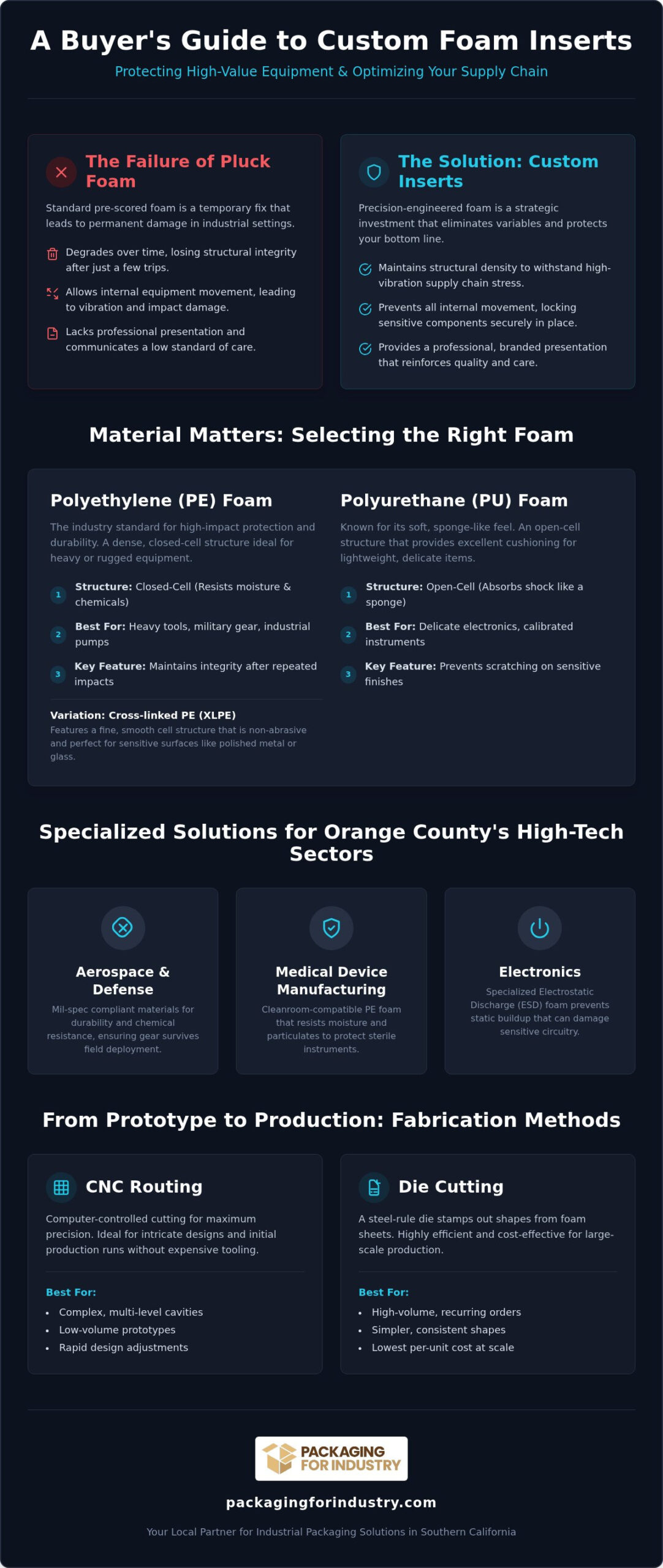
Standard “pluck foam” is a temporary fix that often leads to permanent equipment failure in industrial environments. While these pre-scored cubes are convenient for hobbyists, they lack the structural density required to withstand the high-vibration stresses of a typical supply chain. Over time, the perforated edges of pluck foam degrade, creating internal movement that allows sensitive electronics or calibrated instruments to strike the hard walls of the case. For manufacturers and logistics managers, sourcing custom foam inserts for hard cases in Orange County is a strategic move to eliminate these variables.
The financial logic is straightforward. The cost of a single precision-engineered foam insert is a fraction of the expense required to repair a damaged medical laser or recalibrate an aerospace sensor. Beyond simple protection, custom inserts provide a professional presentation that reinforces your brand’s reputation during field demonstrations or high-value deliveries. When your team opens a case in front of a client, a perfectly fitted, CNC-routed insert communicates technical competence and care. It transforms a standard shipping container into a cohesive, branded kit.
Serving Orange County’s High-Tech Sectors
Southern California is a global hub for specialized manufacturing, and each sector has unique requirements for protective foam packaging. We design solutions that meet the specific environmental challenges of your industry.
- Aerospace and Defense: Companies in Irvine and Huntington Beach require materials that meet strict mil-spec standards for durability and chemical resistance. Our designs ensure gear survives the rigors of flight and field deployment.
- Medical Device Manufacturing: We provide cleanroom-compatible Polyethylene (PE) foam that resists moisture and particulates. This ensures that sterile instruments remain protected without risk of contamination from shedding fibers.
- Electronics: For sensitive circuitry, we utilize specialized Electrostatic Discharge (ESD) foam. This prevents static buildup that can fry components during transit, a critical failure point for high-value electronics.
Beyond Protection: Organization and Accountability
Custom foam does more than cushion; it organizes. By using shadow-boxing techniques, where each tool has a dedicated, color-coded cutout, your team can identify missing items at a glance. This level of tool control is vital for field technicians working on complex assemblies where a single forgotten part can cause significant operational delays or safety hazards. We help businesses in Anaheim and Santa Ana implement packaging kitting solutions that streamline the assembly process and improve overall warehouse efficiency. Transitioning to a reliable local supplier allows you to lower packaging costs by reducing lead times and eliminating the overhead of national distributors. Whether you need a single prototype or a bulk order, local production ensures your gear stays safe and your workflows remain uninterrupted.
Comparing Foam Materials: Polyethylene vs. Polyurethane
Selecting the right material is the most critical decision in the design of custom foam inserts for hard cases in Orange County. While the outer shell provides a barrier against the elements, the foam material dictates how much shock energy actually reaches your equipment. Professional buyers must distinguish between open-cell and closed-cell structures to ensure long-term reliability and cost-effectiveness. Choosing the wrong density doesn’t just risk damage; it leads to premature foam fatigue and increased replacement costs.
Polyethylene (PE) is the industry standard for high-impact protection. It’s a closed-cell foam that doesn’t absorb moisture and maintains its structural integrity after repeated impacts. This makes it ideal for heavy power tools, industrial pumps, or military gear that sees frequent field use. For items with sensitive finishes, Cross-linked Polyethylene (XLPE) offers a much finer cell structure. It has a smooth, non-abrasive surface that won’t scratch polished metal or glass, providing a high-end aesthetic for professional sales kits. If you’re managing a high-volume rollout, you can compare packaging pricing for different PE grades to find the right balance of protection and budget.
Polyurethane (PU) serves a different purpose. This open-cell foam is soft and flexible, behaving much like a sponge. It’s the preferred choice for lightweight, highly delicate instruments like fiber optic sensors or medical glassware. Because it’s less dense, it provides superior deceleration for light objects that would simply bounce off firmer PE foam. This ensures that even the slightest vibration is dampened before it reaches the internal components of your gear.
Understanding Foam Density and Compression
Foam density represents the mass per unit volume and dictates how effectively the material supports a specific weight without bottoming out during impact. Choosing a density that’s too low leads to a failure known as bottoming out, where the equipment strikes the case wall despite the padding. Conversely, a density that’s too high transmits too much shock directly to the gear. We calculate the required density by analyzing the equipment’s weight and its fragility rating, ensuring that your custom foam inserts for hard cases in Orange County provide the exact G-force protection required for your specific model.
Specialized Foam Additives for Industrial Use
Standard foam isn’t always sufficient for specialized industrial environments. Many aerospace and military applications require fire-retardant (FR) additives to meet strict safety compliance standards. In the oil and gas sector, chemical-resistant foam properties are necessary to prevent the material from degrading when exposed to lubricants, fuels, or cleaning solvents.
For electronics manufacturers, the distinction between anti-static and conductive foam is vital. Anti-static foam, typically identified by its pink color, prevents the generation of static electricity caused by movement during transit. Conductive foam, usually black, actually dissipates existing charges. Selecting the wrong ESD protection can lead to latent component failure that isn’t discovered until the equipment is deployed in the field, making material expertise a non-negotiable requirement for your supplier.
Fabrication Techniques: CNC Routing vs. Die-Cutting
Selecting a material is only the first step in the procurement process. The method used to shape that material determines both the precision of the fit and the final unit cost. For custom foam inserts for hard cases in Orange County, the fabrication technique must align with your production volume and the complexity of your gear. Using the wrong method can result in either excessive lead times for complex shapes or unnecessary tooling costs for simple, high-volume runs.
CNC routing and water-jet cutting represent the high-precision end of the spectrum. CNC routing is a subtractive process that uses computer-controlled bits to carve intricate, multi-depth pockets into foam planks. It’s the ideal choice for custom design packaging because it requires no physical dies, allowing for rapid adjustments to the design without financial penalty. Water-jet cutting uses a high-pressure stream of water to slice through thick foam planks, often up to 6 inches deep, with perfectly vertical edges that a physical blade or router bit might struggle to maintain. These methods are perfect for low-to-medium volume orders or highly complex instruments that require contoured support.
When your design is finalized and you move into recurring production, lamination and assembly techniques allow us to create multi-layer inserts. By heat-bonding different foam densities or colors together, we can produce the “shadow-boxing” effect mentioned earlier. This isn’t just for aesthetics; it provides a structural base that supports the weight of the equipment while offering a softer top layer for surface protection.
The Precision of CNC Foam Fabrication
CNC fabrication is the preferred choice for prototype development. Because the process is entirely digital, we can take your CAD files and produce a physical sample in our Anaheim facility within days. This allows your engineering team to verify the fit of sensitive components before committing to a larger production run. It accommodates complex 3D shapes and varying depths within a single foam block, ensuring that every part of your kit is supported at its specific center of gravity.
Scaling Production with Die-Cutting
Die-cutting is the most cost-efficient solution for high-volume recurring orders. While this method requires an initial investment in a steel-rule die, the per-unit cost drops significantly as volume increases. For custom foam inserts for hard cases in Orange County manufacturers who need thousands of identical inserts, die-cutting offers unmatched consistency and speed. Lead times for die-cut orders are often shorter once the tooling is created, as the press can stamp out hundreds of inserts per hour. We help procurement managers analyze the “pivot point” where the upfront tooling cost of a die becomes more economical than the per-minute machine time of a CNC router.
Buying Guide: How to Specify Your Custom Foam Requirements
Procuring custom foam inserts for hard cases in Orange County requires a methodical approach to ensure the final product meets both engineering tolerances and budgetary constraints. A vague request for “protective foam” often leads to misaligned cutouts or inadequate protection levels. Operations managers can streamline the quoting process and ensure first-time accuracy by following a standardized specification checklist. This structured data allows our design team to move quickly from a concept to a functional prototype without the back-and-forth delays typical of less experienced suppliers.
- Step 1: Identify the Case Model: Provide the manufacturer and model number of your hard case. If you’re using a custom container, we require the exact internal length, width, and depth, including the lid clearance.
- Step 2: Inventory Your Components: List every item that must fit in the kit. Note the weight and fragility level of each piece to help us determine the appropriate foam density for shock absorption.
- Step 3: Evaluate the Environment: Determine if the kit will face extreme temperatures, moisture, or sensitive electronic environments that require specialized ESD-safe materials.
- Step 4: Design the Layout: Arrange the gear with the heaviest items near the center of gravity. Ensure there is at least one inch of foam “wall” between components to maintain the structural integrity of the insert.
- Step 5: Request a Prototype: Never skip the physical test. We provide free prototyping services to verify the fit and density before you commit to a bulk production run.
Measuring for a Precision Fit
A precision fit is about more than just a tight grip; it’s about accessibility and long-term durability. We recommend implementing the “Finger-Hole” rule, which involves adding small half-moon cutouts at the sides of deep pockets so technicians can easily retrieve gear without prying at the foam edges. Don’t forget to account for clearance for coiled cables, spare batteries, and peripheral accessories that often take up more volume than the primary device. To generate CAD-ready specifications, use a digital caliper to record the maximum length, width, and depth of each component at its widest points, including any protruding knobs, handles, or lenses.
Procurement Tips for Operations Managers
Optimizing your internal layout can lead to significant packaging cost savings by allowing you to use a smaller, lighter case. This reduces the overall footprint and helps you avoid the dimensional weight surcharges frequently applied by carriers like UPS and FedEx. For companies with recurring needs, leveraging a Vendor Managed Inventory (VMI) program ensures you never run out of inserts during a peak production cycle. By partnering with a local industrial packaging supplier, you gain the agility to adjust designs on the fly while maintaining a lean warehouse operation. This localized oversight eliminates the shipping delays and communication gaps common with national catalog suppliers.
Packaging For Industry: The OC Leader in Custom Foam Inserts
PFI isn’t just a distributor; we’re a specialized Anaheim packaging supplier with the engineering depth to solve complex logistics problems. While national catalog companies offer generic solutions, our local team works directly with your engineers to design custom foam inserts for hard cases in Orange County. This localized oversight ensures that every specification is met before the first production run starts. For manufacturers requiring comprehensive protection, we integrate these inserts with heavy-duty corrugated boxes or custom crates. Whether you need custom boxes in Irvine or specialized kitting in Santa Ana, our facility manages the entire process from design to final delivery. While we’re a local leader, we also maintain robust nationwide shipping capabilities to support your satellite facilities across the country.
Our approach centers on fiscal responsibility and operational reliability. By functioning as an industrial packaging supplier near me for Southern California businesses, we can offer local next-day delivery that distant competitors can’t match. This proximity is vital for the Orange County aerospace and medical device sectors, where lead times are often the difference between a successful launch and a stalled production line. We support local pickups and provide on-site engineering reviews to ensure your gear is protected to mil-spec standards. Our goal is to function as a seamless extension of your warehouse, providing the agility needed to handle urgent orders or mid-cycle design changes.
Local Logistics and Next-Day Delivery
Reducing lead times is a core component of how we help you lower packaging costs. When you’re dealing with sensitive electronics or calibrated gear, waiting weeks for a shipment from an out-of-state vendor isn’t an option. Our Anaheim headquarters is positioned to provide rapid response times for the entire Southern California region. This local presence allows us to offer Vendor Managed Inventory (VMI) programs where we monitor your stock levels and deliver foam inserts or custom boxes in Orange County exactly when your production schedule demands it. You get the benefits of a local partner with the logistical reach of a national provider.
Request Your Custom Foam Quote Today
Getting started is a straightforward process focused on your bottom line. As a high-volume bulk packaging supplier, we provide the CAD/CAM support necessary to translate your equipment dimensions into precision-cut foam. We offer free prototyping to verify the fit and density of your custom foam inserts for hard cases in Orange County before you commit to a bulk order. This eliminates the risk of procurement errors and ensures your high-value kits are ready for immediate deployment. Contact our team today to request a custom packaging quote and see how a local partner can improve your supply chain reliability.
Optimize Your Industrial Protection Strategy
Precision in packaging is a direct investment in your equipment’s longevity and your brand’s professional reputation. We’ve examined how selecting the correct foam density prevents internal movement and eliminates shipping damage. By utilizing local CNC fabrication, you eliminate the long lead times of national suppliers and ensure your gear is protected by materials that meet strict aerospace and medical standards. This methodical approach ensures your kits arrive ready for field deployment every time.
Implementing custom foam inserts for hard cases in Orange County through a local partner allows for immediate design adjustments and on-site engineering support. Our Anaheim facility provides free prototyping. This ensures a 100% accurate fit before you commit to bulk production. Localized oversight reduces procurement stress and helps you lower overall packaging costs while maintaining a lean, responsive supply chain. You don’t have to settle for off-the-shelf cushioning when a precision-engineered alternative is available right here in Southern California.
We’re ready to help you secure your high-value equipment with a protection system built specifically for the rigors of your industry.
Frequently Asked Questions
What is the best foam for heavy industrial equipment in hard cases?
Polyethylene (PE) is the most effective material for heavy-duty protection. Its closed-cell structure ensures it doesn’t compress or lose its shape under the weight of industrial pumps, motors, or heavy power tools. Unlike softer alternatives, PE foam provides the high-impact resistance necessary for gear that faces frequent field deployment and rough handling in the supply chain.
Do I need to provide a CAD file for my custom foam insert?
You don’t need a CAD file to get started with a design. While digital drawings accelerate the process, our engineering team can create precise specifications by measuring your physical gear or using technical data sheets. We provide full CAD/CAM support to ensure your components fit perfectly, regardless of whether you have existing design files or just a physical prototype.
How much does a custom foam insert typically cost in Orange County?
Pricing is determined by material choice, the complexity of the cutouts, and your total order volume. As a high-volume bulk packaging supplier, we’re able to offer significant cost efficiencies for recurring production runs. While initial engineering and setup involve upfront costs, the per-unit price drops as the quantity increases, making custom inserts a highly economical choice for long-term equipment protection.
Can you provide anti-static or ESD foam for electronic components?
We supply specialized anti-static and conductive foams specifically for the electronics and semiconductor sectors. These materials are treated to prevent the buildup of static electricity, which is a common cause of latent component failure during shipping. We help procurement managers select the right grade of ESD protection to ensure sensitive PCBs and sensors remain fully functional upon arrival.
What is the turnaround time for a custom foam prototype?
Our local Anaheim facility typically produces custom prototypes within a few business days. Because we handle all engineering and fabrication in-house, we can move from a design concept to a physical sample much faster than national catalog companies. This speed allows your team to verify the fit and density of your custom foam inserts for hard cases in Orange County before committing to a full production schedule.
Do you offer local delivery for businesses in Anaheim or Irvine?
We provide local next-day delivery to manufacturers and warehouses throughout the region. Many SoCal businesses prefer working with an industrial packaging supplier near me to eliminate the high freight costs and shipping delays associated with out-of-state vendors. This proximity also allows us to offer Vendor Managed Inventory (VMI) services to keep your production lines running without interruption.
Can you design inserts for existing Pelican or Storm cases?
We specialize in designing custom foam inserts for hard cases in Orange County that are sized perfectly for Pelican, Storm, SKB, and other major case brands. Our team maintains a comprehensive library of internal dimensions for most standard case models. This ensures a precision fit that maximizes your storage space while providing the exact level of cushioning required for your specific equipment.
What is the difference between open-cell and closed-cell foam?
The difference lies in the material’s density and its reaction to weight. Closed-cell foam is rigid and non-absorbent, making it the superior choice for heavy gear and moisture-prone environments. Open-cell foam is softer and more flexible, functioning as an excellent cushion for lightweight, highly delicate instruments that require gentle deceleration during an impact.