
The difference between a successful deployment and a costly program delay often comes down to the integrity of a single shipping crate. If you’re managing high-value components, you’ve likely dealt with the frustration of transit damage or the administrative headache of navigating complex military specifications. Securing reliable aerospace packaging solutions Orange County manufacturers can trust means finding a partner who understands that protection is an engineering discipline, not just a procurement line item.
It’s understandable to feel the pressure of rising lead times and the risk of non-compliance with standards like MIL-STD-2073. This article serves as a comprehensive reference to help you navigate these complexities while streamlining your supply chain. You’ll learn how custom-engineered cushioning and strategic Vendor Managed Inventory (VMI) can eliminate inventory bloat and ensure zero-damage transit for your most sensitive electronics. We’ll also explore how localized support in Southern California can significantly reduce your total cost of ownership by improving logistical flow and reliability.
Key Takeaways
- Learn to mitigate transit risks like vibration, G-force impact, and moisture through engineered protection for high-value aviation assets.
- Master the complexities of MIL-STD-2073 to ensure your components meet every requirement for defense-related contracts.
- Discover how custom-engineered foam and heavy-duty crates provide the specialized aerospace packaging solutions Orange County firms need for oversized assemblies.
- Solve warehouse constraints and support lean manufacturing lines by integrating Vendor Managed Inventory (VMI) and packaging kitting.
- Reduce your total cost of ownership through strategic procurement and localized next-day delivery that improves supply chain reliability.
Understanding Aerospace Packaging Solutions for High-Stakes Logistics
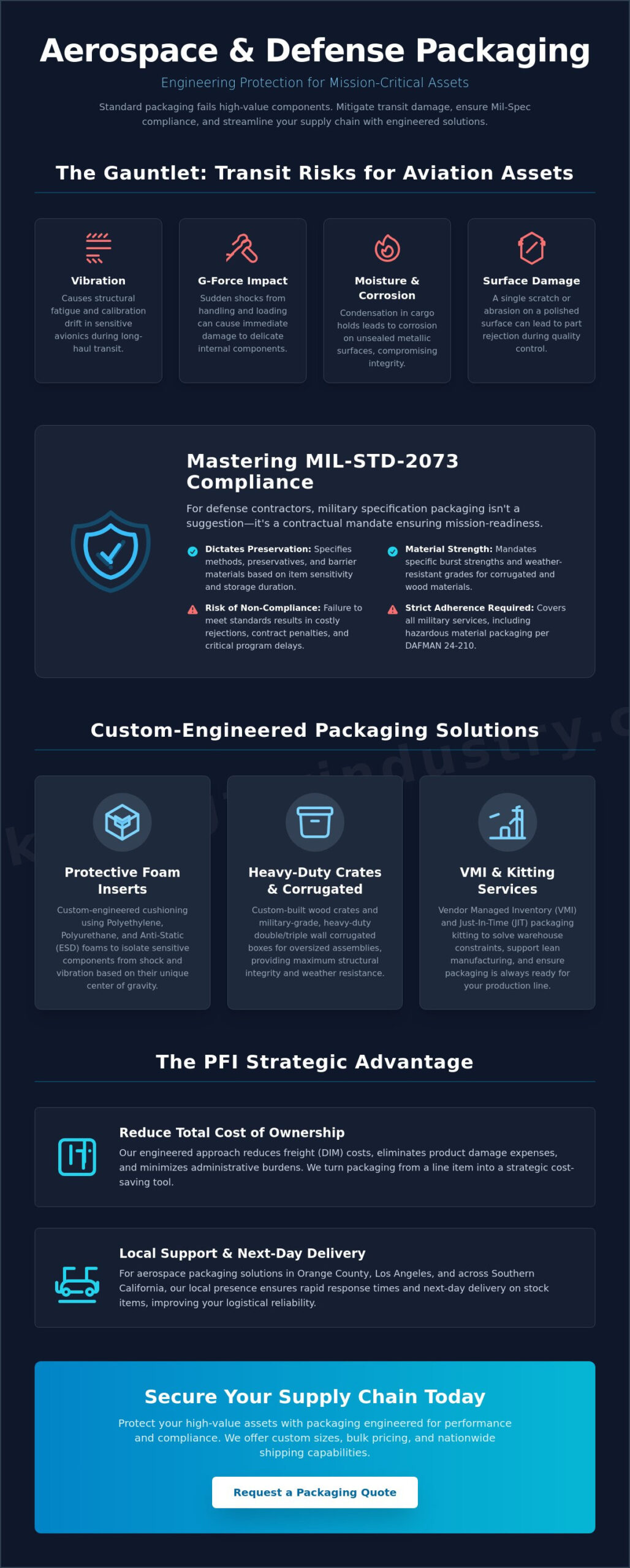
Aerospace manufacturing operates on a zero-tolerance margin for error. When you’re shipping a turbine blade or a flight control system, the packaging isn’t just a container; it’s a critical component of the assembly’s lifecycle. High-value aviation assets face a gauntlet of environmental stressors during transit. Vibration from long-haul trucking and G-force impacts during forklift handling can cause internal structural fatigue or calibration drift in sensitive avionics. Moisture is another silent threat, as temperature fluctuations in cargo holds lead to condensation and subsequent corrosion on unsealed metallic surfaces.
Finding reliable aerospace packaging solutions Orange County manufacturers can depend on requires moving beyond the “box and bubble wrap” mentality. Stock solutions fail because they aren’t designed for the specific center of gravity or the delicate surface finishes of modern aerospace components. The hidden costs of product damage extend far beyond the replacement value of the part. You have to account for the labor hours lost to inspection, the potential for program delays, and the administrative burden of filing insurance claims. Efficient packaging must solve these economic and engineering problems simultaneously.
The Complexity of Aerospace Supply Chains
Moving a part from the manufacturing floor to a final assembly hangar involves multi-modal transit. A single component might travel via flatbed truck, cargo plane, and sea freight before reaching its destination. This journey exposes oversized assemblies to varied mechanical stresses. Surface protection is just as vital as structural integrity; a single scratch on a polished surface can lead to a part being rejected during quality control. Custom aerospace packaging must account for these transitions, ensuring that delicate avionics remain isolated from external shocks at every stage.
Engineering vs. Standard Shipping
An engineered approach treats packaging as a technical problem to be solved with data. By using precision-fit designs, you can reduce the total freight weight and dimensional (DIM) costs of a shipment. Standard shipping often relies on over-packing, which leads to inventory bloat and unnecessary freight expenses. In contrast, custom designs use specialized materials to provide maximum protection with a minimum footprint. This level of precision is necessary for sensitive instrumentation where even a minor misalignment can render the equipment useless. While many contracts mandate compliance with a United States Military Standard, the most effective solutions go beyond the minimum requirements to optimize the entire logistics chain.
Compliance and Precision in Military Specification Packaging
Military specification packaging is a rigorous system of standards designed to ensure that mission-critical equipment remains operational after long-term storage or transport through high-stress environments. In the defense sector, these requirements aren’t suggestions; they’re contractual mandates. Adhering to Defense Logistics Agency (DLA) packaging standards ensures that parts reach their destination in ready-to-use condition, regardless of how many hands they’ve passed through or how long they’ve sat in a depot. For contractors seeking aerospace packaging solutions Orange County, staying current with these evolving standards is essential to maintaining program viability and avoiding costly rejections.
The primary framework for these requirements is MIL-STD-2073, the standard practice for military packaging. This document dictates specific preservation methods based on the item’s sensitivity and the intended duration of storage. It covers everything from the application of preservatives to the use of vapor-proof barrier materials. As of the April 2026 updates to DAFMAN 24-210, compliance also requires strict adherence to hazardous material packaging for all military services. Failing to meet these precision requirements can result in immediate contract penalties or significant shipping delays that ripple through the entire supply chain.
Core Components of Mil-Spec Compliance
Compliance begins with material selection. Military-grade corrugated boxes and wood crating must meet specific burst strengths and weather-resistant grades. For avionics and sensitive electronics, Electrostatic Discharge (ESD) protection is a non-negotiable requirement to prevent invisible component failure. Furthermore, marking and labeling must follow MIL-STD-129. Recent updates, such as the Lockheed Martin PM-5010P guidelines effective April 2, 2026, now place a heavy emphasis on Radio-Frequency Identification (RFID) tags and the digital upload of a Certificate of Conformance (CoC). These details ensure government procurement systems can track and verify every package in the field.
Selecting a Certified Mil-Spec Supplier
The administrative burden of compliance is often the heaviest part of a defense contract. Working with an experienced military specification packaging partner allows you to offload this complexity. A qualified supplier doesn’t just provide boxes; they verify documentation, provide material certifications, and ensure every layer of the package meets the specific MIL-STD code identified in your contract. PFI acts as a proactive fixer in this space, simplifying the compliance process so your team can focus on production rather than paperwork. If you are preparing for a new contract, it’s often helpful to compare packaging pricing and compliance capabilities early in the bidding phase.
Custom Engineering: Protective Foam Inserts and Heavy-Duty Crating
Custom engineering is the bridge between a design on a screen and a part that arrives intact. While compliance ensures you’ve met the legal requirements of a contract, the physical engineering of the package determines the actual survival of the component. For manufacturers seeking aerospace packaging solutions Orange County, this process starts with a technical evaluation of the part’s fragility and weight distribution. We don’t rely on generic fillers; we design protection around the specific G-force thresholds and vibration frequencies your equipment can tolerate.
The science of shock absorption often comes down to selecting the right foam chemistry. Polyethylene foam is a closed-cell material known for its durability and ability to support heavier aerospace assemblies without bottoming out. In contrast, Polyurethane foam is an open-cell, softer material that excels at dampening high-frequency vibrations for delicate sensors or glass cockpit displays. Choosing between them requires a pragmatic understanding of the transit environment. To ensure these materials perform as expected, the prototyping phase is vital. By creating a physical sample before full production, you can verify the component fit and protective performance, eliminating the risk of late-stage design failures.
For items that don’t require full wood crating, heavy-duty corrugated options provide a high-strength, lower-weight alternative. Double and triple-wall Regular Slotted Container (RSC) boxes offer the structural integrity needed for industrial parts while reducing dimensional weight and freight costs. These containers are often the first line of defense in a multi-layered protective system.
Designing Custom Foam Inserts
Precision is mandatory when dealing with the complex geometries of turbine components or landing gear assemblies. We use CNC and die-cutting technology to create foam cavities that mirror the exact profile of your part. This ensures there’s no internal movement during transit. These inserts are frequently integrated with high-strength corrugated boxes to provide a complete internal cushioning system that’s both lightweight and incredibly resilient.
Industrial Crating for Global Transit
International aerospace shipping requires compliance with ISPM-15 standards to ensure wood packaging is heat-treated and pest-free. Beyond the exterior shell, the internal blocking and bracing techniques are what truly secure the load. A hybrid approach often yields the best results. By combining custom-built wood crates with internal foam cushioning and edge protection, we create a multi-stage defense against the rigors of global logistics. This methodical approach ensures that even the most oversized assemblies remain stable and protected from the manufacturing floor to the final hangar.
Operational Efficiency: Vendor Managed Inventory and Kitting for Aerospace
Optimizing the production floor is just as critical as engineering the shipping crate. For manufacturers utilizing aerospace packaging solutions Orange County facilities, the physical space required to store bulk orders of triple-wall boxes or custom foam inserts often leads to inventory bloat. This operational friction is solvable through strategic vendor partnerships that prioritize logistical flow over simple delivery. By treating packaging as a managed utility rather than a commodity, you can reduce total cost of ownership and ensure that your shipping department never becomes a bottleneck for production.
Consolidating your packaging procurement also reduces the administrative burden on your purchasing team. Instead of managing dozens of individual SKUs and tracking multiple lead times, you can rely on a single point of accountability. This approach is particularly valuable for high-stakes aerospace programs where the cost of a missed delivery far outweighs the cost of the packaging itself. When your supplier understands the rhythm of your manufacturing line, they can anticipate your needs and prevent the stockouts that lead to program delays.
Streamlining Procurement with VMI
Vendor Managed Inventory (VMI) transforms your supply chain by moving the burden of inventory monitoring to the supplier. By allowing a partner to manage your levels of industrial packaging supplies, you eliminate the risk of production stops. This Just-In-Time (JIT) approach is essential given the supply chain volatility noted in 2026. It frees up high-value warehouse square footage for manufacturing equipment rather than stacks of empty boxes. Utilizing vendor managed inventory ensures predictable lead times and more consistent cash flow for your operation.
Aerospace Kitting and Assembly Support
Kitting takes efficiency a step further by delivering a complete aerospace packaging solution directly to the assembly or MRO station. Instead of your staff searching for separate components, they receive a single kit containing the custom foam, the crate, and the necessary labels. This improves pack-out speed and ensures that every protective element is used correctly, which is vital for maintaining compliance with strict military standards. For operations focused on lean manufacturing, kitting reduces labor costs and minimizes the physical footprint of packaging materials on the production floor. To see how managed logistics can improve your bottom line, request a packaging quote for a customized VMI or kitting program.
Strategic Procurement: Why Manufacturers Choose PFI for Aerospace Solutions
Procurement in the aerospace sector isn’t just about finding the lowest price per crate. It’s about finding a partner who acts as a proactive fixer for your logistical vulnerabilities. PFI approaches every project with a focus on both engineering precision and fiscal responsibility. We understand that a cheaper box that leads to a damaged avionics component is actually the most expensive option you can choose. By optimizing material density and structural design, we help you reduce the total cost of ownership across your entire supply chain. Our goal is to eliminate professional stress by providing a system that simply works every time a part leaves your facility.
For companies searching for aerospace packaging solutions Orange County, PFI offers a unique combination of nationwide scale and localized agility. While we have the capacity to support large-scale national contracts, our local presence in Southern California allows for next-day delivery on critical stock and custom items. This proximity is a vital asset for manufacturers running lean operations who don’t have the space to store months of inventory. We bridge the gap between high-level engineering and the practical realities of a busy shipping dock.
The Power of Free Prototyping
Prototyping is where we eliminate R&D risk before you commit to a full-scale production rollout. Our engineers work collaboratively with your team to refine protection levels, ensuring that the custom design packaging we develop can withstand every operational hurdle. Whether it’s forklift impacts or atmospheric changes, we provide physical samples so you can test the fit and function in real-world conditions. This iterative process ensures that once we move to bulk production, the solution is already proven to perform. It’s a methodical approach that prevents costly design changes later in the program lifecycle.
Requesting Your Aerospace Packaging Quote
The process of requesting a quote from PFI is consultative rather than transactional. We don’t just provide a price per unit; we evaluate the long-term reliability and stability of your packaging flow. We look at how our VMI and JIT services can reduce your warehouse overhead and improve your shipping speed. Our quotes are grounded in the realities of industrial operations, focusing on how we can help you lower packaging costs through better supply management. If you’re ready to improve your supply chain reliability and secure your high-value assets, the next step is simple. You can Request a Packaging Quote today to begin a technical review of your requirements.
Securing Your Program’s Future Through Engineered Protection
Protecting high-value aviation assets requires more than standard materials; it demands a disciplined engineering approach that balances physical protection with economic efficiency. By integrating custom foam designs with strict MIL-STD-2073 compliance, you ensure that every component arrives ready for mission-critical use. We’ve explored how Vendor Managed Inventory and kitting programs can transform a congested warehouse into a lean, high-output operation by eliminating stockouts and inventory bloat. These strategies don’t just protect parts; they protect your program’s reputation and your bottom line.
Securing the specialized aerospace packaging solutions Orange County manufacturers require doesn’t have to be a source of professional stress. PFI provides the expertise needed to navigate complex defense contracts while offering free prototyping for custom designs and certified Mil-Spec compliance expertise. Whether you require nationwide shipping or local next-day delivery in Southern California, we’re ready to serve as your dependable logistical partner. Request a custom aerospace packaging quote today to optimize your supply chain and eliminate the risk of transit damage. Let’s build a more reliable and cost-effective path forward for your aerospace operations.
Frequently Asked Questions
What is MIL-STD-2073 and why does my aerospace project require it?
MIL-STD-2073 is the Department of Defense standard that outlines preservation methods and packaging levels for military items. Your project requires it because defense contracts mandate specific environmental protection to ensure parts remain operational after storage. It’s a standard that dictates everything from the barrier material used to the specific preservative application required. Following these codes ensures you don’t face contract penalties or shipping rejections during government procurement.
How do custom foam inserts prevent damage to sensitive avionics?
Custom foam inserts prevent damage by providing precise deceleration and vibration isolation for sensitive electronics. By matching the foam density to the component’s weight and fragility, the insert absorbs kinetic energy during transit. CNC-cut cavities ensure a precision fit, which eliminates the internal movement that leads to surface abrasions. It’s a technical solution designed specifically for the unique and complex geometry of modern avionics.
Can PFI provide ISPM-15 certified crates for international aerospace shipping?
Yes, PFI provides ISPM-15 certified wood crates that are heat-treated to meet international shipping regulations. This certification is mandatory for aerospace manufacturers moving assemblies across international borders. It prevents the spread of timber pests and ensures your high-value shipments aren’t delayed by customs authorities. We handle the necessary documentation to ensure your global logistics chain remains uninterrupted and compliant with all international standards.
What are the benefits of using triple-wall corrugated boxes for aerospace parts?
Triple-wall corrugated boxes provide exceptional puncture resistance and stacking strength while remaining lighter than traditional wood crates. This reduction in tare weight helps you lower total freight expenses without compromising structural integrity. These heavy-duty containers are an efficient choice for shipping industrial aerospace parts. They’re particularly effective for components that need robust protection but don’t require the extra bulk or weight of a full timber crate.
How does Vendor Managed Inventory (VMI) reduce packaging costs?
Vendor Managed Inventory (VMI) reduces costs by shifting the responsibility of stock monitoring and replenishment to the supplier. This prevents production downtime caused by packaging stockouts and eliminates the need for massive on-site inventory. By optimizing your supply chain flow, you can reallocate valuable warehouse square footage to revenue-generating assembly. It’s a pragmatic way to improve cash flow and operational efficiency across your entire facility.
Does PFI offer free prototyping for custom aerospace packaging designs?
Yes, PFI provides physical prototypes to verify the engineering of the aerospace packaging solutions Orange County manufacturers depend on for high-stakes projects. This prototyping phase allows you to test the fit and protective performance of a design before committing to a full production run. It’s a pragmatic way to eliminate R&D risk and ensure your components are fully protected during the rigors of multi-modal transit.
What is the difference between polyethylene and polyurethane foam for aerospace?
The primary difference is the cell structure and the level of support they provide to the component. Polyethylene is a closed-cell foam that’s rigid and durable, making it ideal for blocking and bracing heavy assemblies. Polyurethane is an open-cell, softer foam that excels at dampening high-frequency vibrations. We select the specific material based on your part’s fragility and the mechanical shocks it’ll encounter in the field.
How can I get a quote for high-volume military specification packaging?
You can get a quote for high-volume military specification packaging by submitting your project requirements through our online portal. Our team analyzes your specific MIL-STD codes and contract requirements to provide a consultative quote. We focus on ensuring full compliance so you don’t have to worry about administrative rejections. Our goal is to provide a stable supply chain that supports your long-term production schedule.