
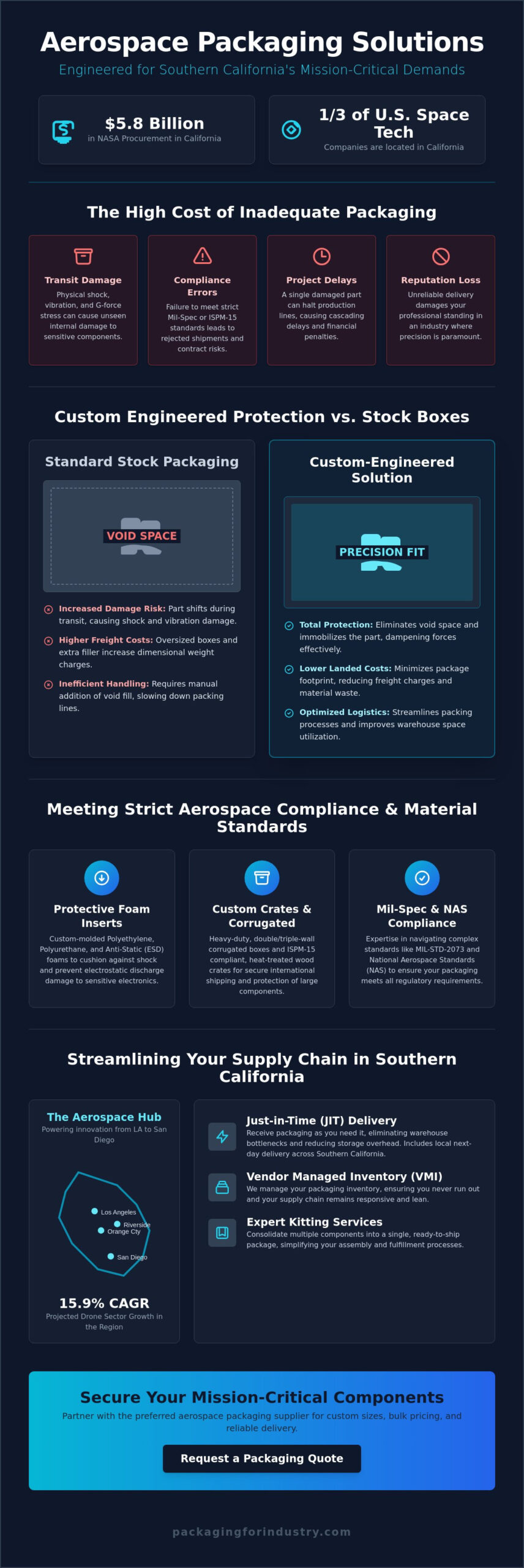
Did you know that California currently houses one-third of the nation’s space technology companies? With NASA procurement in the state reaching $5.8 billion, the pressure on local manufacturers to deliver mission-critical components without a single scratch has never been higher. You’re likely all too familiar with the professional stress that comes from transit damage or the fear of a shipment being rejected due to a minor compliance error. In the aerospace sector, a delay isn’t just an inconvenience; it’s a direct hit to your bottom line and your reputation.
Securing the right aerospace packaging solutions Southern California facilities require is about more than just boxes; it’s about engineering peace of mind. We understand that you need to balance complex standards like MIL-STD-2073 with the constant demand for shorter lead times. This guide will show you how to protect high-value parts, ensure total regulatory compliance, and optimize your logistics flow. We will examine specialized cushioning, the latest ISPM-15 wood marking requirements, and how streamlined procurement strategies like JIT delivery can eliminate your warehouse bottlenecks once and for all.
Key Takeaways
- Learn how custom-engineered containers outperform stock boxes for sensitive aviation components by eliminating void space and preventing transit damage.
- Navigate the complexities of Mil-Spec standards and material selection to ensure your shipments meet strict regulatory compliance and industry benchmarks.
- Discover how implementing JIT and VMI through specialized aerospace packaging solutions Southern California manufacturers rely on can reduce warehouse overhead and streamline your procurement.
- Identify strategies to lower total landed costs by optimizing freight efficiency through custom-sized crates and advanced protective foam inserts.
- Understand the logistical benefits of a local partnership that offers next-day delivery and expert kitting services across the Southern California aerospace hub.
The Critical Role of Aerospace Packaging Solutions in Southern California
Aerospace manufacturing is an industry where the margin for error is non-existent. For businesses operating in this sector, aerospace packaging solutions Southern California providers offer are far more than just shipping containers. They are precision-engineered systems designed to protect high-value, mission-critical components that cannot afford even the slightest deviation in performance. While standard industrial packaging might suffice for consumer goods, it fails to address the specific G-force, vibration, and environmental stressors inherent in aviation logistics.
The “Cost of Failure” in this field is astronomical. If a delicate avionics assembly or a turbine component arrives damaged, the financial impact extends well beyond the replacement cost of the part. You’re looking at project delays, potential safety risks, and compromised contract fulfillment. Effective packaging must balance three core pillars: advanced engineering for physical protection, strict adherence to regulatory standards, and economic efficiency to keep your supply chain lean. In a region where NASA procurement reached $5.8 billion as of late 2024, the ability to deliver parts in perfect condition is a competitive necessity.
Why Aerospace Components Require Specialized Handling
Precision parts like flight control systems and engine sensors are incredibly sensitive to their environment. During transit, these items face significant vibration and mechanical shock that can cause internal structural damage without any visible external signs. Specialized aerospace packaging utilizes custom-molded foam and high-performance corrugated materials to dampen these forces. This ensures that delicate internal alignments remain intact from the factory floor to the final assembly line.
Environmental protection is equally critical. Many components require shielding from moisture, extreme temperature fluctuations, and Electrostatic Discharge (ESD). To ensure these parts arrive in flight-ready condition, materials must often comply with recognized frameworks like the National Aerospace Standards (NAS). These standards dictate the baseline for safety and quality that every shipment must meet, protecting the integrity of the part and the safety of the end-user.
Southern California: A Global Hub for Aviation Logistics
The Southern California region is a powerhouse of aerospace innovation, currently housing one-third of the nation’s space technology companies. From the established giants in Los Angeles and El Segundo to the burgeoning “Space Beach” in Long Beach, the strategic importance of this infrastructure cannot be overstated. With the drone sector in the region projected to grow at a 15.9% CAGR over the next five years, the demand for agile, local logistics is constant.
Local manufacturers can’t afford long lead times for custom crates or foam inserts. By partnering with a regional expert, you gain access to next-day delivery and immediate technical support across Orange County, Riverside, and San Diego. This proximity allows for a more responsive supply chain, ensuring that as your production scales, your packaging keeps pace without adding unnecessary warehouse overhead. It’s about having a partner who understands the local landscape and can provide the rapid turnaround required by modern aviation hubs.
Engineering Custom Protection for Mission-Critical Components
Relying on stock boxes for high-value aviation parts is a gamble that rarely pays off. Standard corrugated solutions often leave excessive void space, which requires additional filler and increases the risk of the part shifting during transit. By utilizing custom design packaging, we eliminate these inefficiencies. Our approach to aerospace packaging solutions Southern California manufacturers depend on focuses on creating a precise fit that secures the component while minimizing the overall shipping footprint. This reduction in package size isn’t just about safety; it directly lowers dimensional weight freight costs, improving your bottom line.
This level of precision is vital for meeting Mil-Spec packaging standards. These government-mandated requirements ensure that mission-critical parts remain functional after facing the extreme vibrations of air and sea transport. We bridge the gap between these rigorous engineering requirements and your procurement budget by identifying the most cost-effective materials that still provide maximum shock absorption and vibration dampening. If you’re currently seeing high rates of transit damage, you can request a packaging quote to see how an engineered approach improves your outcomes.
The Role of Free Prototyping in Design Accuracy
Virtual CAD models are an excellent starting point, but they can’t fully replicate the tactile realities of a busy shipping dock. We prioritize physical prototyping because it’s the only way to guarantee a perfect fit for complex geometries before you commit to a full production run. This process allows your team to test the ease of packing and the durability of the inserts in a real-world setting. Perfecting the design in this initial phase prevents the high cost of re-ordering materials and ensures that your components are protected from day one.
Custom Crating for Large-Scale Aerospace Assemblies
For oversized or exceptionally heavy items like landing gear assemblies or engine blocks, corrugated material often lacks the structural integrity required for safe passage. In these cases, we transition to custom shipping crates. These wooden containers are built to handle extreme loads and provide a rigid exterior shell. Inside the crate, we use advanced internal blocking and bracing techniques to lock the part in place. When combined with custom foam linings, this creates a dual-layer protection system that guards against both external impact and internal shifting during multi-modal transport.
Compliance and Material Selection: Foam, Crates, and Mil-Spec Standards
Choosing the right aerospace packaging solutions Southern California facilities require involves a deep dive into material science and regulatory frameworks. Compliance isn’t just a hurdle to clear; it’s the foundation of your supply chain’s reliability. Adhering to Defense Logistics Agency (DLA) packaging standards is non-negotiable for any supplier looking to maintain a contract. These regulations, such as MIL-STD-2073-1, dictate everything from the method of preservation to the specific chemistry of the materials touching your parts. We help you navigate these complexities by selecting materials that meet strict chemical outgassing requirements and physical durability tests.
Sustainability is also becoming a key factor for California manufacturers. We balance high-performance protection with environmental goals by utilizing recyclable high-density plastics and responsibly sourced wood for crates. When your components require wooden crates, we ensure compliance with ISPM-15 standards. It’s critical to note that full enforcement of the ISPM-15 hyphen requirement, which separates the country and facility codes, resumes on January 1, 2026. Non-compliance at that stage will lead to rejected shipments and costly delays at international borders. We manage these details so you don’t have to.
Comparing Foam Materials: Polyethylene vs. Polyurethane
Selecting the correct foam packaging depends on your part’s fragility rating and total weight. Polyethylene (PE) is a high-density, closed-cell foam that excels at protecting heavy engine components or landing gear. It’s moisture-resistant and maintains its structural integrity through repeated impacts. Polyurethane (PU), on the other hand, is a soft, open-cell cushioning material. It’s the preferred choice for lighter, highly delicate items that require a gentle “cradle” during transit. For avionics and sensitive electronics, we provide specialized ESD-safe versions of these foams to prevent catastrophic electrostatic discharge during handling.
Understanding Mil-Spec Packaging Requirements
Military-grade protection requires a multi-layered approach. Beyond just the outer container, we integrate specialized barriers, moisture-vapor proof bags, and desiccants to maintain an optimal internal environment. This is especially vital for parts being shipped to high-humidity regions or stored in long-term military depots. Our engineering team ensures that every component of the package, including the tapes and labels, meets the rigorous standards set by the Department of Defense. By sourcing materials that are pre-certified for Mil-Spec use, we eliminate the guesswork and provide the documented compliance your quality department demands.
Optimising Procurement: JIT, VMI, and Kitting for Aerospace Hubs
Procurement in the aerospace sector is often viewed as a series of individual transactions. However, the most efficient operations treat packaging as a strategic extension of the manufacturing floor. For manufacturers seeking aerospace packaging solutions Southern California hubs rely on, the goal is to eliminate the friction between production schedules and material availability. When you integrate your packaging supplier into your workflow, you move from reactive ordering to a proactive, synchronized system that drives packaging cost savings through reduced handling and optimized inventory levels.
Southern California firms are uniquely positioned to leverage lean manufacturing due to their proximity to major industrial centers. By utilizing local next-day delivery across Orange County, Los Angeles, and San Diego, you can maintain high throughput without the burden of excessive on-site stock. This approach transforms packaging from a warehouse bottleneck into a logistical advantage that supports your fiscal responsibility and operational flow.
Vendor Managed Inventory (VMI) and Just-in-Time (JIT) Delivery
Managing a vast array of box sizes, foam inserts, and custom crates can quickly overwhelm your floor space. Our VMI programs solve this by placing the responsibility of inventory tracking on the supplier. We monitor your usage levels and replenish stock before a shortage occurs, effectively preventing stockouts that could halt a mission-critical assembly line. You only pay for what you use, which keeps your capital fluid and your warehouse organized.
This pairs perfectly with JIT delivery. Instead of storing bulk quantities of heavy-duty corrugated boxes or bulky protective foam for months, you receive exactly what you need exactly when you need it. This alignment with your production schedule frees up valuable square footage for revenue-generating manufacturing activities. Many aerospace facilities in the region have found that switching to a JIT model allows them to reclaim up to 25% of their storage space for new equipment or assembly stations.
Packaging Kitting for Assembly Line Efficiency
Labor costs on an aerospace assembly line are significant. You don’t want your highly skilled technicians wasting time searching for the right size edge protector, specific tape, or the correct density of foam insert. Through packaging kitting, we provide “ready-to-pack” solutions where all necessary materials for a specific part number are bundled together in a single unit.
These pre-assembled kits reduce packing errors and significantly improve throughput. By providing a standardized set of protective materials, you ensure that every shipment meets your quality control benchmarks without requiring constant supervision. This methodical approach reinforces the reliability of your supply chain. If you’re ready to see how these logistical improvements can benefit your operation, you can request a packaging quote to compare our procurement models and specialized kitting services.
Strategic Partnership: Why PFI is the Preferred Aerospace Packaging Supplier
Choosing a supplier for the aerospace packaging solutions Southern California facilities require is a decision that impacts your entire operational cycle. At PFI, we position ourselves as more than a vendor; we act as a seasoned industrial consultant for your team. We combine national shipping capabilities with a deep, localized understanding of the Southern California aerospace hub. This dual approach allows us to provide the agility of a local partner alongside the stability of a high-volume distributor. Our commitment to engineering-first solutions ensures that every piece of packaging is designed to eliminate professional stress by guaranteeing part safety and fiscal responsibility.
Our expertise lies at the intersection of engineering and economics. We understand that an over-engineered crate is a waste of capital, while an under-engineered box is a liability. By partnering with us, you gain access to a team that prioritizes the end-to-end experience, from the initial design phase to the final delivery. We focus on total accountability, ensuring that your aerospace packaging solutions Southern California shipments arrive on time, in compliance, and within budget. This methodical approach allows you to focus on your core manufacturing goals while we manage the complexities of your protective logistics.
Comprehensive Product Range from Crates to Tapes
We provide a one-stop-shop experience that covers your entire supply chain. Whether you need custom-engineered crates for international transit or a bulk stock of heavy-duty corrugated boxes, our inventory is ready for immediate deployment. We also supply essential secondary materials including stretch film, edge protection, and industrial tapes.
- Consolidated procurement for both custom and stock packaging materials.
- Access to specialized ESD-safe foams and Mil-Spec compliant barriers.
- Next-day delivery across Orange County, Los Angeles, San Diego, and Riverside.
- Bulk packaging pricing that reflects your actual usage and volume requirements.
Requesting a Custom Aerospace Packaging Quote
Our consultative process begins with a thorough needs analysis where we examine your part geometries, fragility ratings, and shipping routes. We don’t believe in a one-size-fits-all approach. Instead, we offer free prototyping to ensure that your custom inserts and crates provide a perfect fit before you commit to a full order. This phase allows your team to verify the ease of assembly and the level of protection in a real-world setting.
To initiate a consultation, you simply need to provide your basic part specifications and any required Mil-Spec or industry standards. This transparency allows us to provide an accurate and competitive quote that addresses your specific pain points, such as reducing transit damage or shortening lead times. We’re ready to help you improve your supply chain reliability and reduce your total landed costs. If you’re ready to optimize your operations, request a packaging quote today to begin your optimization journey.
Secure Your Next Mission-Critical Shipment
Protecting high-value aviation components requires a precise balance of material science and logistical agility. We’ve explored how custom-engineered foam inserts and heavy-duty crates eliminate transit damage while ensuring strict compliance with Mil-Spec and ISPM-15 standards. By moving toward a procurement model that utilizes JIT delivery and VMI, your facility can reclaim warehouse space and focus on production without the stress of packaging stockouts.
When you choose Packaging For Industry, you’re partnering with a local expert that understands the unique pressures of the Southern California aviation hub. We provide the aerospace packaging solutions Southern California manufacturers need to maintain a competitive edge, offering everything from free prototyping for custom designs to local next-day delivery. Our team is ready to help you navigate complex regulatory requirements while streamlining your total packaging costs through smarter supply management.
Don’t let shipping damage or compliance errors delay your next delivery. Request an Aerospace Packaging Quote from PFI today to see how our engineering-first approach protects your bottom line. We look forward to supporting your next project with reliable, professional protection.
Frequently Asked Questions
What is the difference between standard and aerospace-grade packaging?
Standard packaging focuses on basic containment and general protection for consumer goods. Aerospace-grade packaging is a specialized engineering discipline designed to mitigate high G-forces, specific vibration frequencies, and environmental stressors like humidity or Electrostatic Discharge (ESD). These solutions must also meet rigorous certifications such as Mil-Spec or National Aerospace Standards (NAS) to ensure mission-critical parts arrive in flight-ready condition.
Does PFI provide Mil-Spec compliant packaging materials?
Yes, we supply a comprehensive range of materials that meet various military specifications, including MIL-STD-2073-1. Our inventory includes specialized barrier materials, moisture-vapor proof bags, and pre-certified desiccants. We provide the documented compliance necessary to satisfy Defense Logistics Agency (DLA) standards, ensuring your shipments are not rejected at military depots or international borders.
How long does it take to design and prototype a custom aerospace crate?
Lead times for custom designs depend on the complexity of the component, but we typically provide initial designs and physical prototypes within a few business days. Our process includes a detailed needs analysis and free prototyping to ensure a perfect fit before full production begins. This rapid turnaround is essential for Southern California manufacturers who need to maintain tight production schedules without sacrificing part protection.
Can you provide ESD-safe foam inserts for electronic components?
We offer specialized polyethylene and polyurethane foam inserts that are specifically treated for Electrostatic Discharge (ESD) protection. These materials are vital for the safe transport of avionics, engine sensors, and other sensitive electronic assemblies. Our engineering team helps you select the correct foam density to provide both physical cushioning and the necessary electrical resistivity to prevent component failure.
What are the benefits of using a Southern California packaging supplier for aerospace?
Partnering with a local supplier provides superior logistical agility and reduced freight costs. We offer the aerospace packaging solutions Southern California firms rely on to maintain lean manufacturing, including local next-day delivery and on-site engineering consultations. Proximity allows for faster prototyping cycles and immediate technical support, which is critical in a region where aerospace demands can shift rapidly.
How does Vendor Managed Inventory (VMI) work for aerospace manufacturers?
Our VMI programs shift the burden of inventory tracking and replenishment from your procurement team to us. We monitor your usage levels for custom boxes, crates, and foam, delivering new stock before a shortage occurs. This proactive approach to aerospace packaging solutions Southern California hubs utilize reduces your on-site storage needs and keeps your capital fluid by eliminating the need for bulk safety stock.
Do you offer next-day delivery for stock packaging items in Orange County?
Yes, we provide local next-day delivery for a wide range of stock packaging materials throughout Orange County, Los Angeles, and San Diego. This service covers essential items like heavy-duty corrugated boxes, stretch film, and edge protectors. Our local distribution network is designed to support your just-in-time (JIT) production needs, helping you reduce warehouse overhead and maintain a steady logistical flow.
Can PFI help reduce our overall packaging and shipping costs?
We help reduce total landed costs by engineering packages that minimize dimensional weight, which directly lowers your freight expenses. Our team focuses on eliminating void space and reducing product damage, preventing the significant costs associated with re-shipments and part replacements. We analyze the intersection of material science and economics to ensure your packaging system is as cost-effective as it is protective.