
Could a corrosion barrier protect a metal part from moisture yet leave it exposed to impact damage in transit? Buyers seeking anti-corrosion packaging for metal components SoCal need to assess both risks. The right setup depends on the part, storage conditions, handling, and shipping method. Corrosion-control materials may need to be sourced separately from the outer packaging.
This guide explains what to gather before choosing materials or requesting a packaging quote. You’ll learn how to assess the component and its route, coordinate corrosion protection with cushioning and an outer box or crate, and confirm requirements with suppliers. PFI is an Anaheim-based industrial packaging supplier serving Southern California, with custom packaging design support and options including corrugated boxes, foam, and crates. The guide focuses on evaluating those physical-protection options while confirming whether corrosion-inhibiting materials are available or must be supplied separately.
Key Takeaways
- Match corrosion-control materials to the metal component and its handling, storage, and transit conditions instead of relying on a generic package.
- For anti-corrosion packaging for metal components SoCal, assess corrosion protection separately from cushioning and outer-container needs.
- Document storage locations, shipping stages, handling, and any coastal exposure before specifying a packaging solution.
- Prepare component details and clarify who will supply corrosion-control materials before requesting a quote.
- PFI can help design physical protection using confirmed offerings such as foam, corrugated boxes, and crates. Confirm VCI or other corrosion-control material availability separately.
Anti-Corrosion Packaging for Metal Components SoCal: Define the Protection Need
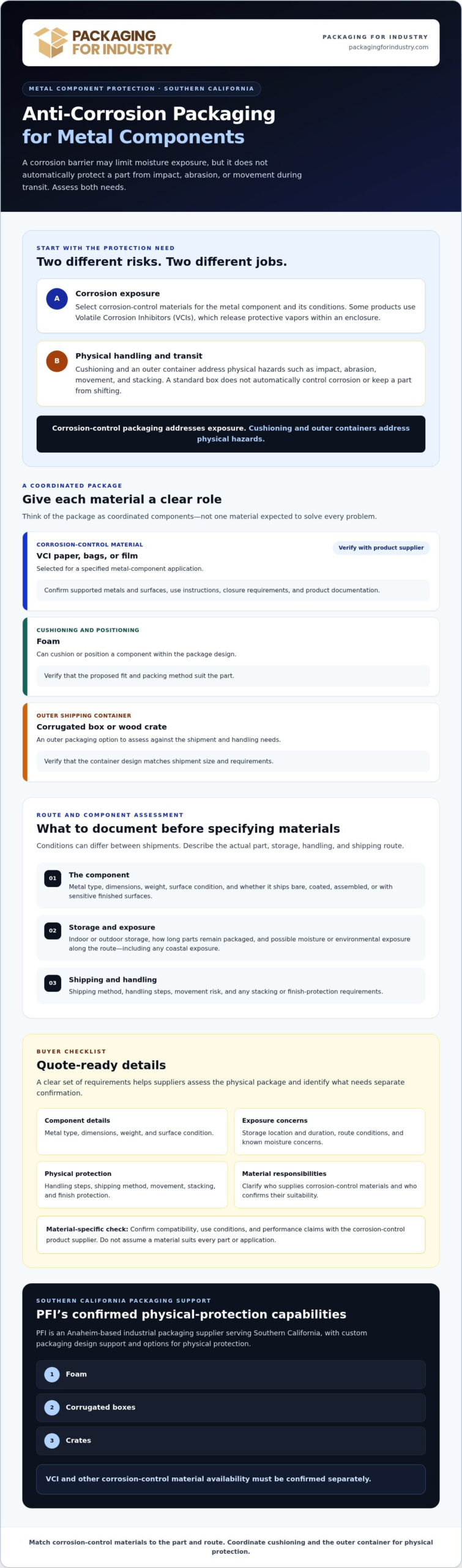
Metal components need packaging suited to how they’re handled, stored, and shipped. A solution selected only to limit corrosion exposure may not address impact, abrasion, or movement in transit. Before choosing materials, define both the corrosion concern and the physical protection the part needs. That distinction matters for SoCal manufacturers shipping through varied routes and storage conditions.
Anti-corrosion packaging uses materials selected to limit a component’s exposure to conditions that can contribute to corrosion. Some products use Volatile Corrosion Inhibitors, or VCIs, which release protective vapors within an enclosure. See Volatile Corrosion Inhibitors for a general description of the technology. This does not establish that a material suits a particular part or application. Confirm material compatibility, use conditions, and performance claims with the corrosion-control product supplier.
What does anti-corrosion packaging protect against?
Assess possible moisture and environmental exposure along the actual storage and shipping route. Don’t assume every shipment faces the same conditions. Record whether parts are stored indoors or outdoors, how long they remain packaged, and what exposures may occur in transit. Specify whether components ship bare, coated, assembled, or with sensitive finished surfaces. These details help suppliers assess material suitability, while the product supplier’s documented application guidance should inform use.
When does a metal component need more than a standard shipping box?
A box provides an outer boundary, but it doesn’t automatically control corrosion or prevent a part from shifting, striking other items, or suffering abrasion. Heavy, fragile, high-value, or precision components warrant a closer review of handling, movement, and stacking needs. For example, heavy industrial hardware sourced from malleable iron casting Canada facilities requires reinforced packaging and secure positioning to avoid shifting while protecting unfinished metal surfaces. These are assessment prompts, not automatic requirements for a particular package.
Corrosion-control packaging addresses exposure; cushioning and outer containers address physical hazards such as impact, abrasion, movement, and stacking. The requirements may call for coordinated materials, but don’t assume one replaces the other. PFI’s confirmed capabilities include custom packaging design, foam, corrugated boxes, and crates for physical protection. The availability of corrosion-inhibiting materials must be confirmed separately. Buyers evaluating foam packaging options can consider how cushioning may fit into the broader package design.
Before requesting a quote, gather the metal type, surface condition, known exposure concerns, expected storage duration, and shipping method. Include part dimensions, weight, handling steps, and any stacking or finish-protection requirements. These details give a packaging supplier a clearer basis for coordinating physical protection with corrosion-control requirements. Material-specific claims should still come from the corrosion-control product supplier.
Compare Corrosion-Control Materials with Foam, Boxes, and Crates
Think of the package as a set of components with distinct jobs, rather than one material expected to solve every problem. A corrosion-control product is selected for its documented use with metal parts. Foam, corrugated boxes, and crates form the physical package around them. Assigning each requirement to the right supplier makes it easier to review material claims and spot gaps in the design.
| Packaging component | Role in the package | What to verify |
|---|---|---|
| VCI paper, bags, or film | Corrosion-control material for a specified application | Supported metals and surfaces, use instructions, closure requirements, and product documentation |
| Foam | Cushions or positions the component within the package design | Whether the proposed fit and packing method suit the part |
| Corrugated box | Provides an outer shipping container | Whether the design matches the shipment’s size and handling needs |
| Wood crate | Provides an outer packaging option for review | Whether a crate design suits the component and shipment requirements |
How should buyers evaluate VCI paper, bags, or film?
Request application-specific written guidance from the corrosion-control material supplier. Confirm which metals and surface conditions the material supports, and ask for instructions on use, closure, and storage. If the supplier makes a performance or duration claim, request documentation that applies to the specific product and proposed packaging arrangement. A general product description does not confirm that the material fits your component.
When do custom foam, corrugated boxes, or crates add value?
Custom packaging design can coordinate the component’s position, cushioning, and outer container as one physical package. Review foam geometry against the part and packing workflow, then assess the box or crate for the shipment. PFI’s confirmed scope includes foam, corrugated boxes, and crates, but does not confirm VCI products. Establish whether your corrosion-control supplier will provide the material and how it should be incorporated.
PFI can review the physical package through its custom packaging design capabilities. Keep responsibilities clear: the corrosion-control product supplier confirms material guidance, while the packaging design review addresses fit and physical protection.
Evaluate Anti-Corrosion Packaging for Your SoCal Shipping Conditions
Southern California isn’t one uniform shipping environment. A component may move from a production floor to a warehouse, sit in outdoor staging, and then travel through several transfer points before delivery. Evaluate the actual route and handling sequence rather than inferring exposure from the origin city. This gives the corrosion-control material supplier and packaging designer a clearer basis for reviewing the application.
Which shipping and storage details should a SoCal buyer document?
Sketch the shipment path from packing through receipt. Mark the origin, destination, transit mode, transfer points, and any planned storage between shipping stages. Note whether the component stays packaged, is opened or repacked, or is handled outdoors. Coastal exposure may be relevant, but document it as a route condition rather than assuming it from a city or county. Ask the corrosion-control material supplier to evaluate the specific conditions against its product guidance.
For shipments with multiple legs or handoffs, identify where packaging may be disturbed or storage conditions may change. This can help the packaging team consider how the outer package will hold the component through handling, while the corrosion-control supplier addresses the documented application of its material.
What should be included in a packaging quote request?
Along with the route, provide the details that affect package design and supply planning:
- Part dimensions, weight, finish, quantity per shipment, and photos or drawings.
- Current packaging and packing sequence, including who handles or repacks the component.
- Known shipping or storage concerns and any recurring shipment schedule.
- Corrosion-control material requirements and the supplier’s written application guidance.
PFI is based in Anaheim and serves Southern California, including Orange County, Los Angeles County, the Inland Empire, and San Diego County. See Anaheim packaging services for local service-area context. Confirm delivery applicability for your destination, order, and requested items.
Choose packaging based on the component and its documented route conditions, not a regional assumption. Share those conditions when you request a packaging quote so the proposed physical package can be reviewed alongside separately confirmed corrosion-control requirements.
Build a Buyer Checklist for a Metal-Component Packaging Quote
A complete quote request gives the packaging supplier enough information to assess component fit, physical protection, order requirements, and the shipping route. For anti-corrosion packaging for metal components SoCal buyers should also identify who will provide the corrosion-control material: the buyer or a supplier that can confirm product suitability and instructions.
What specifications help a packaging supplier quote accurately?
Use this checklist to organize the request before discussing custom sizes, bulk quantities, or repeat orders:
- 1. Describe the component. Share drawings or measurements, weight, metal type, surface details, and photos that show its shape and sensitive areas.
- 2. Define order needs. State the quantity per shipment, shipment frequency, expected repeat demand, and whether you need custom packaging sizes.
- 3. Map the shipment. Provide origin and destination, transit method, handling steps, and storage conditions the package may encounter.
- 4. Explain the current process. Identify existing packaging, how the part is packed and moved, and any damage or handling concerns you want to address.
- 5. Confirm material responsibility. Specify whether your team will provide the corrosion-control material or expects the supplier to source it. Request written product guidance and documentation for any corrosion-control claims.
- 6. Discuss supply requirements. Include bulk quantities, repeat-order expectations, and whether local packaging delivery is needed. Confirm delivery availability for the order and destination.
How can a buyer validate a proposed package before rollout?
Review a prototype or sample, when available, before approving a repeat design. Check that the component fits as intended, the package can be assembled and opened using the expected packing steps, and the design aligns with handling requirements. Ask the corrosion-control material supplier to confirm its application guidance and supporting documentation separately. Record the approved dimensions, materials, packing method, and feedback so future orders follow the agreed specification.
PFI can assess custom corrugated boxes, foam, and crates as physical-protection options through its custom packaging design capabilities. Its listed offerings do not confirm VCI or other corrosion-control materials, so establish that supply responsibility separately. Clear specifications also help compare packaging pricing and discuss a practical repeat-order approach without treating corrosion protection and impact protection as interchangeable.
How PFI Supports Custom Metal-Component Packaging in Southern California
PFI helps manufacturers assess the physical packaging around metal components through custom packaging design, foam, corrugated boxes, and crates. These options can be designed around part fit and packing workflow, supporting efforts to reduce shipping damage, improve supply reliability, and manage packaging costs. They don’t provide corrosion protection by themselves. Confirm separately whether VCI or other corrosion-control materials are available and suitable for your application.
When is PFI a suitable partner for a metal-component packaging project?
PFI may be a fit when a project needs a custom outer package, cushioning, or a crate. Its packaging solutions serve industries including aerospace and aviation, electronics, medical device manufacturing, automotive, and industrial equipment. A design review can consider component fit, packing steps, shipping damage concerns, and repeat supply needs. PFI provides custom packaging design support, prototypes, and samples to help assess the proposed package, without guaranteeing corrosion outcomes.
Based in Anaheim, PFI serves Orange County, Los Angeles County, the Inland Empire, San Diego County, and nationwide customers. For anti-corrosion packaging for metal components SoCal, buyers can work with PFI on the physical-protection portion while confirming corrosion-control materials and claims with the relevant supplier. Learn more about custom packaging design.
What should buyers expect after contacting a SoCal packaging supplier?
Share component dimensions or drawings, photos, weight, surface details, order volumes, and shipping methods. Identify any corrosion-control material already specified, who will supply it, and what product documentation is available. PFI can use these details to review potential box, foam, or crate designs, but VCI materials aren’t confirmed offerings.
PFI states that local next-day delivery is available throughout Southern California. Confirm whether it applies to your destination, requested items, and order. A clear review of packaging and supply needs can help align the design with packing operations and recurring demand.
Submit your specifications and identify your corrosion-control requirements to get the conversation started.
Plan a Packaging Solution Around Your Metal Components
Choosing anti-corrosion packaging for metal components SoCal shipments starts with matching materials to the part’s documented storage and shipping conditions. Keep corrosion control separate from cushioning and outer-container needs, and confirm any corrosion-control material’s suitability and instructions with its supplier.
For the physical-protection portion, PFI is an Anaheim-based industrial packaging supplier serving Southern California and nationwide customers. Its confirmed offerings include foam, corrugated boxes, and wood crates, supported by custom packaging design. Prototypes and samples can help you review fit and packing workflow before moving forward. VCI and other corrosion-control materials aren’t confirmed offerings, so ask about availability separately.
Share your component specifications, shipment details, order quantities, and material requirements to help define the next step. A clear review can support a packaging plan that fits your operation and repeat-supply needs.
With the right details and a coordinated approach, you can move toward a packaging solution built around your parts and shipping conditions.
Frequently Asked Questions
What is anti-corrosion packaging for metal components?
Anti-corrosion packaging uses materials selected to limit a metal component’s exposure to conditions that may contribute to corrosion. The right choice depends on the metal, surface condition, packaging setup, storage period, and shipping route. Some materials use corrosion inhibitors, but suitability and performance claims should be confirmed with the product supplier. Corrosion control also doesn’t replace cushioning or an outer container designed for physical protection.
Does VCI packaging protect every type of metal component?
No. Don’t assume a VCI material is suitable for every metal, finish, or application. Ask the product supplier which metals and surface conditions its specific material supports, along with application and closure instructions. Share details such as whether parts are bare, coated, assembled, or finished. Use the supplier’s documentation to evaluate suitability for the actual package and route rather than relying on a general product description.
Can foam packaging prevent corrosion, or does it only cushion parts?
Foam packaging is generally selected to cushion, position, or separate parts as part of a physical-protection design. Don’t treat foam as a corrosion-control material unless a supplier provides application-specific documentation to support that use. Assess corrosion exposure separately and confirm any corrosion-control material with its supplier. Foam, a box, or a crate can then be designed around the part’s fit and handling needs.
What information should I provide for a metal-component packaging quote in Southern California?
Provide drawings or dimensions, photos, weight, metal and surface details, quantity per shipment, and shipment frequency. Include the origin, destination, transit method, handling steps, storage conditions, and current packaging or damage concerns. For anti-corrosion packaging for metal components SoCal shipments, identify whether corrosion-control material is customer-specified or needs to be sourced, and provide the supplier’s documentation. These details help assess physical packaging needs and quote requirements.
Can PFI supply VCI bags, paper, or corrosion-inhibiting film?
PFI’s confirmed offerings do not include VCI bags, VCI paper, VCI film, or other listed corrosion-inhibiting products. Confirm separately whether PFI can source a specific corrosion-control material or plan to provide it yourself. PFI can assess custom packaging design and physical protection using confirmed offerings such as foam, corrugated boxes, and crates. Confirm material suitability and product claims directly with the corrosion-control material supplier.
How do I combine corrosion protection with custom foam, boxes, or crates?
Specify the corrosion-control material separately from the physical package, then coordinate both around the component and shipping process. Ask the material supplier for written guidance on application, closure, storage, and compatibility. Share those requirements with the packaging designer, along with part dimensions, weight, packing steps, and handling conditions. Reviewing a prototype or sample can help assess fit and workflow, but it doesn’t guarantee corrosion performance.
Does PFI provide local packaging delivery in Orange County and the Inland Empire?
PFI serves Southern California, including Orange County and the Inland Empire, and states that local next-day delivery is available throughout the region. Confirm that delivery timing applies to your destination, requested materials, and order before planning around it. PFI is based in Anaheim and offers custom packaging design, foam, corrugated boxes, and crates. Confirm availability of specific items, especially any corrosion-control materials.