
If your quality control team only discovers product failures after they reach the end user, your current packaging strategy is likely a liability rather than an asset. Latent ESD damage remains one of the most frustrating challenges in modern manufacturing; it often hides until a component is in the field, causing high return rates that eat into your margins. Procurement teams frequently face the choice between overpaying for generic materials or dealing with lead time delays from unreliable local sources. Finding high-quality anti-static foam for electronics Irvine facilities can rely on is about more than just picking a color. It is about engineering a predictable, zero-defect supply chain.
We understand that protecting sensitive components requires a balance between technical precision and fiscal responsibility. This 2026 procurement guide will teach you how to select and specify the right anti-static foam materials to eliminate ESD damage and streamline your logistics. We will cover the critical differences between polyethylene and polyurethane densities, the impact of current ANSI/ESD S20.20-2021 standards, and how custom-engineered inserts can reduce packaging waste while ensuring JIT delivery for your most sensitive electronics.
Key Takeaways
- Understand why latent ESD failures are more costly than physical damage and how chemical additives in foam prevent dangerous static buildup.
- Compare the durability of closed-cell polyethylene against the soft cushioning of polyurethane to select the optimal material for your payload weight.
- Learn how to specify critical data points like surface resistivity and decay time when requesting a quote for anti-static foam for electronics Irvine manufacturers.
- Evaluate the ROI of precision-engineered custom foam inserts versus the hidden labor costs of hand-cutting stock sheets in your warehouse.
- Leverage PFI’s local Southern California delivery and engineering-first approach to ensure a reliable, zero-defect supply chain.
Understanding ESD Risks in Electronic Component Logistics
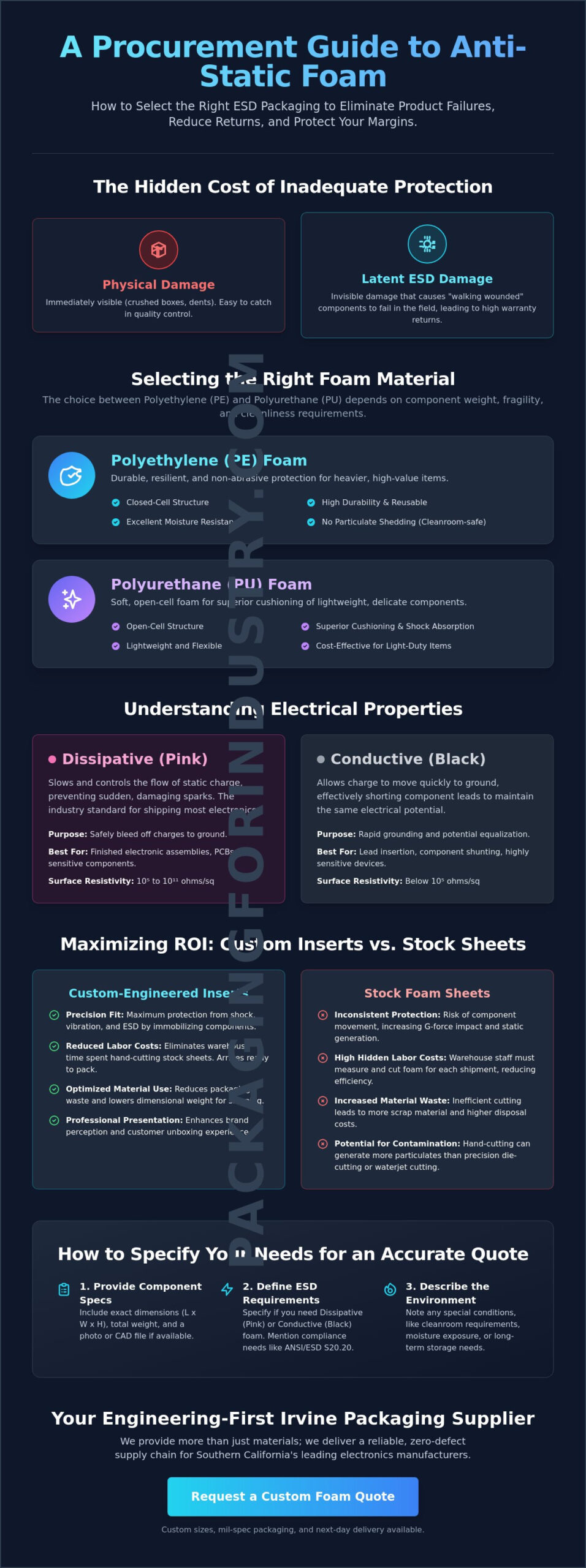
Latent ESD damage represents a significant financial drain because it often bypasses initial quality control. While physical transit damage like a crushed box is immediately visible, an electrostatic discharge can weaken a circuit without causing immediate failure. These “walking wounded” components eventually fail in the field, leading to high warranty return rates and damaged brand reputations. For manufacturers sourcing anti-static foam for electronics Irvine facilities, understanding that this material is a technical safeguard rather than a simple cushion is vital for long-term cost control.
Standard packaging materials are often insulators that generate and hold static charges. Anti-static foam, however, is engineered with specific chemical additives. Understanding how antistatic agents work helps procurement officers see why material quality matters. These agents migrate to the foam’s surface to attract ambient moisture, which creates a dissipative layer that prevents tribocharging. This chemical process is what stops static buildup when components rub against their packaging during transit. Maintaining compliance with current standards like ANSI/ESD S20.20-2021 and IEC 61340-5-1:2024 requires a precise match between the material’s electrical properties and the sensitivity of the device.
Industry color coding provides a quick visual reference for material properties. Pink foam is typically antistatic and dissipative, meaning it won’t generate a charge and will allow existing charges to bleed off slowly. Black foam is usually conductive, containing carbon additives that allow for rapid grounding. Using the wrong material can be just as dangerous as using no protection at all, especially in specialized sectors like aerospace and medical manufacturing where failure is not an option.
Dissipative vs. Conductive Foam: Which Do You Need?
Dissipative (Pink) foam is the most common choice for shipping finished electronic assemblies. It provides a controlled decay of static charges, preventing the sudden “spark” that destroys microchips. Conductive (Black) foam is often used for lead insertion; it allows the leads of a component to stay at the same electrical potential, effectively shorting them out to prevent any voltage differential. To aid in your technical specifications, dissipative materials generally maintain a surface resistivity between 10^5 and 10^11 ohms/sq, while conductive materials fall below 10^5 ohms/sq.
Mechanical Stress and ESD: A Dual Threat
Electrical protection is insufficient if the foam fails to provide adequate shock absorption. Many electronics are susceptible to both “G-force” impacts and high-frequency vibrations. Vibration during long-haul trucking can actually increase static generation if the component isn’t held firmly in place. PFI engineers foam packaging solutions that address this dual threat. By calculating the fragility of your component, we specify the exact density required to dampen physical shock while maintaining the ESD-safe environment necessary for sensitive circuits.
Selecting the Right ESD Foam: Polyethylene vs. Polyurethane
Choosing between polyethylene (PE) and polyurethane (PU) isn’t just about price; it’s about the mechanical and chemical environment your product will face. For operations managers seeking anti-static foam for electronics Irvine suppliers can provide, the choice usually depends on the weight and fragility of the assembly. PE foam is a closed-cell material that offers high durability and moisture resistance, whereas PU is an open-cell, soft cushioning material. Matching the foam’s physical properties to your component’s weight is the only way to ensure the protection actually works.
One major differentiator is particulate shedding and outgassing. High-precision electronics, especially those used in aerospace or medical device manufacturing, are exceptionally sensitive to environmental contaminants. PE foam is typically preferred in these “cleanroom-adjacent” environments because it doesn’t shed fibers or release chemical vapors that could contaminate optical sensors or delicate circuitry. Adhering to industry standards for ESD packaging ensures your material choice meets the necessary surface resistivity while maintaining this level of physical cleanliness.
Material density also dictates the “G-factor” protection of your package. This rating measures the maximum acceleration a component can withstand without damage. A heavy server rack needs a high-density PE to prevent “bottoming out” during a drop, whereas a lightweight, fragile circuit board requires the soft deceleration provided by low-density PU. If you’re unsure which density fits your component’s fragility rating, you can request a packaging quote and our engineering team will help you run the calculations to prevent over-packaging or under-protecting.
Polyethylene (PE) Foam for Heavy-Duty Electronics
PE’s non-abrasive closed-cell surface protects finished metal housings from scratches while providing impressive stacking strength. This makes it the ideal choice for palletized electronic assemblies that must withstand vertical pressure in a warehouse. We utilize custom die-cutting for rigid PE to create precise cavities that lock heavy components in place, preventing lateral movement and friction-based static during long-distance transit.
Polyurethane (PU) Foam for Delicate Instrumentation
PU foam’s open-cell structure makes it exceptionally soft and flexible. It’s the standard for lightweight cushioning in custom corrugated boxes. Whether you require convoluted (eggcrate) foam to gently grip irregular shapes or smooth sheets for interleaving, PU provides superior vibration damping for fragile sensors. However, PU can “set” or lose its shape under heavy loads over long periods; it’s rarely the right choice for the long-term storage of high-mass equipment.
Custom Foam Inserts vs. Stock Sheets: Maximizing Protection and ROI
Operations managers often view stock foam sheets as a budget-friendly option, but the true cost of “DIY” foam cutting is frequently hidden in warehouse labor logs. Hand-cutting stock materials for complex components is an inefficient process that leads to inconsistent seating and higher waste. For those procuring anti-static foam for electronics Irvine businesses, the transition to precision-engineered custom foam inserts is usually a matter of operational efficiency. These inserts are designed to lock components in place, eliminating the internal movement that generates friction-based static and physical abrasion during transit.
PFI provides a consultative approach through free prototyping. This allows your team to verify the fit and protective qualities of an insert before committing to a full production run. Beyond physical protection, custom engineering maximizes packaging density. By eliminating excess space within the box, you can often move to a smaller shipping container. This shift directly reduces dimensional weight charges and overall freight costs, making the “expensive” custom option more cost-effective over the long term.
When to Choose Stock Anti-Static Foam
Stock materials remain the logical choice for low-volume or prototyping phases where component shapes vary frequently. In these scenarios, layering pink anti-static bubble wrap with stock foam sheets provides a versatile barrier. We recommend pairing these stock layers with corner and edge protection to maintain structural integrity during palletization. This approach is particularly effective when you are using standard corrugated containers for non-standardized shipments.
The ROI of Custom Engineering
The return on investment for custom engineering is found in the reduction of Field Failure Rates (FFR). When a component is seated in a custom-cut cavity, the risk of “walking wounded” ESD damage drops significantly compared to loose-fill or hand-wrapped methods. Custom inserts also streamline your assembly line. They facilitate faster packaging kitting, allowing your warehouse team to pack more units per hour with zero guesswork. PFI maintains the capability to supply both custom and bulk stock materials, ensuring your procurement strategy is as flexible as your production schedule.
Specifying Your Anti-Static Foam Requirements for Quotes
Securing a reliable supply of anti-static foam for electronics Irvine manufacturers requires more than a simple part number. To provide an accurate quote that balances protection with cost efficiency, we need specific mechanical and electrical data points. Most procurement delays stem from incomplete specifications, which force suppliers to default to the highest density and most expensive ESD ratings to avoid liability. Providing comprehensive data upfront ensures you receive a solution tailored to your actual risk profile.
When you request a technical packaging quote, have the following data points ready for our engineering team. We require the exact weight and dimensions of the component, along with its fragility rating, often expressed as a “G-rating.” Electrically, you must specify the required surface resistivity in Ohms/sq and the desired static decay time. Aligning these technical needs with your Just-In-Time (JIT) inventory management strategy prevents the common pitfall of over-ordering specialized materials that have a limited shelf life for their anti-static properties.
Mil-Spec and Aerospace Compliance
Specialized sectors like defense and aviation often require adherence to strict military standards, such as MIL-PRF-81705. These standards dictate not just the resistivity, but also the durability and transparency of the packaging. Aerospace manufacturers specifically require permanent ESD protection. They cannot rely on foams treated with topical anti-static sprays that might rub off or lose effectiveness in low-humidity environments. Our Aerospace & Aviation Packaging Solutions focus on materials that provide consistent, long-term dissipative properties for high-value instrumentation.
Optimizing the Procurement Cycle
Managing the stock of bulky foam materials can quickly overwhelm warehouse floor space. We solve this through Vendor Managed Inventory (VMI), where we monitor your stock levels and replenish materials before you face a stockout. This is especially beneficial for Irvine-based operations that want to minimize their warehouse footprint while maintaining bulk packaging pricing. By leveraging PFI’s local Southern California delivery network, you can transition from storing months of inventory to a more efficient, weekly replenishment cycle. This approach keeps your capital fluid and your production lines moving without the stress of lead time uncertainty.
Why PFI is the Preferred Supplier for Industrial Anti-Static Foam
PFI positions itself as more than a commodity vendor. We operate as industrial consultants who bridge the gap between technical engineering and logistical efficiency. When sourcing anti-static foam for electronics Irvine manufacturers require a partner that understands both the physics of ESD and the economics of a lean supply chain. Our engineering-first approach ensures that every material choice is backed by data. We move beyond standard catalog items to provide custom-tailored protection that specifically addresses your component’s fragility and electrical sensitivity. This focus on precision allows us to act as a proactive problem-solver for your most complex shipping challenges.
Our comprehensive capabilities allow us to manage the entire packaging lifecycle from initial design to final delivery. From free prototyping that ensures a perfect fit to nationwide shipping and local Southern California delivery, we provide the infrastructure necessary for a zero-defect operation. We have a proven track record in the electronics, aerospace, and medical sectors, where compliance with rigorous standards is mandatory. By optimizing material density and reducing unnecessary waste, we help our clients lower packaging costs through smarter supply management rather than just cutting corners on quality. This methodical approach reinforces our commitment to your bottom line and your brand’s reputation for reliability.
The PFI Advantage: Custom & Stock Selection
A primary benefit of partnering with PFI is the ability to consolidate your procurement under one roof. We offer a full suite of industrial supplies, ranging from mailing tubes and edge protectors to heavy-duty crates and custom corrugated boxes. This single-source capability simplifies your billing and logistics. It ensures that your ESD protection and mechanical cushioning are perfectly integrated. You gain direct access to packaging specialists who understand the realities of production schedules and the critical nature of lead times. This level of oversight eliminates the stress of managing multiple vendors and ensures consistent quality across your entire packaging portfolio.
Get a Custom Packaging Quote Today
Starting the design process with our engineering team is straightforward. Whether you need a quote for bulk anti-static foam sheets or high-precision custom inserts, we provide the technical support to ensure your components arrive safely. We can help you compare packaging pricing and evaluate the ROI of custom engineering for your specific product line. Our Southern California facility is equipped to provide the high-quality anti-static foam for electronics Irvine companies need to maintain a competitive edge. Contact Packaging For Industry today to discuss your electronics protection requirements and secure a reliable, high-performance supply chain for 2026 and beyond.
Secure Your Supply Chain for 2026
Selecting the correct anti-static material is a technical necessity that prevents latent damage and lowers product return rates. Throughout this guide, we’ve highlighted the importance of matching foam density to component weight and the economic benefits of custom engineering over hand-cut stock sheets. As a dedicated provider of anti-static foam for electronics Irvine facilities, PFI focuses on the intersection of engineering precision and logistical efficiency. We help you eliminate the professional stress of shipping damage by providing predictable, high-performance protection.
Our team offers specialized expertise in aerospace and electronics packaging, ensuring your materials meet every required standard. We provide free prototyping for custom foam designs so you can verify fit and function before committing to a bulk order. For operations across Southern California, our next-day delivery capabilities allow you to maintain a lean warehouse footprint without risking stockouts. Take the next step in optimizing your logistics and reducing operational waste. Request a custom anti-static foam quote from PFI to secure your 2026 supply chain today. We’re ready to help you achieve a zero-defect shipping process.
Frequently Asked Questions
What is the difference between pink and black anti-static foam?
Pink foam is dissipative and prevents the buildup of static electricity by attracting a thin layer of moisture to its surface. It is the industry standard for shipping finished electronic assemblies. Black foam is conductive and contains carbon additives that allow for rapid grounding. Conductive foam is typically used for lead insertion to keep all component pins at the same electrical potential.
Does anti-static foam lose its effectiveness over time?
Pink dissipative foam typically has a functional shelf life of 12 to 24 months. The chemical additives that provide its anti-static properties migrate to the surface and can eventually dissipate or lose effectiveness, especially in low-humidity environments. In contrast, conductive black foam maintains its properties permanently because the carbon is integrated into the material’s molecular structure.
Is anti-static foam safe for direct contact with sensitive circuit boards?
Dissipative anti-static foam is specifically designed for direct contact with sensitive electronic components. It prevents the tribocharging that occurs when items rub against their packaging during transit. For high-precision applications, we recommend using polyethylene foam to avoid the particulate shedding or outgassing that can sometimes occur with lower-quality open-cell materials.
Can I get custom-sized anti-static foam inserts for my specific product?
PFI provides precision-engineered, custom die-cut inserts tailored to your exact component dimensions. Utilizing custom anti-static foam for electronics Irvine manufacturers can rely on eliminates internal movement and reduces the risk of physical abrasion. These custom sizes are available for both low-volume prototypes and high-volume production runs to ensure optimal protection and packaging density.
Does PFI offer local delivery for anti-static foam in Irvine and Southern California?
We offer local next-day delivery for all industrial packaging supplies throughout Irvine and the Southern California region. Our delivery network covers Orange County, Los Angeles, San Diego, and Riverside. This local service supports your Just-In-Time inventory goals, allowing you to reduce on-site storage costs while maintaining a consistent supply of critical ESD protection materials.
What are the common Mil-Spec standards for anti-static foam packaging?
The primary military specification for electrostatic protective materials is MIL-PRF-81705. This standard ensures that the foam provides the necessary resistivity and durability for defense and aerospace applications. Your packaging program should also comply with the current ANSI/ESD S20.20-2021 standard, which outlines the administrative and technical requirements for a successful ESD control program.
How do I determine the right foam density for my electronic components?
Determining the correct density requires balancing the weight of the component against its fragility rating, or G-rating. Lightweight, fragile instruments usually require the soft deceleration of low-density polyurethane foam. Heavier electronic assemblies need high-density polyethylene to prevent the product from bottoming out during a drop. Our specialists can help you calculate the exact density needed when you request a packaging quote.
Can anti-static foam be used for international shipping?
Anti-static foam is essential for international electronics logistics to protect against the varied environmental stresses of global transit. It prevents ESD damage caused by constant vibration during long-haul flights or ocean freight. When combined with heavy-duty corrugated boxes, ESD foam provides a robust barrier against both electrical failure and the physical impacts common in international distribution networks.