
Are you paying for excessive wall thickness that adds nothing but weight to your freight bill, or is your product one transit bump away from a catastrophic core collapse? Most manufacturers in Los Angeles and Orange County find that selecting the best core and tube thickness for industrial packaging is a frustrating balancing act between structural integrity and fiscal responsibility. It’s common to feel stuck between over-engineering your packaging or risking expensive product damage during long-haul shipping.
You can stop the guesswork by understanding the specific engineering requirements of your application. We will show you how to calculate the precise wall thickness needed to withstand radial pressure while minimizing material waste. This approach ensures you meet the strict new California packaging standards, such as SB 54, without overpaying for material you don’t need. This article explores the technical factors behind crush strength, cost-saving optimization strategies, and how to establish a reliable local supply chain right here in Southern California.
Key Takeaways
- Understand the critical relationship between wall thickness and radial crush resistance to ensure your industrial tubes withstand maximum structural loads.
- Identify the specific environmental and weight-based factors used to select the best core and tube thickness for industrial packaging for your unique application.
- Learn industry-specific thickness requirements for sensitive sectors, including aerospace composites and heavy-duty textile rolls.
- Discover how to reduce your total cost of ownership by balancing raw material expenses against potential freight surcharges and shipping damage rates.
- Explore the benefits of sourcing custom-engineered cores from a local Southern California supplier to improve lead times and inventory reliability.
Understanding Wall Thickness and Industrial Crush Resistance
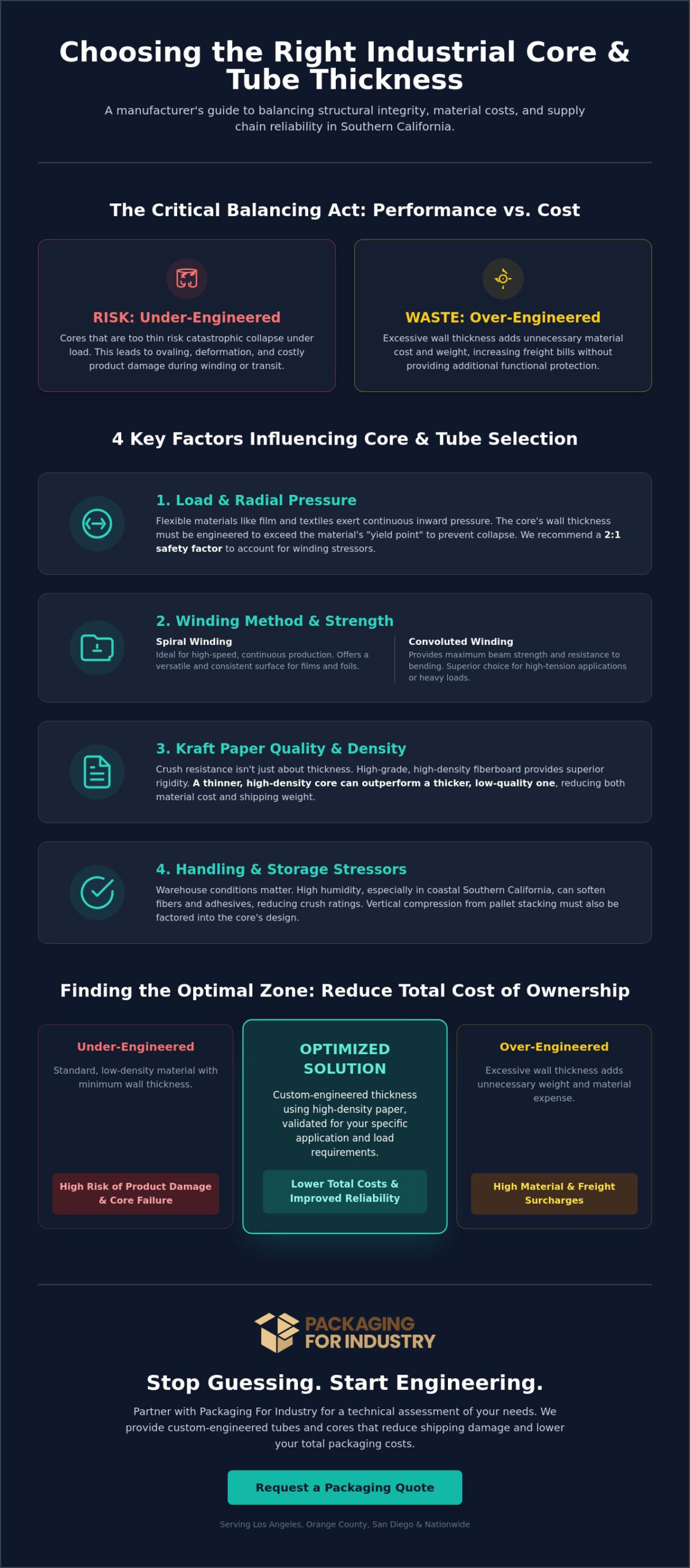
Wall thickness isn’t just a measurement; it’s a structural insurance policy for your products. For Los Angeles manufacturers, selecting the best core and tube thickness for industrial packaging requires a technical understanding of radial pressure. The wall thickness is the mathematical difference between the Inside Diameter (ID) and the Outside Diameter (OD). As the OD increases relative to the ID, the tube gains significant structural load-bearing capacity. This ratio is critical. If the wall is too thin for the ID, the tube will oval or collapse under the weight of the material wound onto it. However, simply adding more paper isn’t always the smart move. Over-engineering leads to excessive material waste and higher freight costs, especially when shipping bulk quantities across the country. Every extra millimeter of paperboard adds weight that compounds across every pallet in your shipment.
Spiral vs. Convoluted Winding: Impact on Strength
Spiral winding is the industrial standard for high-speed automated processes because it allows for continuous production and versatile lengths. It’s ideal for most winding tensions and offers a consistent surface for films and foils. If your application requires maximum beam strength or high resistance to bending, convoluted winding is the superior choice. This method wraps the paper perpendicular to the tube’s axis, creating a more rigid structure that prevents the core from bowing under heavy loads. Choosing the right winding method depends entirely on the tension your machinery applies during the winding phase. High-tension applications require the structural reinforcement that only specific winding patterns can provide.
The Role of Kraft Paper Quality in Core Integrity
The raw material determines the base performance of the tube. High-grade recycled fiberboard offers superior Paperboard rigidity compared to standard, low-density paper. Crush resistance is formally defined as the amount of pressure a tube can withstand before failing, measured in pounds per linear inch. Physical thickness is only one part of the equation; the density of the paper plies and the quality of the adhesive used to bond them are equally critical. A thinner, high-density core often outperforms a thicker, low-quality tube while reducing the total weight of your packaging. Determining the best core and tube thickness for industrial packaging involves calculating these specific radial forces to ensure the core maintains its integrity from your facility to the end user.
Factors Influencing Tube and Core Thickness Selection
Selecting the best core and tube thickness for industrial packaging isn’t a static decision. It requires a comprehensive analysis of the forces acting on the core from the moment of winding until the final user unwinds the last inch of material. You must account for the inward radial pressure exerted by the product, the vertical compression from stacking in transit, and the environmental conditions of your storage facility. If any of these variables are overlooked, the risk of core failure increases exponentially, potentially ruining thousands of dollars in inventory.
Calculating Load and Radial Pressure
Flexible materials like stretch film, foils, or industrial textiles exert continuous, inward radial pressure. This force attempts to shrink the core’s diameter as the material is wound under tension. To prevent deformation, engineers look for the “yield point,” which is the specific threshold where the paperboard’s structural integrity fails. We typically recommend a safety factor of at least 2:1 to account for unforeseen stressors during the winding process. Validating these limits often involves looking at Ring crush testing methods, which provide the scientific baseline for how different paperboard grades resist compression. If you’re unsure of your specific load requirements, you can request a technical assessment to find the optimal specification for your machinery.
Handling and Storage Stressors
Warehouse environments in Los Angeles and Orange County present unique challenges for paper-based components. High humidity levels can soften the adhesives and fibers in a paper core, significantly reducing its crush rating over time. A tube that remains rigid in a climate-controlled lab may fail in a non-climate-controlled distribution center after absorbing ambient moisture. This is why density and wall thickness must be optimized for the most localized “worst-case” scenario.
Beyond the environment, you must consider physical handling. Clamp trucks and forklifts apply localized pressure that can crush thin-walled tubes during loading. If your operations involve high-density racking systems, the cores at the bottom of a stack must support the cumulative weight of everything above them. To ensure the best core and tube thickness for industrial packaging, consider these transit stressors:
- LTL Shipping: Constant vibration and shifting loads in a truck bed can cause fatigue in thin-walled cores.
- Ocean Freight: Extended exposure to high-moisture air and extreme stacking heights in containers requires reinforced wall thickness.
- Equipment Mandrels: The wall thickness must be precise to ensure the core fits securely on winding equipment without slipping or jamming.
Industry-Specific Thickness Standards for Cores and Tubes
Every industrial sector operates under a unique set of mechanical stressors. A tube designed for mailing blueprints will fail instantly if used as a winding core for heavy-duty industrial film. To identify the best core and tube thickness for industrial packaging, manufacturers should consult the CCTI industry-specific thickness standards. These technical notebooks provide the baseline for uniform specifications across the composite tube industry, ensuring that your supplies meet the rigorous demands of modern machinery.
Aerospace and Mil-Spec Requirements
Precision is the baseline for aerospace applications. When managing military packaging, tubes must meet strict dimensional tolerances to fit automated winding mandrels without slippage. Wall thickness for aerospace composites typically ranges from 0.250 to 0.500 inches. This thickness ensures the core does not deflect or “bow” under the extreme weight of carbon fiber or pre-preg materials. We often integrate custom foam end caps into these designs to provide internal component protection, preventing lateral movement and impact damage during transit to defense contractors.
Textile and Film Core Benchmarks
The textile industry faces extreme torque requirements. High-speed looms apply significant winding tension that can twist or collapse a standard core. For these heavy fabric rolls, 6-inch industrial cores with wall thicknesses exceeding 0.400 inches are the standard. This heavy-duty construction prevents the core from deforming as the roll diameter increases.
In the flexible packaging world, preventing “core crush” is the primary operational goal. Film converters often utilize 3-inch industrial tubes and cores with wall thicknesses between 0.125 and 0.250 inches. These cores must feature a high-density, smooth surface finish. A rough surface can “telegraph” or leave visible markings on the inner layers of high-gloss films, leading to significant material waste. Selecting the best core and tube thickness for industrial packaging in this sector requires balancing this surface quality with the crush strength needed for high-speed conversion equipment.
Construction and Manufacturing Protection
Heavy-duty tubes serve as protective sleeves for metal rods, extruded plastic, or sensitive architectural blueprints. These applications don’t always require the precision of a winding core, but they do need enough wall thickness to resist impact from forklift handling. A typical 0.125-inch wall is sufficient for blueprint storage. However, protection for metal components usually requires 0.187 to 0.250 inches to prevent heavy parts from puncturing the tube wall during LTL shipping.
Balancing Material Costs with Structural Integrity
Finding the best core and tube thickness for industrial packaging is an exercise in economic optimization. While purchasing departments often focus on the unit price of the tube, operations managers understand that the true cost includes shipping, handling, and potential damage claims. A core that’s too thin leads to product loss, while a core that’s too thick inflates your freight bill. Every additional millimeter of paperboard adds weight that compounds across every pallet. If you ship via parcel, even a small increase in wall thickness can trigger higher weight tiers and expensive surcharges. The goal is to identify the “sweet spot” where you achieve maximum protection at the lowest possible weight.
The impact of precision engineering is best seen through real-world adjustments. In one specific case, a manufacturer reduced product damage by 15% simply by increasing their wall thickness by 0.125 inches. Previously, their cores were collapsing during high-density stacking in ocean containers. While the thicker core had a slightly higher unit price, the company saved thousands of dollars by eliminating replacement shipments and customer credits. This demonstrates that Total Cost of Ownership (TCO) is a much more valuable metric than unit price alone.
Lowering Packaging Costs through Engineering
Many businesses are currently over-engineering their supplies without realizing it. Our packaging cost savings analysis often identifies opportunities where a higher-density paper grade allows for a thinner wall without sacrificing crush resistance. By switching to a higher-performing material, you can reduce the total weight of your packaging and lower your shipping costs. Identifying this point of diminishing returns ensures you aren’t paying for material that provides no functional benefit. For bulk purchasers, we can help lock in pricing for custom-thickness tubes that are specifically engineered for your volume and transit requirements.
Prototyping and Testing for Reliability
We utilize CAD/CAM design to develop custom core solutions that match your specific load requirements. Southern California manufacturers benefit from our local prototyping services, which allow you to test new specifications before committing to a full production run. It’s critical to conduct real-world crush tests and drop tests to validate the performance of a new thickness. This proactive approach prevents the professional stress of a failed product launch. To find the most efficient specification for your operations, you can request a packaging quote and receive a technical assessment of your current core requirements.
Custom Engineered Tubes and Cores from Packaging For Industry
Packaging For Industry (PFI) provides more than just raw materials; we offer an engineering partnership designed to eliminate the logistical headaches of industrial winding and shipping. While national catalog suppliers often force you into standard sizes that don’t fit your machinery or your budget, we specialize in custom-engineered solutions tailored to your specific application. Finding the best core and tube thickness for industrial packaging shouldn’t involve a compromise between safety and cost. Our goal is to provide a steady and dependable supply chain that supports your production goals without the professional stress of inconsistent lead times.
We solve the common problem of over-engineering by matching the technical requirements of your product to the most efficient material grade. This approach ensures you aren’t paying for excess paperboard while still maintaining the structural integrity needed for high-tension winding. By operating as a seasoned industrial consultant, we help you transition from one-size-fits-all options to high-precision components that improve your logistical flow.
Southern California’s Partner for Industrial Packaging
Our headquarters in Anaheim allows us to serve as a local hub for manufacturers across the region. We provide rapid design changes through direct access to our engineering teams, ensuring that your packaging evolves alongside your product line. Whether you are operating in San Diego, Riverside, or San Bernardino, you can count on dependable local supply and next-day delivery for many stock items. This proximity is a critical advantage when you need to adjust specifications quickly to meet new production demands or regulatory changes. You can request a packaging quote today to see how our custom core thicknesses can improve your operational flow.
Streamlining Procurement with VMI
Managing a diverse inventory of custom-thickness tubes is a significant administrative burden that often leads to warehouse clutter. To solve this, we integrate your supplies into a Vendor Managed Inventory (VMI) program. Our team conducts scheduled inventory reviews at your facility to ensure you never face a stockout of critical components. This just-in-time approach allows you to free up valuable warehouse space by stocking only what you need for immediate production. PFI serves as the pragmatic, cost-saving alternative to impersonal national suppliers. We prioritize your bottom line by ensuring that the best core and tube thickness for industrial packaging is always available when your machines are ready to run.
Optimize Your Packaging Strategy for Long-Term Reliability
Selecting the best core and tube thickness for industrial packaging is a strategic decision that directly impacts your bottom line. By moving away from generic catalog options and embracing precision-engineered specifications, you can simultaneously reduce shipping damage and lower your total material spend. We’ve seen how a minor adjustment in wall thickness can eliminate core collapse while preventing unnecessary freight surcharges. It’s about finding that technical sweet spot where structural integrity meets fiscal responsibility.
Packaging For Industry provides the technical expertise and local support needed to refine your operations. Whether you require Aerospace and Mil-Spec compliance or high-speed winding cores for textiles, our team is ready to assist. We offer free prototyping for custom designs and provide local next-day delivery across Southern California to keep your production lines moving without interruption. Don’t let over-engineered packaging or inconsistent lead times drain your resources. Take control of your logistical flow and ensure your products arrive in perfect condition every time.
Request a Custom Tube and Core Quote today and let us help you build a more resilient supply chain.
Frequently Asked Questions
What is the standard wall thickness for a 3-inch industrial core?
Standard wall thickness for a 3-inch industrial core typically ranges between 0.125 and 0.250 inches. This specification is widely used for film conversion and light-duty winding applications. However, the best core and tube thickness for industrial packaging depends on the tension of your machinery and the total weight of the wound material. Heavier loads or higher winding torque will require moving toward the upper end of that range to prevent the core from ovaling.
How do I calculate the crush strength I need for my shipping tubes?
You calculate required crush strength by identifying the maximum radial pressure and vertical stacking load your tubes will encounter. Start by determining the “yield point” where the paperboard begins to deform; then apply a safety factor of at least 2:1. This calculation ensures the core remains rigid under the stresses of transit and long-term storage. Our engineering team uses these metrics to prevent the professional stress of catastrophic core failure during LTL shipping.
Can I get custom tube thicknesses for heavy-duty aerospace parts?
Yes, PFI provides custom engineered tubes with precise wall thicknesses specifically for the aerospace and defense sectors. We manufacture these components with tight Inside Diameter (ID) tolerances to ensure they fit perfectly on high-precision winding mandrels. These heavy-duty solutions often involve wall thicknesses up to 0.500 inches to support sensitive composite materials and prevent deflection during high-tension winding processes.
What is the difference between a paper tube and a paper core?
The primary difference lies in the application: cores are internal structural components used for winding materials like film or foil, while tubes are external protective containers for shipping products. Cores require high radial crush resistance to withstand inward pressure from the wound material. Tubes focus more on beam strength and impact resistance to protect contents like metal rods or blueprints from forklift damage and stacking pressure in a warehouse.
How does humidity affect the strength of my industrial paper cores?
High humidity significantly reduces the structural integrity of paper cores by softening the cellulose fibers and the adhesives bonding the plies together. In non-climate-controlled Southern California facilities, moisture absorption can lower a core’s crush rating well below its laboratory-tested limits. We account for these environmental stressors by recommending higher-density paperboard grades that maintain their rigidity even in fluctuating warehouse conditions.
Does PFI offer local delivery for tubes and cores in Orange County?
PFI provides local next-day delivery for stock tubes and cores throughout Orange County and the greater Los Angeles area. Because we are based in Anaheim, we can maintain a more responsive supply chain than national catalog suppliers. This proximity allows us to support your just-in-time production schedules and eliminate the long lead times that often disrupt manufacturing operations in Southern California.
How can I reduce shipping damage caused by core collapse?
You can reduce shipping damage by optimizing the density and thickness of your cores to match your specific transit stressors. Core collapse often occurs because the packaging is under-engineered for the stacking heights used in ocean freight or LTL trucks. By adjusting the wall thickness by as little as 0.125 inches, you can significantly increase crush resistance and ensure the best core and tube thickness for industrial packaging is utilized for your cargo.
What industries benefit most from custom-engineered tube thicknesses?
Industries that deal with high-tension winding or heavy, sensitive components benefit most from custom-engineered thicknesses. This includes aerospace composites, industrial film converters, and textile manufacturers where standard catalog sizes often fail. Custom engineering allows these sectors to avoid the high costs of over-engineering while ensuring their products have enough structural support to survive the rigors of global distribution and high-speed machinery.