
Need loose-fill packaging peanuts in bulk? Compare delivered pricing based on your order volume, storage space, and packaging needs, or request a packaging quote. The right loose fill can cushion products and limit movement during shipping while fitting your warehouse workflow.
Plan for the volume you use and the space available to store it. Compare bag sizes and bulk delivery options in Southern California to find a practical fit for your shipments. You’ll also learn how to identify biodegradable peanuts and handle reuse or composting appropriately.
Key Takeaways
- Match bag volume and delivery planning to your shipping pace, storage capacity, and packaging workflow.
- Arrange cushioning around the product to limit movement and help protect shipments from impact.
- Choose packing material based on the product’s needs and the way your operation handles packaging waste.
- Plan reuse and composting around the material type, keeping reuse practical for your packing process.
- Consider packaging design, foam solutions, and inventory management together to support dependable supply and control costs.
Loose-fill packaging peanuts: products and bulk delivery
Businesses can source loose fill from a packaging supplier or packaging distributor. For shipments to Orange County, Los Angeles, and San Diego, local packaging delivery may help reduce freight costs. When comparing suppliers, request bulk pricing and confirm available quantities, delivery options, and replenishment lead times.
Bag Sizes and Bulk Delivery
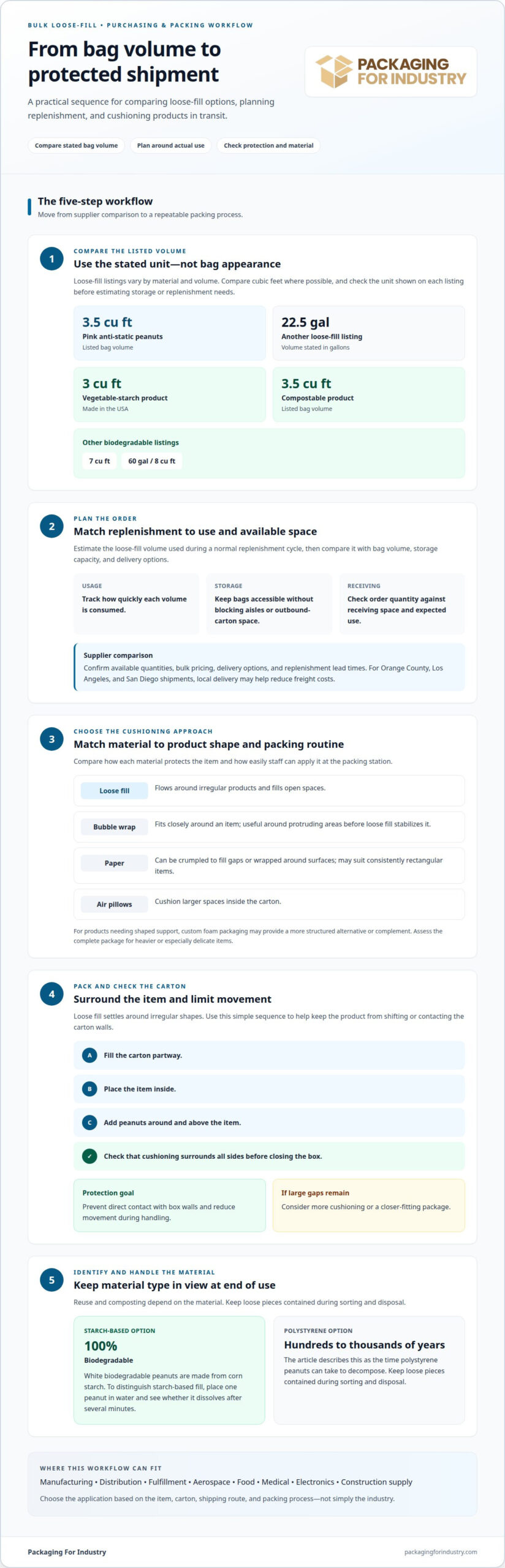
Bag volume varies by material and listing, so compare cubic feet rather than judging by appearance. Pink anti-static peanuts are listed in a 3.5-cubic-foot bag, and another listing gives a 22.5-gallon volume. Check the stated unit when comparing packaging pricing and estimating storage or replenishment needs.
Biodegradable options also come in varied volumes. A vegetable-starch product made in the USA is listed at 3 cubic feet, while a compostable product is listed at 3.5 cubic feet. Other biodegradable listings specify 7 cubic feet, or 60 gallons and 8 cubic feet.
For bulk delivery, estimate how much volume your packing operation uses during a normal replenishment cycle. Compare that need with each bag’s stated volume and your available storage space. A warehouse shipping varied product sizes may use loose fill differently from a facility shipping occasional large items. Ask a local packaging distributor about bulk packaging pricing and delivery to your receiving dock.
Before scheduling delivery, match the order quantity to storage capacity, receiving space, and expected usage. Keep bags accessible to packing stations without obstructing aisles or taking space needed for outbound cartons. Track how quickly each volume is consumed. That record helps purchasing teams plan orders around actual use instead of guesswork and request a quote for quantities that fit their replenishment schedule.
Loose-Fill Cushioning Performance
Loose fill cushions products by surrounding them with small, movable pieces that settle around irregular shapes. The pieces interlock to form a stable cushion and help limit shifting or settling inside the carton. For example, fill the carton partway, place the item, then add peanuts around and above it. Check that cushioning surrounds all sides before closing the box.
To assess shock protection, consider the item’s shape, fragility, and clearance inside the carton. The goal is to prevent direct contact with the box walls and reduce movement during handling. A carton with large empty gaps may need more cushioning or a closer-fitting package.
Comparing Protective Materials
Peanuts flow around irregular products and fill open spaces. Bubble wrap fits closely around an item, while paper can be crumpled to fill gaps or wrapped around surfaces. Air pillows cushion larger spaces. Match the material to the product’s shape and packing routine, and compare bulk supply options for your operation.
For example, a product with protruding parts may need wrap around those areas before loose fill stabilizes it in the carton. A consistently rectangular item may be easier to pack with paper or air pillows. Compare how each material protects the item and how easily staff can apply it when evaluating packaging costs.
Material choice also affects end-of-use handling. White biodegradable peanuts are made from corn starch and described as 100% biodegradable. To distinguish starch-based fill, place one peanut in water and see whether it dissolves after several minutes. Polystyrene peanuts can take hundreds to thousands of years to decompose, so keep loose pieces contained during sorting and disposal.
Industries served
Loose-fill cushioning can support shipping across manufacturing, distribution, fulfillment, aerospace, food, medical, electronics, and construction supply businesses. The right application depends on the item, carton, shipping route, and packing process, not simply the industry.
Manufacturers often ship finished products, replacement parts, and components in different carton sizes. Packing teams can use loose fill to surround irregularly shaped items and fill open spaces while following product-specific packaging instructions. For heavier or especially delicate items, assess the complete package design rather than relying on loose fill alone.
In aerospace supply chains, shipments may include components with distinct shapes and handling needs. Packaging decisions should account for how the part sits inside its carton, whether it can move during transit, and how staff will pack it repeatedly. A standardized process helps keep protection consistent across production and warehouse shifts. For products that need shaped support, custom foam packaging can provide a more structured alternative or complement.
Food companies also package equipment, parts, and other business-to-business shipments. Loose fill can cushion these products inside an outer shipping carton, but keep it separate from food unless the packaging design specifically calls for direct contact. Medical companies likewise need to distinguish a product’s own packaging from the shipping materials around it. Packing instructions should identify which items need added cushioning and where it belongs.
Electronics businesses ship products, accessories, and components of varying sizes and shapes. Loose fill can occupy carton voids, but it should not replace packaging selected for a product’s electrical or handling requirements. A shipping team can define which items use loose fill, which need a closer-fitting package, and which require another protective material. That distinction reduces guesswork and prevents one method being applied to every shipment.
Construction suppliers and industrial distributors may ship fittings, tools, replacement parts, or smaller assemblies alongside larger orders. The packing approach should fit the item’s shape and the carton configuration. For example, loose fill can occupy unused space around a small, irregular component, while a box divider or fitted support may better separate multiple parts. Clear packing standards help staff choose the right method at the workstation.
Warehouses and fulfillment centers need packaging methods that fit their picking, packing, and replenishment routines. Loose fill is most useful when teams can access it near the packing station and dispense it without slowing carton preparation. For mixed product profiles, written instructions can identify the packaging method for each product group. This clarifies training and supports consistent packing across shifts.
These considerations apply to packaging for manufacturers, distribution centers, and businesses shipping through multiple channels. A manufacturing packaging plan can account for product variation, packing-station workflow, and replenishment needs. The practical objective is to choose cushioning around the shipment’s requirements, while keeping the process repeatable for the people who pack it.
Benefits of reuse, cost planning, and reliable supply
Reuse clean cushioning to get more value from packaging supplies, while material type affects end-of-use handling. Plan purchases around packing station demand and available storage, and compare bulk packaging pricing with delivery costs.
Peanut Reuse Opportunities
Reuse clean, dry peanuts if they remain intact and can still fill package voids. Collect them after unpacking, remove tape or debris, and store them in a closed, clearly marked container. For example, a receiving team can return usable fill to a packing station instead of opening a fresh bag for every suitable shipment.
Biodegradable starch peanuts can be compostable, but compostable does not mean recyclable. Keep them separate from polystyrene and follow the requirements of the composting program handling them. Do not mix different materials in a reuse container. This sorting step helps staff choose the right disposal route later.
Keep loose peanuts contained in commercial receiving and packing areas. They are packaging material, not food or toys, and can pose a choking risk if swallowed. Use a closed storage container and clear away spills promptly, especially around packing stations and warehouse walkways.
Polystyrene Environmental Impacts
Polystyrene peanuts can persist in the environment for hundreds to thousands of years. Their lightweight form also makes loose pieces easy to scatter during unpacking or waste handling. Keep them in a bag or lidded bin while sorting, then direct them to an appropriate reuse or disposal route.
Reduce waste with practical controls: prevent spills, recover clean fill, and separate materials at the packing station. For example, a receiving area can use separate containers for reusable peanuts and material that is damaged or contaminated. This prevents compostable starch fill from mixing with polystyrene and simplifies the next handling step.
Cost per bag or cubic foot varies with material, package volume, order quantity, and freight distance. A small bag may suit occasional packing, while larger volumes can work for steady shipping if storage space allows. Compare bulk packaging pricing and delivered costs with the usable cushioning each order provides, rather than comparing bag prices alone.
Shipping distance matters because freight can make up a substantial portion of a packing-peanut purchase. For operations in Orange County, Los Angeles, and San Diego, requesting local packaging delivery from a nearby packaging distributor may help limit that cost. Bulk buying can reduce repeated ordering, but only if the facility can store the material cleanly and use it before damage or contamination. Request a packaging quote to compare order sizes and delivery options.
Build a simple purchasing review around actual use. Record the bag volume received, how quickly it is consumed, and how much remains reusable after unpacking. Then adjust order size to match packing demand and available storage. This helps avoid excess inventory while keeping cushioning accessible during busy shipping periods.
For a clear comparison, assess material type, bag volume, delivery distance, and storage needs together. A 3-cubic-foot bag and an 8-cubic-foot listing represent different replenishment and space requirements, not just different quantities. Compare packaging pricing for the volume that matches your workflow, then account for reuse before planning the next purchase.
Packaging For Industry (PFI)
Packaging For Industry (PFI) helps manufacturers and warehouse teams address cushioning and packaging supply needs within their broader shipping operations. If loose fill does not suit a product’s shape, packing process, or storage setup, consider whether alternative protection and dependable inventory planning would better fit the workflow.
Start with the shipment itself. Consider the product’s shape, fragility, weight, carton, and how it moves through packing and distribution. Loose fill can be useful for filling voids, but some items need more structured support. PFI offers foam packaging for applications where a designed cushion can support a product more closely. Protective foam packaging can be considered alongside the outer package, helping teams evaluate how to reduce shipping damage without relying on one cushioning method for every item.
Packaging decisions also affect warehouse flow. Materials need a practical place at the packing station, and purchasing needs to align replenishment with actual use. If the operation uses several packaging materials, reviewing the full supply process can reveal where stockouts, excess inventory, or inconsistent packing instructions interrupt work. A clear material plan gives staff a repeatable method and helps purchasing coordinate orders with production and shipping demands.
For businesses with recurring packaging needs, Vendor Managed Inventory (VMI) for Packaging can support inventory planning and replenishment. Just-In-Time (JIT) Inventory Management for Packaging can help coordinate supply with operational needs. These approaches are useful when space, stock visibility, or order timing affects the packing line. They address supply continuity, not loose fill’s cushioning performance, so product protection still depends on choosing materials suited to each shipment.
As an Anaheim-based industrial packaging supplier serving Orange County, Los Angeles, and San Diego, PFI works with companies seeking greater packaging efficiency and supply reliability. A local supplier can help purchasing teams coordinate packaging needs with nearby operations. Start by reviewing the products shipped, packing steps, material usage, and storage constraints. These details help determine whether foam packaging, stretch film, inventory management, or a combination fits the operation.
Review how packing standards are used across shifts, too. If teams choose different cushioning for the same product, document the intended method and organize materials at the point of use. PFI helps businesses manage packaging supply alongside the protective materials they use, supporting consistent packing and helping reduce avoidable disruption. For manufacturers, distribution centers, and warehouses, this connects day-to-day packaging choices with purchasing and replenishment decisions.
For an initial discussion, outline the products you ship, the packaging challenges you want to address, and any supply planning concerns. Include whether you need more consistent inventory, improved cushioning, or a more coordinated packaging process. This gives the conversation a practical starting point without assuming one material suits every shipment. Request a packaging quote from Packaging For Industry (PFI) to discuss your requirements.
Frequently Asked Questions
Can I request a quote for biodegradable packing peanuts?
Yes. When requesting a packaging quote, provide the material requirements, order quantity, and delivery location. Include the product specification if you need a particular type of fill, such as biodegradable, foam, or anti-static. Clear details help a packaging supplier check availability and provide pricing for your operation.
Can I order loose-fill packaging peanuts in bulk?
Bulk orders can help businesses plan packaging supply for recurring shipping needs. Share the type of loose fill, estimated quantity, and order frequency when you contact a supplier. Keeping the material and quantity details with purchasing records can also help staff reorder consistently when the same packing stations serve different product lines.
Can a packaging supplier provide different types of packaging peanuts?
Availability may include conventional foam fill, biodegradable fill, and anti-static varieties for electronics-related shipments. When comparing suppliers, specify the material and application requirements separately. Clear purchasing descriptions help the supplier identify suitable options and prevent an unreviewed substitute from entering the packing workflow.
What information should I provide when requesting packaging peanuts?
Provide a representative product and carton, the type of fill required, and the quantity needed. If you have a packing standard, share where staff place the material and what they inspect before sealing the carton. This information helps a supplier understand your requirements and quote for a consistent supply.
Can I arrange local delivery of packaging peanuts in Southern California?
For businesses in Orange County, Los Angeles, and San Diego, ask a packaging supplier about local packaging delivery, available quantities, and lead times. If shipments generate recurring requirements, share the material type and accumulation pattern so the supplier can discuss an appropriate supply plan.