
The lowest-cost mailer can become the costly choice if it doesn’t protect the item in transit. Poly bubble mailers combine a flexible outer layer with interior cushioning, making them practical for compact shipments that need protection from scuffs and routine handling but not a rigid box.
Weigh protection, fit, and shipping efficiency together. This guide explains which products suit padded mailers, when paper mailers or cardboard boxes may be a better fit, and what affects per-mailer and case pricing. You’ll also learn how to compare sizes and order quantities so your packaging supports reliable fulfillment without unnecessary material or cost.
Key Takeaways
- Choose a mailer by its usable interior dimensions and the item’s fit, not by the outside measurements alone.
- Match the cushioning level to the product and shipping risks; items needing rigid protection may call for a different packaging format.
- Compare per-mailer and case pricing by considering order quantity, size, and the protection required for your shipments.
- Review the mailer’s material and local recycling acceptance before deciding how to dispose of it.
- For broader packaging needs, PFI offers foam packaging, stretch film, and packaging inventory management through VMI and JIT programs.
Poly Bubble Mailer Products and Availability
Standard sizes give fulfillment teams options for matching mailers to product dimensions and order volume. USPS, UPS, and FedEx requirements depend on the selected service, package dimensions, weight, and preparation. Use secure packaging and follow the applicable carrier packaging and labeling instructions.
Available Mailer Sizes
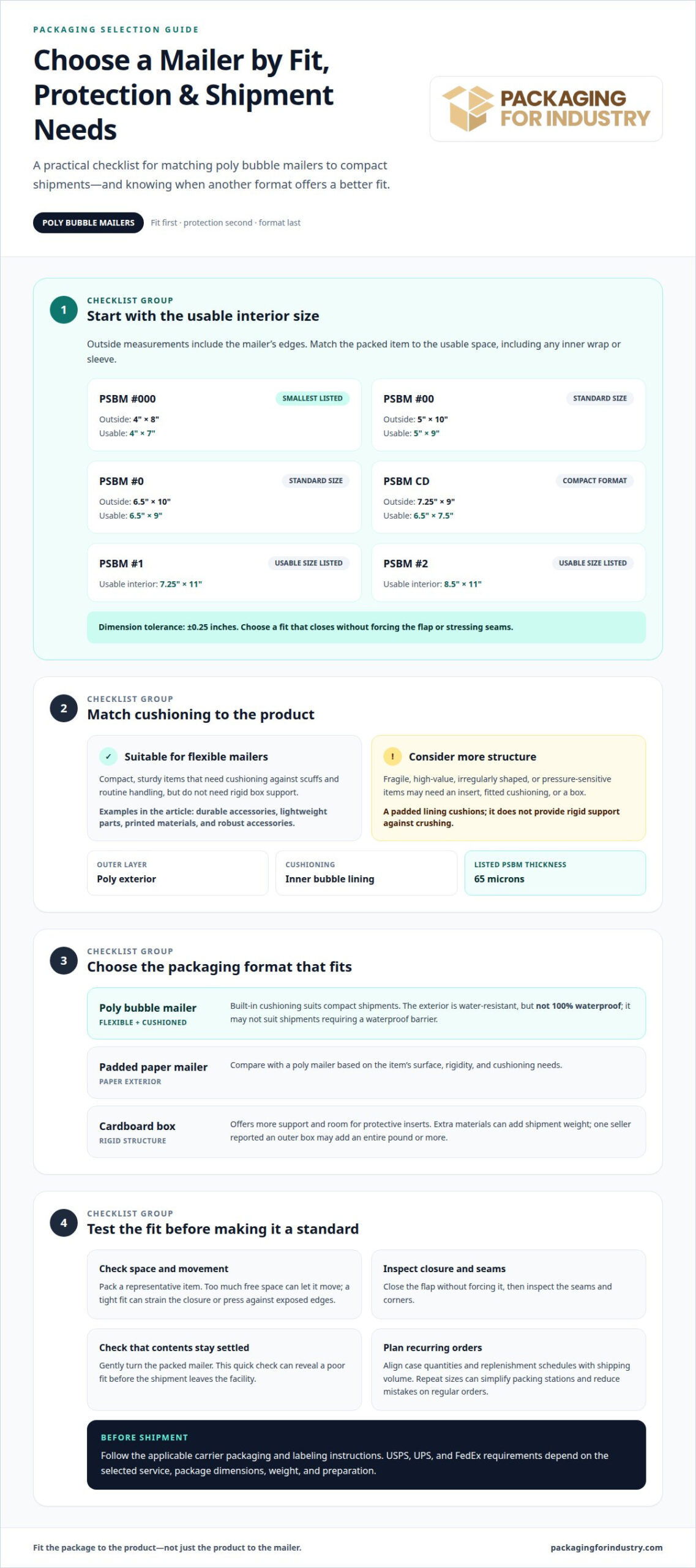
Compare usable interior dimensions with the packed item, since outside measurements include the mailer’s edges. Common options include PSBM #000 at 4" x 8" outside and 4" x 7" usable, and PSBM #00 at 5" x 10" outside and 5" x 9" usable. The PSBM #0 measures 6.5" x 10" outside, with 6.5" x 9" usable space.
Other listed sizes include the PSBM CD at 7.25" x 9" outside and 6.5" x 7.5" usable, plus PSBM #1 and #2. Their usable dimensions are 7.25" x 11" and 8.5" x 11", respectively. Listed dimensions have a manufacturing tolerance of ±0.25 inches. Choose a size that fits the packed product without forcing the closure or stressing the seams.
Mailer and Packaging Comparisons
These padded envelopes combine a flexible outer layer with built-in cushioning, while padded paper mailers use a paper exterior. Choose based on the item’s surface, rigidity, and cushioning needs. The plastic mailers are water-resistant, but not 100% waterproof, so they may not suit shipments requiring a waterproof barrier.
Cardboard boxes provide rigid structure for items that need more support or room for protective inserts. They can also add shipment weight; one seller reported that an outer box may add an entire pound or more. Compare the protection required with the added materials and parcel weight. A compact, sturdy item may suit a padded envelope, while a fragile product may need extra cushioning or a box.
Planning Availability
Standard sizes help buyers select packaging for recurring product dimensions, but availability varies by supplier, size, and order quantity. Before setting a packaging standard, compare the usable interior dimensions with the packed product, including any inner wrap or sleeve. Then align case quantities and replenishment schedules with shipping volume. Focusing on repeat sizes can simplify packing stations and reduce mistakes on regular orders.
Industries Served
Shipping teams across Southern California use padded mailers for compact products that can travel without a box’s rigid support. The right application depends on the product’s shape, fragility, value, and handling needs. A mailer can streamline packing for suitable orders, but it isn’t a universal replacement for protective packaging.
E-commerce and fulfillment operations often process varied orders at pace. A mailer may suit small, durable accessories, lightweight parts, or printed materials when the item fits securely. Standardizing packaging for repeat products can keep packing stations organized and reduce avoidable decisions during order processing. Businesses managing online orders can also review e-commerce packaging as part of their broader fulfillment workflow.
Manufacturers and distributors may ship samples, replacement components, product literature, or small hardware. Before choosing a mailer, consider whether the item can withstand pressure from other parcels and whether its surfaces need protection from abrasion. Delicate, high-value, or irregularly shaped components may need a more structured package or fitted cushioning.
Electronics businesses can assess mailers for accessories and sturdy, non-sensitive items, while using packaging suited to the protection needs of fragile devices and components. Aerospace and medical companies should likewise distinguish routine documents or robust accessories from precision or sensitive products. Packaging selection should reflect the item and its handling requirements, not just the industry label.
Food companies and construction suppliers ship a wide range of products, many of which call for formats beyond a padded mailer. A compact, durable accessory may fit; bulky, sharp, heavy, or easily damaged goods generally need another approach. The same distinction matters for warehouse and distribution-center teams preparing mixed orders.
For each operation, teams can sort shipments by product type, fragility, and packing workflow. This simple classification helps identify where flexible mailers fit and where boxes, inserts, or other cushioning materials better protect the shipment. It also helps purchasing teams align packaging choices with repeat order patterns instead of applying one format to every product.
Poly Bubble Mailer Protective Features and Benefits
The listed PSBM mailers are 65 microns thick, with a poly exterior and an inner bubble lining. Together, these layers provide a flexible package with cushioning for compact shipments. The lining helps limit surface scuffs and soften routine handling impacts. For example, a sturdy accessory can travel without a separate sheet of cushioning. The flexible format also takes up less space than a rigid carton.
Protection depends on how the item sits inside the packed mailer. Too much free space can allow movement, while a tight fit can strain the closure or press against exposed edges. Match the packed product to the mailer’s usable interior, then close it without forcing the seam. Check that the contents stay settled when the package is gently turned. This quick check can reveal a poor fit before the shipment leaves the facility.
The padded lining cushions compact products but doesn’t provide rigid support. A sturdy accessory may tolerate flexible packaging, while a fragile electronic component may need an insert or a box. Consider the product’s fragility, shape, and exposure to pressure during handling. Don’t treat a flexible envelope as a substitute for structural protection when crushing is a concern.
Pack a representative item before standardizing a mailer for repeat orders. Place it inside, close the flap, and inspect the seams and corners. If a sharp edge presses against the material, add suitable inner protection or choose a more structured package. For products with delicate finishes, prevent direct rubbing with an appropriate protective layer inside. Keep the packing method consistent for similar products.
Damage patterns can guide packaging adjustments. Scuffed surfaces may point to rubbing inside the package, while crushed contents suggest a need for stronger structural support. Address these causes separately instead of adding cushioning automatically to every order. Reviewing returned or damaged products can help teams identify which shipments suit a padded envelope and which need another format.
Case and Per-Mailer Prices
Case pricing shows the total purchase cost, while per-mailer pricing helps compare formats. To calculate unit cost, divide the case price by the number of mailers inside. For example, compare the #000 and #2 formats using their respective case quantities. This makes it easier to see whether a larger mailer changes the packaging budget for each shipment.
The case count matters as much as the listed price. A case with more pieces may have a lower unit cost, but it also takes more storage and ties up more purchasing budget. Match the order quantity to actual usage. A fulfillment team shipping a steady stream of one product may use a case efficiently; variable orders may need a different mix.
Size, order quantity, and delivery requirements affect the overall purchasing comparison. A larger format uses more material, while a smaller one may not fit the packed item. Compare the size needed for each product, expected case usage, and replenishment frequency. Price depends on mailer size, case quantity, order volume, and delivery requirements, and is provided after a quote request.
Build a useful comparison using the same assumptions for each option. Record the case price, pieces per case, unit cost, and expected usage period. Then account for storage space and the risk of holding excess stock. For example, a frequently shipped size may justify a larger case purchase, while an occasional size may be better ordered in smaller quantities.
Check whether quoted pricing includes delivery and whether different sizes can be combined in an order. These details affect the total landed packaging cost, not just the per-mailer figure. Also consider whether the mailer’s fit avoids the need for extra inner packaging. A low unit price may not be the lowest-cost choice if the size requires added cushioning or causes avoidable packing delays.
For a purchasing review, compare case totals and calculated unit costs by size, then align each order with forecast usage. Keep the calculation consistent across suppliers and order scenarios. This gives procurement teams a clearer basis for evaluating bulk packaging pricing without treating the case price as the full cost.
Are Poly Bubble Mailers Recyclable, and How Should They Be Disposed Of?
Recycling depends on the mailer’s materials and local program rules. A poly exterior and bubble lining may combine materials that a curbside program handles differently. Don’t assume the entire mailer belongs in a recycling bin. Check the package’s recycling label and your community’s current sorting guidance before disposal.
Use this simple process for each mailer:
- Empty it completely. Remove the shipped item, packing slips, and loose contents.
- Read the package label. Look for material identification or disposal directions printed on the mailer.
- Check local guidance. Follow your city or waste hauler’s instructions for plastic film and padded mailers.
- Separate components only when practical. If the bubble lining and exterior separate cleanly, sort them only as local guidance directs.
- Use the designated disposal route. Put accepted materials in the specified collection stream; place unaccepted mailers in household waste.
For example, a clean mailer without attached paper may still be unsuitable for a curbside bin if the local program excludes flexible packaging. A label alone doesn’t guarantee acceptance. The collection program determines which materials it can process, so follow its instructions rather than treating every plastic-looking package alike.
Keep padded mailers out of paper recycling unless local instructions explicitly allow them. Their cushioning layer can complicate sorting with paper products. Likewise, don’t put them with other recyclable plastics based only on appearance. If a mailer is wet, heavily soiled, or has contents stuck inside, follow local disposal guidance for contaminated packaging.
Businesses can make disposal more consistent by placing a sorting guide near packing and unpacking areas. Use separate, clearly marked containers only for streams accepted by the facility or hauler. For example, a warehouse can direct staff to collect clean mailers separately while keeping ordinary paper and cardboard in their designated bins. Review instructions when local collection rules change, and train teams to follow the same process across shifts.
How Do Poly Bubble Mailers Compare With Padded Paper Mailers and Cardboard Boxes?
Each format solves a different shipping problem. A poly bubble mailer combines a flexible outer layer with cushioning, making it suitable for compact items that don’t need rigid walls. A padded paper mailer has a paper exterior and built-in cushioning. A cardboard box adds structure and room for inserts but requires more packing steps. Match the format to the product, not just the packing station’s routine.
For a lightweight, sturdy accessory, a bubble mailer can keep the package compact and easy to prepare. Padded paper mailers suit similar shipments when a paper exterior fits handling or presentation needs. Neither format protects a crush-sensitive product like a rigid carton. Carefully assess delicate components, fragile electronics, or products with exposed corners before choosing a flexible mailer.
Cardboard boxes support products that need a stable outer structure or extra room around the item. Packers can also place cushioning around fragile contents and separate multiple pieces inside a box. The tradeoff is added material and handling. One seller reported that an outer box can add an entire pound or more to a shipment, so consider package weight alongside protection.
For a repeat shipment, use this decision sequence: identify whether the item is fragile, check if it needs rigid support, then choose a format that fits its dimensions. A compact, durable part can ship in a padded mailer. A delicate instrument needs cushioning and structural protection. A set of several items may fit more securely in a box with inserts than in a flexible mailer.
Finally, compare the total packing process, not only the package itself. A mailer can reduce assembly steps for straightforward orders, while a box supports more complex packing arrangements. For products needing rigid protection, review corrugated box options as part of the format decision. The right choice balances product protection, packing requirements, and shipment weight without applying one packaging type to every order.
Packaging For Industry (PFI)
Packaging For Industry (PFI) helps businesses assess packaging needs beyond individual mailers. Turn to PFI when shipment protection, load handling, or packaging inventory calls for a broader operational review. For example, an e-commerce warehouse may use padded mailers for suitable orders while addressing separate protection needs for products that require cushioning or stable pallet loads.
Foam packaging cushions products that need support inside a shipping package. The material and format should suit the item’s shape, fragility, and handling requirements. A component with delicate surfaces may need a different approach from a sturdy part. Reviewing these differences helps teams select protective packaging for each product instead of applying one method to every shipment.
Stretch film serves a different function. It helps secure packaged goods together for handling and movement, such as cartons grouped on a pallet. Choosing film suited to the load and packing process helps keep warehouse handling consistent. Foam and stretch film address separate packaging tasks, so operations teams can evaluate them as part of a broader effort to protect products and manage shipping workflows.
Packaging inventory also affects daily operations. Packaging For Industry offers Vendor Managed Inventory (VMI) and Just-In-Time (JIT) inventory management for packaging. VMI helps businesses manage packaging supplies, while JIT aligns supply timing with operational needs. These approaches can help teams manage stock deliberately and coordinate supply with ongoing warehouse or fulfillment activity.
To make the discussion productive, outline the products being protected, the packaging tasks involved, and any inventory challenges. Include examples such as a fragile component that needs cushioning or palletized goods that require secure handling. These details help identify relevant packaging and inventory-management options without assuming one solution fits every product or facility.
Request a packaging quote from Packaging For Industry (PFI) and include the mailer size, order quantity, and any protection or inventory requirements.
Frequently Asked Questions
What are poly bubble mailers and what are they made of?
Poly bubble mailers are flexible shipping envelopes with a plastic outer layer and interior bubble cushioning. The exterior helps shield contents from surface moisture and handling, while the bubbles pad the item. They’re commonly used for shipments that need some cushioning but not a rigid carton. Because the envelope flexes, it isn’t a substitute for structural protection for crush-sensitive products.
What sizes and thicknesses are poly bubble mailers available in?
Sizes vary by manufacturer and product line. Listed PSBM formats range from #000, with 4" x 7" usable space, through #2, with 8.5" x 11" usable space. The listed PSBM mailers are 65 microns thick, and their dimensions have a manufacturing tolerance of ±0.25 inches. Larger mailers are also sold in the market, with one seller reporting 24-by-24-inch options for sturdy items.
How much do poly bubble mailers cost in the United States?
There isn’t one standard US price: size, case quantity, order volume, and delivery terms affect the comparison. To calculate a per-mailer figure, divide the case price by the number of mailers in the case. Compare equivalent sizes and quantities rather than a single-unit price with a bulk case. Include storage needs and expected usage when choosing the right purchase quantity for your operation.
Where can I buy poly bubble mailers in the United States?
US buyers can source these mailers through packaging distributors and shipping-supply suppliers that sell by the case or other stated quantities. For business purchasing, compare usable dimensions, thickness, case count, and delivery terms for the exact size required. Southern California operations can plan mailer use alongside other packaging workflows to keep packing materials and product-protection requirements consistent across fulfillment locations.
How do I choose the right poly bubble mailer size for an item?
Measure the item after adding any sleeve, wrap, or inner packaging that will ship with it. Compare those measurements with the mailer’s usable interior dimensions, not its outside size. Leave enough room to insert the product and close the flap without forcing the seam. For repeat shipments, test a representative packed item before standardizing the mailer size across orders.
What items are poly bubble mailers best suited for shipping?
Poly bubble mailers generally suit compact, relatively sturdy products that benefit from padding but don’t need rigid walls. Examples include soft goods, small accessories, and non-fragile items that fit securely inside the envelope. Don’t rely on a mailer alone for heavy, sharp-edged, crush-sensitive, or highly fragile products. Those shipments may need a box or internal protection suited to their handling risks.
How much protection do poly bubble mailers provide against impact, moisture, and punctures?
The bubble lining cushions against routine bumps and scuffs, but it doesn’t provide the rigid support of a box or guarantee protection from severe impact. The plastic exterior is water-resistant, not 100% waterproof. Sharp corners or pointed contents can puncture flexible material, so protect exposed edges or choose a more structured package. Match the mailer’s limits to the product and expected handling conditions.