
Upgrading to a heavier cardboard grade won’t prevent pallet loads from collapsing when coastal humidity saturates your facility. If you stage inventory near the ports of Long Beach or San Pedro, you already know the operational headache of softened containers, mold risks, and costly transit claims. Untreated kraft paper absorbs ambient water vapor rapidly, losing critical stacking strength under compression. Protecting your cargo across the region requires specialized moisture resistant corrugated boxes Southern California logistics teams can deploy to maintain structural integrity in high-humidity corridors.
You shouldn’t have to absorb write-offs from crushed cartons or guess whether your packaging complies with state environmental rules. In this guide, you’ll discover how to specify, select, and source high-performance moisture barrier packaging to eliminate humidity damage across Southern California supply chains. We examine modern repulpable coatings versus wax board, break down essential ASTM moisture resistance standards, and show how partnering with a local supplier provides rapid replenishment to reduce shipping damage and lower packaging costs.
Key Takeaways
- Understand why marine layer moisture cuts standard corrugated stacking strength by up to fifty percent, and how to evaluate ambient risks across coastal logistics hubs.
- Discover the critical differences between modern repulpable coatings and wax treatments when specifying moisture resistant corrugated boxes Southern California facilities require for humid transit.
- Learn how to evaluate water-resistant adhesives and board combinations to prevent carton delamination, crushed bottom tiers, and product corrosion.
- Examine California recycling compliance considerations to avoid steep landfill fees associated with traditional non-recyclable wax cartons.
- Find out how partnering with an Anaheim-based manufacturer for Vendor Managed Inventory and next-day local delivery helps lower packaging costs while freeing up warehouse space.
Understanding Moisture Risks in Southern California Industrial Logistics
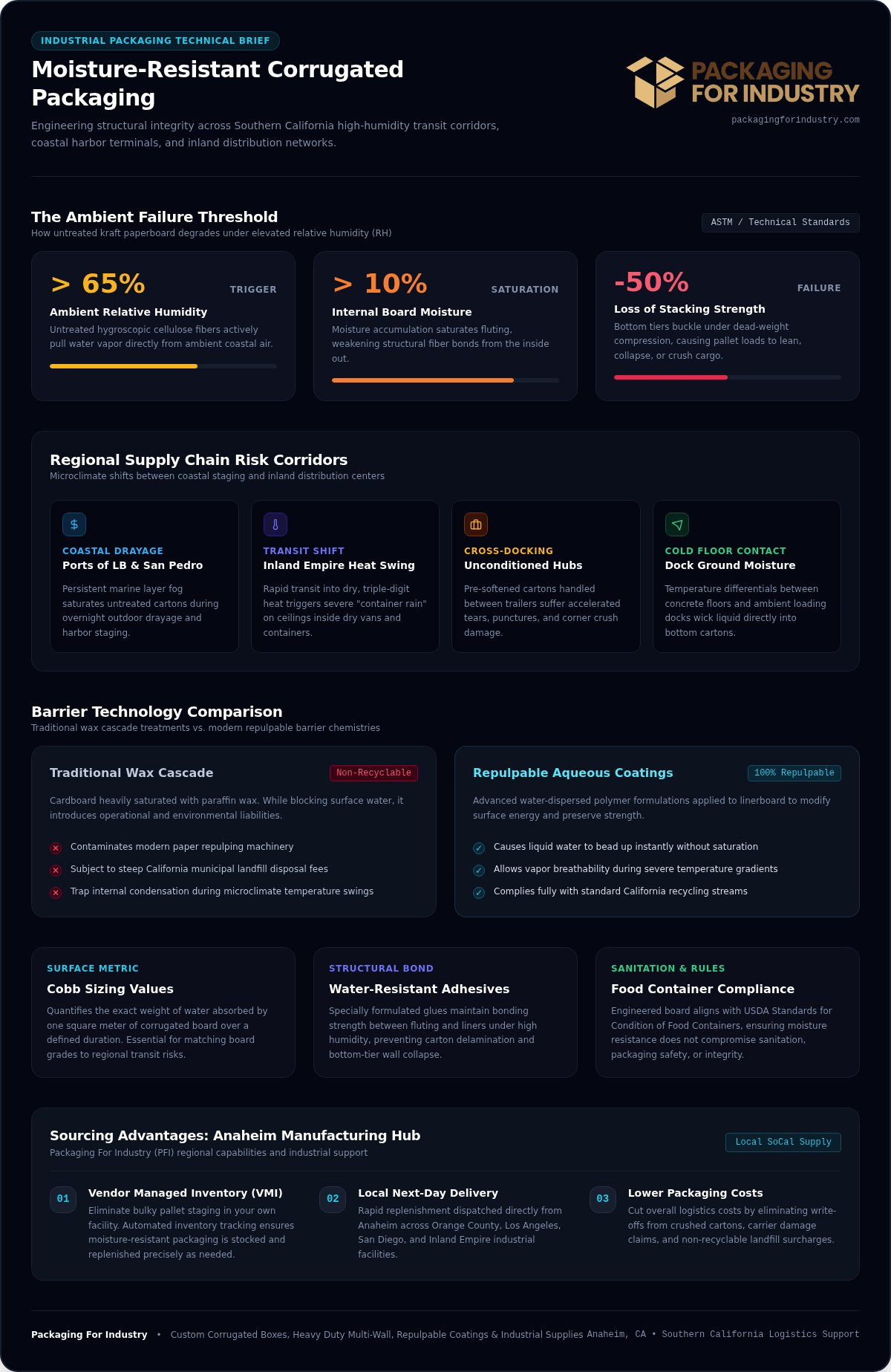
Standard packaging fails silently when relative humidity rises. Corrugated fiberboard is inherently hygroscopic, meaning untreated cellulose fibers pull water vapor directly from ambient air. Once relative humidity surpasses 65%, unlined paperboard absorbs ambient vapor until internal moisture climbs past 10%. At that saturation point, standard containers lose up to fifty percent of their structural stacking strength. For industrial operations moving goods through high-humidity corridors, deploying purpose-built corrugated boxes with moisture barrier properties is essential to prevent catastrophic pallet failure.
The Impact of Coastal Humidity on Standard Corrugated Board
Coastal logistics hubs face persistent marine layer fog that standard corrugated cartons simply cannot withstand. As ambient vapor penetrates outer liners, internal fluting softens and buckles under dead-weight compression. This triggers bottom-box crushing, causing entire pallet loads to lean or topple during overnight container staging near San Pedro and Long Beach harbor terminals. Beyond damaged exterior packaging, structural collapse deforms internal products, leading to unsaleable inventory, costly carrier disputes, and steep freight damage claims.
Regional Logistics Corridors: Port Staging to Inland Warehouses
Moving freight across Southern California exposes cargo to extreme microclimate swings. Shipments originating in cool, damp coastal drayage yards often travel directly into dry, triple-digit heat across Inland Empire distribution hubs. This abrupt temperature shift triggers severe condensation, commonly known as container rain, inside ocean containers and dry van trailers:
- Moisture laden coastal air condenses on trailer ceilings overnight, dripping water directly onto top tier cartons.
- Unconditioned cross-dock facilities transfer pre-softened cartons between trailers, accelerating puncture and tear damage.
- Temperature differentials between cold warehouse floors and ambient loading docks draw ground moisture into bottom carton faces.
Operations teams should conduct moisture audits across specific transport lanes to identify where ambient exposure peaks. For precision manufacturers in Anaheim and Irvine shipping high-value components, relying on the durable moisture resistant corrugated boxes Southern California supply chains require keeps inventory intact and helps lower packaging costs by eliminating preventable freight losses.
Technical Anatomy of Moisture Resistant Corrugated Packaging
Engineering true moisture resistance requires addressing chemical absorption and structural bond integrity simultaneously. Specifying high-performance barrier packaging involves measuring water uptake using Cobb sizing values, which quantify the exact weight of water absorbed by a square meter of board over a set duration. Industrial buyers evaluating corrugated cardboard boxes must match these Cobb ratings to regional transit threats, ensuring the board meets rigorous regulatory expectations like the United States Standards for Condition of Food Containers when excess moisture compromises sanitation or structural safety.
Barrier Chemistry: Functional Coatings and Wax-Free Alternatives
Traditional wax cascade methods coat paper in heavy paraffin, blocking water completely. However, wax contaminates modern repulping machinery and makes corrugated material non-recyclable in standard municipal streams. Modern packaging engineering utilizes repulpable aqueous barrier coatings instead. These water-dispersed polymer formulations modify the linerboard’s surface energy, causing liquid water to bead up while allowing water vapor to escape during temperature swings. For companies sourcing moisture resistant corrugated boxes Southern California distributors provide, switching to recyclable barrier chemistries maintains board rigidity without creating landfill liabilities.
Water-Resistant Adhesives and Multi-Wall Construction
A treated linerboard means little if the container delaminates from the inside out. Standard corrugated board relies on starch-based adhesives that dissolve under high ambient humidity, causing outer liners to pull away from internal fluting. Resilient industrial cartons incorporate cross-linked, water-resistant starch adhesives formulated with synthetic resin modifiers:
- Bond Permanence: Cross-linked adhesives prevent ply separation when staged in damp conditions or high-humidity drayage containers.
- Multi-Wall Rigidity: Double-wall (such as combined B/C flutes) and triple-wall constructions distribute vertical compressive weight across multiple arches, mitigating softening risks.
- Edge Crush Ratings: Heavy-duty board configurations maintain higher residual Edge Crush Test (ECT) ratings, preventing lower-tier box failure during extended warehouse stacking.
When selecting packaging for heavy industrial components or export machinery, matching the adhesive grade to structural fluting ensures pallet stacks remain upright. If you need to evaluate board grades or test custom barrier coatings for your shipping lanes, you can request a packaging quote to compare tailored options directly with an engineering specialist.
Performance Comparison: Wax-Treated vs. Coated vs. Desiccant-Paired Packaging
Selecting the right defense against transit humidity involves balancing barrier endurance against total disposal and handling costs. While traditional wax treatments established the baseline for heavy moisture barriers decades ago, evolving industrial regulations and packaging workflows require procurement teams to weigh modern alternatives. Choosing between coated liners, wax cascades, and desiccant integration directly impacts line packing speeds, regional compliance, and transit success.
Evaluating Operational Trade-Offs and Environmental Regulations
Wax-impregnated cartons deliver exceptional hydrophobic performance under standing water. However, paraffin coatings create significant logistical bottlenecks at the receiver’s dock. Under California sustainability mandates, including strict landfill diversion rules and SB 54 reporting frameworks, wax-coated corrugated containers cannot enter standard recycling pulping streams. Municipalities frequently reject waxed board or charge commercial surcharges for landfill disposal.
Switching to repulpable aqueous-coated barrier cartons avoids these disposal fees entirely while simplifying packaging operations:
- Direct Packout Speed: Coated boxes eliminate the need for warehouse personnel to hand-wrap parts in secondary poly bags, cutting packing time per unit.
- Cleanroom Compatibility: Wax-free coatings produce zero waxy flake or dust transfer, making them suitable for electronic and medical subassemblies.
- Recycling Compliance: Repulpable boxes enter conventional old corrugated container (OCC) recycling systems seamlessly, ensuring compliance across commercial facilities.
When to Integrate Desiccant Packs with Moisture Resistant Containers
A coated box shields contents from external mist, splash, and ambient vapor, but it also traps ambient air sealed inside the container at packout. As temperatures drop during overnight distribution, that trapped air reaches its dew point and forms internal droplet condensation. Sensitive electronic circuits, unpainted tooling, and polished steel assemblies face severe galvanic corrosion when moisture is trapped within an enclosed space.
Pairing sealed barrier containers with internal desiccant packs resolves this balance. Exterior barrier liners block coastal humidity intrusion, while internal desiccants draw down trapped headspace moisture:
- Bentonite Clay Desiccants: Economical, effective for standard industrial equipment stored at normal transit temperatures.
- Silica Gel: Higher adsorption capacity at high ambient temperatures, ideal for sealed components.
- Molecular Sieve: Rapid moisture scavenging for precision defense and critical aerospace electronics requiring near-zero humidity.
For operations teams seeking to optimize secondary packout materials and specify moisture resistant corrugated boxes Southern California facilities can rely on, our packaging engineers help calculate exact desiccant unit requirements. You can consult our specialists to request a packaging quote for complete integrated assemblies.
Industry Guide for Southern California Manufacturers
Cargo vulnerabilities vary widely across regional industrial sectors. While heavy equipment exporters prioritize stack rigidity under salt air exposure, electronics and cleanroom facilities focus on preventing oxidation and particulate contamination. Matching board chemistry, wall structures, and internal inserts to your product profile ensures transit reliability without overpaying for unnecessary packaging materials. Engineering the exact moisture resistant corrugated boxes Southern California facilities deploy begins with an audit of your cargo requirements.
Aerospace, Defense, and Precision Electronics
Aerospace manufacturing hubs across Huntington Beach, Irvine, and Torrance operate under strict defense specifications requiring certified environmental barriers. Unprotected avionics, machined aluminum housings, and circuit cards oxidize rapidly when marine air penetrates outer shipping containers. To prevent micro-corrosion, aerospace packaging programs integrate aqueous-coated corrugated shippers with custom foam packaging inserts. Anti-static and conductive polyethylene foam dampens vibration while physically isolating sensitive components from residual moisture entrapment. For high-value defense shipments exposed to rough logistics chains, pairing double-wall hydrophobic containers with precision foam blocking ensures compliance with mil-spec transit tolerances.
Medical Devices, Pharmaceuticals, and Cleanroom Manufacturing
Controlled manufacturing environments cannot tolerate packaging that sheds fibers or transfers chemical residues. Standard kraft boxes generate corrugated dust during vibratory transport, compromising sterile barriers and cleanroom staging protocols. Medical device producers require sealed, repulpable barrier coatings that provide a dust-free, non-abrasive surface:
- Particulate Containment: Sealed exterior and interior liner coatings eliminate loose paper dusting during unpacking in controlled staging zones.
- Cold-Chain Stability: Medical diagnostic kits moving through refrigerated transit face condensation cycles; water-resistant cross-linked adhesives keep outer cartons rigid during cold-storage holds.
- Chemical Safety: Water-based barrier coatings prevent chemical leaching, maintaining compliance across secondary and tertiary medical packaging lines.
For industrial machinery builders staging overseas exports near coastal terminals, triple-wall containers treated with heavy hydrophobic barriers resist coastal salt spray and prolonged container sweat. Sourcing engineered moisture resistant corrugated boxes Southern California manufacturers can trust eliminates transit damage claims across aerospace, medical, and industrial sectors alike.
How to Source Moisture Resistant Corrugated Boxes Locally with PFI
Sourcing moisture-proof packaging from distant catalog distributors often introduces costly freight surcharges and rigid multi-week lead times. When unexpected marine weather hits regional shipping lanes, waiting days for packaging replenishment disrupts production lines and risks inventory integrity. Packaging For Industry (PFI) operates directly from Anaheim, engineering custom industrial packaging solutions and maintaining dedicated delivery routes to keep regional supply chains moving without delay.
Step 1 to 3: Application Analysis, Prototyping, and Performance Testing
Deploying the right container begins with evaluating your physical transit route rather than guessing at generic board grades:
- Step 1 (Application Audit): Our packaging specialists analyze your distribution footprint, identifying exact ambient moisture exposures across cross-docks, ocean staging yards, and unconditioned carrier trailers.
- Step 2 (CAD/CAM Prototyping): Engineers design custom container geometry with the correct hydrophobic liner chemistry, fluting profile, and water-resistant adhesives. Precision dimensional tailoring eliminates excess void space and protects against dimensional weight carrier penalties.
- Step 3 (Performance Validation): We conduct compression, drop, and edge-crush testing to verify that your barrier boxes maintain full structural ratings under simulated transit stresses.
Step 4 to 5: Local Stocking Programs and Next-Day Replenishment
High industrial lease rates in Orange County and Los Angeles make storing bulky packaging reserves on your production floor expensive. We solve this bottleneck by functioning as your extended off-site warehouse:
- Step 4 (Inventory Structuring): We set up a tailored Vendor Managed Inventory program with customized minimum and maximum stocking thresholds aligned to your manufacturing schedules.
- Step 5 (Scheduled Local Delivery): PFI deploys a dedicated truck fleet providing scheduled replenishment and rapid next-day local delivery across Orange County, Los Angeles County, the Inland Empire, and San Diego.
This localized model frees up premium warehouse square footage, eliminates packaging stockouts, and protects operational cash flow. When you need dependable moisture resistant corrugated boxes Southern California facilities can deploy immediately, our Anaheim team provides direct manufacturer pricing and engineering support. Contact our technical sales group to request a packaging quote and evaluate custom barrier samples for your operation.
Upgrade Your Regional Moisture Protection Strategy
Navigating humid port drayage yards and inland microclimate shifts doesn’t require compromising on stacking strength or sustainability. Modern repulpable barrier coatings and cross-linked adhesives allow operations teams to safeguard freight against compressive collapse without racking up municipal landfill surcharges. Partnering with an engineering-focused manufacturer ensures your packaging balances tight structural tolerances with fiscal common sense.
Packaging For Industry eliminates supply chain friction directly from our Anaheim headquarters. Through in-house CAD/CAM prototyping, custom board design, and automated Vendor Managed Inventory programs, we provide reliable, next-day local delivery across Orange County, Los Angeles, San Diego, and Riverside. Sourcing the engineered moisture resistant corrugated boxes Southern California operations depend on will protect your shipments, eliminate transit damage claims, and free up valuable warehouse square footage.
Let our technical packaging specialists help you build a resilient, cost-effective defense against humidity that protects your cargo from assembly line to final delivery.
Frequently Asked Questions
What makes a corrugated box moisture resistant compared to standard cardboard?
Standard cardboard consists of untreated cellulose fibers that rapidly absorb ambient humidity. Moisture resistant corrugated boxes incorporate aqueous polymer barrier coatings applied to exterior or interior liners, paired with cross-linked water-resistant adhesives. This combination prevents water penetration, stops flute delamination, and ensures the box retains its compressive stacking strength even under sustained exposure to damp maritime air or sudden temperature drops during transit.
Are moisture resistant corrugated boxes recyclable under Southern California waste regulations?
Yes, modern moisture resistant corrugated boxes Southern California facilities use today are fully recyclable when manufactured with repulpable water-based barrier coatings. Unlike traditional wax-dipped boxes, which commercial waste haulers reject due to pulping mill contamination, repulpable barriers re-enter standard Old Corrugated Container (OCC) streams. This helps industrial shippers stay compliant with California packaging regulations like SB 54 while avoiding municipal landfill disposal surcharges.
How do coastal marine layers and humidity degrade stacked shipping boxes in warehouses?
Marine layers push relative humidity levels well above 65% in coastal logistics hubs. Because raw corrugated board is hygroscopic, it absorbs airborne moisture until fiber saturation occurs. As the internal fluting softens, it loses structural stiffness and vertical compression resistance. The lowest carton on a stacked pallet carries the greatest dead-weight load, making it buckle first. Once that base tier collapses, the entire pallet stack leans, leading to transit tip-overs.
Can moisture resistant corrugated packaging replace plastic poly bagging and desiccant packs?
In many staging and cross-docking applications, water-resistant boxes eliminate secondary plastic wraps and labor-intensive manual bag-packing steps. However, barrier boxes seal external humidity out while trapping interior ambient air. If you pack sensitive electronics or bare metal tooling prone to condensation during temperature drops, pairing barrier containers with desiccant packs remains essential. The box shields against external coastal mist, while desiccants absorb trapped internal moisture.
What industries across Orange County and Los Angeles utilize weather resistant corrugated packaging?
High-tech and heavy manufacturing sectors throughout Los Angeles and Orange County depend on moisture resistant corrugated boxes Southern California distributors supply. Key users include aerospace and defense contractors in Huntington Beach and Torrance shipping mil-spec components, medical device manufacturers requiring dust-free cleanroom transport, and industrial machinery builders staging export cargo at the San Pedro bay ports. Commercial cold-chain food distributors also use them to survive refrigerated cross-dock condensation cycles.
How fast can Packaging For Industry deliver custom corrugated boxes in Southern California?
Packaging For Industry operates a manufacturing and distribution center in Anaheim with a dedicated truck fleet, providing local next-day delivery across Orange County, Los Angeles County, the Inland Empire, and San Diego. Because engineering, CAD/CAM prototyping, and box conversion occur regionally, local manufacturers avoid the multi-week lead times and inflated LTL freight charges typical of national catalog distributors.
Does PFI offer Vendor Managed Inventory (VMI) programs for recurring box orders?
Yes, PFI provides structured Vendor Managed Inventory (VMI) programs tailored to recurring production schedules. Our specialists conduct regular inventory assessments, monitor minimum and maximum stocking levels, and automatically replenish your packaging reserves using scheduled local delivery runs. This program eliminates stockouts on critical custom corrugated containers while freeing up valuable warehouse floor space in high-rent Southern California facilities.