
A standard shipping crate is often the most expensive component of your supply chain, not because of its purchase price, but because of what happens when it fails to protect a $500,000 piece of industrial machinery. We understand that for manufacturers and distributors across the region, the frustration of high shipping damage rates and inflated freight costs is a constant operational burden. Finding reliable heavy duty shipping crates Southern California businesses can trust shouldn’t feel like a gamble with your bottom line. You need a partner who treats packaging as a precision engineering challenge rather than a simple commodity purchase.
This guide will show you how to select, specify, and source the right heavy-duty shipping crates to protect high-value industrial cargo while reducing your total freight spend. We’ll explore how to balance material durability with weight optimization and why local supply chain reliability in hubs like Anaheim and Los Angeles is critical for just-in-time operations. You’ll learn how to navigate ISPM 15 export requirements and integrate custom protective foam to achieve zero transit damage for your most sensitive equipment. By the end of this guide, you’ll have a clear framework for optimizing your warehouse space and securing a dependable local supply.
Key Takeaways
- Learn how to specify the exact load requirements and material standards needed when sourcing heavy duty shipping crates Southern California businesses use for high-value transit.
- Discover why the crate itself is only half the solution and how custom foam inserts provide the internal stabilization required for zero-damage delivery.
- Find out how to use free prototyping to eliminate design errors and lower packaging costs before investing in bulk quantities.
- Understand the logistical advantages of local supply, including next-day delivery across Orange County and Los Angeles, to minimize warehouse storage needs.
- Identify the step-by-step procurement strategy for analyzing current shipping failures and transitioning to a more reliable, engineered packaging system.
The Role of Heavy Duty Shipping Crates in Southern California Logistics
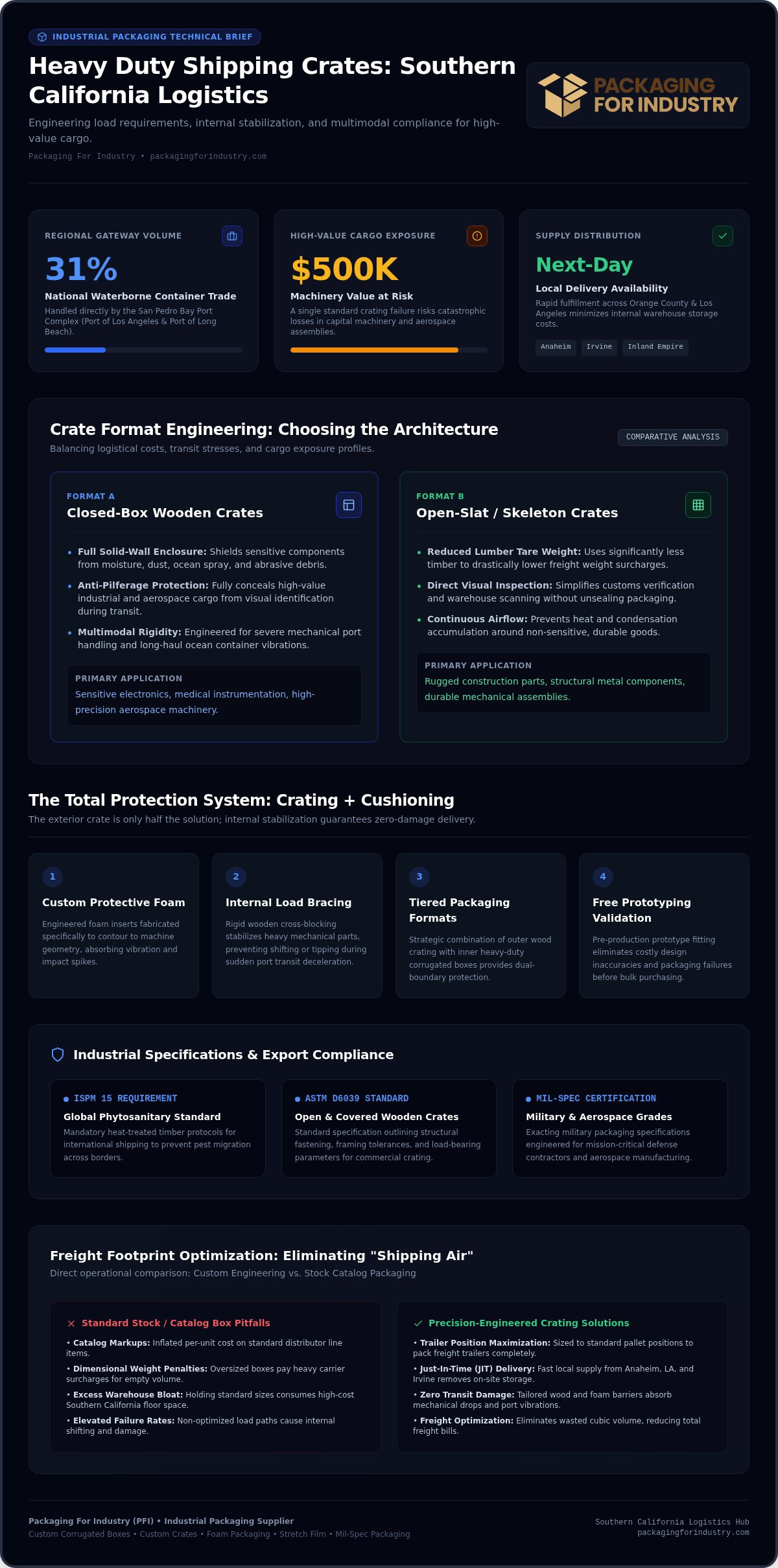
Southern California serves as the primary gateway for international trade in the United States. The San Pedro Bay port complex, comprising the Port of Los Angeles and the Port of Long Beach, handles approximately 31% of all containerized waterborne trade in the nation. For manufacturers operating in this high-velocity environment, heavy duty shipping crates Southern California companies rely on aren’t just boxes; they are engineered assets. These containers must withstand the rigors of multimodal transport, from ocean freight vibrations to the mechanical stresses of port handling equipment.
SoCal Industrial Hubs and Packaging Demand
Industrial hubs in Anaheim, Irvine, and the Inland Empire house the nation’s most sophisticated aerospace and medical device manufacturing. These sectors require industrial wooden shipping crates built to exacting standards like ASTM D6039 or MIL-spec requirements. Partnering with a local Southern California packaging supplier ensures that your crating solutions arrive exactly when production finishes. This proximity is vital for just-in-time manufacturing; holding excess inventory isn’t an option due to high regional real estate costs.
Common Shipping Challenges for Local Manufacturers
Local manufacturers often struggle with the hidden costs of standard packaging. While a catalog box might seem cheaper upfront, the “catalog markup” and potential for shipping damage often outweigh any initial savings. Precision-engineered crates help solve several critical issues:
- Optimizing warehouse space by using custom-sized dimensions instead of oversized stock options.
- Eliminating shipping surcharges caused by inefficient dimensions or excessive weight.
- Providing a seamless transition between different packaging formats, such as combining wood crates with heavy-duty corrugated boxes for tiered protection.
Reliability in the local supply chain is the ultimate goal. By sourcing heavy duty shipping crates Southern California fabricated near your facility, you eliminate the long lead times and high freight costs associated with out-of-state vendors. This logistical efficiency allows your team to focus on production rather than managing packaging delays or processing damage claims from the San Pedro Bay ports.
Types of Industrial Shipping Crates: Choosing the Right Format
Selecting the correct architecture for heavy duty shipping crates Southern California manufacturers utilize requires a balance between logistical costs and protection levels. The structural design must account for the specific vulnerabilities of the cargo, whether it’s high-precision medical instrumentation or rugged construction components. Given the massive volume of cargo movement shown in Port of Los Angeles freight statistics, your crate format must survive multiple mechanical handlings without compromising the integrity of the load.
Closed-Box vs. Open-Slat Designs
Fully enclosed wooden crates provide the highest level of security. These solid-wall containers protect sensitive electronics from moisture, dust, and debris. They also prevent prying eyes from identifying high-value contents, which reduces the risk of pilferage during long-haul transit. Conversely, open-slat or skeleton crates offer a cost-effective alternative for durable goods. These designs use significantly less lumber, which lowers the overall weight and reduces shipping surcharges. Skeleton crates are ideal for items that require airflow or must remain visible for inspection by customs officials or warehouse personnel.
Optimizing the crate footprint is another critical factor in cost reduction. By customizing the height and dimensions of your crates, you can maximize pallet positions in standard trailers. This precision engineering prevents “shipping air” and ensures you aren’t paying for unused space in a truck or container. For businesses managing frequent regional shipments, you can compare packaging pricing to see how custom-sized crates improve your bottom line.
Compliance and Material Standards
For businesses shipping internationally, navigating ISPM 15 requirements is non-negotiable. All solid wood packaging materials must be heat-treated to a core temperature of 56°C for at least 30 continuous minutes to prevent the spread of pests. Using certified export crates ensures your cargo doesn’t face costly delays or rejection at international borders. In domestic applications, adhering to ASTM D6039 or military-grade specifications provides a standardized benchmark for performance and durability.
When evaluating return on investment, consider whether a reusable or one-way crate fits your business model. Reusable crates, often secured with lag bolts or specialized fasteners, are ideal for closed-loop shipments between Southern California hubs like Anaheim and San Diego. For one-way international hauls, a precision-engineered single-use crate often provides the best economic outcome. Selecting the right foundation, such as a heavy-duty skid or pallet, further ensures that oversized industrial equipment remains stable throughout its journey.
Engineering Protection: Integrating Foam Inserts and Internal Bracing
The exterior shell of heavy duty shipping crates Southern California manufacturers deploy is merely the first line of defense. True damage prevention happens inside the crate through precision-engineered cushioning and mechanical stabilization. Without proper internal bracing, even the thickest timber walls cannot prevent a multi-ton industrial component from shifting and causing catastrophic structural failure during transit. High-value cargo requires an integrated approach where the crate and the cushioning work as a single protective system.
Designing Custom Foam for Heavy Loads
Selecting the right material for protective foam packaging involves analyzing the static loading and fragility of the cargo. For heavy industrial loads, high-density polyethylene (PE) foam is the industry standard because its closed-cell structure maintains its shape under significant weight. In contrast, polyurethane (PU) foam is better suited for lighter, more delicate items that require a softer interface. High-density foam provides a controlled deceleration that significantly reduces the G-force impact transferred to fragile components during sudden transit shifts.
When choosing between die-cut foam and foam-in-place solutions, consider the production volume and complexity of the part. Die-cut foam offers repeatable precision for high-volume aerospace or medical device runs. Foam-in-place provides a quick, conformable barrier for irregular, one-off prototypes. For sensitive electronics, anti-static (ESD) foam is essential to prevent electrostatic discharge that can ruin semiconductor components. This material engineering ensures that the crate meets the rigorous demands of the local aerospace and electronics sectors without adding unnecessary bulk or weight.
Internal Hardware and Stabilization
Internal stabilization relies on a combination of blocking, bracing, and specialized hardware. Heavy-duty skids are often integrated into the crate base to support bottom-heavy machinery, ensuring the center of gravity remains low. This prevents the crate from tipping during forklift maneuvers or sharp turns in a transport vehicle. Proactive stabilization is the most effective way to lower packaging costs by eliminating the expense of replacement parts and expedited shipping for damaged goods.
Effective stabilization also requires:
- Corner and edge protection to prevent the cargo from abrading against the crate walls.
- Steel tie-down points or D-rings through-bolted to the crate frame for maximum security.
- Custom wood blocking to lock the item into a fixed position, eliminating internal movement.
All internal wood components must also adhere to USDA wood packaging material regulations if the crate is intended for export. This ensures that every element of your heavy duty shipping crates Southern California is compliant and ready for global distribution through the San Pedro Bay ports. By integrating these internal engineering standards, you secure your cargo against the most demanding logistical environments.
Procurement Strategy: Custom Design vs. Stock Solutions
Procurement of the heavy duty shipping crates Southern California operations require is often misunderstood as a simple bidding war on unit prices. A low unit cost is deceptive if the crate fails to protect the cargo or creates logistical bottlenecks. To optimize your supply chain, you must transition from a price-per-unit mindset to a Total Cost of Ownership (TCO) model. This strategy accounts for the hidden expenses of transit damage, excessive freight charges, and warehouse labor.
Effective procurement follows a methodical four-step process:
- Step 1: Conduct a packaging review. Analyze your current shipping data to identify recurring damage points. This audit reveals whether your failures stem from structural weakness or improper internal cushioning.
- Step 2: Utilize free prototyping. Before committing to a full production run, use physical prototypes to test the crate fit. This eliminates the risk of design errors and ensures the protection levels meet your specific requirements.
- Step 3: Evaluate volume requirements. Determine if your production schedule favors bulk ordering or a recurring stocking program. High-volume manufacturers often benefit from staged deliveries to maintain flow.
- Step 4: Compare TCO. Calculate the full cost, including freight surcharges, labor hours for pack-out, and the potential cost of replacement parts. A custom-engineered solution often proves more economical than a stock box when these variables are factored in.
The Benefits of Custom Crating Design
Investing in custom design packaging is one of the most effective ways to lower packaging costs. Standard crates often result in “shipping air,” which triggers expensive dimensional weight surcharges from carriers like UPS or FedEx. By tailoring the crate dimensions to the exact footprint of your equipment, you maximize trailer density and reduce total freight spend. Custom designs also streamline the manufacturing line by allowing for easier kitting and faster pack-out times, which significantly reduces labor expenses.
Optimizing Supply with VMI and JIT
Southern California industrial real estate is among the most expensive in the nation. Storing bulky crates on-site consumes valuable floor space that should be dedicated to production. Utilizing Vendor Managed Inventory (VMI) allows you to maintain a lean warehouse while ensuring you never face a crate shortage. PFI manages the lead times for complex, engineered crates from our Anaheim hub, providing just-in-time delivery that aligns with your production schedule. This proactive management ensures that your heavy duty shipping crates Southern California supply remains reliable without bloating your inventory costs.
Why PFI is the Preferred Crating Partner in Southern California
Choosing the right industrial packaging supplier is a strategic decision that directly impacts your operational efficiency and bottom line. PFI stands out by offering more than just a product; we provide a fully integrated system designed to protect high-value cargo and streamline logistics. While other distributors might offer a limited selection of stock containers, we specialize in high-stakes heavy duty shipping crates Southern California manufacturers require for aerospace, medical, and defense applications. Our approach focuses on engineering the right solution to lower packaging costs rather than simply selling from a catalog.
One of our primary advantages is the ability to provide a single-source solution for complex packaging needs. Instead of managing multiple vendors, you can rely on PFI for custom wood crates, precision-cut foam, and heavy-duty corrugated boxes. This integrated model ensures that the internal cushioning and external shell are designed with perfect synergy, eliminating the fitment issues that often lead to shipping damage. By consolidating your supply chain, you reduce administrative overhead and ensure a consistent level of quality across all your protective materials.
Anaheim-Based Support and Nationwide Reach
Our facility in Anaheim serves as a central hub for the region’s manufacturing sectors. Being a local Anaheim packaging supplier allows us to offer rapid response times and local next-day delivery across Orange County, Los Angeles, and the Inland Empire. This proximity is essential for businesses operating under just-in-time production schedules where a packaging delay can halt an entire shipping department. While our roots are in Southern California, we maintain nationwide shipping capabilities to support customers with multiple locations across the country, ensuring your packaging standards remain uniform regardless of the destination.
Request a Custom Crating Quote
Starting a project with PFI is a straightforward, consultative process. We begin by identifying your specific pain points, whether you’re facing high damage rates or excessive freight surcharges. Our team utilizes free prototyping to ensure the crate fit and protection levels are verified before you commit to a full production run. This “test-before-you-buy” methodology is part of the PFI promise to provide reliable supply and eliminate professional stress for operations managers.
To receive an accurate packaging quote, please have your cargo dimensions, weight, and fragility requirements ready. We’ll also ask about your shipping environment; such as whether the items are headed for international transit through the San Pedro Bay ports or domestic long-haul freight. This information allows our engineers to specify the exact materials and internal bracing needed to secure your heavy duty shipping crates Southern California for a zero-damage arrival. Our goal is to build a long-term partnership based on fiscal responsibility and logistical flow.
Securing Your Industrial Supply Chain
Protecting high-value industrial assets requires more than a standard wooden box. It demands an integrated engineering approach that combines structural integrity with precision internal cushioning. By sourcing heavy duty shipping crates Southern California businesses can trust, you transition from reactive damage control to proactive logistical optimization. We’ve highlighted how custom designs eliminate freight surcharges and why local supply reliability is essential for maintaining lean warehouse operations.
Utilizing free custom prototyping ensures your packaging fits perfectly before a full rollout, while our specialized aerospace and defense expertise guarantees compliance with the most rigorous standards. Our Anaheim-based team is ready to help you implement a strategy that reduces shipping damage and improves your bottom line.
Relying on local next-day delivery across Southern California allows your team to focus on production rather than packaging delays. We look forward to helping you lower your total cost of ownership and achieve zero transit damage for your most critical cargo.
Frequently Asked Questions
How do I determine the right weight capacity for a heavy-duty crate?
Weight capacity is determined by the maximum load the base and framing can support during mechanical lifting. We evaluate the center of gravity and the footprint of your equipment to specify the appropriate skid thickness and fastening methods. Heavy duty shipping crates Southern California manufacturers use often follow ASTM D6039 standards for loads up to 4,000 lbs. Our engineering team calculates these specs during the prototyping phase to ensure the crate handles both static storage and dynamic transit stresses.
What is ISPM-15 compliance and when do I need it for shipping crates?
ISPM-15 is an international standard requiring solid wood packaging to be heat-treated to kill pests. You need this certification for any crates crossing international borders, including shipments departing through the Port of Los Angeles. Processed wood like plywood is exempt, but the structural framing must bear the official HT stamp. We provide fully compliant export crates to prevent your cargo from being quarantined or rejected at customs, ensuring a smooth global distribution process.
Can custom crates be designed for reuse in a closed-loop supply chain?
Custom crates are frequently engineered for multiple uses in closed-loop logistics. Instead of permanent nails, we utilize reusable hardware such as lag bolts, spring-steel Klimp fasteners, or recessed link locks. This allows your team to easily open and collapse the crates for return shipment or storage. Reusable designs are particularly effective for inter-facility transfers between Anaheim and Irvine, significantly lowering your long-term packaging costs by amortizing the initial crate investment over dozens of trips.
How much can I save by switching from stock boxes to custom crates?
Savings from custom crates come from the reduction in total cost of ownership rather than just unit price. Custom dimensions eliminate the dimensional weight surcharges often triggered by oversized stock boxes. You also save on labor costs because engineered crates are designed for faster pack-out and often require less secondary dunnage. Most importantly, the elimination of shipping damage prevents the massive expenses associated with replacement parts, expedited freight, and damaged client relationships.
What is the typical lead time for custom shipping crates in Southern California?
Lead times for heavy duty shipping crates Southern California depend on the complexity of the internal engineering and material availability. While standard designs might move faster, complex crates with integrated foam inserts typically require more fabrication time. We mitigate these delays through our Vendor Managed Inventory (VMI) programs. By managing your recurring needs from our Anaheim facility, we provide next-day delivery for established designs, ensuring your production line never stops due to a packaging shortage.
Do you provide on-site crating services or pre-assembled delivery?
We specialize in delivering fully assembled, high-quality crates directly to your facility from our Anaheim hub. This allows your operations team to begin the pack-out process immediately upon arrival without the need for on-site construction. Our local fleet provides next-day delivery throughout Orange County and Los Angeles, which simplifies your logistics and reduces on-site labor. If you have specific kitting requirements, we can integrate foam and hardware before the crates reach your warehouse floor.
What industries benefit most from custom foam-lined crates?
Industries with high-value, sensitive, or fragile components benefit most from foam-lined crates. This includes aerospace contractors shipping satellite parts, medical device manufacturers moving sensitive imaging equipment, and semiconductor companies protecting silicon wafers. The combination of a rigid outer shell and precision-cut foam inserts provides the vibration dampening and shock absorption necessary for zero-damage transit. These integrated solutions are essential for any business where the cost of a single shipping failure exceeds the cost of the packaging.
How does a VMI program work for recurring crate orders?
A VMI program involves a partnership where PFI monitors your packaging levels and replenishes stock automatically. We conduct scheduled inventory reviews at your warehouse to identify actual usage patterns. Once stock reaches a pre-determined minimum, we trigger a replenishment order from our local facility. This process frees up your warehouse floor space and capital by preventing over-ordering. It also ensures that custom crates with long lead times are always available when your production finishes.