A part that shifts between workstations can be damaged or delay the next operation. For internal factory logistics in Irvine, returnable dunnage foam inserts separate, cushion, and position parts inside racks or containers, helping prevent movement and contact during repeated trips. The container holds the load; the dunnage keeps each part in place.
That distinction matters when parts move through a steady production loop. Insert design needs to suit each part’s shape and surface, as well as the container and handling process, so protection supports reliable movement without adding unnecessary complexity.
This article explains what dunnage does and when a returnable program may suit your operation better than one-way packaging. It covers material options, the details needed for a custom insert quote, and how design, sampling, and line testing help establish a practical fit.
Key Takeaways
- See how inserts keep parts separated and positioned as they move through internal factory logistics.
- Compare foam and other dunnage materials based on part geometry, surface sensitivity, and repeated handling needs.
- Learn which drawings, samples, route details, and container dimensions help shape a custom quote.
- Understand how testing and a returnable-program review can support reliable part flow and packaging cost decisions.
- Explore how foam packaging and inventory-management services can support manufacturing operations in Irvine.
What Is Dunnage, and How Does It Protect Parts?
Dunnage is the material inside a rack, container, or box that separates, cushions, and positions parts. The outer packaging contains the shipment; dunnage keeps each component from shifting or contacting another surface in transit. For example, a shaped insert can hold a machined component in place as it moves between workstations, helping reduce the risk of impact damage and surface contact.
In internal factory logistics, the same part may travel repeatedly between production steps. A fitted pocket can keep a metal component from sliding, while a partition can separate similar parts and keep them sorted. Inserts above and below a product can add shock absorption. Their shape and placement should suit the part and container without interfering with loading or unloading.
Dunnage can address specific handling needs. Depending on the design, it can help protect products from contamination or moisture, or provide electrostatic protection. Trays and partitions can keep components organized as they move through a plant. For an Irvine operation, the right layout depends on part geometry, the container, and how workers handle the load.
- Separation: Dividers keep adjacent parts from contacting one another.
- Positioning: Contoured pockets limit movement inside a rack or box.
- Cushioning: Foam at contact points helps absorb transit shock.
Start by identifying where contact, movement, or sorting creates a problem. A delicate finished surface may need a smooth contact area; an irregular component may need a shaped cavity. The insert must also suit the existing container and handling sequence. These details help determine whether dunnage can support repeated movement without slowing the line.
Plants moving parts within Irvine can relate insert design to their racks, containers, and production flow; local packaging information is available on the Irvine packaging service-area page. A clear distinction between the container and its internal dunnage helps teams assess where protection and positioning are needed.
Returnable Dunnage Materials and Foam Inserts
Returnable dunnage foam inserts are shaped supports that secure parts during repeated trips. The right foam and density depend on part weight, surface sensitivity, and the cushioning required.
Foam, Plastic, and Other Materials
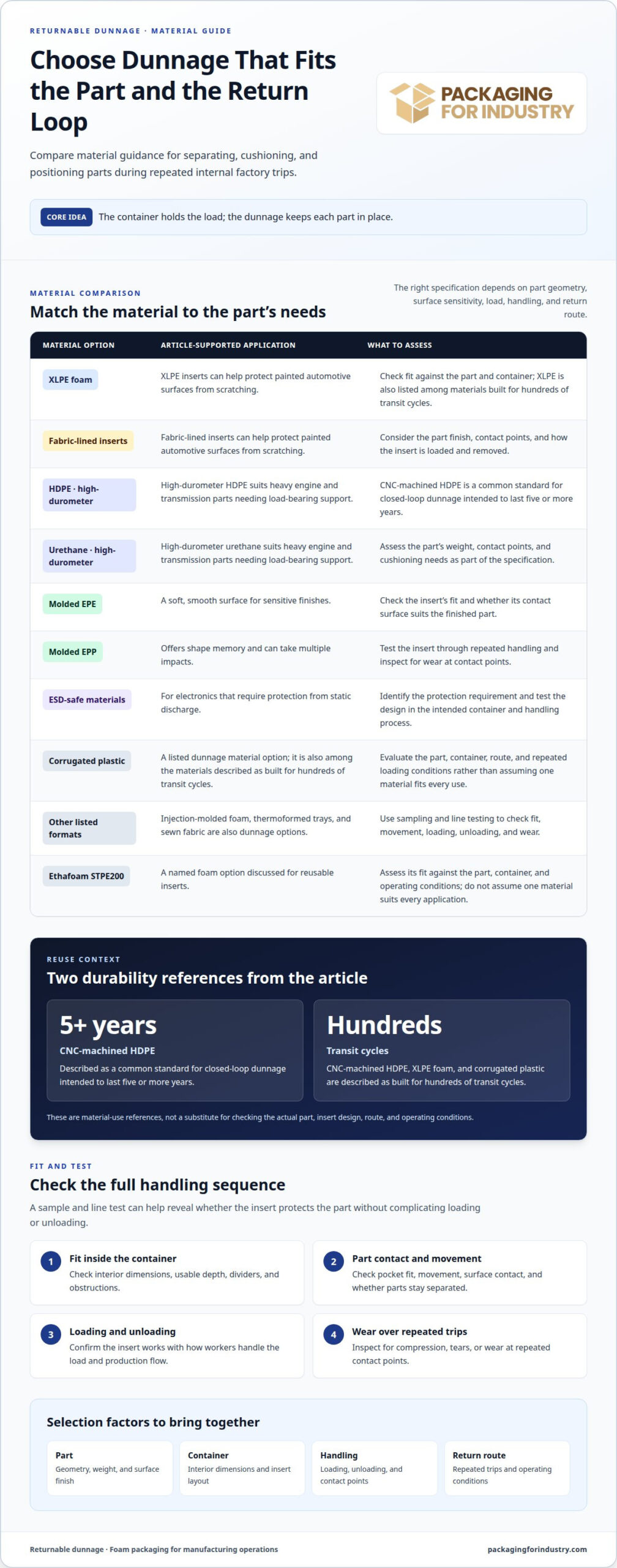
Options include XLPE foam, CNC-machined HDPE, corrugated plastic, sewn fabric, injection-molded foam, and thermoformed trays. XLPE or fabric-lined inserts can protect painted automotive surfaces from scratching. High-durometer HDPE or urethane suits heavy engine and transmission parts that need load-bearing support. ESD-safe materials serve electronics that require protection from static discharge.
Material selection should account for contact points, part finish, load, and return route. Molded EPE has a soft, smooth surface for sensitive finishes. Molded EPP offers shape memory and can take multiple impacts. For Ethafoam STPE200, assess its fit against the part, container, and operating conditions rather than assuming one material suits every application.
Foam Materials and Densities for Reuse
Foam density should match the component’s weight and the cushioning needed at its contact points. A heavier part may require firmer support, while a delicate finish may call for a softer, smooth surface. There is no single density for every reusable insert. Part geometry, handling, and repeated loading all affect the specification.
CNC-machined HDPE is a common standard for closed-loop dunnage intended to last five or more years. CNC-machined HDPE, XLPE foam, and corrugated plastic are built for hundreds of transit cycles. These material categories differ in support and surface contact, so design and testing should reflect the actual part.
Testing should cover fit inside the container, part movement, loading and unloading, and wear over repeated trips. A sample can show whether pockets hold parts securely or press against a finished surface. Designers can adjust the insert before production use. Consider the route and handling conditions too, since impacts and repeated contact can reveal material limitations.
Foam can compress or wear at repeated contact points; plastic and fabric options also need inspection during use. A suitable design balances part protection, practical handling, and durability. This helps match the material to the factory’s returnable flow instead of relying on a generic insert.
Information Needed for a Custom Dunnage Quote
A useful quote starts with the part, container, and route through the plant. For Irvine plants, custom foam inserts for returnable dunnage should be designed around the demands of internal factory logistics.
Custom Inserts for Existing Containers
For inserts fitted to existing containers, provide interior dimensions, usable depth, and details of dividers or obstructions. Part drawings or a physical sample show geometry, contact points, and surface finish. Include the part’s weight, how it is loaded and removed, and whether several components share a container. These details help determine the cavity shape and insert layout.
Annual volume, route, and cycle time show how often the insert travels and how it fits the return loop. Custom inserts can be designed for existing racks or containers. Sampling and line testing then help assess fit and handling before broader use.
Cleaning and storage requirements should suit the foam and plant process. Establish a compatible cleaning method, inspect inserts for tears or compression, and store them in a designated area between trips. Repair or replace worn inserts as needed to maintain a consistent fit inside the container.
Lead Times and Order Minimums
Lead times and minimum order quantities depend on design complexity, material, sampling, testing, and production quantity. For Irvine factories planning returnable foam dunnage, the schedule also depends on rollout needs and design revisions. An established insert design may require different steps from a new layout that needs fit adjustments.
Useful quote details include order quantity, annual usage, launch date, and whether the program needs an initial sample. Specify whether the insert must fit existing containers or racks, and identify planned design changes. These details help determine whether one design can serve the full run or whether multiple versions are needed.
A custom dunnage quote can bring design, sample approval, testing, and production requirements together. Drawings or samples clarify part shape, while container dimensions establish available space. For example, a sample part and tote help assess cavity placement before the insert design is finalized.
Foam Design, Manufacturing, and Distribution
Custom foam dunnage moves from part data through design, sampling, testing, production, and distribution. Irvine plants can use returnable foam inserts for internal factory logistics when the design suits their parts, containers, and handling process.
Foam Design and Manufacturing
The design process starts with part geometry and the areas that need support. Drawings or samples help define cavities, access areas, and component orientation inside the rack. Designers also consider how operators load and remove each part, so the insert protects components without disrupting production flow.
Manufacturing methods depend on the foam and insert design. Foam can be cut or machined to follow a part, while molded EPE or EPP can form complex shapes. A sample helps assess fit and handling before production. For example, a pocket that grips a component too tightly can slow removal, while too much clearance can allow movement.
Testing should reflect the factory line. A trial can assess placement, removal, and whether the insert stays aligned in its rack. For automated handling, consistent positioning can support repeatable pick-and-place operations. Dunnage can also be designed alongside a returnable steel rack, linking the insert layout to the equipment that carries it.
Dunnage Suppliers Near Irvine
Plants sourcing returnable dunnage foam inserts in Irvine can look for a supplier that coordinates design, sampling, production, and distribution. The process should account for the container and route, not just foam fabrication. This keeps insert development connected to how components move through the facility.
Compare supplier workflows for drawing review, sample revisions, line trials, and delivery coordination. A defined process clarifies how design changes are handled and how approved samples guide production. These details help purchasing and operations plan a rollout while keeping packaging decisions grounded in factory handling.
Distribution planning should reflect where inserts are used and how replenishment fits the plant schedule. In a multi-line facility, identifying each insert by component and point of use can support organized storage and deployment. Clear identification also helps teams return each insert to the right production area as reusable packaging circulates through the facility.
Returnable dunnage is designed for repeated trips rather than one-way shipping, while custom dunnage can be made for either one-time use or reuse. Foam inserts can be cut and shaped to cradle parts and absorb transit shock.
Industries Served: Irvine Plants and Automotive Suppliers
Automotive suppliers use returnable packaging to move parts between production sites and assembly operations. Manufacturers in Irvine’s aerospace, electronics, medical, and food sectors may also need inserts suited to their components, handling steps, and internal routes.
In a closed loop, reusable containers travel with parts and then return for another load. Dunnage is the fitted material inside those containers; packaging is the system that contains and moves the shipment. For example, a rack carries several automotive components, while shaped inserts keep each part separated and positioned.
A returnable program generally suits steady, high-volume part flows with a reliable return route. Planning can start with part drawings or samples, annual volume, route, cycle time, and container footprint. The design then moves through sampling and production-line testing, where teams assess fit and handling before rollout.
Expendable packaging may suit low or irregular volumes, one-way or export shipments, service parts, or products still in development. These conditions can make a consistent return loop difficult to maintain. Base the packaging decision on the route and usage pattern, not just the insert material.
Return on investment depends on program volume, container returns, insert life, handling, and the cost of managing the loop. Automotive-sector case studies report payback under 18 months for switching from single-use cardboard to custom plastic dunnage. Reusable dunnage can reduce total packaging spend by 20% or more over a product program’s life. These reported outcomes describe specific program experiences, not a universal result.
For an Irvine automotive supplier, compare recurring expendable purchases with the ongoing work of collecting, inspecting, storing, and returning reusable assets. A stable route with frequent part movement can support reuse; changing product designs or one-way shipments may favor expendable packaging. Matching the system to actual factory flow helps purchasing teams assess total program economics.
Benefits of Starting a Returnable Packaging Program
A returnable program changes how packaging costs accumulate across a production run. Instead of buying expendable packaging for each shipment, a plant manages reusable assets through repeated use. The financial case depends on how reliably those assets circulate and on the labor, space, and transport the loop requires.
Build the comparison around total program costs, not the price of one insert. Include expendable-material replenishment, return freight, handling time, storage, inspection, and replacement of worn components. A route with frequent empty-container movements may affect the economics differently from one where returns are consolidated with other shipments.
Operational fit matters too. Reusable inserts can standardize how parts are presented at workstations, making loading and line-side handling more consistent. Purchasing teams can also assess whether dedicated packaging reduces reliance on substitute materials during shortages. These outcomes depend on how packaging is used across the plant, not simply on whether it can be reused.
For a sound return-on-investment review, compare expected packaging use over the product program with the costs of operating the loop. Use the plant’s own records to track damaged parts, packaging purchases, return movements, and insert replacements. This gives finance and operations a shared basis for deciding whether reuse supports cost control and supply reliability.
Inventory coordination can help prevent a reusable system from creating new supply gaps. Vendor managed inventory for packaging can align replenishment with actual usage, while planned inventory reviews help teams manage stock levels and purchasing workload. This is especially useful when custom inserts require more planning than standard, readily available packaging.
Returnable packaging is not the right fit for every shipment. Irregular demand, one-way routes, changing part designs, or limited space for empty containers can weaken the case for reuse. Compare packaging purchases, handling requirements, and return logistics to help Irvine manufacturers choose an approach suited to their production pattern and financial priorities.
Why Choose Packaging For Industry for Foam Packaging
Packaging For Industry supplies foam packaging for parts moving through production and internal logistics. It helps manufacturers match packaging supply to operational needs, whether the priority is component protection, coordinated replenishment, or packaging inventory management. Irvine plants can connect insert requirements with purchasing and production planning.
Part details and handling requirements guide the foam packaging discussion. Component shape, surface finish, container fit, and how parts move through the plant all help define the application. These details give purchasing and operations teams a practical basis for discussing foam packaging solutions for factory use, rather than selecting packaging without considering the product and workflow.
Packaging For Industry also offers Vendor Managed Inventory (VMI) and Just-In-Time (JIT) inventory management for packaging. VMI supports coordinated replenishment based on packaging usage, while JIT aligns supply with production demand. These options can help when foam inserts are part of a recurring flow and availability needs to stay connected to operating schedules.
For an Irvine plant evaluating a returnable program, bring the packaging need and supply process into the same discussion. Part drawings or samples, annual volume, route, cycle time, and container footprint help describe the application. Inventory planning can then account for usage patterns and replenishment alongside foam requirements, giving operations and purchasing a clearer view of how packaging fits the process.
Packaging For Industry’s foam packaging and inventory-management services support business packaging needs with practical solutions. They can help manufacturers review insert requirements, coordinate supply, or align replenishment with ongoing production. Start with a clear description of the parts, containers, and factory flow the packaging needs to support.
To discuss foam packaging for your operation, contact Packaging For Industry and request a foam packaging quote.
Packaging For Industry supplies foam packaging for Irvine plants. Share details about your parts, containers, and factory flow to discuss a suitable packaging and supply approach.
Frequently Asked Questions
What is dunnage?
Dunnage is the material inside a package, tote, or rack that supports and protects products during handling and transit. Unlike the outer container, it manages how individual parts sit in that space. A tray holding separate machined pieces, for example, can keep them organized and prevent direct contact. The right arrangement depends on part shape, surface finish, and how operators handle the load.
How does a packaging provider design foam inserts for parts, totes, and returnable containers?
A packaging provider uses part drawings or samples, container dimensions, and handling details to develop an insert layout. The design can account for pocket placement, loading and removal access, and how totes stack or move through the plant. A sample lets teams assess fit before rollout. For a tote with several component types, separate cavities can keep parts organized and simplify line-side picking.
How many reuse cycles can returnable foam inserts withstand?
There is no single cycle count for every foam insert. Reuse life depends on the material, part weight and geometry, contact points, handling, and return route. Foam inserts designed for closed-loop shipping can be built for hundreds of transit cycles, but actual service life depends on the application. Inspection for compression, tears, or changes in fit helps identify when an insert needs repair or replacement.
What safety, ESD, chemical, and fire-resistance requirements should factory foam dunnage meet?
Requirements depend on the part and its factory environment. Electronics sensitive to static need an ESD-safe insert material. Chemical exposure, heat, and fire-related requirements should be matched to materials and operating conditions. Share applicable handling and material requirements during design so insert selection reflects the actual use case. A general foam description alone does not establish suitability for every hazard.
How can a packaging provider help Irvine factories assess shipping, handling, and environmental costs of returnable dunnage?
A provider can help map the full loop, including delivery, empty-container returns, storage, handling, cleaning, inspection, and insert replacement. Comparing those activities with current expendable packaging gives purchasing teams a clearer view of total program costs. Environmental assessment can also consider materials, reuse, transport, and end-of-life handling. For an Irvine plant, route length and return frequency are important inputs.